

Phase 1: Empathy & The K-Culture Hook
Hello! I’m the Lead Editor of Daily Hangul, your veteran tutor and local culture navigator.
You just signed a contract for your first apartment in Korea! You’ve watched enough K-Dramas to know what comes next: unpacking a few boxes, sitting on the floor with newspaper spread out, and ordering a steaming bowl of Jajangmyeon (black bean noodles) to celebrate.
But wait! Before you take that first bite, there’s a crucial, unspoken rule every Korean knows. You have to visit the local community center to get your ‘Fixed Date’ (확정일자) and register your move-in. In a country where you hand over a massive chunk of your savings as a housing deposit (보증금), this tiny red stamp from the government is your ultimate shield.
Walking into a Korean government office can feel intimidating, especially when you are a beginner. Don’t worry! I’ve seen countless expats panic over this exact moment. Today, we’re going to learn the exact phrases you need to breeze through the community center like a true local.
Phase 2: Core Expressions Deep Dive
Let’s break down the essential phrases you’ll need to protect your deposit!
1. 확정일자 받으러 왔어요. (hwak-jeong-il-ja ba-deu-reo wa-sseo-yo)
- Pronunciation: [hwak-jeong-il-ja ba-deu-reo wa-sseo-yo]
- Tip: ‘확’ (hwak) sounds like the sudden breath you let out when you’re surprised. ‘받으러’ (ba-deu-reo) flows smoothly—don’t hit the consonants too hard!
- Meaning:
- Literal: I came to receive a fixed date.
- Real Nuance: “Hi, I need the official move-in stamp on my housing contract, please.”
- K-Culture Moment: Imagine a tense K-Drama scene where the main character rushes to the community center just before it closes at 6 PM, clutching their contract to secure their rooftop room (옥탑방).
- Editor’s Insight: The grammar
~으러 왔어요(came in order to do ~) is a magic formula in Korea. Whether you’re at a bank, a clinic, or a government office, just attach your purpose to this phrase! - Situation Spectrum:
- Casual with friends: 🚫 (They can’t give you the stamp!)
- Public Official (Polite): ✅
- 🤔 Think About It: Why do Koreans prefer saying “I came to do X” rather than “I want X” in public offices? Does framing it as a statement of action sound more humble than a direct demand in your culture?
2. 전입신고도 같이 할게요. (jeo-nip-sin-go-do ga-chi hal-ge-yo)
- Pronunciation: [jeo-nip-sin-go-do ga-chi hal-ge-yo]
- Tip: ‘같이’ is written as ‘gat-i’ but pronounced as ‘ga-chi’ (like the first part of ‘ca-chee’).
- Meaning:
- Literal: I will also do the move-in report together.
- Real Nuance: “I’d like to register my new address at the same time.”
- K-Culture Moment: Koreans love efficiency. “Doing it together” (같이) is a massive part of the culture, from eating from the same pot to bundling administrative tasks to save time.
- Editor’s Insight: You almost always need to do these two things together to legally protect your deposit. Saying this shows you’ve done your homework!
- Situation Spectrum:
- Friends: 🚫
- Public Official (Polite): ✅
- 🤔 Think About It: “같이” (together) is one of the most frequently used words in Korean. How does this reflect the “community-first” mindset of Korean society compared to individualistic cultures?
3. 원본 필요해요? (won-bon pi-ryo-hae-yo?)
- Pronunciation: [won-bon pi-ryo-hae-yo?]
- Tip: ‘필’ (pil) sounds like “peel” a banana.
- Meaning:
- Literal: Do you need the original copy?
- Real Nuance: “Do I have to give you the original contract, or is a copy okay?”
- K-Culture Moment: When organizing fan club events or submitting documents for K-Pop auditions, agencies are extremely strict about original documents. Korean bureaucracy is exactly the same!
- Editor’s Insight: Spoiler alert: They ALWAYS need the original contract (원본) for the Fixed Date. Never bring just a photocopy!
- Situation Spectrum:
- Casual with friends: ✅ (e.g., sharing photos)
- Public Official (Polite): ✅
Phase 3: Textbook vs. Real Korean
Let’s see how the textbook differs from the real streets of Seoul.
[At the counter explaining why you are there]
* 📖 Textbook Korean: 저는 확정일자를 부여받고 싶습니다. (I would like to be granted a fixed date.)
* 🗣️ Real Korean: 확정일자 받으러 왔는데요. (I came to get a fixed date…)
* 💡 Why the difference?: Adding ~는데요 at the end makes the sentence slightly open-ended, politely prompting the clerk to take the lead and tell you what to do next.
[Handing over your documents]
* 📖 Textbook Korean: 여기 제 신분증과 계약서가 있습니다. (Here are my identification card and contract.)
* 🗣️ Real Korean: (Handing them over) 신분증하고 계약서요. (ID and contract here.)
* 💡 Why the difference?: In Korean, attaching ~요 (yo) to the end of a noun is the most efficient and natural way to be polite without using a full, stiff sentence.
Bottom Note: At the A2 level, don’t worry about overly formal bureaucratic terms. Sticking to polite
~요forms is perfect and sounds highly natural!
Phase 4: K-Culture Deep Dive
4-1. Non-Verbal Communication: The “Two-Handed” Rule
When you hand your precious original contract and your Alien Registration Card (ARC) to the government clerk, always use two hands. Or, support your right elbow with your left hand. In Korean culture, handing something to an official (or anyone older) with one hand is considered slightly disrespectful.
4-2. The “Jeonse” Anxiety in K-Dramas
If you’ve watched K-Dramas like Because This Is My First Life or Reply 1988, you know that housing deposits (보증금) are a huge plot point. Korea has a unique system called Jeonse (전세), where you give the landlord a massive lump sum instead of monthly rent. Even for monthly rent (Wolse, 월세), deposits are typically $5,000 to $10,000!
Because so much money is on the line, the tension is real. The “Fixed Date” (확정일자) is the legal timestamp that says, “I live here, so if the landlord goes bankrupt, I get my money back first!” When you get that red stamp, you are experiencing a true Korean rite of passage.
Phase 5: Interactive Role-play Scenario
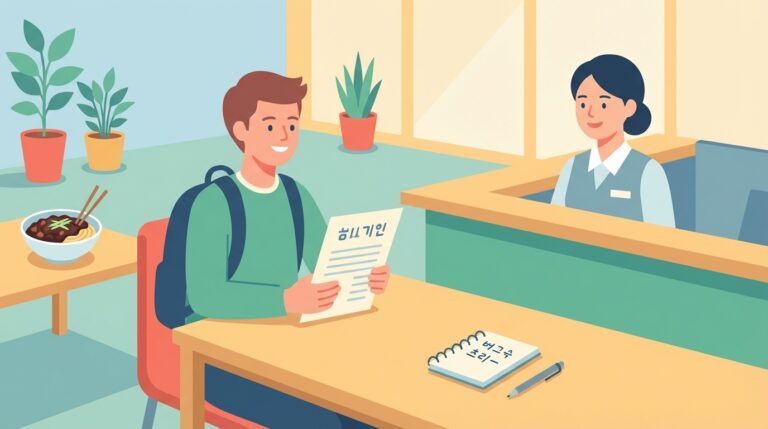
Setting: Tuesday, 2:00 PM. The local Jumin Center (Community Center). You pulled a number ticket from the machine and finally heard the ‘ding’. You walk up to Counter 3. The clerk looks busy but gives you a polite nod.
Characters:
* YOU: An expat who just moved into a nice studio near Hongdae.
* Clerk (직원 – jik-won): A polite civil servant wearing a lanyard.
The Dialogue:
직원: 어떻게 오셨어요?
(eotteoke osyeosseoyo?)
[How can I help you? / What brings you here?]
YOU: 안녕하세요. 확정일자 받으러 왔어요.
(annyeonghaseyo. hwakjeong-ilja badeureo wasseoyo.)
[Hello. I came to get a fixed date.]
직원: 네, 전입신고도 같이 하시나요?
(ne, jeonipsingodo gachi hasinayo?)
[Yes, are you also registering your move-in together?]
YOU: 네, 같이 할게요.
(ne, gachi halgeyo.)
[Yes, I’ll do them together.]
직원: 신분증하고 임대차 계약서 원본 주시겠어요?
(sinbunjeunghago imdaecha gyeyakseo wonbon jusigesseoyo?)
[Could you give me your ID and the original lease contract?]
🔀 Your Turn! How do you hand over the documents?
* A) Slide them across the desk with one hand while looking at your phone.
* B) Hand them over with both hands, saying “여기 있습니다” (Here you go).
* C) Throw them on the desk and say “빨리요!” (Hurry!)✅ Best Choice: B — Korean bureaucracy respects politeness. Handing items with two hands and a polite phrase will make the clerk want to process your paperwork flawlessly!
⚠️ Choice A & C Analysis: Both are extremely rude. Acting like C might get you the cold shoulder, even if they have to do their job.
(Continuing the scenario assuming you chose B…)
YOU: (With two hands) 네, 여기 있습니다.
(ne, yeogi itseumnida.)
[Yes, here they are.]
직원: (Typing quickly) 수수료는 600원입니다. 현금이나 카드 다 됩니다.
(susuryoneun yungbaegwonimnida. hyeongeumina kadeu da doemnida.)
[The fee is 600 won. Cash or card is fine.]
YOU: 카드로 할게요.
(kadeuro halgeyo.)
[I’ll pay by card.]
직원: 네, 다 되었습니다. 계약서에 도장 찍어드렸어요.
(ne, da doeeotseumnida. gyeyakseoe dojang jjigeodeuryeosseoyo.)
[Yes, it’s all done. I’ve stamped the contract for you.]
YOU: 감사합니다! 수고하세요!
(gamsahamnida! sugohaseyo!)
[Thank you! Keep up the good work!]
Phase 6: 10-Second Shadowing Drill
Practice this sentence to sound confident at the counter!
😊 안녕하세요! / 저는 / 확정일자 / 받으러 왔어요!
(annyeonghaseyo! / jeo-neun / hwak-jeong-il-ja / ba-deu-reo wa-sseo-yo!)
Emotion: Bright and polite, showing you know exactly what you need.
Phase 7: K-Culture Mini Dictionary
| 한국어 (Korean) | Romanization | English | Context |
|---|---|---|---|
| 주민센터 | ju-min sen-teo | Community Center | The local gov office where you handle daily admin tasks. Older people still call it “동사무소” (dong-sa-mu-so). |
| 전입신고 | jeo-nip-sin-go | Move-in Notification | Legally registering your new address with the government. |
| 확정일자 | hwak-jeong-il-ja | Fixed Date | An official stamp proving the date your lease contract exists. Crucial for protecting your deposit. |
| 보증금 | bo-jeung-geum | Housing Deposit | A lump sum of money given to the landlord, returned when you move out. |
| 계약서 | gye-yak-seo | Contract | Your lease agreement. Must be the original! |
Phase 8: Expat Survival Kit (Community Center Edition)
Navigating Korean government offices can feel like traveling through an uncharted territory. Here are your survival tools!
🆘 Survival Phrase #1: Taking a Number
* 🇰🇷 “어디서 번호표 뽑아요?” (eo-di-seo beon-ho-pyo ppo-ba-yo?)
* 🗣️ English sound guide: uh-dee-suh bun-ho-pyo ppo-ba-yo?
* 📍 Where to use: As soon as you walk into a busy public office or bank.
* 💡 Pro Tip: Don’t just stand in line! Korean banks and offices run strictly on a ticketing system. Look for a machine that says 번호표 (Number Ticket).📌 Editor’s Real Estate Note
* Timing: Get your fixed date the exact day you move in. Don’t wait for the weekend!
* Digital Alternative: If you have a registered Korean digital certificate (공동인증서), you can actually do this online via the government website, but visiting in person is often easier for newcomers.
* The Fee: The fee is incredibly cheap (usually around 600 KRW, less than $0.50). Yes, they accept cards for even this small amount!
Phase 9: Critical Thinking Corner — “A Step Deeper”
Language & Power in Bureaucracy
If you listen closely to the clerk in our role-play, they used very formal language like 하시나요? and 주시겠어요?. In Korea, public officials are trained to use high-level honorifics (존댓말) to all citizens, regardless of age or nationality. This reflects modern Korea’s “customer service” approach to governance. It’s a huge shift from decades ago when government officials held all the power and spoke more bluntly.
🧠 Think Deeper:
The language used by the government toward its people shows the balance of power. The extreme politeness you experience in a Korean community center is a sign of a service-oriented society.💬 Your Turn: How do public officials speak to citizens in your country? Are they formal, casual, or somewhere in between? Let me know in the comments!
Phase 10: FAQ & Avoiding Mistakes
Q: Can I use a photocopy or a picture of my contract on my phone?
* NO! This is the most common mistake. The government must physically stamp the original (원본) contract. If you bring a photo, they will send you home.
Q: Is it okay to use casual language (반말) if the clerk looks younger than me?
* NO! Never use casual language to a service worker or public official, no matter their age. Always stick to the ~요 form to show mutual respect.
❌ Common Mistake #1: Going to the wrong community center.
✅ Do This Instead: You cannot go to any community center in Seoul. You must go to the specific center that governs your new neighborhood (your 동 / Dong). Search “[Your Neighborhood name] 주민센터” on KakaoMap!
Phase 11: Summary & Action Items
- One-Liner Summary: To protect your housing deposit, confidently ask the community center for a “Fixed Date” by saying: 확정일자 받으러 왔어요!
🔥 Action Mission 3 Steps:
* 🥉 Bronze (Solo): Stand in front of the mirror and say “전입신고도 같이 할게요” with a confident smile three times.
* 🥈 Silver (Online): Find your local “주민센터” on a Korean map app (like Naver Map) and drop the screenshot in a Korean learning forum.
* 🥇 Gold (Real Life): If you are moving soon, use this exact phrase at the counter!
🍜 K-Culture Mission:
Did you finish your community center visit? You’ve earned it! Order a bowl of Jajangmyeon (짜장면) for delivery to your new address. It’s the ultimate Korean moving-day tradition.
How did your moving day go in Korea? Did you get your red stamp? Share your stories below! 👇
Phase 12: Interactive Quiz
1. Situational Judgment: You just walked into the Community Center. What is the FIRST thing you should do?
* A) Yell “확정일자 주세요!” (Give me a fixed date!)
* B) Look for a machine to pull a number ticket (번호표).
* C) Walk directly to the nearest desk and sit down.
2. Fill in the Blank:
“저는 오늘 이사했어요. 그래서 주민센터에 __________ 받으러 왔어요.”
(I moved today. So I came to the community center to get a __________.)
3. True or False — K-Culture Edition:
You can show a clear photo of your lease contract on your smartphone to get the Fixed Date. (T/F)
(Answers: 1. B – Always take a ticket first! / 2. 확정일자 / 3. False – You MUST bring the physical original contract (원본).)
Frequently Asked Questions (FAQ)
Q: What does "확정일자 받으러 왔어요. (hwak-jeong-il-ja ba-deu-reo wa-sseo-yo)" mean in Korean and how do you pronounce it?
A: In Korean, "확정일자 받으러 왔어요. (hwak-jeong-il-ja ba-deu-reo wa-sseo-yo)" is pronounced [hwak-jeong-il-ja ba-deu-reo wa-sseo-yo] and means: a key conversational Korean expression covered in this lesson.
Q: What does "전입신고도 같이 할게요. (jeo-nip-sin-go-do ga-chi hal-ge-yo)" mean in Korean and how do you pronounce it?
A: In Korean, "전입신고도 같이 할게요. (jeo-nip-sin-go-do ga-chi hal-ge-yo)" is pronounced [jeo-nip-sin-go-do ga-chi hal-ge-yo] and means: a key conversational Korean expression covered in this lesson.
Q: What does "원본 필요해요? (won-bon pi-ryo-hae-yo?)" mean in Korean and how do you pronounce it?
A: In Korean, "원본 필요해요? (won-bon pi-ryo-hae-yo?)" is pronounced [won-bon pi-ryo-hae-yo?] and means: a key conversational Korean expression covered in this lesson.







