

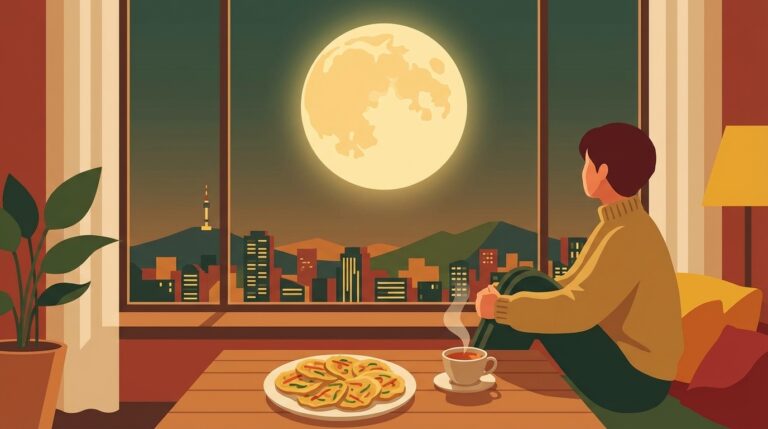
Phase 1: Empathy – The “Chuseok in the Empty City” Feeling
Hello there! I’m your Daily Hangul Editor.
Imagine this: It’s the eve of Chuseok (추석), Korea’s biggest autumn harvest holiday. The normally gridlocked streets of Seoul are suddenly… empty. You’re watching a K-Drama, and the main character sits alone at a convenience store patio, eating instant ramen while staring up at a massive full moon. Inside, you feel that same twinge. Everyone you know is posting photos of endless Jeon (Korean pancakes) and family gatherings, while you’re stuck in your apartment, wondering if the local fried chicken place is even open.
If you live in or visit Korea during major holidays like Chuseok or Seollal, you will inevitably face the “What are your plans?” question. Knowing how to express that you aren’t going to your hometown—and the subtle loneliness that comes with it—won’t just make your Korean sound incredibly natural; it’s the ultimate key to bonding with your Korean colleagues or friends. Who knows? They might even take pity on you and invite you over for some leftover Songpyeon (half-moon rice cakes)!
This guide is based on real struggles my B1-level students have faced during the “Great Holiday Migration.” Let’s dive into the real Korean way to talk about flying solo during Chuseok.
Phase 2: Core Expressions Deep Dive
Here are the top 3 expressions you need to sound like a local who is missing out on the family trip.
1. 이번 명절엔 고향에 못 내려가요.
- Pronunciation: [ibeon myeongjeoren gohyange mot naeryeogayo] / [ee-bun myung-juhl-en go-hyang-eh moht nae-ryuh-ga-yo]
- Meaning: (Literal) I cannot go down to my hometown this holiday. / (Real Nuance) I’m stuck here for the holidays.
- K-Culture Moment: You’ll hear this a lot around the office water cooler a week before Chuseok. Notice the word “내려가다” (to go down). Since Seoul is geographically in the north-western part of South Korea, and it’s the capital, going anywhere else in the country is colloquially referred to as “going down” (내려가다), regardless of actual elevation!
- Editor’s Insight: This is the most standard, polite way to state your situation. It implies it wasn’t exactly your choice (using 못 – can’t, rather than 안 – won’t), which subtly invites sympathy.
- Situation Spectrum:
- Casual with friends: ✅ (Usually shortened: “나 이번에 안 내려가.”)
- Semi-formal with colleagues: ✅
- Formal with bosses/elders: ✅
- 🤔 Think About It: Why does Korean distinguish between “고향” (hometown) and “본가” (parents’ house)? In Korea, people often move to Seoul for work, leaving their “original family home” behind. Does your language have a specific word for “the house my parents live in now”?
2. 다들 본가에 가고 저만 남았어요.
- Pronunciation: [dadeul bongae gago jeoman namasseoyo] / [da-deul bon-ga-eh ga-go juh-man na-mass-uh-yo]
- Meaning: (Literal) Everyone went to their parents’ home, and only I am left. / (Real Nuance) I’m the only one left in the city.
- K-Culture Moment: This is the classic K-Drama dialogue when the protagonist calls their friend who is stuck in massive holiday traffic, sighing while looking around an empty office or dorm.
- Editor’s Insight: The use of “저만” (only me) heavily emphasizes the “FOMO” (Fear Of Missing Out) feeling. It perfectly captures that specific B1 grammar point: contrasting what others are doing with your own isolation.
- Situation Spectrum:
- Casual with friends: ✅
- Semi-formal with colleagues: ✅
- Formal with bosses/elders: ⚠️ (Might sound like you’re complaining too much)
- 🤔 Think About It: Koreans love the concept of “우리” (we/us). When the “we” is broken, and it’s just “나만/저만” (only me), it feels uniquely isolating in Korean culture. Have you noticed how often Koreans do things in groups?
3. 혼자 있으니까 좀 적적하네요.
- Pronunciation: [honja isseunikka jom jeokjeokanehyo] / [hon-ja iss-eu-ni-kka johm juk-juk-ha-neh-yo]
- Meaning: (Literal) Since I am alone, it is a bit quiet/lonely. / (Real Nuance) The house feels too quiet without anyone around.
- K-Culture Moment: This is a fantastic, slightly advanced word! “외롭다” (lonely) sounds a bit tragic, like a heartbreak. “적적하다” (jeok-jeok-ha-da) sounds more like the hollow, quiet feeling when a space that should be noisy is completely silent.
- Editor’s Insight: If you use “적적하다” instead of “외롭다,” Korean people will be amazed by your vocabulary. It sounds very mature and poetic.
- Situation Spectrum:
- Casual with friends: ✅
- Semi-formal with colleagues: ✅
- Formal with bosses/elders: ✅ (Very appropriate to use with older people!)
- 🤔 Think About It: Why do you think “외롭다” is rarely used with acquaintances? In Korea, showing too much raw negative emotion to people you aren’t close to can make them uncomfortable (burdened). “적적하다” is a safer, softer alternative.
Phase 3: Textbook vs Real Korean
How do actual Koreans talk about their lonely holidays? Let’s break it down.
[Situation 1: Answering “Are you going to your hometown?”]
* 📖 Textbook Korean: 아니요, 고향에 가지 않습니다. 매우 외롭습니다. (No, I am not going to my hometown. I am very lonely.)
* 🗣️ Real Korean: 아니요, 이번엔 그냥 집콕하려고요. (No, I’m just going to be stuck at home this time.)
* 💡 Why so different?: Young Koreans love portmanteaus! “집” (Home) + “콕” (stuck/poked in) = 집콕. It takes a lonely situation and makes it sound like a chill, voluntary choice.
[Situation 2: Expressing jealousy over holiday food]
* 📖 Textbook Korean: 맛있는 음식을 많이 먹어서 부럽습니다. (I am jealous that you ate lots of delicious food.)
* 🗣️ Real Korean: 와, 전 냄새 맡고 싶네요. 저도 한 입만요! (Wow, I want to smell the Jeon. Give me a bite too!)
* 💡 Why so different?: Instead of abstractly saying “delicious food,” specifying iconic Chuseok food like “Jeon” (pancakes) makes your Korean incredibly vivid and culturally tuned in.
Bottom Note: For B1 learners, mastering these slight cultural nods (like mentioning specific foods or using cute slang like 집콕) bridges the gap between sounding like a textbook and sounding like a friend.
Phase 4: Cultural Context — K-Culture Deep Dive
4-1. The Non-Verbal Nunchi (눈치)
When you tell a Korean friend that you’re spending Chuseok alone, they will immediately use their Nunchi (situational awareness) to read your vibe. Are you happy about avoiding family drama, or are you genuinely lonely?
* Body Language Tip: If you want them to know you’re fine, stretch your arms and say “집콕하려고요!” with a big smile. If you genuinely want some company or sympathy, give a slight, wistful sigh, look down a bit, and use “적적하네요.”
4-2. The K-Food Connection: Why Loneliness Tastes Like Delivery
Chuseok is fundamentally about food and family. Traditionally, large extended families gather to make mountains of Jeon (savory pancakes) and Songpyeon (sweet rice cakes).
If you are alone in Seoul during Chuseok, you will quickly realize a harsh reality: many local mom-and-pop restaurants close for 3 to 4 days. This is a common trope in K-Dramas! The lonely protagonist wanders the streets, finding only convenience stores and maybe a 24-hour Gukbap (soup and rice) restaurant open.
Critical Viewpoint: Why is eating alone during Chuseok considered so sad in Korea? Because Korean dining is inherently communal. Soups are shared, side dishes (banchan) are shared. When the whole country is participating in the ultimate communal meal, eating a triangle kimbap alone highlights the contrast. However, recently, “혼족” (solo-livers) have created a new culture of buying premium “Holiday Bento Boxes” from convenience stores to treat themselves!
Phase 5: Real-world Roleplay Scenario
Time to step into the scene. You are the star of your own K-Drama!
- Setting: It’s Thursday evening, 6 PM. Tomorrow kicks off the 4-day Chuseok long weekend. You are grabbing a quick coffee with your Korean colleague at the company cafe.
- Characters:
- YOU: An expat working in Seoul, a bit sad about staying in the empty city.
- Minsu (32): Your friendly, slightly exhausted Korean colleague who has to drive 6 hours to Busan tomorrow.
Dialogue:
Minsu: 아, 내일 부산까지 운전할 생각하니까 벌써 피곤하네요. 🚗
(A, naeil busankkaji unjeonhal saenggakanikka beolsseo pigonhaeneyo.)
[Ugh, just thinking about driving to Busan tomorrow makes me tired already.]
YOU: 부산이 고향이셨어요? 귀성길 장난 아니겠네요.
(Busani gohyangisyeosseoyo? Gwiseonggil jangnan anigenneyo.)
[Your hometown is Busan? The holiday traffic is going to be no joke.]
Minsu: 네… (이름) 씨는 이번 연휴에 뭐 해요? 고향 내려가요?
(Ne… [Name] ssineun ibeon yeonhue mwo haeyo? Gohyang naeryeogayo?)
[Yeah… What are you doing this holiday, [Name]? Are you going down to your hometown?]
YOU: 아니요, 저는 못 가요. 다들 본가에 가는데, 저만 서울에 남았어요.
(Aniyo, jeoneun mot gayo. Dadeul bongae ganeunde, jeoman seoure namasseoyo.)
[No, I can’t go. Everyone is going to their parents’ home, and I’m the only one left in Seoul.]
Minsu: 헉, 진짜요? 혼자 있으면 밥은 어떻게 해요? 식당 다 문 닫을 텐데.
(Heok, jinjjayo? Honja isseumyeon babeun eotteoke haeyo? Sikdang da mun dadeul tende.)
[Gasp, really? What are you going to do for food if you’re alone? Most restaurants will be closed.]
(🎭 Stage Direction: Minsu looks genuinely concerned, his Nunchi radar pinging!)
🔀 YOUR TURN! How do you reply?
* A) “그냥 굶을 거예요. 너무 외로워요.” (I’m just going to starve. I’m so lonely.)
* B) “배달 시켜 먹거나 집콕하려고요. 좀 적적하겠지만 푹 쉬어야죠!” (I’ll just order delivery or stay stuck at home. It’ll be a bit quiet, but I should get some good rest!)
* C) “민수 씨가 저한테 전 좀 주세요!” (Minsu, give me some Jeon!)✅ Best Choice: B — It perfectly balances expressing the quietness (적적하다) with a positive spin (집콕, 푹 쉬다). It assures Minsu you’re okay while still sounding perfectly natural.
⚠️ Choice A Analysis: Too dramatic! Minsu will feel extremely burdened and might feel obligated to invite you to Busan (which you probably don’t want!).
⚠️ Choice C Analysis: A bit too aggressive/joking unless you and Minsu are very close friends outside of work.
Minsu (If you chose B): 아유, 그래도 맛있는 거 많이 챙겨 드세요! 연휴 끝나고 봐요!
(Ayu, geuraedo masinneun geo mani chaenggyeo deuseyo! Yeonhyu kkeunnago bwayo!)
[Aw, still, make sure you eat lots of good food! See you after the holiday!]
Phase 6: 10-Second Shadowing Drill
Practice saying this aloud to capture the perfect “I’m a bit lonely but I’m surviving” vibe!
🥺 다들 / 본가에 가는데 / 저만 / 남았어요...
(dadeul / bongae ganeunde / jeoman / namasseoyo…)
Tip: Drop your pitch slightly at the end to sound a little sad!
😊 아휴, / 그래도 이번 연휴는 / 그냥 집에서 / 푹 쉬려고요!
(Ahyu, / geuraedo ibeon yeonhyuneun / geunyang jibeseo / puk swiryeogoyo!)
Tip: Say “Ahyu” with a big, dramatic sigh, but smile brightly at the end!
Phase 7: K-Culture Mini Dictionary
Keep these keywords in your back pocket during the autumn season.
| Korean | Romanization | English | Cultural Context |
|---|---|---|---|
| 귀성길 | gwiseonggil | The journey home | The massive traffic jam of people returning to their hometowns. The opposite (returning to Seoul) is 귀경길. |
| 본가 | bonga | Parents’ home | Used by independent adults to refer to the house their parents currently live in. |
| 집콕 | jipkok | Staying home | Slang meaning “stuck/poked” into your house. A cozy way to say you have no plans. |
| 명절 증후군 | myeongjeol jeunghugun | Holiday Syndrome | The intense physical and mental stress Koreans feel from cooking for days and dealing with nagging relatives. |
| 전 | jeon | Korean pancake | The staple holiday food. The smell of oil and Jeon is the official scent of Chuseok. |
Phase 8: Traveler Survival Kit (Holiday Edition)
If you are traveling in Korea during Chuseok, Seoul will feel wonderfully empty, but you need to know how to survive the restaurant closures!
🆘 Survival Expression #1: Checking if they are open
* 🇰🇷 “추석 연휴에도 영업하나요?” (chuseok yeonhuedo yeongeopanayo?)
* 🗣️ English Sound-alike: [choo-suk yun-hyu-eh-do yung-up-ha-na-yo?]
* 📍 Where to use: Calling a restaurant or asking a cafe owner before the holiday starts.
* 💡 Pro Tip: Never assume a place is open. Always ask or check Naver Maps!🆘 Survival Expression #2: Buying traditional food
* 🇰🇷 “송편 1인분 포장해 주세요.” (songpyeon irinbun pojanghae juseyo.)
* 🗣️ English Sound-alike: [song-pyun eer-in-boon po-jang-hae joo-seh-yo]
* 📍 Where to use: Traditional markets (like Gwangjang Market) to buy the special Chuseok rice cakes.📌 Editor’s Travel Note
* Useful Apps: Naver Maps is a lifesaver during holidays. Places will update their hours with a red tag saying “추석 당일 휴무” (Closed on the day of Chuseok).
* What remains open? Big franchises (Starbucks, Olive Young), convenience stores, and palaces (Gyeongbokgung is usually FREE to enter during Chuseok!).
Phase 9: Critical Thinking — “One Step Deeper”
Food & Identity: Why Loneliness is Measured in Side Dishes
🧠 Think Deeper:
In many Western cultures, holidays are often about individual gifts (like Christmas) or a single large dinner. In Korea, Chuseok is deeply tied to the collective labor of making food (like folding hundreds of Songpyeon) and sharing it with the community. Korean culture is built on the concept of Jeong (정 – deep affection/connection), which is most often expressed through feeding someone. When you say “I am alone during Chuseok,” to a Korean, it doesn’t just mean you are physically alone; it means you are cut off from the communal exchange of Jeong and food. This is why “밥 먹었어?” (Did you eat?) is a standard greeting. Food is identity, love, and belonging in Korea.💬 Your Turn: How important is traditional food during holidays in your culture? Is eating alone on a major holiday considered sad, or just a relaxing break? Share your thoughts in the comments!
Phase 10: FAQ & Avoiding Common Mistakes
Q: Can I tell my boss “저 외로워요” (I am lonely)?
* A: NO! “외롭다” is a very emotionally loaded word. It sounds too personal for the workplace. Use “적적하네요” (It’s a bit quiet) or simply say “집에서 쉴 계획입니다” (I plan to rest at home).
Q: Are convenience stores actually open during Chuseok?
* A: YES! 99% of them are open 24/7. In fact, they release special, highly-coveted “Chuseok Dosirak” (bento boxes) filled with traditional holiday foods for the solo-livers.
❌ Common Mistake #1: Trying to travel outside of Seoul on the day before Chuseok.
✅ Do this instead: Stay in Seoul! The traffic going out is a nightmare (taking 6-8 hours to go a distance that usually takes 2). Seoul becomes beautifully peaceful and uncrowded.❌ Common Mistake #2: Feeling pity for friends who say they have “명절 증후군” (Holiday Syndrome).
✅ Do this instead: Sympathize with them! Many young Koreans actually envy foreigners who get a 4-day weekend to just relax in Seoul without having to deal with nagging relatives asking, “When are you getting married?”
Phase 11: Summary & Action Items
One-Liner Summary: Use “본가에 못 내려가요” and “조금 적적하네요” to perfectly express the quiet FOMO of a solo Chuseok in the city.
Your Action Missions:
* 🥉 Bronze (Solo): Stand in front of your mirror and practice the 10-second shadowing drill. Perfect that dramatic sigh!
* 🥈 Silver (Online): Go to a language exchange app or our comment section and write: “이번 연휴에는 다들 고향에 가고 저만 남아서 좀 적적하네요.”
* 🥇 Gold (Real World): Ask a Korean friend or cafe worker, “이번 추석에 고향 내려가세요?” (Are you going to your hometown this Chuseok?)
K-Culture Mission 🌕:
Open Netflix or Viki, pick any slice-of-life K-Drama (like Reply 1988 or Hospital Playlist), and find a scene where someone is eating ramen alone at a convenience store at night. That is the exact vibe we learned today!
Did you ever spend a holiday alone in a foreign country? How did you survive? Drop your story in the comments below! 👇
Phase 12: Interactive Quiz — Test Your Nunchi!
1. Situational Judgment: Your boss asks, “이번 명절에 고향 가나?” (Are you going to your hometown this holiday?). What is the most natural and polite B1-level response?
* A) 네, 너무 외로워요.
* B) 아니요, 이번엔 그냥 집콕하려고요.
* C) 아니요, 혼자 있어서 적적하네요.
👀 Click for the Answer!
Answer: C!
Why? “적적하네요” is a very polite and mature way to express quietness/loneliness to an older person or boss. “집콕” (B) is too much of an internet slang/casual word to use with your boss, though it’s perfect for friends!
2. True or False – K-Culture Edition: “During Chuseok, you cannot find any food in Seoul because everything is closed.”
👀 Click for the Answer!
False!
While many independent restaurants close, large chains, cafes, and convenience stores remain open. Convenience store holiday bento boxes are actually a big trend!
3. Fill in the Blank:
다들 ( _____ )에 가고 저만 서울에 남았어요.
Hint: The word for the house where your parents live.
👀 Click for the Answer!
본가 (bonga)
Using “본가” instead of just “집” makes you sound like a true native speaker!
Frequently Asked Questions (FAQ)
Q: What does "이번 명절엔 고향에 못 내려가요." mean in Korean and how do you pronounce it?
A: In Korean, "이번 명절엔 고향에 못 내려가요." is pronounced [ibeon myeongjeoren gohyange mot naeryeogayo] and means: (Literal) I cannot go down to my hometown this holiday. / (Real Nuance) I'm stuck here for the holidays.
Q: What does "다들 본가에 가고 저만 남았어요." mean in Korean and how do you pronounce it?
A: In Korean, "다들 본가에 가고 저만 남았어요." is pronounced [dadeul bongae gago jeoman namasseoyo] and means: (Literal) Everyone went to their parents' home, and only I am left. / (Real Nuance) I'm the only one left in the city.
Q: What does "혼자 있으니까 좀 적적하네요." mean in Korean and how do you pronounce it?
A: In Korean, "혼자 있으니까 좀 적적하네요." is pronounced [honja isseunikka jom jeokjeokanehyo] and means: (Literal) Since I am alone, it is a bit quiet/lonely. / (Real Nuance) The house feels too quiet without anyone around.







