

Phase 1: Empathy (The K-Culture Cold Open)
Hello! I’m the Lead Editor of Daily Hangul.
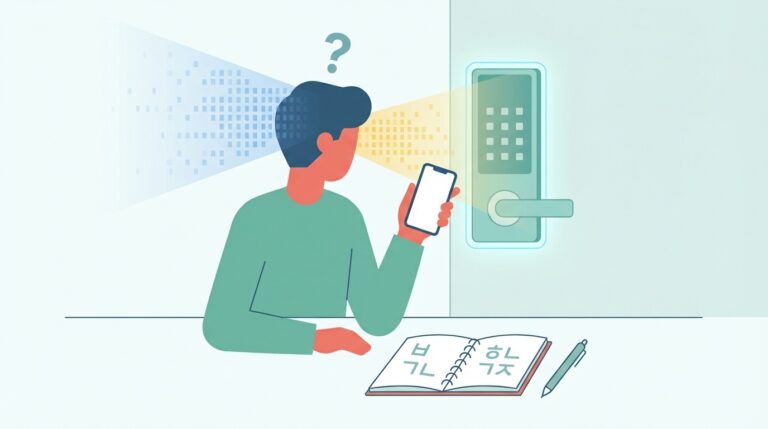
You’ve definitely seen this scene in a K-Drama: The protagonist, heartbroken and slightly intoxicated, stumbles up to their apartment door. They stare at the glowing digital keypad of their smart door lock… and they can’t remember the passcode. It’s a classic trope, but let’s be honest—have you ever stood in front of a kiosk in Seoul, or tried to join a restaurant queue on an iPad, and suddenly realized you’ve completely forgotten your own phone number?
Welcome to 디지털 치매 (Digital Dementia).
In a hyper-connected country like South Korea, where your smartphone is your wallet, your map, your ID, and your memory, our brains rarely have to do the heavy lifting of remembering numbers or passwords anymore. This unit is about the C2-level expressions you need when your biological hard drive fails you, and how Koreans express this unique modern frustration. Master these, and you won’t just sound fluent; you’ll sound like someone who truly understands the nuances of the Korean ‘ppalli-ppalli’ (hurry-hurry) digital life.
Phase 2: In-Depth Analysis of Core Expressions
1. 깜빡깜빡하다 (My memory is flickering)
- Pronunciation: [Kkam-ppak-kkam-ppak-hada] / Sounds like the sharp, rhythmic snapping of a camera shutter or a blinking neon sign.
- Meaning: Literal = To blink/flicker. Real Nuance = To be forgetful; things slipping one’s mind repeatedly.
- K-Culture Moment: You’re at a K-Pop merchandise pop-up store. You meant to buy three specific photocards, but you got distracted by the music and only bought two. You’d tap your head and say, “아, 요새 자꾸 깜빡깜빡하네” (Ah, I keep forgetting things lately).
- Editor’s Insight: This is an ideophone (mimetic word). Korean is rich with words that mimic shapes or movements. Using 깜빡깜빡하다 elevates your Korean instantly because it shows you understand the sensory nature of the language. It feels much lighter and more forgivable than saying “I have memory issues.”
- Situation Spectrum:
- Friends (Casual): ✅
- Coworkers (Semi-formal): ✅
- Boss/Elders (Formal): ⚠️ (Use with self-deprecation, not as an excuse for a major mistake)
- 🤔 Think About It: Why does Korean rely so heavily on mimicking sensory experiences (like a flickering light) to describe abstract cognitive states like forgetfulness?
2. 가물가물하다 (My memory is blurry/fading)
- Pronunciation: [Ga-mul-ga-mul-hada] / Say it slowly. It sounds like a gentle murmur or a candle flame slowly dying out.
- Meaning: Literal = To be dim/faint. Real Nuance = I vaguely remember, but the details are blurry.
- K-Culture Moment: A friend asks if you remember the plot of that famous K-Drama Goblin from 2016. You know the gist, but the ending? 가물가물해요.
- Editor’s Insight: If 깜빡깜빡하다 is a short-term memory glitch, 가물가물하다 is long-term memory fade. It’s the perfect, poetic way to say “It’s on the tip of my tongue, but the image is hazy.”
- Situation Spectrum:
- Friends (Casual): ✅
- Coworkers (Semi-formal): ✅
- Boss/Elders (Formal): ✅
- 🤔 Think About It: Does your native language have a word that visually describes the fade of a memory rather than just the absence of it?
3. 머리가 굳다 (My brain has stiffened)
- Pronunciation: [Meo-ri-ga gut-tta] / ‘Gut’ sounds abrupt, like hitting a solid wall.
- Meaning: Literal = The head/brain has hardened. Real Nuance = I can’t process information quickly anymore; I’ve lost my cognitive flexibility (often used when trying to learn something new, like a digital device).
- K-Culture Moment: Your younger Korean friend tries to teach you how to use a new AI filter on Instagram or how to navigate the complex transfer system of the Seoul subway app. You stare blankly and sigh.
- Editor’s Insight: This is a fantastic idiomatic expression. It acknowledges aging or mental fatigue with a touch of self-deprecating humor. It’s what you say during “Digital Dementia prevention training” when you can’t solve a simple puzzle.
- Situation Spectrum:
- Friends (Casual): ✅
- Coworkers (Semi-formal): ✅
- Boss/Elders (Formal): 🚫 (Do not say this about them, only about yourself!)
- 🤔 Think About It: Why is cognitive flexibility often associated with “softness” and aging/stubbornness with “hardness” across different cultures?
Phase 3: Textbook vs Real Korean
[Situation 1: Forgetting a password]
* 📖 Textbook Korean: 비밀번호를 잊어버렸습니다. (I forgot the password.)
* 🗣️ Real Korean: 아, 비번 뭐였지? 또 깜빡했네. (Ah, what was the password again? Slipped my mind again.)
* 💡 Why the difference?: Koreans love abbreviations for efficiency. ‘비밀번호’ (password) becomes ‘비번’. Adding ‘또’ (again) shows the chronic nature of our digital reliance.
[Situation 2: Feeling mentally sluggish from too much screen time]
* 📖 Textbook Korean: 기억력이 나빠졌습니다. (My memory has worsened.)
* 🗣️ Real Korean: 폰만 보니까 진짜 머리가 굳는 것 같아요. (I think my brain is literally turning to stone because I only look at my phone.)
* 💡 Why the difference?: Connecting the physical act of looking at the phone (폰만 보니까) to the physical sensation of the brain stiffening (머리가 굳다) creates a much more vivid, relatable complaint.
Phase 4: Cultural Context — K-Culture Deep Dive
4-1. Non-Verbal Cues: The “Head Tap”
When Koreans say “깜빡했다” (I forgot), you will almost always see them lightly tap the side of their head with their knuckles or palm. It’s a universal gesture of self-reproach, like saying, “Wake up, brain!” It’s a humble, mildly comedic way to apologize for a mental slip. Just remember, only tap your own head!
4-2. K-Food Connection: The “Catchtable” Dilemma
If you visit famous restaurants in Seoul (like a trendy Samgyeopsal spot in Gangnam or a bagel shop in Bukchon), you won’t stand in line. You will enter your phone number into an iPad kiosk running an app like ‘Catchtable’ (캐치테이블).
Here’s where Digital Dementia strikes: Foreigners or even locals who rely entirely on auto-fill often freeze. “What’s my number again?” Standing in front of that iPad while a line of hungry, impatient people forms behind you is a true test of Korean Nunchi (눈치 – situational awareness). If you freeze up, a polite “아, 제 번호가 깜빡깜빡하네요” (Ah, my number keeps slipping my mind) with an apologetic smile works wonders to diffuse the tension.
Phase 5: Interactive Roleplay Scenario
Setting: Friday evening, 7:00 PM. A bustling, smoke-filled Samgyeopsal restaurant in Gangnam. You and your Korean coworkers are standing near the entrance. The smell of roasting pork belly is torturing you. There’s an iPad kiosk for the waiting list.
Characters:
– YOU: A foreign expat who has been living in Korea for a year, but still occasionally suffers from digital brain-freeze.
– Minsu (32): Your cheerful Korean coworker who is very eager to eat.
Dialogue:
Minsu: 배고파 죽겠어요! 빨리 대기 등록해요. 제가 할게요! 🥩
(Baegopa jukgesseoyo! Ppalli daegi deungnokaeyo. Jaega halgeyo!)
[I’m starving to death! Hurry up and register for the waitlist. I’ll do it!]
(🎭 Stage Direction: Minsu eagerly taps the iPad screen, bringing up the phone number input pad.)
Minsu: 어? 근데 OO씨(YOU) 번호로 등록할게요. 제 폰 배터리가 없어서요. 번호가 뭐죠?
(Eo? Geunde OO-ssi beonhoro deungnokalgeyo. Je pon baeteoriga eopseoseoyo. Beonhoga mwojyo?)
[Huh? Actually, I’ll register with your number. My phone battery is dead. What’s your number?]
YOU: 네? 제 번호요? 아… 잠시만요.
(Ne? Je beonhoyo? Ah… jamsimanyo.)
[Excuse me? My number? Ah… just a second.]
(🎭 Stage Direction: You pat your pockets, realizing your brain is completely blank without looking at your own contacts.)
🔀 Your Turn! How do you respond?
– A) “기억이 나지 않습니다. 죄송합니다.” (I do not remember. I am sorry.)
– B) “아, 요즘 완전 디지털 치매인가 봐요. 제 번호가 깜빡깜빡하네요.”
– C) “저 폰맹이에요. 몰라요.”✅ Best Choice: B — Reason: It perfectly captures the C2-level self-deprecating humor. You blame the modern disease of “digital dementia” and use the natural mimetic word. It makes Minsu laugh instead of getting frustrated.
⚠️ Choice A Analysis: Too robotic. You sound like a GPS navigating system apologizing for losing signal.
⚠️ Choice C Analysis: ‘폰맹’ (Smartphone illiterate) implies you don’t know how to use a phone at all, which isn’t true here. You just forgot the number!
Minsu: (Laughs) 아, 진짜요? 저도 가끔 제 번호 헷갈려요. 천천히 찾아보세요.
(Ah, jinjayo? Jeodo gakkeum je beonho hetgallyeoyo. Cheoncheonhi chajaboseyo.)
[Ah, really? I sometimes confuse my own number too. Take your time looking for it.]
Phase 6: 10-Second Shadowing Drill
Read these aloud, paying attention to the pauses (/) and the intonation!
- 😅 Embarrassed/Laughing at yourself:
아휴 / 요즘 완전 / 디지털 치매인가 봐요. / 비번이 / 가물가물해요.
(Ahyu / yojeum wanjeon / dijiteol chimaeinga bwayo. / bibeoni / gamul-gamul-haeyo.)
[Sigh… I must have full-on digital dementia these days. The password is blurry in my memory.] -
😤 Frustrated with yourself:
폰만 보니까 / 머리가 굳어서 / 계산이 안 돼요!
(Ponman bonikka / meoriga gudeoseo / gyesani an dwaeyo!)
[Because I only look at my phone, my brain has stiffened and I can’t do the math!]
Phase 7: K-Culture Mini Dictionary
| Korean (Hangul) | Romanization | English | Context / Nuance |
|---|---|---|---|
| 디지털 치매 | dijiteol chimae | Digital Dementia | The phenomenon of losing memory abilities due to over-reliance on smart devices. |
| 멍때리기 | meong-ttaerigi | Spacing out | The act of doing nothing and blanking your mind. Korea even hosts an annual “Space-out Competition” as an antidote to digital burnout. |
| 비번 | bibeon | Password | Abbreviation for 비밀번호. Used daily. |
| 아날로그 감성 | analloge gamseong | Analog Sensibility | The romanticized feeling of non-digital things (film cameras, handwritten letters, vinyl records). Highly trendy in Korea. |
| 인증번호 | injeungbeonho | Verification Code | The 4-6 digit code sent to your phone for identity verification. The ultimate enemy of digital dementia! |
Phase 8: Traveler’s Survival Kit
In a country heavily reliant on Naver Maps and KakaoT, a dead phone battery or a forgotten password isn’t just an inconvenience; it’s a survival crisis. Here is how to navigate an “analog” emergency.
🆘 Survival Expression #1: The Dead Battery Excuse
– 🇰🇷 “죄송한데, 핸드폰 배터리가 나가서요. 혹시 OO역이 어디예요?”
– 🗣️ Pronunciation: [Joesong-hande, haendeupon baeteoriga nagaseoyo. Hoksi OO yeogi eodiyeyo?]
– 📍 Where to use: Asking locals for directions when your map app is dead.
– 💡 Pro Tip: Approaching a younger person or a convenience store worker usually gets you the fastest help.🆘 Survival Expression #2: The “I Need a Charger” Plea
– 🇰🇷 “혹시 핸드폰 충전 좀 할 수 있을까요?”
– 🗣️ Pronunciation: [Hoksi haendeupon chungjeon jom hal su isseulkkayo?]
– 📍 Where to use: Cafes, restaurants, convenience stores.
– 💡 Pro Tip: Korea is incredibly generous with charging. Most restaurants have a multi-charging station near the counter. Just ask!📌 Editor’s Travel Note:
– Digital Detox Zones: If you want a break from screens, look for cafes in Seoul labeled “북카페” (Book Cafe) or traditional tea houses in Insadong. Some even ask you to put your phone in a locker!
– Wi-Fi: You don’t need to memorize Wi-Fi passwords. Just point your camera at the QR code usually taped to the cafe counter.
Phase 9: Critical Thinking Corner — “One Step Deeper”
🧠 Think Deeper: Media vs Reality (The Hyper-Digital Society and the Craving for ‘Analog’)
South Korea boasts one of the fastest internet speeds in the world and an infrastructure where you can literally survive without ever touching physical cash or paper. Yet, paradoxically, there is a massive cultural craving for 아날로그 감성 (analog sensibility).
This is why LP (vinyl) bars are packed with people in their 20s, why disposable film cameras are bestsellers, and why the government-sponsored “Space-out Competition” (멍때리기 대회) in Han River Park—where people sit without phones to rest their brains—gathers thousands of participants. The language reflects this tension: we use digital devices to survive, but we complain about “디지털 치매” (digital dementia) to express our underlying exhaustion with constant connectivity. We yearn for the days when memory was human, not outsourced to a cloud.
💬 Your Turn: How does your culture handle the fatigue of a hyper-connected world? Do you have an equivalent to the “Space-out Competition”? Share it in the comments!
Phase 10: FAQ & Avoiding Common Mistakes
Q: Can I use the word “치매” (dementia) as a joke around elderly Koreans?
NO. Absolutely not. “디지털 치매” is a trendy buzzword used among younger/middle-aged people regarding technology. However, using the actual word 치매 (Alzheimer’s/dementia) playfully in front of elders is considered highly insensitive and rude. Stick to “깜빡깜빡해요” around older adults.
Q: How do I tell a cafe worker I forgot the Wi-Fi password without sounding rude?
Say: “죄송한데, 와이파이 비밀번호를 깜빡했어요. 다시 알려주시겠어요?” (I’m sorry, I forgot the Wi-Fi password. Could you let me know again?)
❌ Common Mistake #1: Confusing 잃어버리다 and 잊어버리다.
Many learners say: “비밀번호를 잃어버렸어요.”
✅ Do this instead: “비밀번호를 잊어버렸어요.”
Explanation: 잃어버리다 (to lose) is for physical objects (losing a phone). 잊어버리다 (to forget) is for information/memories. You don’t misplace a password on the subway; you forget it in your brain!
Phase 11: Summary & Action Items
One-Liner Summary: When your digital brain fails you, tap your head gently and use 깜빡깜빡하다 to elegantly excuse your memory glitch.
Action Mission 3-Steps:
– 🥉 Bronze (Solo): Stand in front of a mirror, gently tap your temple, and say “아휴, 비번이 깜빡깜빡하네” three times with exasperation.
– 🥈 Silver (Online): Post a picture of your favorite analog item (a book, a diary) on social media with the caption: “오늘은 디지털 치매 예방의 날!” (Today is Digital Dementia Prevention Day!).
– 🥇 Gold (Real-World): Leave your phone at home (or turn it off) and walk to a local cafe. Order entirely from memory and pay with physical cash or a physical card. Feel the 아날로그 감성!
K-Culture Mission:
Memorize the phone numbers of your two closest friends or family members. In Korea, being able to type someone’s number from memory into a Catchtable kiosk is considered a supreme act of affection!
Phase 12: Interactive Quiz
1. Situational Judgment:
You are at work, and you forgot the code to the office photocopier. Your boss is waiting. What is the most natural thing to say?
– A) 머리가 굳었나 봅니다.
– B) 복사기 비밀번호가 가물가물하네요. 죄송합니다. 다시 확인해 보겠습니다.
– C) 저 디지털 치매인가 봐요.
Explanation: B is the best answer. It politely states that the memory is blurry (가물가물) and offers an immediate solution. A and C are too casual or self-deprecating for a serious moment with a boss.
2. Fill in the Blank:
“아… 그 배우 이름이 뭐였지? 얼굴은 기억나는데 이름이 ( __________ )해요.”
(Ah… what was that actor’s name? I remember the face but the name is _________.)
Answer: 가물가물 (blurry/fading).
3. True or False – K-Culture Edition:
In Seoul, you can easily join restaurant waiting lists by just writing your name on a piece of paper.
(False. Almost all popular places now use digital kiosks requiring a Korean phone number, which is why remembering it is crucial!)
Frequently Asked Questions (FAQ)
Q: What does "깜빡깜빡하다 (My memory is flickering)" mean in Korean and how do you pronounce it?
A: In Korean, "깜빡깜빡하다 (My memory is flickering)" is pronounced [Kkam-ppak-kkam-ppak-hada] and means: Literal = To blink/flicker. Real Nuance = To be forgetful; things slipping one's mind repeatedly.
Q: What does "가물가물하다 (My memory is blurry/fading)" mean in Korean and how do you pronounce it?
A: In Korean, "가물가물하다 (My memory is blurry/fading)" is pronounced [Ga-mul-ga-mul-hada] and means: Literal = To be dim/faint. Real Nuance = I vaguely remember, but the details are blurry.
Q: What does "머리가 굳다 (My brain has stiffened)" mean in Korean and how do you pronounce it?
A: In Korean, "머리가 굳다 (My brain has stiffened)" is pronounced [Meo-ri-ga gut-tta] and means: Literal = The head/brain has hardened. Real Nuance = I can't process information quickly anymore; I’ve lost my cognitive flexibility (often used when trying to learn something new, like a digital device).







