

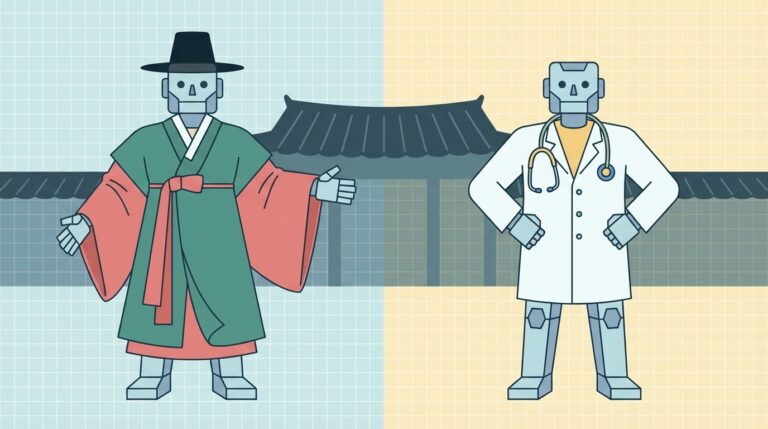
Phase 1: Empathy (The K-Culture Cold Open)
Hello! I’m your Daily Hangul Editor.
Picture this: You are watching a hit K-Drama like Extraordinary Attorney Woo (이상한 변호사 우영우) or Hospital Playlist (슬기로운 의사생활). The climax of the episode hits. A judge looks at a struggling defendant with eyes full of pity before delivering a surprisingly lenient sentence. Or, a doctor holds a crying patient’s hand, offering comfort that no medicine can provide.
Now, imagine replacing that judge or doctor with a hyper-intelligent, cold, calculating AI.
South Korea is currently one of the most hyper-digitalized societies on Earth. Walk into a major hospital like Severance or Asan in Seoul, and you’ll see AI systems actively assisting in medical diagnoses. Turn on the Korean news, and you’ll hear heated debates about whether AI judges could solve the backlog in courts.
But for Koreans, this isn’t just a technological debate—it’s a deeply cultural one. How do you program Jeong (정, deep human affection) or Nunchi (눈치, situational awareness) into an algorithm? If you want to engage in these high-level, fascinating discussions with your Korean friends or colleagues, textbook phrases won’t cut it.
Today, we are going to master C1-level expressions to debate AI ethics, AI judges, and medical diagnoses, all while uncovering the deeply human side of the Korean language. Let’s dive in!
Phase 2: Core Expressions Deep Dive
To talk about AI in law and medicine, you need vocabulary that touches on morality, responsibility, and human emotion.
1. 정상참작 (Extenuating Circumstances)
- Pronunciation: jeongsangchamjak [sounds like: jeong-sang-cham-jak. ‘jak’ sounds like a sharp ‘jack’ without the breathiness]
- Meaning: (Literal) Taking the normal state into consideration / (Real nuance) Making allowances for someone’s specific, difficult situation; extenuating circumstances.
- K-Culture Moment: In a legal K-Drama, the defense attorney passionately pleads, “재판장님, 피고인의 사정을 정상참작해 주십시오!” (Your Honor, please consider the defendant’s extenuating circumstances!). It’s the moment the human heart overrides cold law.
- Editor’s Insight: This is the ultimate “anti-AI” word. Koreans often argue that an AI judge would be perfectly fair, but it would completely lack the ability to offer jeongsangchamjak because it can’t read the room or feel empathy.
- Situation Spectrum:
- Casual Friends: ⚠️ (A bit too formal/legal, though sometimes used jokingly)
- Co-workers (Semi-formal): ✅ (Great for intellectual debates)
- Boss/Elders (Formal): ✅ (Perfect for professional discourse)
- 🤔 Think About It: Why is jeongsangchamjak such a crucial concept in Korean society? It stems from the culture of Jeong (정)—the belief that rules shouldn’t completely erase human compassion. Does your justice system rely more on strict rules or human context?
2. 책임 소재를 가리다 (To determine where the responsibility lies)
- Pronunciation: chaegim sojaereul garida [chaek-gim so-jae-reul ga-ri-da]
- Meaning: (Literal) To distinguish the whereabouts of responsibility / (Real nuance) To figure out exactly whose fault it is when things go wrong.
- K-Culture Moment: When a medical misdiagnosis happens in a drama, the hospital directors gather in a dark boardroom to “책임 소재를 가리다”—usually trying to blame the youngest doctor.
- Editor’s Insight: If an AI doctor makes an ojin (오진, misdiagnosis), who is at fault? The AI? The doctor who used it? The programmer? This phrase is absolutely essential for any high-level ethical debate in Korea.
- Situation Spectrum:
- Casual Friends: ⚠️ (A bit heavy for grabbing a beer)
- Co-workers (Semi-formal): ✅
- Boss/Elders (Formal): ✅
- 🤔 Think About It: Notice the verb garida (가리다), which means to distinguish or sift through. Responsibility in Korean corporate or legal culture isn’t always black and white; it’s something that has to be carefully untangled.
3. 얄짤없다 (To be uncompromising / zero mercy)
- Pronunciation: yaljjaleopda [yahl-jjal-uhp-da. ‘uhp’ sounds like the ‘up’ in ‘cup’ but abruptly stopped]
- Meaning: (Literal) No mercy / (Real nuance) Strictly bound by the rules without any flexibility or forgiveness.
- K-Culture Moment: Imagine a strict senior doctor in the ER who doesn’t accept any excuses from junior residents. The residents whisper behind his back, “우리 교수님 진짜 얄짤없어.” (Our professor has absolutely zero mercy.)
- Editor’s Insight: While the previous two expressions are formal, this is the slang you use when debating AI with friends. “AI 판사? 완전 얄짤없겠지!” (An AI judge? There’d be zero mercy!).
- Situation Spectrum:
- Casual Friends: ✅
- Co-workers (Semi-formal): ⚠️ (Only with close colleagues)
- Boss/Elders (Formal): 🚫 (Too informal/slangy)
- 🤔 Think About It: AI is the definition of yaljjaleopda. It follows the code. Do humans actually want a justice system with “zero mercy,” or do we secretly want a system that bends slightly when we are the ones in trouble?
Phase 3: Textbook vs. Real Korean
Let’s see how discussions about AI change from the textbook to a smoky Korean BBQ joint.
[Situation 1: Discussing the Fairness of AI Judges]
* 📖 Textbook Korean: 인공지능 판사는 매우 공정할 것입니다. (AI judges will be very fair.)
* 🗣️ Real Korean: AI가 판결하면 인맥이나 학연은 안 통하겠지, 얄짤없잖아. (If AI rules, personal connections or school ties won’t work. It’s zero mercy.)
* 💡 Why the difference?: Koreans are highly sensitive to Hakyeon (학연, school ties) and Jiyeon (지연, regional ties) influencing decisions. The appeal of AI in Korea is largely driven by the frustration with these human biases.
[Situation 2: The Fear of AI Misdiagnosis]
* 📖 Textbook Korean: 인공지능의 오진 발생 시 책임이 누구에게 있는지 불분명합니다. (If an AI misdiagnoses, it is unclear who is responsible.)
* 🗣️ Real Korean: AI가 오진하면 책임 소재는 어떻게 돼? 의사 탓? 개발자 탓? 골치 아프지. (If AI misdiagnoses, what happens to the responsibility? The doctor’s fault? The developer’s? It’s a headache.)
* 💡 Why the difference?: Dropping formal nouns for rhetorical questions makes the debate much more engaging and natural in spoken Korean.
Phase 4: Cultural Context — K-Culture Deep Dive
4-1. Non-Verbal Elements: The Gaze (시선 처리)
When debating heavy topics like ethics in Korea, eye contact is tricky. In Western cultures, maintaining strong eye contact during a debate shows confidence. In Korea, staring a senior colleague dead in the eye while arguing about AI ethics can come off as aggressive or rebellious. Instead, look at their chin or tie, or glance down thoughtfully when delivering a counter-argument.
4-2. K-Culture Connection: “National Sentiment Law” (국민정서법)
In K-Dramas, you often see public outrage shifting the verdict of a trial. In Korea, there is a satirical term called 국민정서법 (The National Sentiment Law). It means that the collective emotion and moral outrage of the public sometimes carry as much weight as the actual written law.
An AI judge operates strictly on code. It cannot read the National Sentiment. This creates a fascinating tension in Korea: People want AI judges because they don’t trust human corruption, but they fear AI judges because an AI won’t care if the whole nation is crying for a lenient sentence for a sympathetic defendant.
Phase 5: Real-Life Roleplay Scenario
Setting: Friday night, 8 PM. A trendy cafe in Gangnam. You just attended a tech conference with your Korean colleagues. The topic of “AI replacing doctors and judges” is still fresh on everyone’s mind over iced Americanos.
Characters:
– YOU: A foreign tech professional working in Seoul. You have strong opinions but want to navigate the conversation smoothly.
– Min-su (32): Your pragmatic Korean colleague. He loves efficiency and fully trusts tech.
– Ji-yoon (35): Your senior colleague. She is more traditional and values the “human touch.”
Dialogue:
민수: 솔직히 저는 AI 판사 무조건 찬성이에요. 혈연, 학연 다 무시하고 완전 객관적이잖아요.
(Soljiki jeoneun AI pansa mujeogeon chanseong-ieyo. Hyeolyeon, hagyeon da musihago wanjeon gaekgwanjeogijanhayo.)
[Honestly, I’m absolutely in favor of AI judges. They ignore blood ties and school ties and are completely objective.]
지윤: 에이, 그래도 재판이라는 게 인간미가 있어야지. 기계가 어떻게 사람의 마음을 알아요?
(Ei, geuraedo jaepaniraneun ge inganmiga isseoyaji. Gigyega eotteoke saramui maeumeul arayo?)
[Hey, but trials need a human touch. How can a machine understand a person’s heart?]
민수: 인간미 찾다가 불공평한 판결이 나오는 거라니까요. AI는 얄짤없이 법대로만 하니까 낫죠.
(Inganmi chatdaga bulgongpyeonghan pangyeori naoneun georanikkayo. AIneun yaljjaleopsi beopdaeroman hanikka natjyo.)
[Looking for a ‘human touch’ is exactly why unfair verdicts happen. AI is better because it follows the law with zero mercy.]
지윤: 그럼 의료 쪽은요? 만약 AI 의사가 오진을 내리면, 그 책임 소재는 누가 지는데요?
(Geureom uiryo jjogeunyo? Manyak AI uisaga ojineul naerimyeon, geu chaegim sojaeneun nuga jineundeyo?)
[What about the medical field then? If an AI doctor makes a misdiagnosis, who bears the responsibility?]
민수: 그건… 병원이 져야겠죠?
(Geugeon… byeongwoni jyeoyagetjyo?)
[That… the hospital should bear it, right?]
🔀 Your Turn! How do you interject?
– A) “제 생각엔, AI 의사를 절대 믿으면 안 됩니다!” (In my opinion, we should never trust AI doctors!)
– B) “맞아요. 책임 소재를 가리는 게 가장 큰 윤리적 문제 중 하나죠.” (That’s right. Determining where the responsibility lies is one of the biggest ethical issues.)
– C) “대박! 기계가 감옥에 갈 수도 없잖아요 ㅋㅋㅋ” (Awesome! Machines can’t go to jail anyway lol)✅ Best Choice: B — It uses the advanced vocabulary (책임 소재를 가리다) seamlessly, acknowledges Ji-yoon’s point respectfully, and elevates the intellectual tone of the debate.
⚠️ Choice A Analysis: Too aggressive and black-and-white. Korean debates often prefer acknowledging the gray areas.
⚠️ Choice C Analysis: Too casual and completely breaks the serious, intellectual vibe of the conversation.
지윤: 맞아요. OO씨(Your Name) 말이 정답이네요. 법이나 제도가 기술을 못 따라가고 있어요.
(Majayo. OO-ssi mari jeongdap-ineyo. Beob이나 jedoga gisureul mot ttaragago isseoyo.)
[Right. Your Name has the right answer. The laws and systems aren’t keeping up with the tech.]
Phase 6: 10-Second Shadowing Drill
Practice reading this C1-level sentence aloud. Pay attention to the pauses (/) and the mood tags!
😤 단호하게 (Firmly, making a strong point)
인공지능이 / 아무리 뛰어나도, / 결국 / 책임 소재를 가리는 일은 / 인간의 몫입니다.
(ingongjineung-i / amuri ttwieonado, / gyeolguk / chaegim sojaereul garineun ireun / inganui moks-imnida.)
No matter how outstanding AI is, ultimately, the task of determining responsibility falls to humans.
Phase 7: K-Culture Mini Dictionary
| 한국어 | Romanization | English | Cultural Context |
|---|---|---|---|
| 오진 | ojin | Misdiagnosis | A critical fear in Korea’s rapidly digitizing medical sector. |
| 인간미 | inganmi | Human touch / Humanity | Often cited as the “missing piece” in AI. Deeply connected to the concept of Jeong. |
| 학연/지연 | hakyeon/jiyeon | School/Regional ties | The bias in human judges that makes Koreans actually desire AI judges. |
| 팩트폭행 | paekteupokaeng | Fact assault (Dropping truth bombs) | Slang for using cold, hard facts to win an argument, much like an AI would. |
Phase 8: Traveler Survival Kit (Hospital/Pharmacy Edition)
You might not debate AI ethics while traveling, but you will interact with Korea’s highly advanced medical system. If an AI (or human) doctor treats you, here are the survival phrases you need.
🆘 Survival Phrases for Medical Care
– 🇰🇷 “처방전 주세요.” (cheobangjeon juseyo.)
– 🗣️ Meaning: “Please give me the prescription.”
– 📍 Where to use: Hospital desk (to take to the pharmacy).
- 🇰🇷 “부작용은 없나요?” (bujagyong-eun eomnayo?)
- 🗣️ Meaning: “Are there any side effects?”
- 📍 Where to use: Pharmacy, when receiving medication.
🇰🇷 “보험 처리 되나요?” (boheom cheori doenayo?)
- 🗣️ Meaning: “Can this be covered by insurance?”
- 📍 Where to use: Paying the medical bill.
📌 Editor’s Travel Note
– Korean Pharmacies (약국): Unlike in many Western countries where you buy off-the-shelf painkillers at a supermarket, in Korea, you must talk to the pharmacist (약사) for almost everything beyond basic Tylenol.
– Speed: Korean hospitals operate at light speed. Don’t be offended if the human doctor spends exactly 3 minutes with you. It’s not a lack of Jeong; it’s just the hyper-efficient system!
Phase 9: Critical Thinking Corner — “A Step Deeper”
🧠 Think Deeper: Language & Power in the AI Era
Korean is a hierarchical language built on honorifics (존댓말) and power dynamics. When you speak to a human doctor or judge, you use the highest level of respect (e.g., 판사님, 의사 선생님). But how do we address an AI? Do we use honorifics for a machine? Currently, Koreans speak to AI assistants (like Siri or Bixby) in informal language (반말). But if an AI holds the power of life and death in a hospital, or the power of freedom in a court, will the language adapt to give machines honorific titles? The intersection of Korea’s hierarchical language and artificial intelligence is a fascinating linguistic frontier.
💬 Your Turn: In your native language, do you say “please” and “thank you” to AI like ChatGPT? Do you think we will eventually have to show “linguistic respect” to AI judges? Share your thoughts in the comments!
Phase 10: FAQ & Avoiding Misunderstandings
Q: Can I use “얄짤없다” in a formal presentation about AI?
A: No! 🚫 While it’s great for cafe debates, using “얄짤없다” in a boardroom presentation will make you sound unprofessional. Stick to “예외가 없습니다” (There are no exceptions) or “엄격합니다” (It is strict) in formal settings.
Q: How do I politely disagree with a senior colleague about AI ethics?
A: Never say “틀렸습니다” (You are wrong). Always use the “Yes, but…” Korean method: “말씀하신 부분도 맞지만, 저는 이렇게 생각합니다.” (What you said is also correct, but I think this way.)
❌ Common Mistake: Translating “Whose fault is it?” literally to “누구 잘못입니까?” during a professional debate.
✅ Do This Instead: Use “책임 소재가 불분명합니다” (The whereabouts of responsibility are unclear). It sounds 100x more professional and native-like.
Phase 11: Summary & Action Items
💡 One-Liner Summary: Debating AI in Korean requires balancing cold logic (책임 소재) with an understanding of deep human emotion (정상참작, 인간미).
Action Mission:
– 🥉 Bronze: Stand in front of the mirror and say “책임 소재를 가리는 일이 중요합니다” three times with a serious, intellectual face.
– 🥈 Silver: Leave a comment below using the word “인간미” (Human touch) to describe something you love about humans that AI can’t do.
– 🥇 Gold (K-Culture Mission): Watch an episode of a Korean medical or legal drama (like Stranger or Hospital Playlist). Imagine an AI replacing the main character. Whenever a human makes an emotional decision, shout “AI였으면 얄짤없지!” (If it were AI, there’d be zero mercy!) at your screen.
Phase 12: Quiz — Interactive Challenge
1. Situational Judgment: You are discussing a news article about an AI making a mistake in surgery. You want to ask, “Who takes the blame?” professionally. What do you say?
A) 누가 잘못했어요?
B) 책임 소재를 어떻게 가리나요?
C) AI 진짜 얄짤없네요.
2. True or False – K-Culture Edition:
Because Koreans value efficiency, the general public 100% prefers AI judges over human judges without any hesitation.
3. Fill in the Blank:
기계는 완벽할지 몰라도, 사람의 마음을 헤아리는 ______가 부족해요.
(Machines might be perfect, but they lack the ________ to understand a person’s heart.)
(Toggle for Answers)
1. B (A is too basic/childish, C is totally unrelated to taking blame).
2. False (While many favor AI due to distrust in human bias, there is immense fear of losing the Jeong and Jeongsangchamjak that humans provide).
3. 인간미 (Human touch/Humanity).
Frequently Asked Questions (FAQ)
Q: What does "정상참작 (Extenuating Circumstances)" mean in Korean and how do you pronounce it?
A: In Korean, "정상참작 (Extenuating Circumstances)" is pronounced [jeongsangchamjak [sounds like: jeong-sang-cham-jak. 'jak' sounds like a sharp 'jack' without the breathiness] and means: (Literal) Taking the normal state into consideration / (Real nuance) Making allowances for someone's specific, difficult situation; extenuating circumstances.
Q: What does "책임 소재를 가리다 (To determine where the responsibility lies)" mean in Korean and how do you pronounce it?
A: In Korean, "책임 소재를 가리다 (To determine where the responsibility lies)" is pronounced [chaegim sojaereul garida [chaek-gim so-jae-reul ga-ri-da] and means: (Literal) To distinguish the whereabouts of responsibility / (Real nuance) To figure out exactly whose fault it is when things go wrong.
Q: What does "얄짤없다 (To be uncompromising / zero mercy)" mean in Korean and how do you pronounce it?
A: In Korean, "얄짤없다 (To be uncompromising / zero mercy)" is pronounced [yaljjaleopda [yahl-jjal-uhp-da. 'uhp' sounds like the 'up' in 'cup' but abruptly stopped] and means: (Literal) No mercy / (Real nuance) Strictly bound by the rules without any flexibility or forgiveness.







