

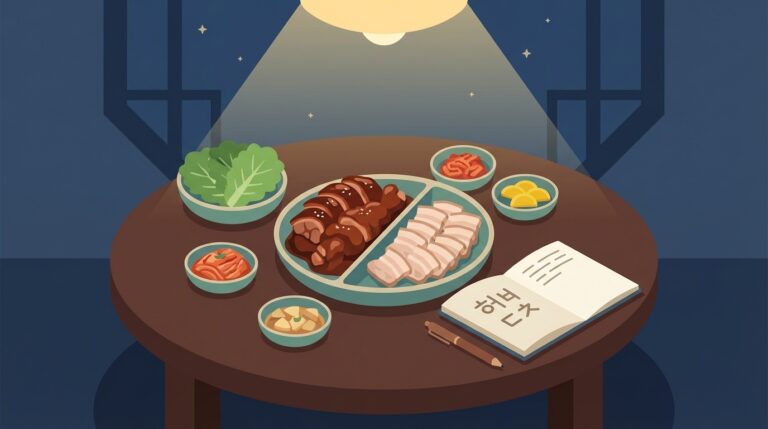
Phase 1: Empathy & Immersion (The Midnight K-Culture Cold Open)
Hello! I’m your Senior Editor at Daily Hangul.
Picture this: It’s 11:30 PM in Seoul. You’re binge-watching a K-Drama where the main characters have just survived a grueling day at work. They sit on the floor of a small rooftop apartment, popping open a bottle of Soju, and unwrapping a massive plastic delivery container. Inside? A glistening mountain of meat, spicy red noodles, and fresh lettuce. Your mouth waters. You grab your phone and open a Korean delivery app, but suddenly, you are faced with the ultimate, quintessential Korean culinary dilemma: Jokbal (족발) or Bossam (보쌈)?
If you don’t know the difference, you might end up staring at a giant pig’s trotter when you actually wanted tender slices of boiled pork belly. Or worse, you might miss out on the greatest compromise Korean late-night food (Yashik, 야식) has ever invented. As a C1 learner, you’re not just ordering food anymore—you are participating in a cherished cultural ritual.
Let’s dive into the delicious world of Yashik, learn the exact vocabulary Koreans use to describe these textures, and make sure you order like an absolute insider!
Phase 2: Core Expressions Deep Dive
To master this midnight dilemma, you need to speak the language of texture and desire.
1. 야식 당긴다 (Yashik dang-ginda)
- Pronunciation: [yashik dang-ginda] (‘Dang-ginda’ sounds like you are stretching a rubber band—there’s a slight tension in the ‘dang’.)
- Meaning: Literal: Late-night food is pulling me. / Real nuance: I’m really craving a midnight snack right now.
- K-Culture Moment: You’ll hear this in K-Pop idols’ live streams around midnight. They’ll whisper to the camera, “아, 오늘 야식 당기는데 어떡하죠?” (Ah, I’m really craving a late-night snack today, what should I do?), fully knowing they have a photoshoot the next day.
- Editor’s Insight: This is much more natural and visceral than saying “야식을 먹고 싶어요” (I want to eat a late-night snack). It implies an irresistible, almost physical urge.
- Situation Spectrum:
- Casual with friends: ✅
- Close colleagues (Semi-formal): ⚠️ (Use ‘당기네요’)
- Formal/Elders: 🚫
- 🤔 Think About It: Why does Korean use the passive/directional verb ‘당기다’ (to pull) for cravings? Doesn’t it feel like the food is magnetically pulling you, rather than you actively wanting it? How do you express sudden cravings in your language?
2. 쫀득쫀득하다 (Jjondeuk-jjondeukhada)
- Pronunciation: [jjondeuk-jjondeukhada] (The double ‘jj’ is a strong, tense sound. Imagine the sound of pulling a sticky piece of gum off your shoe.)
- Meaning: Literal/Real: Chewy, sticky, gelatinous in a pleasant way.
- K-Culture Moment: This is the absolute core identity of Jokbal (braised pig’s trotters). When K-Food YouTubers (Mukbangers) take a bite of the glistening, soy-sauce-braised skin of Jokbal, they will inevitably close their eyes and exclaim, “식감이 진짜 쫀득쫀득해요!” (The texture is so delightfully chewy!).
- Editor’s Insight: English speakers often associate “chewy” with tough meat (a negative trait). In Korea, 쫀득쫀득하다 is a highly praised texture, often associated with collagen-rich foods like Jokbal, mochi, or tteokbokki.
- Situation Spectrum:
- Casual with friends: ✅
- Close colleagues (Semi-formal): ✅
- Formal/Elders: ✅ (It’s a standard descriptive word)
- 🤔 Think About It: Korean cuisine places immense value on Sikgam (식감, mouthfeel). Is texture as highly praised in your native cuisine, or is flavor usually the sole king?
3. 야들야들하다 (Yadeul-yadeulhada)
- Pronunciation: [yadeul-yadeulhada] (Say it softly and fluidly, like a gentle breeze ruffling silk.)
- Meaning: Literal/Real: Soft, tender, meltingly smooth.
- K-Culture Moment: If Jokbal is ‘jjondeuk’, Bossam (boiled pork belly) is ‘yadeul’. In a K-Drama dinner scene, a senior colleague might place a piece of Bossam on a junior’s plate saying, “이 집 보쌈 참 야들야들하네” (This place’s Bossam is really tender).
- Editor’s Insight: While ‘부드럽다’ (soft) is generic, ‘야들야들하다’ specifically evokes the visual and tactile sensation of thinly sliced meat or delicate tofu that is so tender it wiggles slightly and melts in your mouth.
- Situation Spectrum:
- Casual with friends: ✅
- Close colleagues (Semi-formal): ✅
- Formal/Elders: ✅
- 🤔 Think About It: Notice how both ‘쫀득쫀득’ and ‘야들야들’ are repeated onomatopoeic/mimetic words? Korean uses repetition extensively to intensify sensory experiences.
Phase 3: Textbook vs. Real Korean
Let’s see how these expressions evolve from the classroom to the streets of Seoul.
[Situation 1: Expressing your craving for late-night pork]
* 📖 Textbook Korean: 저는 족발과 보쌈 중에서 족발을 먹고 싶습니다. (I want to eat Jokbal among Jokbal and Bossam.)
* 🗣️ Real Korean: 아, 무조건 족발이지! 껍질 쫀득한 거 당기잖아. (Ah, it’s gotta be Jokbal! I’m craving that chewy skin.)
* 💡 Why the difference?: C1 speakers rarely state their desires politely to friends. “무조건 ~지” (It unconditionally has to be ~) asserts a strong, passionate preference, making you sound like a true foodie.
[Situation 2: When you can’t decide between the two]
* 📖 Textbook Korean: 족발과 보쌈을 둘 다 주문합시다. (Let’s order both Jokbal and Bossam.)
* 🗣️ Real Korean: 야, 고민할 시간에 족보 세트 시켜! (Hey, instead of wasting time thinking, just order the Jokbo Set!)
* 💡 Why the difference?: Efficiency is everything in Korea (Pali-pali culture). “족보 세트” is a brilliant portmanteau of Jokbal and Bossam. Why choose when you can have a half-and-half combo?
Bottom Note: At the C1 level, mastering abbreviations like ‘족보 세트’ or ‘반반’ (half-and-half) shows that you are highly integrated into modern Korean lifestyle rhythms.
Phase 4: Cultural Context — K-Culture Deep Dive
4-1. Non-Verbal Cues: The Art of the Ssam (쌈)
Whether you order Jokbal or Bossam, it will arrive with lettuce, perilla leaves (깻잎), garlic, and sauces. Wrapping the meat is mandatory.
* The Unspoken Rule: Never bite a Ssam in half. It is considered slightly rude and visually unappealing. You must craft a wrap small enough to eat in one single bite.
* Nunchi (눈치) Check: If a Korean friend makes a beautifully crafted Ssam and holds it out to you, open your mouth! Feeding someone a Ssam is a supreme gesture of Jeong (정, deep affection/care). Refusing it can kill the mood.
4-2. The K-Food Delivery Ritual
In K-Dramas, you’ve definitely seen characters struggling to open the tightly sealed plastic wrapping of delivery food. Every Jokbal/Bossam delivery comes with a tiny, shark-tooth-shaped plastic knife. It’s informally called the “배달 칼” (delivery knife). Knowing to immediately grab this little tool and swiftly cut open the airtight seals while your friends set the table is the ultimate sign of a seasoned Seoulite.
Phase 5: Interactive Roleplay Scenario
Setting: It’s Friday, 10:00 PM. You are in a tech office in Pangyo. You and your team are working late to meet a deadline. The energy is dropping. Your Korean colleague, Minsu, spins around in his chair and pulls out his phone.
Characters:
– YOU: A foreign manager working in Korea. You’re exhausted but starving.
– Minsu (32): Your witty, slightly over-caffeinated Korean co-worker.
Dialogue:
Minsu: 아, 도저히 안 되겠다. 우리 야식 하나 시킬까요? 제가 쏠게요!
(A, dojeohi an doegetda. Uri yashik hana sikilkkayo? Jaega ssolgeyo!)
[Ah, I can’t take this anymore. Should we order a late-night snack? It’s on me!]
(🎭 Stage Direction: Minsu dramatically waves his smartphone displaying the Baedal Minjok app)
YOU: 좋아요! 아까부터 배에서 꼬르륵 소리가 났어요.
(Joayo! Akkabuteo bae-eseo kkoreureuk soriga nasseoyo.)
[Sounds good! My stomach has been growling for a while now.]
Minsu: 고생했으니까 고기 먹어야죠. 족발? 보쌈? 뭐 당겨요?
(Gosaenghaesseunikka gogi meogeoyajyo. Jokbal? Bossam? Mwo dang-gyeoyo?)
[We’ve suffered, so we need meat. Jokbal? Bossam? What are you craving?]
🔀 Your Turn! How do you answer?
– A) “저는 보쌈이 좋습니다. 감사합니다.”
– B) “콜라겐 듬뿍 들어간 쫀득쫀득한 족발 당기네요!”
– C) “아, 둘 다 당기는데… 족보 세트 어때요? 막국수도 추가해서요!”✅ Best Choice: C — Why? Choice C is the ultimate C1/Insider response. It acknowledges the dilemma, uses the insider abbreviation (‘족보 세트’), and proactively adds ‘Makguksu’ (spicy buckwheat noodles), which is the absolute mandatory side dish for this meal. Minsu will likely treat you as a true local after this.
⚠️ Choice A Analysis: Too robotic. You’re working late together; it’s time to be slightly more casual and expressive about the food!
Minsu (If you chose C): 와… OOO 님, 진짜 배운 사람이네요. 막국수 추가는 국룰이죠. 바로 주문할게요!
(Wa… OOO nim, jinjja bae-un saram-ineyo. Makguksu chuganeun gungnurijyo. Baro jumunhalgeyo!)
[Wow… you are truly a person of culture (lit. learned person). Adding Makguksu is a national rule. I’ll order right away!]
Phase 6: 10-Second Shadowing Drill
Let’s practice ordering like a boss. Pay attention to the intonation!
😋 아, / 오늘 밤엔 / 야들야들한 보쌈보다 / 쫀득~한 족발이 / 더 당기는데요?
(Ah, / oneul bamen / yadeul-yadeulhan bossamboda / jjondeuk~han jokbari / deo dang-gindeun-deyo?)
[Ah, tonight I’m craving the chewy Jokbal more than the tender Bossam!]
- Vibe: Expressive and slightly playful.
- Tip: Stretch out the ‘존’ in 쫀득한 to really emphasize how delightfully chewy you expect it to be!
Phase 7: K-Culture Mini Dictionary
| Korean | Romanization | English | Context/Meaning |
|---|---|---|---|
| 야식 | yashik | Late-night snack | A massive part of Korean culture, deeply tied to long working/studying hours. |
| 족보 세트 | jokbo sete | Jokbal + Bossam Combo | The ultimate half-and-half menu. Saves friendships from food debates. |
| 식감 | sikgam | Texture / Mouthfeel | A critical criteria for evaluating food in Korea (chewy, crispy, tender). |
| 막국수 | makguksu | Spicy Buckwheat Noodles | Always served with Jokbal/Bossam. You wrap the meat with the noodles! |
| 국룰 | gungnul | National Rule | Slang for an unwritten social consensus (e.g., “Adding noodles is gungnul”). |
Phase 8: Traveler’s Survival Kit
Even if you’re just visiting Korea, ordering delivery to your hotel room or AirBnb or visiting a late-night restaurant is a must-do experience.
🆘 Survival Expressions for Late-Night Meat
– 🇰🇷 “여기 족보 세트 중(中)자 하나랑, 막국수 주세요.”
(yeogi jokbo sete jung-ja hanarang, makguksu juseyo.)
– 🗣️ Meaning: I’ll have a medium-sized Jokbo set and Makguksu, please.
– 🇰🇷 “앞발로 주실 수 있나요?”
(apballo jusil su innayo?)
– 🗣️ Meaning: Can I get the front leg? (Insider knowledge: The front trotters of the pig are fattier, juicier, and more expensive than the hind legs!).
– 🇰🇷 “반찬 좀 리필해 주실 수 있나요?”
(banchan jom ripilhae jusil su innayo?)
– 🗣️ Meaning: Can we get a refill on the side dishes?📌 Editor’s Travel Note
– App Tip: As a tourist without a Korean resident ID, you might struggle to use Baedal Minjok or Coupang Eats because of payment verification. Try Shuttle Delivery (which accepts foreign cards and has English menus), or ask your hotel concierge to order for you!
– Sizes: Jokbal and Bossam are shared meals. “대(Large), 중(Medium), 소(Small).” A “Small” is usually good for 2 people.
– Bones: If you order Jokbal, you will find a massive, dinosaur-like bone at the bottom of the container. It’s meant to be picked up and gnawed on. Don’t be shy!
Phase 9: Critical Thinking — “One Step Deeper”
Food & Identity: The Bonding Power of High-Calorie Suffering
🧠 Think Deeper:
Why is Yashik so monumental in Korea? While late-night snacking exists everywhere, in Korea, it is deeply intertwined with the society’s intense work ethic. Eating a massive platter of Jokbal at midnight isn’t just about hunger; it’s a communal coping mechanism. By sharing a highly caloric, somewhat indulgent meal out of a single large platter after a long day of overtime, colleagues and friends solidify their Jeong (emotional bond). The shared exhaustion is washed away by the shared sensory pleasure of jjondeuk-jjondeuk pork and spicy noodles.💬 Your Turn: Do you have a specific “late-night survival food” in your culture that you eat not just for hunger, but to bond with others over shared stress? Share it in the comments!
Phase 10: FAQ & Avoiding Mistakes
Q: Is Bossam just boiled pork? That sounds boring.
No! It’s boiled with an aromatic broth containing coffee, soybean paste, onion, and herbs to remove any smell. Furthermore, Bossam is heavily defined by the Kimchi it’s served with. “Bossam Kimchi” is sweeter and crispier than regular fermented Kimchi. Eating Bossam without its specific Kimchi is like eating a burger without the patty.
Q: Can I eat Jokbal with a fork?
Yes, but for the true local experience, use chopsticks for the sliced meat, and for the big bone pieces? Put on the disposable plastic gloves (비닐장갑) provided and eat with your hands!
❌ Common Mistake #1: Ordering Jokbal/Bossam just for yourself.
✅ Do this instead: These dishes are historically banquet foods meant for sharing (priced around 30,000~40,000 KRW). If you are traveling solo, look for restaurants offering “1인 보쌈” (1-person Bossam meals) to avoid wasting food and money!
Phase 11: Summary & Action Items
One-Liner Summary: Whether you crave the chewy (jjondeuk) delight of Jokbal or the tender (yadeul) comfort of Bossam, knowing how to express your texture preferences and navigating the “Jokbo” compromise will make you an insider in Korean late-night food culture.
Action Mission:
– 🥉 Bronze (Solo): Say “아, 오늘 야식 당긴다!” out loud next time you feel hungry past 10 PM.
– 🥈 Silver (Online): Look up the hashtag #족보세트 on Instagram and comment “너무 야들야들해 보여요!” on a delicious-looking post.
– 🥇 Gold (Real Life): Order a Jokbo Set in a Korean restaurant or via an app, and explicitly ask for the front leg (앞발).
K-Culture Mission:
Open a K-Drama you are currently watching. The next time the characters are eating late at night, look closely at the meat. Is the skin dark and gelatinous? (Jokbal!) Or is it pale, sliced pork belly? (Bossam!) You now possess the eye of a Korean foodie.
Did reading this make you hungry? What are you ordering tonight? Let me know in the comments below! 👇
Phase 12: Quiz — Interactive Challenge
1. Situational Judgment:
You and your Korean manager are exhausted after a long shift. Your manager says, “우리 오늘 보쌈 시켜 먹을까요?” (Shall we order Bossam today?). You actually prefer Jokbal. What is the most natural, C1-level response?
A) “아니요. 저는 족발을 먹고 싶습니다.”
B) “보쌈도 좋지만, 쫀득한 족발이 더 당기는데요? 족보 세트 어때요?”
C) “야식 당기네요!”
2. Fill in the Blank:
K-Mukbangers love Jokbal because of its amazing ________ (mouthfeel/texture).
“와, 족발 _________ 미쳤다! 진짜 쫀득쫀득해요.”
3. True or False — K-Culture Edition:
“It is polite to bite your Bossam lettuce wrap (Ssam) in half so you don’t look greedy.”
(Answers: 1: B – It politely expresses preference while offering the brilliant compromise. A is too blunt. / 2: 식감(sikgam) / 3: False. Biting a Ssam in half is frowned upon; make it bite-sized!)
Frequently Asked Questions (FAQ)
Q: What does "야식 당긴다 (Yashik dang-ginda)" mean in Korean and how do you pronounce it?
A: In Korean, "야식 당긴다 (Yashik dang-ginda)" is pronounced [yashik dang-ginda] and means: Literal: Late-night food is pulling me. / Real nuance: I'm really craving a midnight snack right now.
Q: What does "쫀득쫀득하다 (Jjondeuk-jjondeukhada)" mean in Korean and how do you pronounce it?
A: In Korean, "쫀득쫀득하다 (Jjondeuk-jjondeukhada)" is pronounced [jjondeuk-jjondeukhada] and means: Literal/Real: Chewy, sticky, gelatinous in a pleasant way.
Q: What does "야들야들하다 (Yadeul-yadeulhada)" mean in Korean and how do you pronounce it?
A: In Korean, "야들야들하다 (Yadeul-yadeulhada)" is pronounced [yadeul-yadeulhada] and means: Literal/Real: Soft, tender, meltingly smooth.







