

Phase 1: Empathy (The K-Culture Cold Open)
Hello! I am your Daily Hangul Editor, your veteran tutor and local cultural navigator in Seoul.
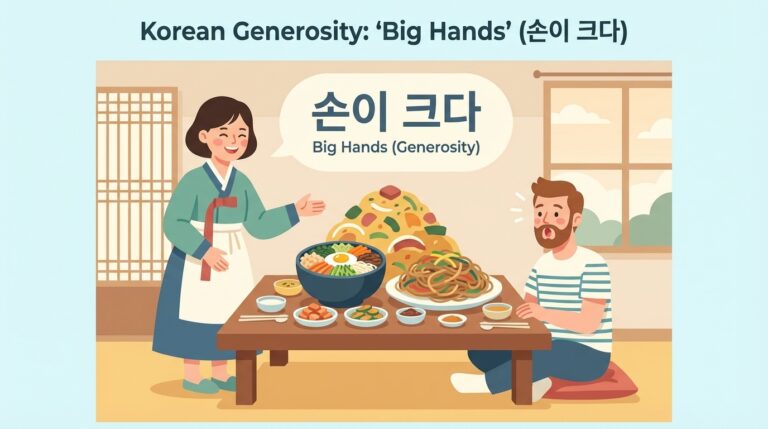
Imagine this: You are watching a heartwarming K-Drama. The main character visits her hometown, and her mother brings out a literal mountain of food—kimchi, bulgogi, three types of soup, and countless side dishes. The character sighs and says to her friend, “우리 엄마가 손이 좀 커 (My mom’s hands are a bit big).” The subtitles might just say, “My mom always cooks too much.”
But wait, you pause the screen. You look closely at the mother’s hands. They look perfectly normal! What is she talking about?
Welcome to the colorful, slightly confusing, and absolutely essential world of B2 Intermediate Korean: Body Part Idioms (신체 관용어). If you translate these literally, you’ll end up staring at people’s hands, feet, or ears in confusion. But if you master them? You will instantly sound like a local ‘Insider’ (인싸). These phrases are deeply woven into everyday Korean conversations, reflecting everything from the culture of generosity to office politics.
This guide is built on real questions from students just like you, who have been bewildered by ‘heavy mouths’ and ‘wide feet.’ Let’s dive in!
Phase 2: Core Expressions Deep Dive
1. 손이 크다 (To have big hands)
- Pronunciation: son-i keuda [sohn-ee koo-dah]
- Meaning: Literal: Hands are big. / Real Nuance: To be generous, especially when preparing food, buying gifts, or spending money.
- K-Culture Moment: Think of the classic Korean grandmother (할머니) at a traditional market or a K-Drama mom. Even if you say you are “just a little bit hungry,” she will cook enough to feed a small army. That’s son-i keuda.
- Editor’s Insight: This isn’t about physical size. It’s about a generous spirit. It carries a warm, positive vibe, though sometimes it’s used jokingly when someone accidentally makes way too much food.
- Situation Spectrum:
- Casual with friends: ✅
- Semi-formal (Co-workers): ✅
- Formal (Boss/Elders): ✅ (Often used as a compliment!)
- 🤔 Think About It: Why does Korean culture associate the ‘hands’ that prepare food with ‘generosity’? How is hospitality expressed in your home country’s language?
2. 입이 무겁다 (To have a heavy mouth)
- Pronunciation: ib-i mugeopda [ee-bee moo-geop-dah]
- Meaning: Literal: The mouth is heavy. / Real Nuance: To be good at keeping secrets; tight-lipped.
- K-Culture Moment: In a tense K-Drama office scene, a junior employee discovers a huge corporate secret. The senior tells them, “너 입 무거운 거 알지?” (I know your mouth is heavy, right?). It’s an order to stay quiet.
- Editor’s Insight: The opposite is 입이 가볍다 (light mouth – a blabbermouth). If someone trusts you with a secret, you want to assure them your mouth is practically weighed down with lead!
- Situation Spectrum:
- Casual with friends: ✅
- Semi-formal (Co-workers): ✅
- Formal (Boss/Elders): ⚠️ (Use cautiously; praising a boss for keeping secrets can sound inappropriate.)
- 🤔 Think About It: In English, we say “my lips are sealed.” Why do you think Korean focuses on the ‘weight’ of the mouth instead?
3. 귀가 얇다 (To have thin ears)
- Pronunciation: gwi-ga yalpda [gwee-gah yahl-pdah]
- Meaning: Literal: The ears are thin. / Real Nuance: To be easily persuaded, gullible, or easily influenced by what others say.
- K-Culture Moment: You are in Myeongdong, and a K-Beauty salesperson tells you this snail cream will make you look 10 years younger. You instantly buy five bottles. Your Korean friend shakes their head: “넌 진짜 귀가 얇아!” (Your ears are so thin!).
- Editor’s Insight: It implies that words easily penetrate your ears because they are “thin.” It’s usually used to tease a friend or self-deprecate when you’ve been easily convinced to buy something or change your mind.
- Situation Spectrum:
- Casual with friends: ✅
- Semi-formal (Co-workers): ⚠️ (Okay for self-deprecation, rude to say to others.)
- Formal (Boss/Elders): 🚫
- 🤔 Think About It: Is there a body-part idiom in your language for someone who is easily scammed or persuaded?
Phase 3: Textbook vs. Real Korean
Here is how these concepts change from the classroom to the streets of Hongdae!
[Describing a generous friend]
* 📖 Textbook Korean: 제 친구는 관대하고 음식을 많이 줍니다. (My friend is generous and gives a lot of food.)
* 🗣️ Real Korean: 내 친구 진짜 손 커. (My friend’s hands are really big.)
* 💡 Why the difference?: Korean relies heavily on metaphorical imagery (like hands) rather than abstract adjectives (like generous) in daily conversation to make the speech feel more colorful and relatable.
[Promising to keep a secret]
* 📖 Textbook Korean: 저는 비밀을 잘 지킵니다. (I keep secrets well.)
* 🗣️ Real Korean: 나 입 무거워. 걱정 마. (My mouth is heavy. Don’t worry.) OR 무덤까지 가져갈게 (I’ll take it to my grave.)
* 💡 Why the difference?: “비밀을 지키다” sounds a bit like a formal oath. “입이 무겁다” feels much more natural and personal between friends.
[Regretting an impulse buy]
* 📖 Textbook Korean: 저는 다른 사람의 말을 너무 쉽게 믿습니다. (I believe other people’s words too easily.)
* 🗣️ Real Korean: 아, 나 또 팔랑귀 발동했어… (Ah, my flapping ears activated again…)
* 💡 Why the difference?: “팔랑귀” (flapping ears) is a trendy, slang-y evolution of “귀가 얇다.” It compares easily persuaded ears to something flapping in the wind!
Bottom Note: For B2 learners, using expressions like “손이 크다” instead of “관대하다” immediately elevates your Korean from ‘textbook’ to ‘natural.’
Phase 4: Cultural Context — K-Culture Deep Dive
4-1. Non-Verbal Cues & Nunchi (눈치)
When you use these expressions, remember that Korean communication is heavily based on context and Nunchi (the ability to read the room). If you say, “I have a heavy mouth,” you don’t need to actually point to your mouth. Simply giving a reassuring nod with steady eye contact is enough.
4-2. The K-Food Connection: The Generosity of ‘Jeong’ (정)
The idiom “손이 크다” is intricately linked to Korean food culture and the concept of Jeong (정)—a deep feeling of affection, attachment, and community spirit.
In Korea, eating alone was historically uncommon. Food is meant to be shared. When you visit a local traditional market (시장) or an old mom-and-pop restaurant (백반집), the owner might give you extra side dishes (서비스 / service) just because you smiled at them. They aren’t calculating the food cost; they are showing Jeong.
Critical View: While “손이 크다” is heartwarming, it also stems from a time when having abundant food was a symbol of wealth and care in a post-war society. Today, younger generations might prefer exact portions to prevent food waste, but the emotional warmth of “big hands” remains a core Korean value.
Phase 5: Real-Life Roleplay Scenario
Setting: It’s 7 PM on a Friday. You are at a friend’s newly rented apartment in Seoul for a housewarming party (집들이 – jibdeuri). The kitchen is chaotic.
Characters:
* YOU: An expat living in Korea. You brought some toilet paper as a traditional housewarming gift.
* Jimin (28, your close Korean friend): A fantastic cook, but maybe a bit too enthusiastic today.
Dialogue:
Jimin: 와줘서 고마워! 배고프지? 앉아봐. 🍲
(Wajwoseo gomawo! Baegopeuji? Anjaba.)
[Thanks for coming! You’re hungry, right? Sit down.]
YOU: 냄새 너무 좋다! 뭐 만들었어?
(Naemsae neomu jota! Mwo mandeureosseo?)
[It smells so good! What did you make?]
Jimin: 그냥 간단하게 떡볶이랑, 김밥이랑, 치킨 시키고, 오뎅탕 끓였어.
(Geunyang gandanage tteokbokki-rang, gimbap-irang, chikin sikigo, odengtang kkeuryeosseo.)
[Just kept it simple with Tteokbokki, Gimbap, ordered some fried chicken, and boiled some fish cake soup.]
YOU: (Looking at the mountain of food for just two people) 간단하게…? 너 진짜…
(Gandanage…? Neo jinjja…)
[Simple…? You really…]
🔀 Your Turn! How should you respond?
* A) “너는 정말 음식을 많이 하는구나.” (You really make a lot of food.)
* B) “너 진짜 손이 크다! 이거 다 먹을 수 있어?” (You really have big hands! Can we eat all this?)
* C) “너 귀가 진짜 얇다!” (You really have thin ears!)✅ Best Choice: B — Reason: It perfectly captures the surprised but appreciative tone of seeing too much food! It compliments her generosity.
⚠️ Choice A Analysis: Grammatically correct, but very robotic and boring.
❌ Choice C Analysis: Completely wrong idiom! This would mean you think she is gullible.
(Continuing with B)
Jimin: (Laughs) 우리 엄마 닮아서 그래. 남기면 포장해 줄게!
(Uri eomma dalmaseo geurae. Namgimyeon pojanghae julge!)
[(Laughs) It’s because I take after my mom. If we have leftovers, I’ll pack them up for you!]
Phase 6: 10-Second Shadowing Drill
Let’s practice the rhythm of real Korean! Pay attention to the slashes (/) for pauses and the emotional tags.
- 😊 Playfully teasing a friend:
야, / 너는 / 진짜 / 손이 크다! / 식당 차려도 되겠어!
(Ya, / neo-neun / jinjja / son-i keuda! / sikdang charyeodo doegesseo!)
[Hey, your hands are seriously big! You could open a restaurant!] -
😤 Making a serious promise:
걱정 마. / 나 / 입 / 무거운 거 알지? / 절대 / 안 말할게.
(Geokjeong ma. / na / ip / mugeoun geo alji? / jeoldae / an malhalge.)
[Don’t worry. You know my mouth is heavy, right? I will absolutely not tell.]
Phase 7: K-Culture Mini Dictionary
| 한국어 | Romanization | English | Context |
|---|---|---|---|
| 큰손 | keun-son | Big hand (Noun) | Used to describe a very wealthy investor, a big spender, or someone who buys in massive bulk. |
| 팔랑귀 | pallang-gwi | Flapping ears | A slang term for someone who is extremely easily persuaded by others. |
| 집들이 | jibdeuri | Housewarming | A party held when moving to a new home. Bringing toilet paper or detergent is a must! |
| 인싸 | inssa | Insider | Someone who is popular, knows all the trends, and fits in perfectly with the culture. |
| 눈치 | nunchi | Nunchi | The subtle art of assessing the mood and understanding unspoken context. |
Phase 8: Traveler’s Survival Kit
Even as a traveler, you will encounter the “Big Hands” of Korea, especially at traditional markets like Gwangjang Market or Namdaemun Market!
🆘 Survival Phrase #1: Dealing with Big Portions
* 🇰🇷 “사장님, 저희 양 쪼금만 적게 주세요~” (Sajangnim, jeohui yang jjogeumman jeokge juseyo~)
* 🗣️ Pronunciation: [Sah-jang-nim, jeo-hee yahng jjoh-geum-mahn jeok-geh joo-seh-yo]
* 📍 Where to use: At a traditional market or local restaurant when you see the huge portions coming and want to avoid food waste.
* 💡 Pro Tip: Say it with a smile and a hand gesture indicating “a little bit.” They might still give you a lot anyway because of their Jeong!📌 Editor’s Travel Note
* Tipping Culture: There is absolutely NO tipping in Korea. If a restaurant owner gives you extra food (because son-i keuda), do not leave money on the table. Just say a loud, cheerful “잘 먹었습니다!” (I ate well!) on your way out.
Phase 9: Critical Thinking — “Think Deeper”
Food & Identity: The Power of the “Big Hand”
🧠 Think Deeper:
In modern global societies, individuality and personal boundaries are highly valued. However, the Korean concept of “손이 크다” reveals a different cultural identity—one rooted in collectivism and the agrarian history of sharing the harvest. Giving someone an overwhelming amount of food isn’t about ignoring their dietary limits; it’s a physical manifestation of love and inclusion. When a Korean elder gives you more food than you can possibly eat, they are essentially saying, “You are part of my family now, and I will not let you go hungry in this harsh world.”💬 Your Turn: How does your culture express hospitality? Is it through massive amounts of food, or perhaps through giving personal space and privacy? Share in the comments!
Phase 10: FAQ & Avoiding Mistakes
Q: Can I tell my boss “부장님은 손이 크시네요!” (Your hands are big, Boss!)?
* Yes! If your boss treats the team to an expensive dinner or buys a ton of coffee for everyone, saying they have “big hands” (generosity) is a great compliment. Just remember to use the honorific form (-시-).
Q: If an idol shares a lot of behind-the-scenes photos, can I say they have “big hands”?
* Not quite. “손이 크다” is usually reserved for physical resources like food, money, or gifts. For sharing lots of photos, fans use the slang “혜자스럽다” (generous/bountiful) or just say “떡밥이 많다” (lots of content).
❌ Common Mistake #1: Translating “You have a big mouth” to “입이 크다” (ib-i keuda).
✅ Do this instead: In English, a “big mouth” means someone who gossips. In Korean, “입이 가볍다” (light mouth) means a gossiper. If you literally say someone has a big mouth (입이 크다), you are just commenting on their facial anatomy!
Phase 11: Summary & Action Items
- One-Liner Summary: In Korean, generous people have big hands (손이 크다), good secret-keepers have heavy mouths (입이 무겁다), and gullible people have thin ears (귀가 얇다).
-
Action Mission 3 Steps:
- 🥉 Bronze (Solo): Stand in front of a mirror and say “나 입 무거워. 걱정 마!” three times with a reassuring nod.
- 🥈 Silver (Online): Post a picture of your favorite huge meal on Instagram or a language learning forum with the hashtag #손이크다.
- 🥇 Gold (Real Life): Next time a Korean friend or a restaurant owner gives you extra food, jokingly say, “우와, 진짜 손이 크세요!” (Wow, your hands are really big!).
- K-Culture Mission: Watch one episode of a family K-Drama (like Reply 1988). Count how many times the mothers prepare a ridiculous amount of food. That is the visual definition of 손이 크다!
Phase 12: Quiz — Interactive Challenge
1. Situational Judgment: Your friend asks you not to tell anyone that they are secretly dating a coworker. What is the best way to reassure them?
* A) 내 귀는 얇아! (My ears are thin!)
* B) 내 손은 커! (My hands are big!)
* C) 나 입 무거워! (My mouth is heavy!)
2. Fill in the Blank:
“민수는 세일즈맨의 말을 듣고 또 필요 없는 화장품을 샀어. 민수는 참 ______ 얇아.”
(Minsu listened to the salesman and bought unnecessary cosmetics again. Minsu’s ______ are really thin.)
3. True or False – K-Culture Edition:
If a Korean market vendor gives you extra food (서비스) because they have “big hands,” you should leave a 15% tip to show gratitude. (T / F)
🚨 Click to reveal answers!
1. C – You need to promise you can keep a secret (heavy mouth).
2. 귀가 (Ears) – Having thin ears means being easily persuaded.
3. False – Tipping is not part of Korean culture. A polite “Thank you” (감사합니다) is perfect!
Frequently Asked Questions (FAQ)
Q: What does "손이 크다 (To have big hands)" mean in Korean and how do you pronounce it?
A: In Korean, "손이 크다 (To have big hands)" is pronounced [son-i keuda [sohn-ee koo-dah] and means: Literal: Hands are big. / Real Nuance: To be generous, especially when preparing food, buying gifts, or spending money.
Q: What does "입이 무겁다 (To have a heavy mouth)" mean in Korean and how do you pronounce it?
A: In Korean, "입이 무겁다 (To have a heavy mouth)" is pronounced [ib-i mugeopda [ee-bee moo-geop-dah] and means: Literal: The mouth is heavy. / Real Nuance: To be good at keeping secrets; tight-lipped.
Q: What does "귀가 얇다 (To have thin ears)" mean in Korean and how do you pronounce it?
A: In Korean, "귀가 얇다 (To have thin ears)" is pronounced [gwi-ga yalpda [gwee-gah yahl-pdah] and means: Literal: The ears are thin. / Real Nuance: To be easily persuaded, gullible, or easily influenced by what others say.







