

Hello! I am the Lead Editor of Daily Hangul. 👋
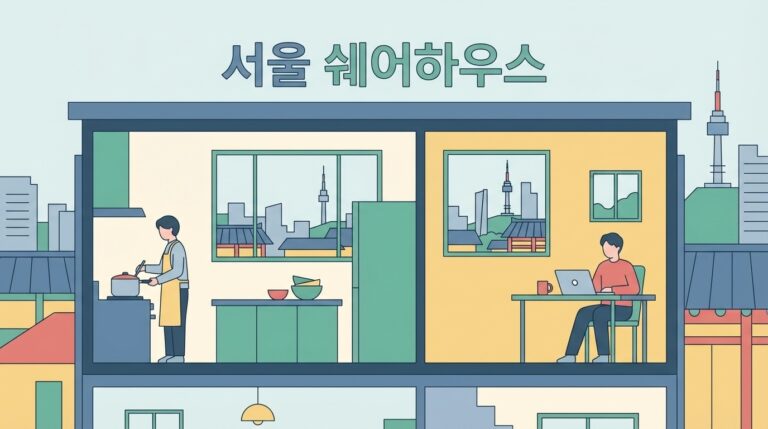
Imagine this: You are watching a K-Drama like Age of Youth (청춘시대) or Because This Is My First Life (이번 생은 처음이라). The protagonist stares blankly at their bank account, sighs at the astronomical Jeonse (전세, lump-sum deposit) prices in Seoul, and ends up dragging their suitcase into a beautifully decorated ‘Sharehouse’ (셰어하우스). They meet a quirky cast of housemates, share late-night beers on the rooftop, and suddenly, they are no longer alone in this massive city.
But wait—is that really what it’s like?
As someone who has navigated the wild urban jungle of Seoul for over a decade, I can tell you that the shift toward 1-person households (1인 가구) has completely transformed Korea’s urban planning and housing culture. Gone are the days when everyone lived in massive multi-generational family homes. Today, the modern Korean youth faces a dilemma: I want my privacy, but I also don’t want to be entirely alone… and I definitely can’t afford a $100,000 deposit right now.
Enter the sharehouse.
At a C2 (Advanced) level, you already know basic words like 집 (house) and 방 (room). Today, we are going to dive deep into the socio-economic vocabulary and the nuanced ‘Nunchi’ (눈치) culture that governs these modern shared spaces. Knowing these expressions won’t just help you rent a room—it will give you profound insight into the minds of modern young Koreans. Let’s get started!
Phase 2: Core Expressions Deep Dive
1. 따로 또 같이
- Pronunciation: ttaro tto gachi [ttaro tto ga-chi]
- Meaning: Separately but together.
- K-Culture Moment: This is the ultimate marketing slogan for every premium sharehouse in Seoul. It perfectly encapsulates the modern Korean millennial/Gen Z mindset. You want your own private sanctuary (따로), but you also want the comfort of knowing someone is in the living room if you want to share a delivery pizza (같이).
- Editor’s Insight: This isn’t just a housing term; it’s a lifestyle philosophy. Korea has historically been heavily collectivist. This phrase represents the transitional phase toward individualism, softening the blow of isolation.
- Situation Spectrum:
- Casual with friends: ✅
- Professional/Sociological discussions: ✅
- To a traditional elder (they might not understand the lifestyle appeal): ⚠️
- 🤔 Think About It: Why does Korean society need a phrase to justify living alone while maintaining community? How does this reflect the evolution of ‘Jeong’ (정 – the invisible bond between people)?
2. 눈칫밥(을) 먹다
- Pronunciation: nunchitbap(eul) meokda [noon-chit-bap meok-da]
- Meaning: Literal: “To eat Nunchi rice.” Real nuance: To feel uncomfortable or walk on eggshells because you are hyper-aware of others’ disapproval or boundaries.
- K-Culture Moment: You are in the shared kitchen of your sharehouse. It’s 1 AM. You want to boil ramen, but your housemate has an early interview tomorrow. You quietly open the cupboard, trying not to make a sound, feeling guilty. You are ‘eating nunchitbap’.
- Editor’s Insight: Nunchi is the Korean superpower of reading the room. Nunchitbap adds the element of survival and discomfort. When living in a sharehouse, respecting boundaries means you occasionally have to ‘eat nunchitbap’ instead of doing whatever you want.
- Situation Spectrum:
- Casual venting to a friend: ✅
- Semi-formal: ✅
- Formal complaints: ⚠️ (Can sound a bit informal/emotional)
- 🤔 Think About It: Does your language have a word for the specific discomfort of feeling like a burden in a shared space?
3. 자발적 아싸
- Pronunciation: jabaljeok assa [ja-bal-jeok ah-ssa]
- Meaning: Voluntary outsider (아싸 is short for 아웃사이더 / outsider).
- K-Culture Moment: A housemate declines the Friday night rooftop beer gathering. Not because they hate the housemates, but because their social battery is at 0%. They proudly declare themselves a ‘자발적 아싸’.
- Editor’s Insight: In the past, being an ‘outsider’ in Korea was a social death sentence. Now, as 1-person households surge, being a voluntary outsider is seen as a valid, even healthy, boundary-setting choice. It means “I enjoy my own company.”
- Situation Spectrum:
- Casual (Peers/Housemates): ✅
- Formal/Workplace: 🚫 (Too much slang for the boardroom)
Phase 3: Textbook vs Real Korean
Let’s see how the language of urban living has evolved from the textbook to the streets of Yeonnam-dong.
[Looking for a place]
* 📖 Textbook Korean: 룸메이트를 찾고 있습니다. 같이 살 사람 있나요? (I am looking for a roommate. Is there anyone to live with?)
* 🗣️ Real Korean: 셰어하우스 메이트 구함. (생활 패턴, MBTI 맞으시는 분 환영) (Looking for a sharehouse mate. Welcome those with matching lifestyle patterns and MBTI.)
* 💡 Why the difference?: Modern urbanites prioritize compatibility. ‘MBTI’ has become a legitimate metric for assessing housemate compatibility in Korea to avoid future conflicts!
[Explaining your living situation]
* 📖 Textbook Korean: 저는 원룸에 혼자 삽니다. 월세가 비쌉니다. (I live alone in a one-room. The monthly rent is expensive.)
* 🗣️ Real Korean: 숨만 쉬어도 돈이 나가서, 가성비 좋은 셰어하우스로 들어갔어요. (Money disappears just by breathing, so I moved into a cost-effective sharehouse.)
* 💡 Why the difference?: The phrase “숨만 쉬어도 돈이 나간다” (Money goes out just by breathing) perfectly captures the economic anxiety of the youth navigating Seoul’s brutal real estate market.
Phase 4: Cultural Context — K-Culture Deep Dive
K-Drama vs. The Reality of Shared Living
In K-Dramas, sharehouses are often depicted as magical places where beautiful people with diverse backgrounds accidentally fall in love (think Welcome to Waikiki or My First First Love). The living rooms are massive, the kitchens look like a Michelin-star restaurant, and there is always a perfectly timed acoustic guitar playing in the background.
The Critical Reality:
In reality, the rise of the sharehouse in Seoul is closely tied to Urban Planning and economic pressure. Seoul is dense. The Jeonse (lump-sum deposit) system requires tens, sometimes hundreds, of thousands of dollars just to secure a small studio (원룸). For young professionals and students (the MZ generation), a sharehouse isn’t just a quirky lifestyle choice; it is an economic necessity. It allows them to live in desirable, well-connected neighborhoods (like Hongdae, Gangnam, or Seongsu) without paying exorbitant deposits.
However, living together requires an intense level of Nunchi. Korean sharehouses often have strict, written ‘House Rules’ (하우스 룰) regarding cleaning duties, shower times, and inviting guests. The drama romance? Rare. The passive-aggressive Post-it note on the unwashed frying pan? Guaranteed.
Phase 5: Real-Life Roleplay Scenario
Setting: It is 8 PM on a Sunday. You live in a stylish sharehouse in Mangwon-dong. You are in the shared living room with Min-su (30, a graphic designer who has lived here for 2 years). You both just finished cleaning the house according to the weekend chore chart.
You: 민수 씨, 이번 주 거실 청소 끝났어요!
(Minsu ssi, ibeon ju geosil cheongso kkeunnasseoyo!)
[Min-su, I finished cleaning the living room for this week!]
(🎭 Stage Direction: You collapse onto the shared beanbag chair, exhausted.)
Min-su: 아, 고생했어요! 진짜 청소 당번 날은 늘 피곤하네요.
(Ah, gosaenghaesseoyo! Jinjja cheongso dangbeon nareun neul pigonhaeneyo.)
[Ah, great job! Cleaning duty days are always so tiring.]
You: 맞아요. 그래도 이렇게 다 같이 치우니까 금방 하네요.
(Majayo. Geuraedo ireoke da gachi chiunikka geumbang haneyo.)
[Right. Still, doing it all together makes it fast.]
Min-su: 그게 셰어하우스의 장점이죠. ‘따로 또 같이’의 매력이랄까? 앗, 벌써 8시네요. 저녁 안 드셨죠?
(Geuge syeo-hauseu-ui jangjeomijyo. ‘Ttaro tto gachi’-ui maeryeogiralkka? At, beolsseo yeodeol-ssineyo. Jeonyeok an deusyeotjyo?)
[That’s the perk of a sharehouse. The charm of ‘separately but together’, maybe? Oh, it’s already 8. You haven’t eaten dinner, right?]
You: 네, 배달 시킬까 고민 중이었어요.
(Ne, baedal sikilkka gomin jung-ieosseoyo.)
[Yeah, I was debating whether to order delivery.]
Min-su: 저도요. 혹시 치킨 어때요? 배달비도 비싼데 같이 시켜서 나눠 먹을래요?
(Jeodoyo. Hoksi chikin eottaeyo? Baedalbi-do bissande gachi sikyeoseo nanwo meogeullaeyo?)
[Me too. How about chicken? Delivery fees are expensive, want to order together and share?]
🔀 Your Turn! How do you respond to Min-su?
– A) “아, 저는 혼자 제 방에서 먹는 게 편해요. 따로 시킬게요.” (Ah, I’m comfortable eating alone in my room. I’ll order separately.)
– B) “오, 좋아요! 배달비 반띵(n빵) 하시죠! 제가 주문할게요.” (Oh, sounds good! Let’s split the delivery fee (n-bbang)! I’ll order.)
– C) “치킨이요? 저 다이어트 중이라 안 먹어요.”(Chicken? I’m on a diet so I don’t eat that.)✅ Best Choice: B — Why? It perfectly embodies the sharehouse spirit. Splitting the delivery fee (배달비 엔빵/반띵) is a highly practical and common bonding experience. It builds camaraderie without crossing personal boundaries.
⚠️ Choice A Analysis: While technically fine, saying it this bluntly lacks Nunchi and might come off as cold. If you must decline, it’s better to use a white lie or soften it: “아, 어쩌죠? 저 오늘 속이 좀 안 좋아서요.” (Ah, what should I do? My stomach isn’t feeling great today.)
Phase 6: 10-Second Shadowing Drill
Practice explaining why you chose a sharehouse like a true Seoulite!
😊 솔직히 / 혼자 살면 외롭고, / 😤 같이 살면 피곤하잖아요? / 😌 셰어하우스는 / 그 중간이라서 딱 좋아요.
(soljikhi / honja salmyeon oeropgo, / gachi salmyeon pigonhajana-yo? / syeo-hauseuneun / geu jung-gan-iraseo ttak joayo.)
[Honestly, living alone is lonely, and living together is exhausting, right? A sharehouse is right in the middle, so it’s perfect.]
Phase 7: K-Culture Mini Dictionary
| 한국어 | Romanization | English | Cultural Context |
|---|---|---|---|
| 1인 가구 | il-in gagu | 1-person household | Over 30% of Korea’s population now lives alone, reshaping the economy (solo dining, solo packaging). |
| 보증금 / 월세 | bojeunggeum / wolse | Security Deposit / Monthly Rent | The Korean rental system. High deposits are the #1 reason young people choose sharehouses. |
| N빵 (엔빵) | en-bbang | Splitting the bill | Dividing the cost equally by ‘N’ people. Essential for sharing delivery food or household goods. |
| 공용 공간 | gong-yong gong-gan | Shared/Common space | Living rooms, kitchens. The battleground for Nunchi in a sharehouse. |
| 개인 생활 존중 | gae-in saenghwal jonjung | Respecting personal life | The unspoken golden rule. Just because you live together doesn’t mean you are best friends. |
Phase 8: Traveler Survival Kit (Urban Nomad Edition)
Are you planning to live in Seoul for a few months as a digital nomad, student, or traveler? You might look into a ‘Goshiwon’ (고시원) or a short-term sharehouse.
🆘 Survival Phrases for Housing/Sharehouses
– 🇰🇷 “여기 최소 계약 기간이 어떻게 되나요?” (yeogi choeso gyeyak gigan-i eotteoke doenayo?)
– 🗣️ Meaning: What is the minimum contract period here?
– 📍 Where to use: Real estate apps, messaging a sharehouse manager.
– 💡 Pro Tip: Many premium sharehouses require a minimum stay of 6 months. Always ask upfront if you are a short-term traveler!📌 Editor’s Real Estate Note
– Useful Apps: Zigbang (직방), Dabang (다방), and Peter Pan’s Good Room Search (피터팬의 좋은방 구하기) are the holy trinity of Korean real estate hunting.
– Utility Bills (관리비): Always check if Gwallibi (maintenance fee/utilities) is included in the rent! Sharehouses usually split this by N-bbang.
Phase 9: Critical Thinking — “One Step Deeper”
Societal Shifts: The Redefinition of ‘Jeong’ (정) in the Global Era
🧠 Think Deeper:
Traditional Korean housing, the Hanok, and subsequent massive family apartments were built around communal living and deep-rooted Jeong (affection/attachment). However, as hyper-competitive urbanization created a surge in 1-person households, young Koreans began experiencing immense isolation. The sharehouse phenomenon is fascinating because it is an attempt to artificially recreate Jeong under contractual terms. It asks a profound sociological question: Can community be manufactured to cure urban loneliness, even if the primary motivation is purely economic (saving on rent)?💬 Your Turn: Does your culture have a rising trend of co-living spaces for young professionals? Is it driven by economics, or a desire for community? Let me know in the comments!
Phase 10: FAQ & Common Mistakes
Q: “If I live in a sharehouse, am I expected to cook for everyone?”
No! In fact, doing so without asking might cross a boundary. The modern Korean sharehouse strictly respects individual meals (혼밥). You only share if you explicitly agree beforehand.
Q: “Can I use formal language (존댓말) with my housemates forever?”
Yes. Even if you become friendly, many housemates maintain a polite distance by using ‘요’ form. It helps maintain mutual respect and prevents the relationship from becoming “too comfortable” (which can lead to neglecting chores!).
❌ Common Mistake: Confusing ‘룸메이트’ (Roommate) with ‘하우스메이트’ (Housemate).
✅ How to fix it: In Korea, a Roommate literally means someone you share a bedroom with (like in a university dorm). If you have your own room but share the living room and kitchen, they are your Housemate (하우스메이트) or Sharehouse mate (셰어하우스 메이트).
Phase 11: Summary & Action Items
One-Liner Summary: Modern Seoul’s sharehouse culture represents a delicate balance of economic survival and the desire for community, governed by the philosophy of ‘따로 또 같이’ (separately but together).
Action Mission 3 Steps:
– 🥉 Bronze (Solo): Read the 10-second shadowing phrase out loud, imagining you are explaining your lifestyle to a friend.
– 🥈 Silver (Online): Go to a Korean property app like Zigbang or search “서울 셰어하우스” on YouTube and look at how they advertise the ‘공용 공간’ (shared spaces).
– 🥇 Gold (Real Life): The next time you are with Korean friends and want to share an expense (like a taxi or food), confidently suggest, “우리 배달비 엔빵 할까요?” (Shall we split the delivery fee?).
K-Culture Mission: Watch an episode of Age of Youth (청춘시대) and pay close attention to the kitchen scenes. Watch how the characters use Nunchi when they interact!
Drop a comment below: Have you ever lived with housemates? What was your ultimate ‘Nunchi’ moment?
Phase 12: Interactive Challenge Quiz
1. Situational Judgment:
You come home late at 11 PM to your sharehouse. Your housemate left their unwashed dishes in the sink, which violates the “wash immediately” house rule. What is the most culturally nuanced (Nunchi-appropriate) way to handle this in a modern Korean sharehouse?
- A) Wash it for them and never mention it. (Sacrificing yourself)
- B) Send a polite text to the group chat: “민수 씨, 혹시 시간 나실 때 설거지 부탁드려도 될까요?” (Min-su, when you have time, could I ask you to do the dishes?)
- C) Yell their name and tell them to clean it.
💡 Click here for the Answer!
Answer: B. In modern sharehouses, direct but polite communication via text is preferred. A is too collectivist (and you’ll build resentment), and C breaks the harmony and respect of the house.
2. Fill in the Blank:
I want privacy, but I don’t want to be lonely. I love the concept of “[ _____ ] 또 같이” (Separately but together).
💡 Click here for the Answer!
Answer: 따로 (Ttaro).
Frequently Asked Questions (FAQ)
Q: What does "따로 또 같이" mean in Korean and how do you pronounce it?
A: In Korean, "따로 또 같이" is pronounced [ttaro tto gachi [ttaro tto ga-chi] and means: Separately but together.
Q: What does "눈칫밥(을) 먹다" mean in Korean and how do you pronounce it?
A: In Korean, "눈칫밥(을) 먹다" is pronounced [nunchitbap(eul] and means: Literal: "To eat Nunchi rice." Real nuance: To feel uncomfortable or walk on eggshells because you are hyper-aware of others' disapproval or boundaries.
Q: What does "자발적 아싸" mean in Korean and how do you pronounce it?
A: In Korean, "자발적 아싸" is pronounced [jabaljeok assa [ja-bal-jeok ah-ssa] and means: Voluntary outsider (아싸 is short for 아웃사이더 / outsider).







