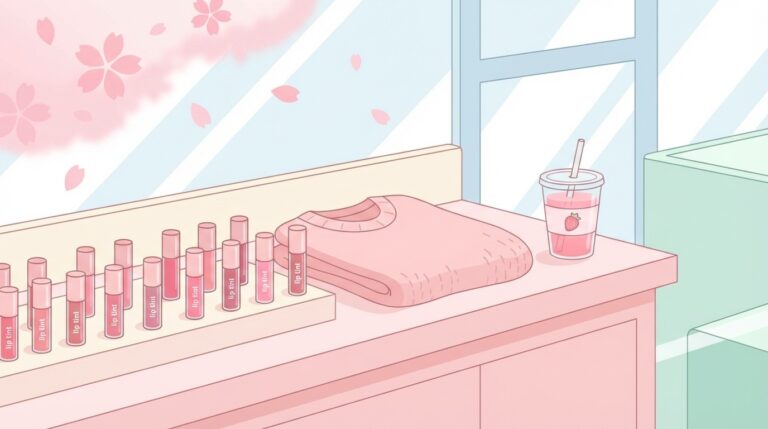
Phase 1: Empathy (Welcome to the Pink World of Korea!)\n\nHello! I’m your Daily Hangul Editor. Imagine this: It’s springtime in Seoul. You are walking down the streets of Hongdae, and suddenly, the whole world turns pink. Couples are wearing matching pink sweaters, cafes are selling ‘Cherry Blossom Lattes,’ and cosmetic shops like Olive Young are overflowing with hundreds of different pink lip tints.\n\nYou walk into a store, spot the perfect sweater, but it’s only displayed in black. You want to ask, ‘Do you have this in pink?’… but your mind goes blank. In your textbook, you learned the word for pink is ‘bunhongsaek’ (분홍색). But when you finally say it, the staff replies using a completely different word! \n\nWhy does this happen? Today, we are going to learn how to survive the ‘Pink Paradise’ of Korea. Whether you are shopping for K-Beauty items, ordering trendy cafe drinks, or waving a pink light stick at a BLACKPINK concert, this guide is all you need for your A1 Korean survival. Let’s dive in!\n\n—\n\nPhase 2: Core Expressions Deep Dive\n\n### 1. 분홍색 (Pink – The Standard Way)\n\n* Pronunciation: bun-hong-saek [bun like a hamburger ‘bun’, hong like ‘Hong Kong’, saek sounds like ‘sack’ but softer]\n* Meaning: Pink color (Literal & Standard)\n* K-Culture Moment: You will hear this word in traditional settings, educational materials, or when buying traditional Hanbok. It’s a pure, beautiful Korean word.\n* Editor’s Insight: This is the ‘proper’ way to say pink. If you use it, Koreans will be impressed that you studied your vocabulary well! However, in trendy fashion or makeup stores, it might sound just a tiny bit formal.\n* Situation Spectrum:\n * Casual (Friends): ✅\n * Semi-formal (Clerks, colleagues): ✅\n * Formal (Elders, bosses): ✅\n* 🤔 Think About It: Notice the ‘색’ (saek) at the end? In Korean, ‘saek’ means ‘color’. We often attach it to the end of color names to be clear. Does your native language have a separate word for ‘color’ that you must attach to the color name?\n\n### 2. 핑크 / 핑크색 (Pink – The Trendy Konglish)\n\n* Pronunciation: ping-keu / ping-keu-saek [ping-koo (but with relaxed lips) sack]\n* Meaning: Pink (Trendy, everyday use)\n* K-Culture Moment: K-Pop fans shouting ‘BLACKPINK in your area!’, or makeup YouTubers reviewing ‘cool-tone pink’ blushes. If you order a ‘Pink Chamomile Relaxer’ at Starbucks Korea, you use this word.\n* Editor’s Insight: Welcome to ‘Konglish’ (Korean + English)! In the fashion, beauty, and cafe industries, Koreans love using the English word ‘pink’ because it sounds modern and trendy. \n* Situation Spectrum:\n * Casual (Friends): ✅\n * Semi-formal (Shopping, cafes): ✅\n * Formal (Elders, bosses): ⚠️ (Better to use 분홍색 with traditional elders)\n\n### 3. ~색 있어요? (Do you have it in ~ color?)\n\n* Pronunciation: ~saek is-seo-yo? [ee-ssuh-yo]\n* Meaning: Do you have [color]?\n* K-Culture Moment: The magical survival phrase in any underground shopping mall in Gangnam or Myeongdong.\n* Editor’s Insight: ‘있어요?’ literally means ‘Does it exist?’ or ‘Do you have?’. It is the most powerful verb you will learn at the A1 level. Just put the color in front of it, and you’re shopping like a local!\n\n—\n\nPhase 3: Textbook vs. Real Korean\n\n[Shopping for a Pink Lip Tint]\n* 📖 Textbook Korean: 이것은 분홍색입니까? (Is this the pink color?)\n* 🗣️ Real Korean: 이거 핑크색 있어요? (Do you have this in pink?)\n* 💡 Why the difference?: Koreans prefer practical, action-oriented questions when shopping. Instead of asking ‘what color is this?’, they jump straight to ‘Do you have the color I want?’ using the trendy Konglish word.\n\n[Expressing Your Favorite Color]\n* 📖 Textbook Korean: 나의 제일 좋아하는 색깔은 분홍색입니다. (My most favorite color is pink.)\n* 🗣️ Real Korean: 저 핑크 완전 좋아해요! (I totally love pink!)\n* 💡 Why the difference?: Real conversation drops unnecessary subjects (‘My’) and uses strong, emotional adverbs like ‘완전’ (totally/completely) to show enthusiasm.\n\n—\n\nPhase 4: Cultural Context — K-Culture Deep Dive\n\n#### 4-1. Non-verbal Communication\nWhen you ask for a pink item (‘이거 핑크색 있어요?’), gesture toward the item with an open hand, palm facing up. Pointing with a single index finger can sometimes be seen as rude in Korea. A subtle ‘Nunchi’ (social sense) tip: Wait until the clerk makes eye contact with you before asking!\n\n#### 4-2. K-Food Connection: The ‘Rosé’ Craze\nDid you know that pink has taken over Korean street food? Over the last few years, ‘Rosé’ (로제 – ro-je) has become a massive K-Food trend. But it’s not wine! In Korea, ‘Rosé’ refers to a pink-ish sauce made by mixing spicy Gochujang (red pepper paste) or Tteokbokki sauce with heavy cream or milk. \n\nIf you go to a restaurant and order ‘로제 떡볶이’ (Rosé Tteokbokki), you will get a creamy, spicy, pink-colored dish that is absolutely addictive. It shows how Koreans love to blend intense traditional flavors with soft, creamy modern ingredients to create something entirely new.\n\n—\n\nPhase 5: Real-Life Roleplay Scenario\n\nSetting: Friday afternoon, 3 PM. You are inside a bright, buzzing Olive Young store in Myeongdong. K-Pop is playing in the background. You are looking for a gift for your friend who loves K-Beauty.\n\nCharacters:\n* YOU: A traveler on their 3rd day in Korea, determined to buy makeup using Korean.\n* Ji-eun: (25) Friendly Olive Young staff member, holding a little basket.\n\nDialogue:\n\nJi-eun: 찾으시는 거 있으세요? 😊\n(cha-jeu-si-neun geo is-seu-se-yo?)\n[Are you looking for anything?]\n\nYOU: 아, 네. 립 틴트 찾아요.\n(A, ne. lip tin-teu cha-ja-yo.)\n[Ah, yes. I’m looking for a lip tint.]\n\nJi-eun: 이쪽으로 오세요. 베스트셀러는 이거예요.\n(I-jjog-eu-ro o-se-yo. be-seu-teu-sel-leo-neun i-geo-ye-yo.)\n[Come this way. This is our best seller.]\n(🎭 Stage Direction: Ji-eun points to a bright red tint)\n\nYOU: 음… 이거 핑크색 있어요? \n(Eum… i-geo ping-keu-saek is-seo-yo?)\n[Hmm… Do you have this in pink?]\n\nJi-eun: 네! 연한 핑크, 진한 핑크 다 있어요. 어떤 거 드릴까요?\n(Ne! yeon-han ping-keu, jin-han ping-keu da is-seo-yo. eo-tteon geo deu-ril-kka-yo?)\n[Yes! We have light pink and dark pink. Which one should I give you?]\n\n> 🔀 Your Turn! How will you respond?\n> * A) 연한 핑크 주세요. (Light pink, please.)\n> * B) 이거 분홍색입니까? (Is this pink?)\n> * C) 몰라요. (I don’t know.)\n>\n> ✅ Best Choice: A — ‘주세요’ (ju-se-yo / please give me) is the perfect polite ending for shopping. \n> ⚠️ Choice B Analysis: You are reverting to textbook grammar when the clerk already offered you the pink one!\n> 🚫 Choice C Analysis: ‘몰라요’ (I don’t know) can sound a bit blunt or dismissive to a shop clerk. If you want to see both, you can just point and say ‘이거요’ (This one).\n\nJi-eun: 네, 여기 있습니다!\n(Ne, yeo-gi it-seum-ni-da!)\n[Yes, here you go!]\n\nYOU: 감사합니다!\n(Gam-sa-ham-ni-da!)\n[Thank you!]\n\n—\n\nPhase 6: 10-Second Shadowing Drill\n\nLet’s practice speaking like a local! Focus on the rhythm and emotion.\n\n* 🥺 Asking a clerk: 저기요, / 이거 / 핑~크색 / 있어요? \n(jeo-gi-yo, / i-geo / ping~keu-saek / is-seo-yo?)\n[Excuse me, do you have this in pink?]\n\n* 😊 Expressing preference: 저는 / 분홍색을 / 정~말 / 좋아해요! \n(jeo-neun / bun-hong-saek-eul / jeong~mal / jo-a-hae-yo!)\n[I reeeally like pink!]\n\n—\n\nPhase 7: K-Culture Mini Dictionary\n\n| Korean | Romanization | English | Context & Culture |\n|—|—|—|—|\n| 분홍색 | bunhongsaek | Pink | The standard, pure Korean word for pink. |\n| 핑크 | pingkeu | Pink | Trendy Konglish, mainly used in beauty, fashion, and food. |\n| 벚꽃 | beotkkot | Cherry blossom | The symbol of Korean spring. Famous places: Yeouido, Jinhae. |\n| 쿨톤 / 웜톤 | kulton / womton | Cool-tone / Warm-tone | Personal color terms. Crucial for buying K-Beauty cosmetics! |\n| 로제 | roje | Rosé (sauce) | A popular creamy, spicy sauce used in Tteokbokki and pasta. |\n\n—\n\nPhase 8: Traveler Survival Kit\n\nAre you heading to Korea? If you love pink clothes, cafes, or makeup, save these phrases!\n\n> 🆘 Survival Expressions\n> * 🇰🇷 ‘이거 핑크색 주세요.’ (i-geo ping-keu-saek ju-se-yo.)\n> * 🗣️ English meaning: Please give me this in pink.\n> * 📍 Where to use: Olive Young, clothing stores, souvenir shops.\n> * 💡 Pro Tip: If you want to buy clothes in Korea, know that many trendy shops in places like Hongdae sell ‘Free Size’ (프리 사이즈), which is basically ‘One Size Fits Most’. Always check if the ‘pink’ version has your preferred fit!\n\n> 📌 Editor’s Travel Note\n> * App Recommendation: Use Papago (파파고) for translation. It’s much better than Google Translate for Korean!\n> * Payment: Korea is a card heaven. Even for a $3 pink lip balm, you can tap your card.\n\n—\n\nPhase 9: Critical Thinking — ‘One Step Deeper’\n\nKorean in the Global Era (Konglish & Identity)\n\nHave you wondered why young Koreans use the English word ‘핑크’ (pingkeu) so often when they already have the beautiful native word ‘분홍’ (bunhong)? As K-Beauty and K-Fashion expanded globally, using English loanwords became a way to sound ‘sophisticated’ and ‘modern’ in marketing. It shows how dynamic the Korean language is—constantly adapting and absorbing global influences. However, some traditionalists worry that pure Korean words are slowly fading away in everyday commerce. \n\n🧠 Think Deeper:\nDoes your language borrow words from English for marketing purposes? Do you think it makes a language richer, or does it harm its original identity?\n\n💬 Your Turn: How do you say ‘pink’ in your language? Share it in the comments below!\n\n—\n\nPhase 10: FAQ & Avoiding Mistakes\n\nQ: Can I call an older person and say ‘할머니, 핑크색 치마 예뻐요’ (Grandma, the pink skirt is pretty)?\nA: You can, but it’s much more polite and natural to use the traditional word with elders: ‘할머니, 분홍색 치마 예뻐요.’\n\nQ: If I want to order a pink drink, do I say ‘분홍색 라떼 주세요’?\nA: Actually, menus usually use the ingredient name (like ‘딸기’ – Strawberry, or ‘체리’ – Cherry) or the English word (‘핑크 카모마일’ – Pink Chamomile). But if you are pointing at a picture, you can just say ‘이거 주세요’ (This one, please).\n\n> ❌ Common Mistake #1: Forgetting the word ‘색’ (saek).\n> Learners often say: ‘이것은 분홍 입니다’ (This is bun-hong).\n> ✅ Do this instead: Always attach ‘색’ to colors when talking about objects: ‘이것은 분홍색 입니다’ (This is bun-hong-saek).\n\n—\n\nPhase 11: Summary & Action Items\n\n* One-Liner Summary: To survive the trendy Pink Paradise of Korea, use ‘분홍색’ (bunhongsaek) for tradition and ‘핑크’ (pingkeu) for shopping, and always remember ‘있어요?’ (Do you have)!\n\nYour Action Missions for Today:\n* 🥉 Bronze (Solo): Look around your room. Point to three pink items and say ‘분홍색’ or ‘핑크색’ out loud.\n* 🥈 Silver (Online): Go to your favorite K-Pop idol’s Instagram or YouTube video. If they are wearing pink, leave a comment: ‘핑크색 완전 예뻐요!’ (Pink is totally pretty!)\n* 🥇 Gold (Real Life): Next time you visit a Korean cosmetic store or restaurant, ask the staff: ‘이거 핑크색 있어요?’\n\n—\n\nPhase 12: Quiz — Interactive Challenge\n\n1. You are at a trendy cafe in Seoul and want to ask if they have a pink-colored tumbler on display. What is the most natural thing to say?\nA) 이것은 핑크색입니까?\nB) 핑크색 있어요?\nC) 로제 떡볶이 주세요.\n\n2. Fill in the blank: The standard Korean word for pink is __________.\nA) 벚꽃 (beotkkot)\nB) 분홍색 (bunhongsaek)\nC) 빨간색 (ppalgansaek)\n\n3. True or False: In Korea, ‘Rosé’ (로제) only refers to pink wine.\n(T/F)\n\nScroll down for answers!\n.\n.\n.\nAnswers: 1. B (It’s the most natural, real-life shopping phrase), 2. B, 3. False (It heavily refers to the popular creamy-spicy pink sauce in K-Food!)
 TOPIK 1
· 9 min read
How to Say Pink in Korean: Master K-Beauty Shopping in 1 Minute