

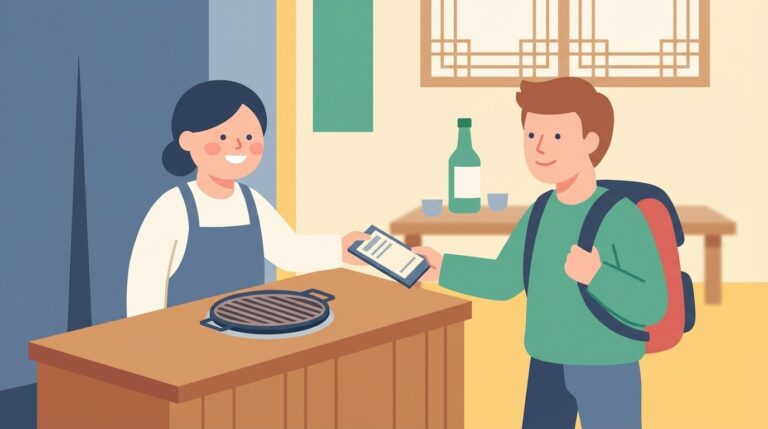
Phase 1: Empathy & Immersion
Hello! I’m the Senior Editor at Daily Hangul.
Picture this: You are watching a classic K-Drama. The main characters have just finished eating at a lively Korean BBQ place. Suddenly, they both jump up, grabbing the little piece of paper on the table, yelling at each other, “No, I’m paying! Put your wallet away!”
Have you ever wondered what exactly they are saying to the cashier? Or maybe you’ve actually been to a Korean restaurant, finished your delicious Bibimbap, and sat there for 20 minutes waiting for the waiter to bring the check… but no one came. You felt ignored, right?
Trust me, you weren’t ignored! Asking for the bill and paying in Korea is a completely different game from the West. As a veteran tutor who has seen countless students wait endlessly at their tables, I’m here to save you from that awkward silence.
Today, we are going to learn exactly how to handle the bill like a true Korean local. Let’s dive in!
Phase 2: Core Expressions Deep Dive
Here are the absolute must-know phrases when it’s time to pay.
1. 계산해 주세요.
- Pronunciation: [Gye-san-hae ju-se-yo] + Sounds like: Gyeh-san-hey joo-seh-yo.
- Meaning: Literal: “Please calculate.” / Real nuance: “Bill, please.” or “I’d like to pay.”
- K-Culture Moment: You’ll hear this at the front counter of almost any restaurant. The customer walks up with their coat on, hands over their credit card, and says this casually.
- Editor’s Insight: This is your magic phrase. It’s polite, clear, and works 100% of the time. Think of it as the “Check, please” of Korea.
- Situation Spectrum:
- Casual (Friends): ✅ (Usually shortened to “계산할게”)
- Semi-formal (Staff/Colleagues): ✅
- Formal (Elders/Boss): ✅
- 🤔 Think About It: Why “calculate” instead of “bill”? In the past, Korean restaurant owners used an abacus or calculator right in front of you to add up the dishes. The phrase stuck!
2. 따로 계산해 주세요.
- Pronunciation: [Tta-ro gye-san-hae ju-se-yo] + Sounds like: Dda-roh (rolling ‘r’) gyeh-san-hey joo-seh-yo.
- Meaning: Literal: “Please calculate separately.” / Real nuance: “We’d like to split the bill.”
- K-Culture Moment: University students or young office workers often use this at cafes or casual eateries so everyone pays exactly for what they ate.
- Editor’s Insight: Splitting the bill is becoming much more common among the younger generation in Korea. However, saying this at a fancy group dinner with older folks might raise an eyebrow!
- Situation Spectrum:
- Casual (Friends): ✅
- Semi-formal (Colleagues): ✅
- Formal (Elders/Boss): 🚫 (Usually, the oldest or highest-ranking person pays the whole thing!)
- 🤔 Think About It: In many Western countries, the waiter asks “Together or separate?” In Korea, the default is always together unless you specifically ask. Why do you think that is?
3. 영수증 주세요.
- Pronunciation: [Yeong-su-jeung ju-se-yo] + Sounds like: Young-soo-jung joo-seh-yo.
- Meaning: “Please give me the receipt.”
- K-Culture Moment: Often, cashiers will ask you first: “영수증 드릴까요?” (Shall I give you the receipt?). You can reply with this phrase or simply say “네” (Yes) or “아니요, 괜찮아요” (No, it’s okay).
- Editor’s Insight: Koreans are very eco-friendly and fast-paced, so many people decline the paper receipt. But if you are traveling and tracking expenses, use this!
- Situation Spectrum:
- Casual: 🚫 (You don’t say this to friends)
- Semi-formal (To staff): ✅
- Formal: ✅
Phase 3: Textbook vs. Real Korean
[Situation 1: Asking for the check at the table]
* 📖 Textbook Korean: “계산서를 가져다 주시겠어요?” (Could you bring the bill, please?)
* 🗣️ Real Korean: (Standing up, grabbing the small paper slip on the table, and walking to the counter) “계산이요!” (Paying!)
* 💡 Why the difference?: Pali-pali (hurry-hurry) culture! Koreans don’t wait for the waiter to bring the card machine to the table. You bring your table’s “Billji” (the paper slip) straight to the register. It saves time for everyone!
[Situation 2: Telling a friend you will pay]
* 📖 Textbook Korean: “이번 식사는 제가 지불하겠습니다.” (I will pay for this meal.)
* 🗣️ Real Korean: “내가 쏠게!” (I’ll shoot/treat!) or “내가 낼게!” (I’ll pay!)
* 💡 Why the difference?: “쏘다” (to shoot) is a fun slang that implies treating someone like you are firing an arrow of generosity. It’s highly used among friends and in K-Dramas.
Phase 4: Cultural Context — K-Culture Deep Dive
4-1. Non-Verbal Elements
When handing over your credit card or cash to the cashier, use two hands (or support your right elbow with your left hand). This is a basic sign of respect in Korea. Also, read the room (Nunchi): if there is a long line behind you, don’t take forever to split a tiny bill.
4-2. The K-Drama Connection: The “Jeong” (정) Battle
You’ve definitely seen this in K-Dramas: Two characters literally wrestling at the cash register, both shoving their credit cards at the poor cashier.
“내가 낼게!” (I’ll pay!)
“아니야, 내가 쏠게!” (No, I’ll treat!)
This isn’t just for TV; it happens in real life! In Korean culture, paying for a meal is a strong expression of Jeong (정 – affection/connection). Treating someone means “I care about you, and I want to share my wealth with you.” If an older Korean friend or colleague insists on paying, refusing too much might actually hurt their feelings. Just say, “감사합니다! 잘 먹었습니다!” (Thank you! I ate well!) and offer to buy the coffee afterward!
Phase 5: Interactive Roleplay Scenario
Setting: It’s Friday at 7 PM. You are at a bustling, smoke-filled Samgyeopsal (pork belly) restaurant in Gangnam. Soju bottles are on the table. You’ve just finished a fantastic meal with your Korean friend, Minsu.
Characters:
– YOU: A foreigner visiting Korea for a month, learning the language.
– Minsu (30): Your friendly and energetic Korean friend.
Dialogue:
Minsu: 와, 진짜 배부르다. 가자! (Wa, jinjja baebureuda. Gaja!)
[Wow, I’m so full. Let’s go!]
(🎭 Stage Direction: Minsu grabs his coat and heads straight to the counter. He takes out his wallet.)
YOU: 민수 씨, 내가 낼게요. (Minsu ssi, naega naelgeyo.)
[Minsu, I’ll pay.]
Minsu: 에이, 아니야. 한국에 왔으니까 내가 쏠게! (Ei, aniya. Hanguge wasseunikka naega ssolge!)
[Hey, no way. Since you came to Korea, I’ll treat!]
🔀 Your Turn! How should you respond?
– A) “아니에요. 우리 따로 계산해요.” (No. Let’s split the bill.)
– B) “진짜요? 그럼 잘 먹겠습니다! 제가 커피 살게요!” (Really? Then I’ll eat well! I’ll buy the coffee!)
– C) “알았어. 고마워.” (Got it. Thanks.)✅ Best Choice: B — In Korea, it’s polite to accept a treat after a light refusal, and offering to buy dessert or coffee (2차 – the second round) shows great manners and understanding of Korean social flow!
⚠️ Choice A Analysis: While splitting the bill is fine, if a host insists on treating as a welcoming gesture, forcing a split can kill the warm mood.
(Back to the cashier)
Cashier: 45,000원입니다. 영수증 드릴까요? (Samanocheon-wonimnida. Yeongsujeung deurilkkayo?)
[That’s 45,000 won. Would you like a receipt?]
Minsu: 아니요, 버려주세요. (Aniyo, beoryeojuseyo.)
[No, please throw it away.]
Phase 6: 10-Second Shadowing Drill
Let’s practice! Speak out loud focusing on the pauses (/) and the emotion tags.
😊 카드로 / 계산할게요. (kadeuro / gyesanhalgeyo)
[I will pay by card.]
🙏 영수증은 / 버려주세요. (yeongsujeungeun / beoryeojuseyo)
[Please throw away the receipt.]
😤 (Playfully arguing with a friend) 오늘 / 내가 쏠게! (oneul / naega ssolge!)
[I’m treating today!]
Phase 7: K-Culture Mini Dictionary
| Korean | Romanization | English | Cultural Context |
|---|---|---|---|
| 빌지 | bil-ji | Bill pad | The small clipboard left at your table. Bring this to the counter to pay! |
| 쏘다 | sso-da | To treat | Slang for “buying the meal for everyone.” Literal meaning: to shoot. |
| 엔빵 | en-ppang | Splitting the bill evenly | N refers to the number of people. Very common among Gen Z. |
| 더치페이 | deo-chi-pe-i | Dutch pay | The Konglish word for going Dutch (paying for exactly what you ordered). |
| 2차 | i-cha | 2nd round | Usually a cafe or a pub after dinner. If someone buys dinner, someone else buys 2차! |
Phase 8: Traveler’s Survival Kit
Since asking for the bill usually means you are out exploring the amazing Korean food scene, here are your absolute survival tips.
🆘 Survival Phrases Top 3
1. 🇰🇷 “이거 얼마예요?” (Igeo eolmayeyo?) – “How much is this?”
2. 🇰🇷 “카드 되나요?” (Kadeu doenayo?) – “Do you take credit cards?”
3. 🇰🇷 “포장해 주세요.” (Pojang-hae juseyo.) – “Please pack it to go. / Takeout please.”📌 Editor’s Travel Note
– No Tipping! There is absolutely NO tipping culture in Korea. If you leave cash on the table, the waiter might literally chase you down the street thinking you forgot your money!
– Card is King: 99% of places in Korea accept credit cards (Visa/Mastercard). Even for a $1 coffee. However, small street food stalls (like in Myeongdong or Gwangjang Market) might prefer cash or bank transfers.
– Pay at the door: Remember, don’t wait at the table. Walk to the exit/counter to pay.
Phase 9: Critical Thinking Corner — “One Step Deeper”
Food & Identity: Why Do Koreans Fight to Pay?
🧠 Think Deeper:
In many Western cultures, independence and fairness are highly valued, making splitting the bill (going Dutch) the logical and polite thing to do. However, Korea has historically been an agricultural society that values “We” (우리 – Woori) over “I”. Sharing a meal from the same pot and paying for the entire group are ways of cementing this group identity and showing affection (Jeong). Paying for someone isn’t just about money; it’s a social investment saying, “We are close, and we will see each other again.”💬 Your Turn: How does your culture handle the bill at a group dinner? Do people secretly pay the waiter, or is out out-in-the-open math time? Share in the comments!
Phase 10: FAQ & Mistake Prevention
Q: Is it rude to ask to split the bill in Korea?
No, it’s not rude, especially among young people. Just say “따로 계산해 주세요” before handing over your cards. Pro tip: Hand all the cards to the cashier at once.
Q: I saw a tip jar at a cafe in Seoul. Should I tip?
A few trendy places in tourist areas have tried introducing tip jars recently, but it has actually caused a huge backlash among Koreans. You do not need to tip. Excellent service is included in the price!
❌ Common Mistake #1: Waiting at the table for the check.
✅ Do this instead: Pick up your belongings, grab the bill slip, and walk to the front counter. If there’s no slip, just go to the counter and tell them your table number.❌ Common Mistake #2: Handing your card with one hand while looking at your phone.
✅ Do this instead: Hand the card with two hands, or use your right hand while your left hand lightly supports your right arm.
Phase 11: Summary & Action Items
One-Liner Summary: Don’t wait at the table—grab your bill slip, walk to the counter, and confidently say “계산해 주세요!” (Gye-san-hae ju-se-yo).
Action Mission:
– 🥉 Bronze (Solo): Say “계산해 주세요” out loud 3 times while pretending to hand over a credit card.
– 🥈 Silver (Online): Comment below with what you would do if a Korean friend yelled “내가 쏠게!”
– 🥇 Gold (Real Life): Next time you visit a Korean restaurant, stand up, take the bill to the counter, and use your new Korean phrase!
K-Culture Mission: Watch any episode of a K-Drama today. I guarantee you will see a restaurant scene. Pay close attention to who pays and how they walk to the counter!
Phase 12: Quiz — Interactive Challenge
1. Situational Judgment: You are at a restaurant with an older Korean manager who just bought you a nice Korean BBQ dinner. They paid the whole bill. What is the BEST reaction?
– A) Insist on giving them cash for your half.
– B) Say “감사합니다! 2차 커피는 제가 살게요!” (Thank you! I’ll buy the round 2 coffee!)
– C) Say “영수증 주세요” (Give me the receipt).
2. True or False – K-Culture Edition:
– If the service was truly amazing in a Korean restaurant, leaving a 10% tip on the table is a polite way to say thank you. (True / False)
3. Fill in the Blank:
You want to treat your friends to fried chicken. You can confidently say: “오늘 치킨은 내가 ______!” (Today, I will treat the chicken!)
– A) 쏠게 (ssolge)
– B) 따로 계산할게 (ttaro gyesanhalge)
Click here for the Answers!
1. B – Offering to buy the coffee is the golden standard of Korean dining etiquette!
2. False – Never leave money on the table. They will think you forgot your change!
3. A – “쏠게” means to treat someone!
Frequently Asked Questions (FAQ)
Q: What does "계산해 주세요." mean in Korean and how do you pronounce it?
A: In Korean, "계산해 주세요." is pronounced [Gye-san-hae ju-se-yo] and means: Literal: "Please calculate." / Real nuance: "Bill, please." or "I'd like to pay."
Q: What does "따로 계산해 주세요." mean in Korean and how do you pronounce it?
A: In Korean, "따로 계산해 주세요." is pronounced [Tta-ro gye-san-hae ju-se-yo] and means: Literal: "Please calculate separately." / Real nuance: "We'd like to split the bill."
Q: What does "영수증 주세요." mean in Korean and how do you pronounce it?
A: In Korean, "영수증 주세요." is pronounced [Yeong-su-jeung ju-se-yo] and means: "Please give me the receipt."







