

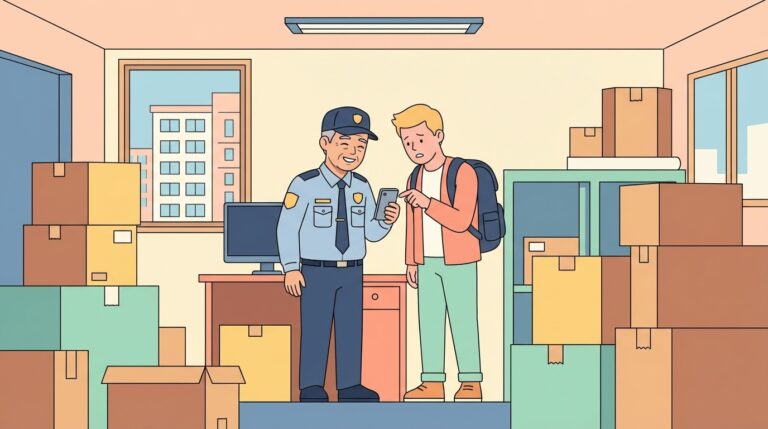
Phase 1: The “Pali-Pali” Panic 📦
Hello! I’m your Daily Hangul Editor.
Imagine this: You’re sitting in your room in Seoul. Your phone buzzes with a familiar, exciting notification: [Coupang] Delivery Complete! Your package has been left at the front door. You practically run to the door, swing it open, and… nothing. Empty hallway. Just your neighbor’s slightly sad-looking umbrella.
Panic sets in. Was it stolen? Did they deliver it to Room 302 instead of 203? Is your limited-edition K-Pop merch gone forever?
In Korea, where the delivery system is lightning fast and generally incredibly safe, a missing package usually means one of two things: it was misdelivered, or it was left at the 경비실 (Gyeongbisil – Security Office).
To solve this, you need to venture down to the security office. But walking up to the Kyungbi ajeossi (security guard) and suddenly speaking Korean can be intimidating. If you use the wrong nuance, you might sound like you’re accusing him. If you learn these phrases, however, he’ll likely turn into a friendly neighborhood grandpa who will move mountains of boxes to help you find yours. Let’s get that package back!
Phase 2: Core Expressions Deep Dive
Here are the “golden keys” to unlocking the security office mystery.
1. 배송 완료라고 뜨는데, 물건이 없어서요.
- Pronunciation: baesong wallyorago tteunde, mulgeoni eopseoseoyo. [bae-song wal-lyo-ra-go tteu-neun-de / mul-geo-ni op-suh-suh-yo]
(Tip: ‘eu’ in ‘tteu’ sounds like the disgusted sound you make when stepping in gum)- Meaning: (Literal) It pops up as delivery complete, but there is no item, so… (Real nuance) My tracking says delivered, but it’s not at my door.
- K-Culture Moment: You show your phone screen to the guard. You aren’t saying “Where is it?!” You are simply stating a mysterious fact. “The app says this… but reality is this.”
- Editor’s Insight: The magic is in ~서요 (~seoyo). In Korean, ending a sentence with “because…” implies “…so I need your help” without explicitly demanding it. It’s the ultimate polite cushion.
- Situation Spectrum:
- Friends (Casual): 🚫 (Too formal)
- Store clerks/Guards (Semi-formal/Formal): ✅
- 🤔 Think About It: Why do Koreans often end sentences with “~서요” (because) instead of a direct request? How does this soften the conversation in your native language?
2. 혹시 여기 맡겨진 택배 있나요?
- Pronunciation: hoksi yeogi matgyeojin taekbae innayo? [hok-shi yuh-gi mat-gyuh-jin tek-bae in-na-yo?]
- Meaning: (Literal) By any chance, is there an entrusted parcel here? (Real nuance) Did the delivery guy leave my package here by mistake?
- K-Culture Moment: You peek your head into the security office window. You start with “혹시” (hok-shi – by any chance). This word instantly lowers the guard’s defenses.
- Editor’s Insight: Using “맡겨진” (entrusted/left behind) removes the blame. You aren’t saying “Did you take it?” You are asking if the universe (or the Coupang driver) left it in his care.
- Situation Spectrum:
- Strangers/Guards (Formal): ✅
- Coworkers (Semi-formal): ⚠️ (A bit too specific for office mail)
- 🤔 Think About It: “혹시” is used constantly when asking for favors. Is there a “buffer word” like this in your culture that makes questions sound less aggressive?
3. 분실된 것 같은데, 어떻게 해야 하나요?
- Pronunciation: bunsildoen geot gateunde, eotteoke haeya hanayo? [bun-shil-dwen guk ga-teun-de, uh-ttuh-ke hae-ya ha-na-yo?]
- Meaning: (Literal) It seems like it became lost, how should I do? (Real nuance) I think it’s lost, what should I do now?
- K-Culture Moment: The guard has checked everywhere. You’ve checked the stairs. It’s gone. You look at him with puppy-dog eyes, asking for his wisdom.
- Editor’s Insight: Notice it’s “~것 같은데” (it seems like). Koreans rarely say “It IS lost” immediately. Leaving room for doubt is a key part of polite Korean communication, preserving harmony just in case it turns up!
- Situation Spectrum:
- Any formal/semi-formal problem-solving situation: ✅
Phase 3: Textbook vs. Real Korean
Let’s see how native speakers actually talk when a package is MIA.
[Explaining the missing package]
* 📖 Textbook Korean: 제 택배가 없어졌습니다. (My parcel has disappeared.)
* 🗣️ Real Korean: 택배가 안 와서요. / 배송됐다고 하는데 안 보여서요. (The parcel hasn’t come. / It says delivered but I can’t see it.)
* 💡 Why the difference?: The textbook sounds like a police report. Real Korean states the situation indirectly, focusing on the evidence (it says delivered) rather than the crime (it disappeared).
[Asking them to check]
* 📖 Textbook Korean: 제 택배를 찾아 주십시오. (Please find my parcel.)
* 🗣️ Real Korean: 혹시 여기 있을까요? / 한번 확인해 주실 수 있나요? (By any chance, would it be here? / Could you check for me?)
* 💡 Why the difference?: Directly commanding an older person (like a security guard) is a big no-no in Korea. Formulating it as a soft question shows respect.
Phase 4: Cultural Context — K-Culture Deep Dive
4-1. Non-verbal Cue: The Art of the “Slight Bow”
When you approach the security office window (which is usually a tiny sliding glass window), don’t just stand tall and yell. Bend your knees slightly or lean in, make eye contact, and give a small head bow while saying “안녕하세요 (Hello).” This shows you respect his space. Also, always have your tracking number (송장 번호) and address ready on your phone screen to show him!
4-2. K-Culture Connection: The “Kyungbi Ajeossi” (경비 아저씨)
If you watch K-Dramas set in apartment complexes, you’ve seen the Kyungbi ajeossi. He’s the older gentleman in a uniform who seems to know everything about everyone. He sorts recycling, manages parking, and, crucially, receives mountains of packages.
In Korea’s hyper-fast delivery culture, drivers often leave packages at the security office if you aren’t home or if the building’s main door is locked. The guard isn’t just a security monitor; he’s the gatekeeper of your online shopping. Treating him with respect (using polite Korean and a warm tone) means he’ll likely keep a special eye out for your deliveries in the future. Sometimes, a simple “수고하십니다! (Thank you for your hard work!)” along with a cold canned coffee can make you his favorite resident.
Phase 5: Real-Life Roleplay Scenario
Setting: Tuesday, 7:30 PM. The tiny, brightly lit security office at the entrance of your Officetel in Hongdae. It’s overflowing with Coupang Fresh bags and cardboard boxes.
Characters:
– YOU: A foreign resident who just got off work. You’ve been waiting for a new winter coat.
– Ajeossi (Guard): A 60-something man with reading glasses, currently organizing a stack of boxes.
Dialogue:
YOU: 안녕하세요, 수고 많으십니다! 😊
(annyeonghaseyo, sugo maneusimnida!)
[Hello, thank you for your hard work!]
(🎭 Stage Direction: You bow slightly at the sliding window.)
Ajeossi: 네, 안녕하세요. 무슨 일이에요?
(ne, annyeonghaseyo. museun irieyo?)
[Yes, hello. What is the matter?]
YOU: 저… 배송 완료라고 뜨는데, 문 앞에 택배가 없어서요.
(jeo… baesong wallyorago tteunde, mun ape taekbaega eopseoseoyo.)
[Um… it says delivery complete, but there is no parcel in front of the door.]
Ajeossi: 그래요? 몇 호예요?
(geuraeyo? myeot hoyeyo?)
[Is that so? What room number are you?]
YOU: 502호입니다. 혹시 여기 맡겨진 거 있나요?
(obaegihoyeyo. hoksi yeogi matgyeojin geo innayo?)
[Room 502. By any chance, is there anything left here?]
Ajeossi: 502호… (He checks his ledger) 음, 오늘 502호로 들어온 건 없는데.
(obaegiho… eum, oneul obaegihoro deureoon geon eomneunde.)
[Room 502… Hmm, nothing came in for 502 today.]
🔀 YOUR TURN! How do you reply?
– A) “아닙니다. 다시 잘 찾아보세요!” (No. Look carefully again!)
– B) “진짜요? 아… 혹시 다른 층에 잘못 갔을까요?” (Really? Ah… by any chance, could it have gone to the wrong floor?)
– C) “아저씨가 잃어버렸어요?” (Did you lose it, ajeossi?)✅ Best Choice: B — Reason: It shows you believe him but are still brainstorming solutions together. It maintains harmony.
⚠️ Choice A & C Analysis: Both are incredibly aggressive and accuse the older guard of lying or incompetence. This will instantly ruin your relationship with him!
(Assuming you chose B)
Ajeossi: 그럴 수도 있지. 가끔 402호나 602호로 가는 경우도 있어요. 택배사에 전화해 봐요.
(geureol sudo itji. gakkeum sabaegihona yugbaegihoro ganeun gyeongudo isseoyo. taekbaesae jeonhwahae bwayo.)
[That could happen. Sometimes they go to 402 or 602. Try calling the delivery company.]
YOU: 아, 네! 감사합니다. 한 번 확인해 볼게요.
(a, ne! gamsahamnida. han beon hwaginhae bolgeyo.)
[Ah, yes! Thank you. I will try checking.]
Phase 6: 10-Second Shadowing Drill
Read this aloud, paying attention to the pauses (/) and the emotion tags!
🥺 저기... / 배송 완료라고 / 뜨는데, / 물건이 / 없어서요.
(jeogi… / baesong wallyorago / tteunde, / mulgeoni / eopseoseoyo.)
[Excuse me… it says delivery complete, but the item isn’t there.]
Tip: Start softly with ‘저기…’ (Excuse me) and make your tone slightly rising at the end with ‘~서요’, showing you are asking for help.
Phase 7: K-Culture Mini Dictionary
| 한국어 (Korean) | Romanization | English | Cultural Context |
|---|---|---|---|
| 택배 | taekbae | Parcel / Delivery | Korea’s lifeblood. Usually arrives within 1-2 days. |
| 경비실 | gyeongbisil | Security Office | The hub of an apartment building. Usually located at the entrance. |
| 배송 완료 | baesong wallyo | Delivery Complete | The text message status that brings joy (or panic if it’s missing!). |
| 송장 번호 | songjang beonho | Tracking Number | Essential to have ready when looking for a lost package. |
| 무인 택배함 | muin taekbaeham | Unmanned Parcel Locker | Many modern buildings use electronic lockers instead of guards to store boxes safely. |
Phase 8: Traveler Survival Kit
Even if you are staying in an Airbnb or short-term rental, you might order something or need to figure out building logistics.
🆘 Survival Expressions for Buildings
– 🇰🇷 “비밀번호가 뭐예요?” (bimilbeonhoga mwoyeyo?)
– 🗣️ English: What is the passcode/password?
– 📍 Where to use: Entering a building’s main glass door or an unmanned parcel locker.
– 💡 Pro Tip: Almost all buildings in Korea require a passcode to enter the lobby. Make sure your Airbnb host gives you the “공동현관 비밀번호” (Common entrance passcode).📌 Editor’s Travel Note
– Photos are proof! Delivery drivers in Korea will almost always take a photo of the box in front of your door and text it to you. If your package is missing, check the photo carefully! Does the floor tile match your floor?
– Coupang rockets: If you order via Coupang Rocket Delivery, packages are often left out at 3 AM. Don’t worry, package theft is incredibly rare in Korea!
Phase 9: Critical Thinking — “One Step Deeper”
Language & Power: The Hierarchy of Respect
Notice how carefully we tiptoed around the issue with the security guard? In Korean culture, age commands deep respect, even overriding the “customer is always right” dynamic. A security guard is performing a service, but because he is likely much older than you (often a retiree), using direct, demanding language like “Find my box” is considered incredibly rude (싸가지 없다 – ill-mannered).
By using indirect phrases like “It seems to be missing” and “Would it be here by any chance?”, you are acknowledging his seniority while still solving your problem. You are navigating the complex intersection of consumer rights and Confucian respect for elders.
💬 Your Turn:
In your home country, how do you speak to service workers who are much older than you? Do you use a different tone, or is age irrelevant in a customer-service setting? Let us know in the comments!
Phase 10: FAQ & Avoiding Mistakes
Q: Can I just ask the guard, “제 택배 어디 있어요?” (Where is my parcel?)
A: No! To a Korean ear, this sounds like an interrogation. It sounds like you are accusing him of hiding it. Always use “혹시 여기 있나요?” (Is it here by any chance?).
Q: The delivery guy sent a text in Korean asking where to leave the box. What do I reply?
A: Simply reply: “문 앞이요” (mun apiyo – At the front door) or “경비실이요” (gyeongbisiriyo – At the security office). Short and sweet is fine via text!
❌ Common Mistake #1: Going to the security office without your tracking number or room number ready.
✅ Do this instead: Have your phone screen open to the text message or app showing the delivery confirmation. It saves everyone time, especially if the guard doesn’t speak English!
Phase 11: Summary & Action Items
One-Liner Summary: Soften your problem with “~서요” and politely ask “혹시” to turn the security guard into your best ally when finding a lost package.
Action Mission:
– 🥉 Bronze: Stand in front of a mirror and practice “배송 완료라고 뜨는데, 물건이 없어서요” with a slightly concerned but polite face.
– 🥈 Silver: Check your recent online orders and try translating the delivery status into Korean.
– 🥇 Gold: Next time you pass your building’s security guard, give a slight bow and say “안녕하세요, 수고하십니다!”
K-Culture Mission:
Next time you watch a K-Drama, look for the scene where a character walks into their apartment building. Watch how they interact (or don’t interact) with the guard in the lobby!
Phase 12: Interactive Challenge
1. Situational Judgment:
You can’t find your package. You approach the guard. Which greeting is the best start?
A) “아저씨! 내 택배!” (Ajeossi! My parcel!)
B) “안녕하세요. 혹시 여기 맡겨진 택배 있나요?” (Hello. By any chance, is there a parcel left here?)
C) “당신이 훔쳤어요?” (Did you steal it?)
2. Fill in the Blank:
“배송 완료라고 _____ 물건이 없어서요.”
(It says delivery complete, but the item isn’t there.)
3. True or False – K-Culture Edition:
It is common for delivery drivers in Korea to just leave the box in front of your apartment door without knocking or calling.
👀 Click here for Answers!
1. B (A is extremely rude and demanding. C will probably get the police called on you!)
2. 뜨는데 (tteunde – it pops up/shows up)
3. True! Korea is so safe that leaving packages at the door (문 앞) is the standard default option for almost all deliveries. They usually just send a photo text message as proof.
Frequently Asked Questions (FAQ)
Q: What does "배송 완료라고 뜨는데, 물건이 없어서요." mean in Korean and how do you pronounce it?
A: In Korean, "배송 완료라고 뜨는데, 물건이 없어서요." is pronounced [baesong wallyorago tteunde, mulgeoni eopseoseoyo. [bae-song wal-lyo-ra-go tteu-neun-de / mul-geo-ni op-suh-suh-yo] and means: (Literal) It pops up as delivery complete, but there is no item, so... (Real nuance) My tracking says delivered, but it's not at my door.
Q: What does "혹시 여기 맡겨진 택배 있나요?" mean in Korean and how do you pronounce it?
A: In Korean, "혹시 여기 맡겨진 택배 있나요?" is pronounced [hoksi yeogi matgyeojin taekbae innayo? [hok-shi yuh-gi mat-gyuh-jin tek-bae in-na-yo?] and means: (Literal) By any chance, is there an entrusted parcel here? (Real nuance) Did the delivery guy leave my package here by mistake?
Q: What does "분실된 것 같은데, 어떻게 해야 하나요?" mean in Korean and how do you pronounce it?
A: In Korean, "분실된 것 같은데, 어떻게 해야 하나요?" is pronounced [bunsildoen geot gateunde, eotteoke haeya hanayo? [bun-shil-dwen guk ga-teun-de, uh-ttuh-ke hae-ya ha-na-yo?] and means: (Literal) It seems like it became lost, how should I do? (Real nuance) I think it's lost, what should I do now?







