

Phase 1: Empathy & Immersion (Cold Open)
Hello! I’m the Lead Editor of Daily Hangul.
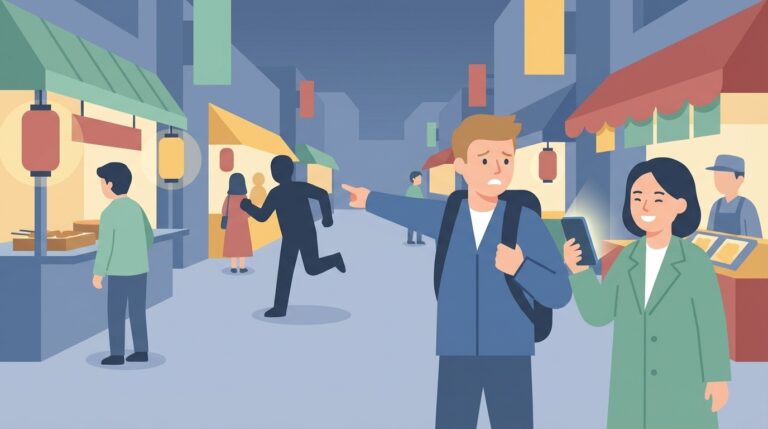
Imagine this: You’re standing in the middle of a bustling street in Myeongdong or walking through a crowded subway station in Gangnam. You’re totally immersed in your K-Travel dream, snapping photos and enjoying the vibe. Suddenly, you reach for your phone or wallet… and your bag feels suspiciously light. Someone bumped into you a second ago! You want to scream, but wait—what do you yell? Screaming “Thief!” in English might just confuse the people around you.
In K-Dramas, when someone steals a bag, the main character points dramatically and yells a specific word. Today, we are going to learn that exact word. Knowing how to express an emergency doesn’t just make you a smart traveler; it’s the ultimate survival tool. Let’s dive into how to handle an emergency like a true local!
Phase 2: Core Expressions Deep Dive
1. 도둑이야!
- Pronunciation: dodugiya! [doh-doo-gee-yah!]
- Meaning: Literal: “It is a thief!” / Real nuance: “Thief! Catch them!”
- K-Culture Moment: Think of a classic K-Drama scene set in a traditional market. The heroine’s purse is snatched, and she points at the running culprit, screaming “도둑이야!” at the top of her lungs, prompting the handsome male lead to chase them down.
- Editor’s Insight: Forget about polite endings here. In a true emergency, you don’t have time to be formal. Yelling this loudly instantly alerts everyone around you that a crime is happening.
- Situation Spectrum:
- Casual (Friends): ✅
- Semi-formal (Coworkers): ✅
- Formal (Boss/Elders): ✅ (In emergencies, survival beats hierarchy!)
- 🤔 Think About It: Notice how Koreans yell “It is a thief” (도둑+이야) rather than just “Thief!”? Korean sentences often prefer to state a complete situation. How do you yell for help in your native language?
2. 도와주세요!
- Pronunciation: dowajuseyo! [doh-wah-joo-seh-yo!]
- Meaning: Literal: “Please give me help!” / Real nuance: “Help me!”
- K-Culture Moment: This is your universal SOS. Whether you lost your child at a K-Pop concert or you took a bad fall while hiking Namsan Mountain, this phrase guarantees someone will rush over.
- Editor’s Insight: This phrase is incredibly polite but urgent. It shows respect to the stranger you are asking for help.
- Situation Spectrum:
- Casual (Friends): ⚠️ (To friends, you’d say 도와줘 – dowajwo)
- Semi-formal (Coworkers): ✅
- Formal (Boss/Elders/Strangers): ✅
- 🤔 Think About It: The ending “주세요 (juseyo)” literally means “please give.” In Korean, favors and help are things you give and receive.
3. 경찰 불러주세요!
- Pronunciation: gyeongchal bulleojuseyo! [gyoung-chal bool-luh-joo-seh-yo!]
- Meaning: Please call the police!
- K-Culture Moment: You are in a crowded K-BBQ restaurant and a fight breaks out, or you witness a scam. Shouting this tells the owner exactly what action to take.
- Editor’s Insight: If you just yell “Police!” (경찰!), people might look around confused. Adding “불러주세요” (please call) gives a clear command.
- Situation Spectrum:
- Casual (Friends): ⚠️ (You’d say 경찰 불러 – gyeongchal bulleo)
- Semi-formal (Coworkers): ✅
- Formal (Boss/Elders/Strangers): ✅
- 🤔 Think About It: Why is it so important to give a specific instruction in a crowd? (Hint: The Bystander Effect exists everywhere!)
Phase 3: Textbook vs. Real Korean
[Situation 1: Discovering a pickpocket]
* 📖 Textbook Korean: 누군가 제 지갑을 훔쳐갔어요. (Someone stole my wallet.)
* 🗣️ Real Korean: 앗! 내 지갑! 저기요! 도둑이야! (Ah! My wallet! Hey! Thief!)
* 💡 Why the difference?: In a panic, Koreans drop full sentences and use short, punchy fragments to get immediate attention.
[Situation 2: Asking a bystander to call the cops]
* 📖 Textbook Korean: 경찰서에 신고해 주시겠습니까? (Would you please report this to the police station?)
* 🗣️ Real Korean: 112 (일일이) 눌러주세요! (Please press 112!)
* 💡 Why the difference?: Giving the specific emergency number (112) is faster and more direct than asking them to “make a report.”
Bottom Note: As an A1 (Super Beginner) learner, don’t worry about complex grammar in an emergency. The louder and shorter the word, the better. Memorize the keywords: 도둑 (Thief), 경찰 (Police), 도와 (Help)!
Phase 4: Cultural Context — K-Culture Deep Dive
4-1. Non-verbal Cues (The Emergency Nunchi)
In Korea, if you just yell “Help!” to a crowd, people might freeze, unsure of who should act. Use your Nunchi (눈치)! Make direct eye contact with one specific person. Point at them and say, “거기 안경 쓰신 분, 경찰 불러주세요!” (You there with the glasses, call the police!). Giving a specific person a task breaks the bystander effect instantly.
4-2. K-Travel Connection: The “Cafe Laptop” Myth vs. Reality
You’ve probably seen TikToks of people leaving their laptops and iPhones on Korean cafe tables while they go to the restroom. Yes, Korea is famously safe, and CCTV is everywhere. However, highly crowded tourist spots (like Dongdaemun Night Market or crowded subways) are the rare places where pickpockets (소매치기 – somaechigi) can strike. Don’t let the “K-Drama safe utopia” image make you completely drop your guard. Be smart, keep your bag zipped in crowds, and if it happens, yell “도둑이야!”
Phase 5: Interactive Roleplay Scenario
Setting: Friday night, 8 PM. Hongdae Shopping Street. It’s packed with people watching buskers.
Characters:
* YOU (The Reader): A tourist enjoying your first night in Seoul. You just bought some K-Beauty items.
* Minho (28): A friendly Korean college student standing next to you watching a dance cover group.
Dialogue:
YOU: (Reaching into your bag) 앗! 제 가방! 🎒
(at! je gabang!)
(English) [Ah! My bag!]
(🎭 Stage Direction: You notice your bag is wide open and your wallet is gone.)
Minho: 네? 무슨 일이에요?
(ne? museun irieyo?)
(English) [Yes? What’s wrong?]
YOU: 지갑! 지갑이 없어요!
(jigap! jigabi eopseoyo!)
(English) [Wallet! My wallet is gone!]
Minho: 네? 소매치기예요?
(ne? somaechigiyeyo?)
(English) [What? A pickpocket?]
YOU: 네! 저 사람이에요!
(ne! jeo saramieyo!)
(English) [Yes! It’s that person!]
(🎭 Stage Direction: You point at a man running away in a black hoodie.)
Minho: 헐! 야! 거기 안 서?
(heol! ya! geogi an seo?)
(English) [OMG! Hey! Stop right there!]
YOU: 도와주세요! 도둑이야!
(dowajuseyo! dodugiya!)
(English) [Help me! Thief!]
Minho: 제가 쫓아갈게요!
(jaega jjochagalgeyo!)
(English) [I’ll chase him!]
YOU: 경찰 불러주세요!
(gyeongchal bulleojuseyo!)
(English) [Please call the police!]
Minho: 주변 분들, 112에 전화해 주세요!
(jubyeon bundeul, il-il-ie jeonhwahae juseyo!)
(English) [People around, please call 112!]
🔀 Your Turn! The police arrive. How do you respond?
* A) “저 사람이 제 지갑을 훔쳤어요!” (That person stole my wallet!)
* B) “저는 괜찮아요…” (I’m okay…)
* C) “사진 찍어주세요!” (Please take a picture of me!)✅ Best Choice: A — Point out the culprit immediately!
⚠️ Choice B & C Analysis: B will make the police think it’s a false alarm. C is definitely not the time for a selfie, even if Korean police uniforms look cool!
Bonus K-Culture Roleplay: At the Police Station
Police: 안에 뭐가 있었나요? (What was inside?)
YOU: 제 여권이랑 신용카드요. (My passport and credit card.)
Police: 대사관에 연락하셔야겠네요. (You’ll need to contact your embassy.)
Phase 6: 10-Second Shadowing Drill
Practice saying this like a true K-Drama protagonist in distress!
Read aloud, minding the pauses (/) and the emotion tags.
- 🚨 Urgent: 저기요! / 제 가방! / 도와주세요!
(jeogiyo! / je gabang! / dowajuseyo!)
[Excuse me! My bag! Help me!] -
😤 Loud & Bold: 저기요! / 도둑이야!! / 잡아요!!!
(jeogiyo! / dodugiya!! / jabayo!!!)
[Hey! Thief!! Catch them!!!]
Phase 7: K-Culture Mini Dictionary
| 한국어 (Korean) | Romanization | English | 맥락 설명 (Context) |
|---|---|---|---|
| 도둑 | doduk | Thief | General term for anyone stealing. |
| 소매치기 | somaechigi | Pickpocket | Very specific to street theft from pockets/bags. |
| 경찰 / 경찰서 | gyeongchal / gyeongchalseo | Police / Police Station | Look for the blue and yellow eagle logo in Korea! |
| 지갑 | jigap | Wallet | Essential vocab for travelers. |
| 여권 | yeogwon | Passport | The most important item to protect! |
| 눈치 | nunchi | Social Awareness | Reading the room (crucial for getting help!). |
Phase 8: Traveler’s Survival Kit
🆘 Survival Phrases TOP 3 for Lost/Stolen Items
1. 🇰🇷 “여권 잃어버렸어요.” (yeogwon ireobeoryeosseoyo.)
– 🗣️ [yuh-gwon ee-ruh-buh-ryuh-so-yo]
– 📍 Meaning: I lost my passport.
2. 🇰🇷 “112 눌러주세요.” (il-il-i nulleojuseyo.)
– 🗣️ [eel-eel-ee nool-luh-joo-seh-yo]
– 📍 Meaning: Please press 112 (Call the police).
3. 🇰🇷 “OOO 대사관이 어디예요?” (OOO daesagwani eodiyeyo?)
– 🗣️ [OOO dae-sa-gwan-ee uh-dee-yeh-yo?]
– 📍 Meaning: Where is the [Your Country] embassy?📌 Editor’s Travel Note
* Emergency Numbers: In Korea, 112 is for Police, and 119 is for Medical/Fire emergencies. Do NOT dial 911; it won’t connect properly on local networks!
* CCTV Capital: If you lose something in Korea, there is a 90% chance a camera saw it. Always file a police report—they can trace exactly where your wallet went!
* Lost & Found (분실물 센터): Subways have excellent lost and found centers. Often, people turn in lost wallets intact!
Phase 9: Critical Thinking Corner — “One Step Deeper”
Media vs Reality: The “Perfectly Safe” Myth
If you watch K-Dramas, Korea looks like a mix of extreme crime thrillers and absolute peaceful utopias where people leave their wallets on cafe tables to reserve a seat. The reality? Korea is incredibly safe. The collective social contract and heavy CCTV presence discourage petty theft. However, as K-Tourism booms, crowded global hotspots like Myeongdong see occasional pickpockets. This teaches us an important lesson: Appreciate the trust-based culture of Korea, but don’t abandon your basic traveler’s street smarts!
💬 Your Turn: Do people leave their laptops unattended in cafes in your country? Let us know in the comments how your culture views public safety and theft!
Phase 10: FAQ & Avoiding Common Mistakes
- Q: “Is it rude to yell ‘도둑이야’ loudly in public? Shouldn’t I use honorifics?”
- A: No! In an emergency, safety completely overrides politeness. Yelling loudly is actually expected so people know it’s a real crisis.
- Q: “What if I’m not sure if they stole it or if I dropped it?”
- A: If you aren’t 100% sure, DO NOT yell “도둑이야!” Instead, say “지갑을 잃어버렸어요” (I lost my wallet) and ask for help looking for it.
❌ Common Mistake #1: Calling 911.
✅ Do this instead: Memorize 112 for the police in Korea.❌ Common Mistake #2: Freezing and whispering “Excuse me…”
✅ Do this instead: Use your “Drama Voice.” Inhale deeply and project: “도와주세요!!”
Phase 11: Summary & Action Items
- One-Liner Summary: When your belongings vanish, drop the grammar, channel your inner K-Drama star, and scream “도둑이야!” (Dodugiya!).
-
Action Mission 3 Steps:
- 🥉 Bronze (Solo): Stand in front of your mirror and dramatically yell “도둑이야!” three times.
- 🥈 Silver (Online): Save the number 112 in your brain and share it with a friend who loves K-Travel.
- 🥇 Gold (Real Life): Next time you watch a K-Drama thriller, listen closely for the word “경찰” (Police) or “도둑” (Thief)!
- K-Culture Mission: Open Google Street View in Myeongdong. Imagine you are standing there. Pick out one virtual bystander and practice pointing at them and shouting, “거기! 경찰 불러주세요!”
Phase 12: Quiz — Interactive Challenge
1. Situational Judgment: You are in a crowded subway and notice someone’s hand in your bag. What is the most effective thing to shout?
* A) “Excuse me, please stop.”
* B) “제 지갑을 훔치지 마시겠어요?”
* C) “도둑이야!!!”
(Answer: C. It immediately alerts everyone to the crime!)
2. Fill in the Blank: You need someone to call the police.
“112 ____ 주세요!” (Please press 112!)
(Answer: 눌러 – nulleo)
3. True or False – K-Culture Edition: In Korea, dialing 911 from a local phone will automatically connect you to the police.
(Answer: FALSE. You must dial 112 for Police, or 119 for Fire/Medical.)
4. Roleplay Follow-up: If you yell “도와주세요” but everyone just stares, what Korean cultural concept should you use to break the bystander effect?
(Answer: Nunchi (눈치) – Use your social awareness to point directly at ONE specific person and give them a task!)
Frequently Asked Questions (FAQ)
Q: What does "도둑이야!" mean in Korean and how do you pronounce it?
A: In Korean, "도둑이야!" is pronounced [dodugiya! [doh-doo-gee-yah!] and means: Literal: "It is a thief!" / Real nuance: "Thief! Catch them!"
Q: What does "도와주세요!" mean in Korean and how do you pronounce it?
A: In Korean, "도와주세요!" is pronounced [dowajuseyo! [doh-wah-joo-seh-yo!] and means: Literal: "Please give me help!" / Real nuance: "Help me!"
Q: What does "경찰 불러주세요!" mean in Korean and how do you pronounce it?
A: In Korean, "경찰 불러주세요!" is pronounced [gyeongchal bulleojuseyo! [gyoung-chal bool-luh-joo-seh-yo!] and means: Please call the police!






