

Phase 1: Empathy & K-Culture Cold Open
Hello! I’m the Lead Editor of Daily Hangul.
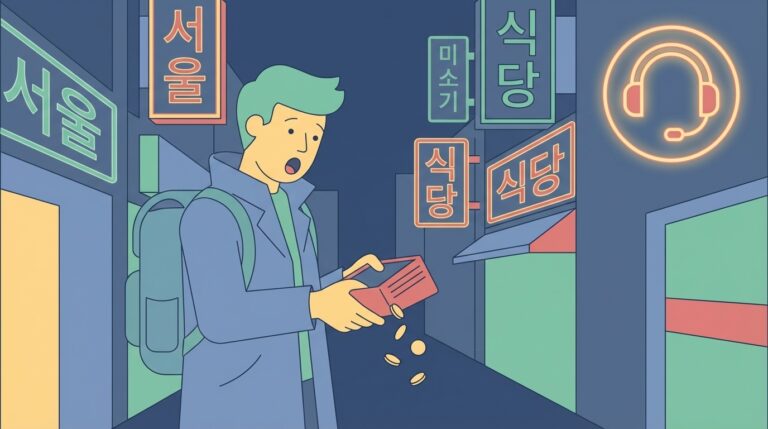
Picture this: You’re in the bustling underground shopping mall at Gangnam Station. You’ve just found the perfect K-beauty lip tint, or maybe a limited-edition photocard of your favorite K-Pop idol. You reach into your bag with a huge smile, and… nothing. You dig deeper. Your heart drops to your stomach. Your wallet—and your credit card—is gone.
Panic sets in. How do you explain this? In textbooks, they give you long, complex sentences to report a lost item. But in the real world, especially in Korea’s fast-paced ‘Ppalli-ppalli’ (hurry, hurry) culture, you don’t need a perfectly constructed essay. You need absolute survival phrases to lock that card down before someone else uses it.
Korea is famously a cashless society (카드 천국 – card heaven). You can pay for a 1,000 KRW pack of gum with a card. Losing your card here doesn’t just mean losing money; it means losing your ability to ride the subway, buy a coffee, or grab a late-night snack at the convenience store.
Today, I’ll teach you exactly what to say to stop your card and save the day. Trust me, these phrases are lifesavers. Let’s dive in!
Phase 2: Core Expressions Deep Dive
Here are the most critical phrases you need when your card goes missing.
1. 카드를 잃어버렸어요. (I lost my card.)
- Pronunciation: kadeureul ireobeoryeosseoyo. [kah-deu-reul / ee-raw-baw-ryaw-ssaw-yo]
- Sound Analogy: For ‘으’ (eu) in ‘kadeu’, make the sound you make when you step in wet gum!
- Meaning: Literal: Card, lost it. / Real nuance: “I lost my card!”
- K-Culture Moment: This is the exact phrase you use when you rush into a bank or call a hotline. Notice we don’t say “I” (저는). In Korean, the focus is on the action and the object. We know you lost it because you’re the one panicking!
- Editor’s Insight: Say this with a slightly distressed tone. Koreans are highly empathetic, and customer service workers will immediately shift into ‘emergency help mode’ when they hear this.
- Situation Spectrum:
- Casual (Friends): ✅ (Drop the ‘요’ -> 카드 잃어버렸어)
- Semi-formal (Staff): ✅
- Formal (Boss): ✅
- 🤔 Think About It: Why do Koreans often omit the word “I” (저는) in emergencies? How does your native language handle emergency statements—do you focus on yourself or the problem?
2. 카드 정지해 주세요. (Please suspend my card.)
- Pronunciation: kadeu jeongjihae juseyo. [kah-deu / jawng-jee-hae / joo-se-yo]
- Meaning: Literal: Please stop the card. / Real nuance: “Please cancel/suspend my card immediately.”
- K-Culture Moment: In K-Dramas, when the rich CEO gets angry at his spoiled child, he calls his secretary and says, “카드 정지해!” (Suspend the card!). For you, adding “주세요” (please) makes it polite but urgent.
- Editor’s Insight: ‘정지’ (Jeong-ji) means ‘stop’ or ‘suspend’. This is the absolute magic word for the bank teller. Even if you forget everything else, just say “카드 정지!”
- Situation Spectrum:
- Casual: ⚠️ (Sounds a bit robotic to a friend)
- Semi-formal: ✅
- Formal: ✅
- 🤔 Think About It: “~해 주세요” (Please do ~ for me) is the backbone of Korean customer service. It shows respect while making a clear request. Does your culture use a specific word to get service quickly?
3. 재발급해 주세요. (Please reissue it.)
- Pronunciation: jaebalgeuphae juseyo. [jae-bal-geup-hae / joo-se-yo]
- Meaning: Please reissue (the card).
- K-Culture Moment: You’ve stopped the thief, but now you need a new card! Korean banks are incredibly fast. If it’s a domestic bank, they can often print a new debit card for you right on the spot in 5 minutes.
- Editor’s Insight: If “재발급” (jae-bal-geup) is too hard to pronounce, simply say: “새로 만들어 주세요” (saero mandeureo juseyo – Please make a new one).
- Situation Spectrum:
- Casual: 🚫
- Semi-formal: ✅
- Formal: ✅
Phase 3: Textbook vs. Real Korean
When panic hits, you don’t have time for textbook grammar. Let’s look at how native Koreans actually speak in this situation.
[Situation 1: Explaining the Loss]
* 📖 Textbook Korean: 제 신용카드를 분실했습니다. (I have lost my credit card.)
* 🗣️ Real Korean: 카드 잃어버렸어요! (Lost the card!)
* 💡 Why it’s different: “분실했습니다” is highly formal, usually seen in written reports. In spoken Korean, dropping the pronoun “제” (my) and using “잃어버렸어요” sounds much more natural and urgent.
[Situation 2: Asking for Suspension]
* 📖 Textbook Korean: 카드 사용을 중지해 주시길 바랍니다. (I wish for you to stop the usage of the card.)
* 🗣️ Real Korean: 카드 정지해 주세요. (Or simply: 카드 정지요!)
* 💡 Why it’s different: Korea’s Ppalli-ppalli (efficiency) culture dictates that in an emergency, you get straight to the verb. Shorter is better!
Bottom Note: For A2 learners, sticking to “[Noun] + 주세요” is the smartest, safest, and most natural way to survive in Korea.
Phase 4: Cultural Context — K-Culture Deep Dive
4-1. Non-verbal Nuances (Nunchi in Emergencies)
When reporting a lost card, hand gestures matter. Have your passport or ID ready before you even speak. Korean bank tellers are incredibly efficient, but they need to verify your identity. Handing your ID with two hands while saying “카드 잃어버렸어요” will make the process 10 times faster.
4-2. The Cashless Society & Travel Reality
If you’re traveling in Korea, you’ll quickly realize that cash is rarely used. Even tiny street food stalls (포장마차) at Myeongdong or Gwangjang Market now accept card payments or bank transfers (계좌이체).
Because of this, losing your card essentially paralyzes your travel plans. You can’t tap into the subway, you can’t grab a quick Americano, and you can’t order delivery on Baedal Minjok. Understanding how to block your card quickly isn’t just a language lesson; it’s a vital survival skill in modern-day Korea’s digital ecosystem.
Phase 5: Interactive Roleplay Scenario
Setting: It’s 2:00 PM. You are at a bright, air-conditioned bank branch near your hotel. You’ve just taken a numbered ticket (번호표) and sat down in front of a friendly bank teller.
Characters:
– YOU: A tourist whose heart is beating out of their chest because you lost your wallet at a cafe.
– Teller (은행원): A helpful, fast-moving Korean bank employee.
Dialogue:
Teller: 어서 오세요. 어떻게 오셨어요?
(eoseo oseyo. eotteoke osyeosseoyo?)
[Welcome. How can I help you?]
YOU: 저기요… 카드를 잃어버렸어요.
(jeogiyo… kadeureul ireobeoryeosseoyo.)
[Excuse me… I lost my card.]
Teller: 헉, 언제 잃어버리셨어요? 신분증 있으세요?
(heok, eonje ireobeorisyeosseoyo? sinbunjeung isseuseyo?)
[Oh no, when did you lose it? Do you have your ID?]
YOU: 네, 여기요. 여권이에요.
(ne, yeogiyo. yeogwonieyo.)
[Yes, here. It’s my passport.]
Teller: 네, 확인했습니다. 지금 바로 카드 정지해 드릴까요?
(ne, hwaginhaetseumnida. jigeum baro kadeu jeongjihae deurilkkayo?)
[Yes, confirmed. Shall I suspend the card for you right now?]
🔀 YOUR TURN! How do you reply?
– A) 아니요, 괜찮아요. 제가 찾을게요. (No, it’s okay. I’ll find it.)
– B) 네! 지금 바로 정지해 주세요.
– C) 잘 모르겠어요…✅ Best Choice: B — “네! 지금 바로 정지해 주세요.” (Yes! Please suspend it right now.) Always freeze it first! If you find it later, you can usually unfreeze it. Better safe than sorry in a foreign country.
⚠️ Choice A Analysis: If you wait, someone might use it! Never say “it’s fine” to a bank teller offering to protect your money.
Teller: 네, 정지 완료되었습니다. 새로 만들어 드릴까요?
(ne, jeongji wallyodoeeotseumnida. saero mandeureo deurilkkayo?)
[Yes, suspension is complete. Shall I make a new one for you?]
YOU: 네, 재발급해 주세요. 감사합니다!
(ne, jaebalgeuphae juseyo. gamsahamnida!)
[Yes, please reissue it. Thank you!]
Phase 6: 10-Second Shadowing Drill
Practice these lines out loud. Pay attention to the pauses (/) and the emotion tags!
- 🥺 (Panicked)
저기요... / 제가 / 카드를 / 잃어버렸어요!
(jeogiyo… / jega / kadeureul / ireobeoryeosseoyo!) - 😤 (Urgent)
당장 / 카드 / 정지해 주세요!
(dangjang / kadeu / jeongjihae juseyo!) - 😊 (Relieved)
다행이다! / 카드를 / 다시 만들어 주세요.
(dahaengida! / kadeureul / dasi mandeureo juseyo.)
Phase 7: K-Culture Mini Dictionary
| Korean | Romanization | English | Context |
|---|---|---|---|
| 신분증 | sinbunjeung | ID Card | You absolutely need this (or a passport) at the bank. |
| 분실물 센터 | bunsilmul senteo | Lost and Found | Found at subway stations, airports, and police stations. |
| 재발급 | jaebalgeup | Reissuance | The magic word to get a new card printed. |
| 빨리빨리 | ppallippalli | Hurry, Hurry | The core of Korean service culture. Fast solutions! |
Phase 8: Traveler’s Survival Kit
When you lose something while traveling, these three phrases are your safety net.
🆘 Survival Phrases TOP 3
1. 🇰🇷 “지갑을 잃어버렸어요.” (jigabeul ireobeoryeosseoyo.) – I lost my wallet.
2. 🇰🇷 “도와주세요!” (dowajuseyo!) – Please help me!
3. 🇰🇷 “경찰서가 어디예요?” (gyeongchalseoga eodiyeyo?) – Where is the police station?📌 Editor’s Travel Note
– Hotline Hack: Did you know Korea has a 24/7 tourist helpline that speaks English, Chinese, and Japanese? Just dial 1330 from any phone. They can even translate for you at the police station or bank!
– CCTV Magic: Korea has CCTVs everywhere. If you leave your wallet at a cafe, there is a 99% chance it is still sitting on the table, or the barista has it behind the counter. Nobody touches other people’s stuff in Korea!
Phase 9: Think Deeper — K-Culture Critical Thinking
Korean in the Global Era: The Digital Reliance
South Korea’s transition to a cashless, fully digital society is a marvel of the global era. From Samsung Pay to KakaoPay, physical cash is disappearing. While this provides incredible convenience and speed (aligning perfectly with Ppalli-ppalli culture), it also means that losing your digital access or physical card creates an immediate crisis for foreigners who don’t have local bank apps. The language has shifted too; people rarely say “I lost my money,” they specifically say “I lost my card.”
💬 Your Turn: How digital is your home country? Can you survive a whole week without cash, or is physical money still king where you live? Let us know in the comments!
Phase 10: FAQ & Avoiding Mistakes
Q: Can I just go to the police instead of the bank?
Yes! If you lost it in public, go to the nearest 경찰서 (police station). But ALWAYS call your bank to say “카드 정지해 주세요” first.
Q: What if I left my card on the subway?
Go to the subway station office (역무실) and tell them your train number and the time you got off. They are incredibly good at tracking down lost items!
❌ Common Mistake #1: Trying to explain how you lost the card using broken Korean.
✅ Do This Instead: Just say “잃어버렸어요” (I lost it). Don’t try to explain that you were eating Tteokbokki, dropped your bag, and it fell down a grate. The bank teller only needs to know the fact, not the backstory. Focus on the solution!
Phase 11: Summary & Action Items
One-Liner Summary: When disaster strikes, forget the long stories and simply say: “카드 잃어버렸어요. 정지해 주세요!”
Action Mission 3 Steps:
* 🥉 Bronze (Solo): Stand in front of your mirror and practice saying “카드 정지해 주세요” 3 times with a serious face.
* 🥈 Silver (Online): Write down your local bank’s emergency international hotline number in your phone right now. (Trust me, do it!).
* 🥇 Gold (Real World): Memorize the 1330 Korea Travel Helpline number. If you ever visit Korea, you’ll feel so much safer.
🎬 K-Culture Mission:
The next time you watch a K-Drama and see a character run out of a cafe leaving their phone or wallet behind, yell at the screen: “잃어버렸어요!!!”
Phase 12: Interactive Quiz
Test your emergency Korean skills!
1. Situational Judgment: You are at a cafe and realize your card is missing. What is the FIRST thing you should say to the bank on the phone?
– A) 제 이름은 존입니다. (My name is John.)
– B) 경찰서가 어디예요? (Where is the police station?)
– C) 카드 정지해 주세요! (Please suspend my card!)
2. Fill in the Blank:
“저기요, 신용카드를 _________.”
– A) 좋아해요 (like)
– B) 잃어버렸어요 (lost)
– C) 맛있어요 (delicious)
3. True or False – K-Culture Edition:
If you drop your wallet in a Korean cafe, someone will probably steal it within 5 minutes. (T/F)
(Answers: 1. C – Stop the card first!, 2. B – I lost it, 3. False – Korea is famous for its cafe culture where people leave laptops and wallets unattended for hours!)
Frequently Asked Questions (FAQ)
Q: What does "카드를 잃어버렸어요. (I lost my card.)" mean in Korean and how do you pronounce it?
A: In Korean, "카드를 잃어버렸어요. (I lost my card.)" is pronounced [kadeureul ireobeoryeosseoyo. [kah-deu-reul / ee-raw-baw-ryaw-ssaw-yo] and means: Literal: Card, lost it. / Real nuance: "I lost my card!"
Q: What does "카드 정지해 주세요. (Please suspend my card.)" mean in Korean and how do you pronounce it?
A: In Korean, "카드 정지해 주세요. (Please suspend my card.)" is pronounced [kadeu jeongjihae juseyo. [kah-deu / jawng-jee-hae / joo-se-yo] and means: Literal: Please stop the card. / Real nuance: "Please cancel/suspend my card immediately."
Q: What does "재발급해 주세요. (Please reissue it.)" mean in Korean and how do you pronounce it?
A: In Korean, "재발급해 주세요. (Please reissue it.)" is pronounced [jaebalgeuphae juseyo. [jae-bal-geup-hae / joo-se-yo] and means: Please reissue (the card).






