

Survive a Korean First Birthday: What to Say When the Baby Cries!
Phase 1: The Panic at the Buffet 🍼
Hello! It’s your Daily Hangul Editor.
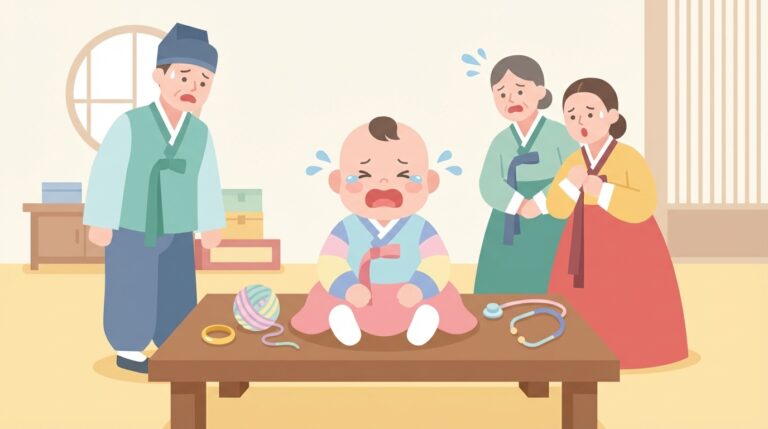
Imagine this: You’ve been invited to your Korean colleague’s baby’s 돌잔치 (Doljanchi – First Birthday Party). You’re at a fancy buffet in Gangnam. The baby is dressed in a stunning, miniature traditional Hanbok. The MC grabs the microphone, the lights dim for the highlight of the event—the Doljabi (where the baby grabs an item to predict their future).
Suddenly… “WAAAAAH!”
The baby bursts into tears. The parents look flustered, sweating under the spotlight. The lively room suddenly goes quiet. You want to say something comforting, but the textbook phrase “아기가 웁니다 (The baby is crying)” feels way too cold. What do you do?
Today, we’re going to learn exactly how to handle this awkward situation like a true Korean insider. These B1-level expressions will not only show your empathy but also prove that you deeply understand Korean social nuances (Nunchi). Let’s dive in!
Phase 2: Core Expressions for Comforting Parents
In Korea, when a baby cries in public, the parents often feel incredibly apologetic to the people around them. Your goal is to give them a “social excuse” to ease their burden. Here is how we do it using the B1 grammar ~나 봐요 (It seems like / I guess).
1. 아기가 낯을 가리나 봐요.
- Pronunciation: agiga nacheul garina bwayo. [‘낯을’ sounds like ‘na-cheul’ – soft ‘ch’]
- Meaning: Literal: “I guess the baby distinguishes faces.” / Real nuance: “I guess the baby is shy around strangers.”
- K-Culture Moment: You’ll hear this in K-Dramas all the time when a neighbor tries to hold a baby and it cries. Instead of saying “Your baby doesn’t like me,” they smoothly say, “Ah, they must be at the age where they are shy!”
- Editor’s Insight: This is the #1 lifesaver phrase. It shifts the “blame” from the parents’ soothing skills to a natural developmental stage. It tells the parents, “Don’t worry, it’s normal!”
- Situation Spectrum:
- Close Friends (Casual): ✅ (낯가리나 보다~)
- Co-workers (Semi-formal): ✅ (낯을 가리나 봐요)
- Boss/Elders (Formal): ✅ (낯을 많이 가리나 봅니다)
- 🤔 Think About It: Why do Koreans prefer to offer an “excuse” for someone else’s situation rather than just asking “What’s wrong?” How does this relate to saving face (체면 – che-myeon)?
2. 아이고, 졸린가 봐요.
- Pronunciation: aigo, jollinga bwayo. [‘졸’ sounds like ‘jol’ in jolly]
- Meaning: Literal: “Oh my, I guess they are sleepy.” / Real nuance: “Poor thing, they must be tired from all the excitement.”
- K-Culture Moment: Picture a loud, bustling family gathering during Chuseok. The baby is overwhelmed and cries. The grandmother will immediately say this while patting the baby’s back.
- Editor’s Insight: The exclamation “아이고” (aigo) is crucial here. It’s a verbal sigh of empathy. Using this makes you sound 200% more native.
- Situation Spectrum:
- Close Friends (Casual): ✅ (아이고, 졸린가 봐~)
- Co-workers (Semi-formal): ✅ (아이고, 졸린가 봐요)
- Boss/Elders (Formal): ⚠️ (Skip the ‘aigo’ when speaking to very senior people, just say: 많이 졸린가 봅니다)
- 🤔 Think About It: In your culture, what is the go-to comment when a baby throws a tantrum at a party? Is it similar to guessing they are tired or hungry?
3. 울어도 너무 귀여워요!
- Pronunciation: ureodo neomu gwiyeowoyo!
- Meaning: “Even when they cry, they are so cute!”
- K-Culture Moment: At a K-Pop fan meeting, when an idol gets emotional and cries, fans often shout “울어도 귀여워요!” to cheer them up. It works for babies too!
- Editor’s Insight: This is pure positive reinforcement. When the mother is embarrassed that the baby is ruining the photos, this phrase completely changes the mood.
- Situation Spectrum:
- Close Friends (Casual): ✅ (우는 것도 귀엽네!)
- Co-workers (Semi-formal): ✅ (울어도 너무 귀여워요)
- Boss/Elders (Formal): ✅
Phase 3: Textbook vs. Real Korean
Let’s see how native speakers actually react compared to what language apps teach you.
[Situation: The baby starts crying loudly]
* 📖 Textbook Korean: 아기가 웁니다. 왜 웁니까? (The baby is crying. Why are they crying?)
* 🗣️ Real Korean: 어머 어떡해~ 많이 놀랐나 봐요. (Oh no, what do we do~ They must be very startled.)
* 💡 Why the difference?: Asking “Why?” directly puts pressure on the parents to explain. In Korea, expressing collective empathy (“어떡해”) and guessing the cause smoothly relieves that pressure.
[Situation: Trying to compliment the crying baby]
* 📖 Textbook Korean: 아기가 슬퍼 보이지만 아름답습니다. (The baby looks sad but beautiful.)
* 🗣️ Real Korean: 아이고~ 우는 것도 예쁘네요. (Aigo~ Even their crying is pretty.)
* 💡 Why the difference?: Koreans use “예쁘다 (pretty)” or “귀엽다 (cute)” for babies universally. Using “아름답다 (beautiful)” sounds like you are describing a landscape or a piece of art!
Bottom Note: For B1 learners, mastering the
~나 봐요(I guess/It seems like) grammar form is your golden ticket to sounding soft, polite, and observant!
Phase 4: Cultural Context — K-Culture Deep Dive
4-1. Non-verbal Nunchi (눈치)
When a baby cries at a Doljanchi, your gaze matters. Staring directly at the stressed parents can make them feel judged.
– Pro Tip: Give a warm, quick smile, drop one of the phrases above, and then look away or talk to the person next to you. This shows you are unbothered, giving the parents the physical and mental space to calm the child without an audience.
4-2. The K-Drama Trope: The Chaotic Family Gathering
If you watch Korean family dramas (like Reply 1988 or weekend soap operas), you’ve seen this scene. The whole extended family is gathered. The baby cries. The mother-in-law inevitably says, “애가 왜 이리 울어? 배고픈 거 아니야?” (Why is the baby crying so much? Aren’t they hungry?)
This creates instant tension for the mother!
– Critical View: In real life, modern Korean parents prefer when guests don’t overly interfere. Rather than offering unsolicited advice (like “Feed the baby!”), making a gentle, supportive comment like “낯가리나 봐요 (They must be shy)” is the modern, polite way to handle it.
Phase 5: Real-Life Roleplay Scenario
Setting: Saturday lunch at a premium seafood buffet in Yeouido. You are attending the Doljanchi of your manager’s baby. You are sitting at a round table with a friendly colleague, Min-su. The baby, wearing a slightly scratchy silk Hanbok, suddenly starts wailing just as the photos are being taken.
Characters:
– YOU: An expat working in Korea for a year, trying to show good manners to your manager.
– Min-su (32): Your Korean colleague. Friendly and helpful.
– Manager Park (40): The father, currently sweating profusely while holding the crying baby.
Dialogue:
Manager Park: 아, 죄송합니다. 애가 갑자기 왜 이러지… 💦
(a, joesonghamnida. aega gapjagi wae ireoji…)
(Oh, I’m sorry. I don’t know why the baby is suddenly acting like this…)
(🎭 Stage Direction: Manager Park nervously bounces the baby, looking apologetically at the guests.)
Min-su: 부장님, 괜찮습니다. 사람이 많아서 애기가 놀랐나 봐요.
(bujangnim, gwaenchansseumnida. sarami manaseo aegiga nollanna bwayo.)
(Manager, it’s fine. I guess the baby is startled because there are so many people.)
Manager Park: 하하, 그런가 봐요. 한복이 불편한가…
(haha, geureonga bwayo. hanbogi bulpyeonhanga…)
(Haha, I guess so. Or maybe the Hanbok is uncomfortable…)
Min-su: (Whispering to you) [Name], say something to comfort him!
🔀 Your Turn! How do you reply to Manager Park?
– A) “아기가 왜 웁니까? 배고픕니까?” (Why is the baby crying? Is it hungry?)
– B) “아이고, 부장님. 아기가 낯을 가리나 봐요. 울어도 너무 귀여워요!” (Aigo, Manager. I guess the baby is shy. They are so cute even when crying!)
– C) “부장님, 시끄러워요. 밖으로 나가세요.” (Manager, it’s noisy. Please go outside.)✅ Best Choice: B — It uses the perfect blend of empathy (“Aigo”), a polite excuse (“shy”), and a compliment (“cute”). Manager Park will definitely remember your kindness during the next performance review! 😉
⚠️ Choice A Analysis: Too direct. It sounds like an interrogation.
🚫 Choice C Analysis: Absolutely do not say this unless you want to be fired tomorrow!
Phase 6: 10-Second Shadowing Drill
Practice reading this aloud to master the intonation!
🥺 Empathizing:
아이고~ / 우리 아기가 / 많이 / 졸린가 봐요~
(aigo~ / uri agiga / mani / jollinga bwayo~)
😊 Cheering up the parents:
어머, / 낯을 가리나 봐요. / 그래도 / 너~무 귀여워요!
(eomeo, / nacheul garina bwayo. / geuraedo / neo~mu gwiyeowoyo!)
(Tip: Stretch out the ‘너~’ (neo~) to sound extra expressive!)
Phase 7: K-Culture Mini Dictionary
| 한국어 | Romanization | English | Context |
|---|---|---|---|
| 돌잔치 | doljanchi | 1st Birthday Party | A huge milestone in Korea, traditionally celebrating a baby surviving their first year. |
| 돌잡이 | doljabi | Grabbing Event | The highlight where the baby grabs an item (money, pencil, thread) to predict their future. |
| 낯가림 | natgarim | Shyness with strangers | The developmental stage where babies cry at unfamiliar faces. |
| 돌반지 | dolbanji | 24k Gold Ring | The traditional gift for a first birthday. |
| 눈치 | nunchi | Social sense | The ability to read the room (e.g., knowing when to look away when a baby cries). |
Phase 8: Event Survival Kit
Even if you aren’t at a Doljanchi, you might encounter babies on public transit or at cafes during your travels in Korea.
🆘 Survival Phrases for K-Travelers (Baby Encounters)
– 🇰🇷 “몇 개월이에요?” (myeot gaeworieyo?)
– 🗣️ Meaning: “How many months old are they?” (The standard way to ask a baby’s age in Korea).
– 🇰🇷 “안녕~” (annyeong~) + Wave enthusiastically
– 🗣️ Meaning: “Hello~” (Koreans love it when foreigners wave at their babies!).
– 📍 Where to use: Subways, cafes, parks.
– 💡 Pro Tip: Never touch a Korean baby without explicit permission. Due to hygiene and personal boundaries, simply smiling and waving from a distance is the best etiquette.📌 Editor’s Event Note: The Gift
At a Doljanchi, you are expected to bring 축의금 (Chug-ui-geum – Congratulatory money) in a white envelope.
Usually, 50,000 KRW to 100,000 KRW is standard, depending on your closeness to the parents. Always hand it with two hands!
Phase 9: Critical Thinking — “A Step Deeper”
Public Spaces and Parenting in Korea
In recent years, the debate over “No Kids Zones” in Korean cafes and restaurants has become a hot social issue. Due to complaints about noise or disruptive behavior, some business owners restrict children. This puts immense pressure on modern Korean parents. When their baby cries in public, they aren’t just embarrassed; they often feel panicked about disturbing others and facing societal judgment.
By offering a gentle phrase like “졸린가 봐요 (They must be sleepy),” you are doing more than just speaking Korean. You are offering a micro-moment of grace and solidarity to a stressed parent in a society that can sometimes be harsh regarding public etiquette.
💬 Your Turn: Does your country have “No Kids Zones”? How do people in your culture react when a baby cries loudly in a quiet restaurant? Let me know in the comments!
Phase 10: FAQ & Mistake Prevention
Q: Can I use “어떡해 (What do I do/Oh no)” to my boss?
A: Yes, but with a twist. “어떡해” is an exclamation. If you just say “어떡해~” to yourself while looking at the baby, it shows empathy and is totally fine regardless of hierarchy. However, do not say “부장님, 어떡해요?” (Manager, what are you going to do?) as it puts them on the spot!
Q: Can I offer to hold the crying baby to help?
A: Usually, NO. Unless you are extremely close family or a best friend, offering to take a crying baby from a Korean parent might make them more anxious. Verbal support is best.
❌ Common Mistake #1: Saying “아기가 왜 울어요?” (Why is the baby crying?)
✅ Do This Instead: “아기가 낯을 가리나 봐요.” (I guess the baby is shy.) Let the parents offer the explanation!
Phase 11: Summary & Action Items
- One-Liner Summary: When a baby cries in Korea, don’t ask why; guess the reason politely using
~나 봐요to show empathy and save the parents’ face.
Action Mission:
– 🥉 Bronze (Solo): Look in the mirror, make an empathetic face, and say “아이고, 졸린가 봐요” three times.
– 🥈 Silver (Online): Find a video of a Korean baby on YouTube (like The Return of Superman) and leave a comment: “우는 것도 귀여워요!”
– 🥇 Gold (Real World): The next time you see a colleague or friend with a tired baby, use one of today’s phrases to comfort them.
K-Culture Mission:
Watch an episode of a Korean family drama or reality show like The Return of Superman (슈퍼맨이 돌아왔다). Pay attention to how adults react when the kids throw a tantrum. Can you catch them using ~나 봐요?
Did you find this helpful? Share your own “awkward event” stories in the comments below!
Phase 12: Quiz — Interactive Challenge
1. Situational Judgment: You are at a cafe. A mother is struggling because her baby dropped its toy and started crying. You make eye contact with the flustered mother. What is the most polite, native-sounding reaction?
A) “시끄러워요.” (It’s noisy.)
B) “아기가 배고픈가 봐요.” (I guess the baby is hungry.)
C) “아이고, 놀랐나 봐요.” (Aigo, I guess they were startled.)
2. Fill in the Blank: “Oh my, I guess they are sleepy.”
아이고, __________ 봐요. (Hint: 졸…)
3. True or False – K-Culture Edition: “At a Doljanchi, it is polite to take the baby from the mother’s arms to let her rest, even if you are just a co-worker.” (T/F)
Answers (Click to reveal)
1. C – It shows empathy without assuming they are failing at feeding the baby (B).
2. 졸린가 (jollinga)
3. False – Personal boundaries are important. Verbal support and giving them space is much better unless you are very close family!
Frequently Asked Questions (FAQ)
Q: What does "아기가 낯을 가리나 봐요." mean in Korean and how do you pronounce it?
A: In Korean, "아기가 낯을 가리나 봐요." is pronounced [agiga nacheul garina bwayo. ['낯을' sounds like 'na-cheul' - soft 'ch'] and means: Literal: "I guess the baby distinguishes faces." / Real nuance: "I guess the baby is shy around strangers."
Q: What does "아이고, 졸린가 봐요." mean in Korean and how do you pronounce it?
A: In Korean, "아이고, 졸린가 봐요." is pronounced [aigo, jollinga bwayo. ['졸' sounds like 'jol' in jolly] and means: Literal: "Oh my, I guess they are sleepy." / Real nuance: "Poor thing, they must be tired from all the excitement."
Q: What does "울어도 너무 귀여워요!" mean in Korean and how do you pronounce it?
A: In Korean, "울어도 너무 귀여워요!" is pronounced [ureodo neomu gwiyeowoyo!] and means: "Even when they cry, they are so cute!"







