

Phase 1: Empathy (The Cold Open)
Hello! I am your Daily Hangul Editor.
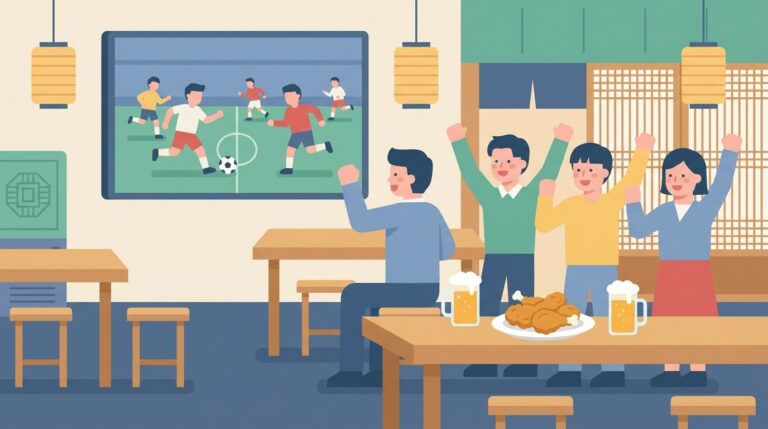
Picture this: You are watching a K-Drama. The main characters are sitting in a cozy living room, eating crispy fried chicken, and screaming at the TV screen as a soccer player runs down the field. Or maybe you are in Seoul, walking past a pub, and suddenly a massive roar erupts from inside, followed by people clinking their beer glasses.
The subtitles simply say ‘Go team!’ or ‘Oh no!’… but what are they really saying?
When watching a sports match (경기 – gyeong-gi) in Korea, standard textbook phrases won’t cut it. Sports are deeply tied to community, loud emotions, and of course, food! If you only know textbook Korean, you might sit quietly while everyone else is going wild. But if you know the exact cheering phrases Koreans use, you will instantly become an ‘Insider’ (인싸 – in-ssa) even if you just arrived in Seoul yesterday.
Don’t worry, absolute beginners! Today, we are going to learn the easiest, most practical A1-level phrases so you can cheer, gasp, and celebrate just like a true local.
Phase 2: Core Expressions Deep Dive
1. 파이팅! / 화이팅! (Paiting! / Hwaiting!)
- Pronunciation: Paiting / Hwaiting [Sounds like ‘pie-ting’ or ‘h-why-ting’]
- Meaning: Literal: Fighting. Real nuance: Let’s go! You can do it! Good luck!
- K-Culture Moment: You will hear this everywhere! From a K-Drama heroine cheering on her friend before a job interview, to an entire baseball stadium chanting it in unison. It is the ultimate Korean cheer.
- Editor’s Insight: Forget the English meaning of ‘fighting’ (punching). In Korean, it’s a burst of positive energy. You say it while making a small fist pump.
- Situation Spectrum:
- Casual (Friends): ✅
- Semi-formal (Colleagues): ✅
- Formal (Boss/Elders): ⚠️ (Use cautiously, add ‘하세요’ -> 화이팅 하세요!)
- 🤔 Think About It: Why did a word for combat become a word for encouragement? It reflects Korea’s intense, hard-working modern history where overcoming challenges was seen as a ‘battle’ to win together.
2. 아깝다! (Akkapda!)
- Pronunciation: Ah-kkap-dah [Sounds like a frustrated ‘Ah’, followed by ‘gap’, then ‘da’]
- Meaning: Literal: It is a waste. Real nuance: So close! What a shame! Almost had it!
- K-Culture Moment: A soccer player kicks the ball, it hits the goalpost, and bounces away. The entire pub grabs their heads and yells, ‘Ah~~~ Akkapda!’
- Editor’s Insight: This isn’t an angry word; it’s a word of shared regret. It means you really wanted them to succeed, and it breaks your heart that they missed by an inch.
- Situation Spectrum:
- Casual (Friends): ✅
- Semi-formal (Colleagues): ✅
- Formal (Boss/Elders): 🚫 (Too casual for direct conversation, but okay to yell at a TV screen!)
- 🤔 Think About It: Koreans use this word not just for sports, but when you miss a train by 1 second. Does your native language have a single word that perfectly captures ‘that was so close and I am frustrated’?
3. 잘한다! (Jalhanda!)
- Pronunciation: Jal-han-da [Sounds like ‘Jal’ (rhymes with pal) + han + da]
- Meaning: Literal: Does well. Real nuance: Good job! You are doing great!
- K-Culture Moment: When a baseball batter hits a home run, fans jump up and scream ‘Jal-han-da!!’ You’ll also hear it in K-Pop concerts when an idol hits a high note perfectly.
- Editor’s Insight: It is an exclamation. You are not politely informing them they are good; you are cheering because their skill just gave you a thrill!
- Situation Spectrum:
- Casual (Friends): ✅
- Semi-formal (Colleagues): ✅
- Formal (Boss/Elders): 🚫 (Do not say this directly to an elder, but again, fine to yell at a TV!)
- 🤔 Think About It: Why do Koreans talk to the TV? Cheering out loud is a way of showing ‘Nunchi’ (social sense) that you are actively participating in the group’s excitement.
Phase 3: Textbook vs Real Korean
[Situation 1: Your team just scored a goal!]
* 📖 Textbook Korean: 매우 기쁩니다. (I am very happy.)
* 🗣️ Real Korean: 대박! (Daebak! – Awesome/Jackpot!) / 나이스! (Nice!)
* 💡 Why the difference?: Textbooks teach descriptive emotions, but in a fast-paced game, Koreans use short, punchy slang and Konglish (Korean-English) for maximum energy.
[Situation 2: The referee makes a bad call]
* 📖 Textbook Korean: 이해할 수 없습니다. (I cannot understand.)
* 🗣️ Real Korean: 아, 진짜! (Ah, jinjja! – Ah, seriously!)
* 💡 Why the difference?: ‘Jinjja’ usually means ‘really’, but when said with a frustrated sigh, it becomes the universal Korean sound of annoyance.
Bottom Note: For A1 beginners, sticking to ‘Hwaiting!’, ‘Akkapda!’, and ‘Daebak!’ is more than enough to sound like a local without risking rudeness.
Phase 4: Cultural Context — K-Culture Deep Dive
4-1. Non-Verbal Cues: The Group Vibe
When watching sports in Korea, the non-verbal energy is just as important as the words. Koreans value ‘Nunchi’ (눈치), which is the ability to read the room. If everyone is holding their breath during a penalty kick, you hold yours. If they jump up, you jump up. Also, clapping is a huge part of Korean cheering. You will often hear a rhythmic clap: Clap-clap-clap-clap-clap… Dae-han-min-guk! (Republic of Korea!).
4-2. K-Food Connection: The Magic of Chimaek
Watching a game in Korea without Chimaek (치맥 – Chicken and Maekju/Beer) is like watching a movie without popcorn. In K-Dramas like ‘Crash Landing on You’ or ‘My Love from the Star’, you see characters bonding over this iconic combo.
When watching sports at a pub or home, the food isn’t just for eating; it’s a shared activity. Everyone eats from the same plate of chicken, pouring beer for each other. It creates a sense of ‘We’ (우리 – Uri). When the team wins, the chicken tastes better. When they lose, the spicy chicken helps sweat out the stress!
Phase 5: Interactive Roleplay Scenario
Setting: Friday night, 8 PM. A lively fried chicken pub in Hongdae. The big TV screen is showing a highly anticipated Korea vs. Japan soccer match. The table is filled with crispy chicken and cold draft beers.
Characters:
– YOU: A foreigner in Korea for a month, hanging out with new local friends.
– Minsu (32): Your friendly, energetic Korean friend who loves soccer.
(The match is tied 1-1. The tension is high.)
Minsu: 아, 오늘 경기 진짜 떨린다! 치킨 먹으면서 보자.
(Ah, oneul gyeong-gi jinjja tteollinda! Chikin meogeumyeonseo boja.)
[Ah, today’s match is so nerve-wracking! Let’s watch while eating chicken.]
(🎭 Stage Direction: Minsu hands you a cold glass of beer)
YOU: 짠! 한국 팀, 이겨라!
(Jjan! Hanguk tim, igyeora!)
[Cheers! Korean team, win!]
Minsu: 오, 한국어 잘하는데? 맞아, 무조건 이겨야 돼!
(O, hangugeo jalhande? Maja, mujogeon igyeoya dwae!)
[Oh, your Korean is good! Right, we absolutely have to win!]
(🎭 Stage Direction: Suddenly, a Korean player steals the ball and runs toward the goal)
Minsu: 뛰어! 뛰어! 제발!!!
(Ttwieo! Ttwieo! Jebal!!!)
[Run! Run! Please!!!]
(🎭 Stage Direction: The player kicks the ball… but it hits the top of the goalpost and flies away! The whole pub groans.)
Minsu: 아아아아!!! 안 돼!!
(Aaaaa!!! An dwae!!)
[Ahhhhh!!! No!!]
🔀 Your Turn! How should you react to the missed goal?
– A) ‘수고하셨습니다!’ (Sugo-hasyeot-seumnida! – Thank you for your hard work!)
– B) ‘아깝다!!’ (Akkapda!! – So close! / What a shame!)
– C) ‘괜찮아요, 울지 마세요.’ (Gwaenchanayo, ulji maseyo. – It’s okay, do not cry.)✅ Best Choice: B — Reason: ‘Akkapda!’ perfectly captures the shared frustration of a close miss. The whole pub will nod in agreement with you.
⚠️ Choice A Analysis: This is formal textbook Korean used to thank someone for their service (like a coworker leaving the office). Shouting it at a TV is very awkward!
(🎭 Stage Direction: Minsu sighs and takes a bite of a chicken drumstick)
Minsu: 하아… 진짜 아깝다. 한 잔 더 마실래?
(Haa… jinjja akkapda. Han jan deo masillae?)
[Sigh… that was really close. Do you want another drink?]
YOU: 네! 우리 팀, 화이팅!
(Ne! Uri tim, hwaiting!)
[Yes! Our team, fighting!]
Minsu: 그래, 화이팅!
(Geurae, hwaiting!)
[Yeah, fighting!]
Phase 6: 10-Second Shadowing Drill
Speak out loud! Follow the emotional tags and pauses.
- 🥺 (With frustration) 아아… / 진짜 / 아깝다! (A-a… / jin-jja / a-kkap-da!)
- 😤 (Pumping your fist) 한국 팀, / 화이팅!! (Han-guk tim, / hwai-ting!!)
- 😊 (Excitedly) 우와, / 대박! / 잘한다! (U-wa, / dae-bak! / jal-han-da!)
Phase 7: K-Culture Mini Dictionary
| Korean | Romanization | English | Cultural Context |
|---|---|---|---|
| 치맥 | chimaek | Chicken & Beer | The ultimate soul food combo for watching sports or relaxing. |
| 화이팅 | hwaiting | Fighting / Let’s go | Used to cheer up friends, athletes, or even yourself. |
| 대박 | daebak | Awesome / Jackpot | Slang used for anything amazing, shocking, or unbelievable. |
| 경기 | gyeong-gi | Match / Game | A sports match. (e.g., 축구 경기 – soccer match) |
| 인싸 | in-ssa | Insider / Cool person | Someone who fits in perfectly with the trends and culture. |
Phase 8: Traveler Survival Kit
If you go to a Korean pub to watch a game, or visit a baseball stadium, you will need these basic A1 phrases to survive!
🆘 Survival Phrases TOP 3
– 🇰🇷 1. ‘여기요!’ (Yeogiyo!)
– 🗣️ Pronunciation: Yeo-gi-yo!
– 📍 Meaning: ‘Over here!’ (Use this to politely call the waiter in a noisy pub).
- 🇰🇷 2. ‘생맥주 두 잔 주세요.’ (Saeng-maekju du jan juseyo.)
- 🗣️ Pronunciation: Saeng-maek-joo doo jahn joo-se-yo.
- 📍 Meaning: ‘Two draft beers, please.’
🇰🇷 3. ‘화장실 어디예요?’ (Hwajangsil eodiyeyo?)
- 🗣️ Pronunciation: Hwa-jang-shil eo-di-ye-yo?
- 📍 Meaning: ‘Where is the bathroom?’ (Crucial during half-time!).
📌 Editor’s Travel Note
– Calling the staff: In Western cultures, raising your hand and shouting for a waiter is rude. In Korea, it’s totally normal! Just say ‘Yeogiyo!’ loudly, or press the call button on your table.
– Tipping: There is NO tipping culture in Korea. Do not leave money on the table; the staff will chase you down thinking you forgot your change!
Phase 9: Critical Thinking — ‘Think Deeper’
Food & Identity: The Power of ‘Uri’ (Us)
Have you ever wondered why Koreans almost always order a whole chicken to share when watching sports, instead of individual meals? In Korea, food is deeply tied to the concept of Jeong (정 – affection) and Uri (우리 – ‘us’ or ‘we’). Sharing a large plate of food breaks down personal boundaries. When you eat from the same plate and cheer for the same team, you aren’t just watching a game; you are forming a micro-community. The shared joy of a goal and the shared crunch of fried chicken create an emotional bond.
💬 Your Turn: In your home country, what is the traditional food you eat while watching sports? Is it shared with everyone, or does everyone get their own plate? Share in the comments!
Phase 10: FAQ & Avoiding Mistakes
- Q: Can I yell ‘Jalhanda!’ or ‘Akkapda!’ loudly?
- A: Yes! At a pub or a stadium, loud cheering is expected. Just don’t scream it in a quiet cafe.
- Q: Is ‘Hwaiting’ an angry word?
- A: Not at all! Despite sounding like ‘fighting’, it is 100% positive and supportive.
- Q: Can I high-five strangers when our team scores?
- A: Yes! Sports matches are one of the few times Koreans easily break physical boundaries with strangers to celebrate.
❌ Common Mistake #1: Saying ‘화이팅’ (Hwaiting) with an angry face.
✅ Do this instead: Smile brightly and make a small fist pump!❌ Common Mistake #2: Using formal ‘수고하셨습니다’ (Good job/Thank you for your effort) toward the TV.
✅ Do this instead: Use ‘잘한다!’ (Jalhanda!) for athletes on a screen.
Phase 11: Summary & Action Items
- One-Liner Summary: Ditch the textbook and use ‘Hwaiting!’, ‘Akkapda!’, and ‘Jalhanda!’ to cheer like a true Korean insider!
-
Action Mission 3 Steps:
- 🥉 Bronze (Solo): Stand in front of a mirror, make a fist pump, and say ‘Hwaiting!’ 3 times with energy.
- 🥈 Silver (Online): Find a YouTube video of a Korean sports highlight and comment ‘진짜 아깝다!!’ or ‘한국 화이팅!’
- 🥇 Gold (Real Life): Order Korean fried chicken this weekend, turn on a game or a K-Drama, and cheer out loud using today’s words!
- K-Culture Mission: Watch one episode of a K-Drama where characters eat Chimaek (Chicken & Beer). Can you spot them saying ‘Hwaiting’ or cheering together?
Phase 12: Interactive Quiz
1. Situational Judgment: Your Korean friend is playing a casual game of bowling. He throws the ball, and it leaves just ONE pin standing. What is the most natural thing to shout?
– A) 잘한다! (Jalhanda!)
– B) 아깝다! (Akkapda!)
– C) 안녕하세요! (Annyeonghaseyo!)
2. True or False — K-Culture Edition:
In a busy Korean pub, it is considered very rude to shout ‘여기요!’ (Over here!) to call the waiter.
– True / False
3. Fill in the Blank:
The legendary Korean combination of Fried Chicken and Beer is called ________.
(Answers: 1: B – It was so close! / 2: False – It is perfectly normal and expected! / 3: 치맥 – Chimaek)
Frequently Asked Questions (FAQ)
Q: What does "파이팅! / 화이팅! (Paiting! / Hwaiting!)" mean in Korean and how do you pronounce it?
A: In Korean, "파이팅! / 화이팅! (Paiting! / Hwaiting!)" is pronounced [Paiting / Hwaiting [Sounds like 'pie-ting' or 'h-why-ting'] and means: Literal: Fighting. Real nuance: Let's go! You can do it! Good luck!
Q: What does "아깝다! (Akkapda!)" mean in Korean and how do you pronounce it?
A: In Korean, "아깝다! (Akkapda!)" is pronounced [Ah-kkap-dah [Sounds like a frustrated 'Ah', followed by 'gap', then 'da'] and means: Literal: It is a waste. Real nuance: So close! What a shame! Almost had it!
Q: What does "잘한다! (Jalhanda!)" mean in Korean and how do you pronounce it?
A: In Korean, "잘한다! (Jalhanda!)" is pronounced [Jal-han-da [Sounds like 'Jal' (rhymes with pal] and means: Literal: Does well. Real nuance: Good job! You are doing great!







