

Phase 1: Empathy & The “Real” Korea
Hello! It’s your Daily Hangul Editor.
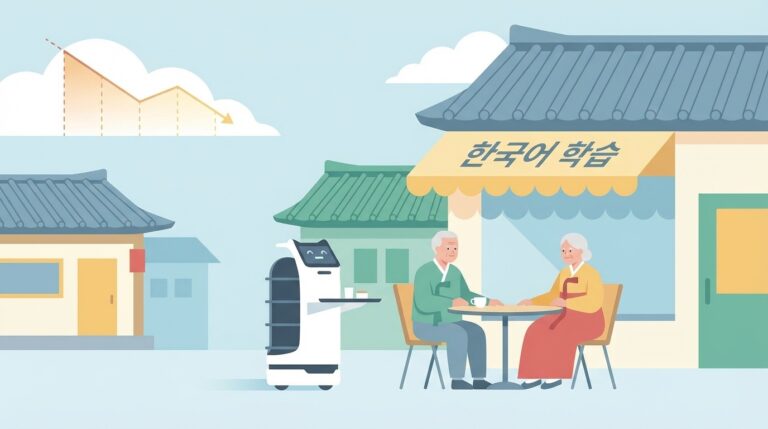
Imagine this: You are watching a high-stakes corporate K-Drama. The dashing CEO stands in front of a boardroom, aggressively pointing his laser pointer at a graph plummeting downward. The subtitles simply say, “Our economy is slowing down.” But if you listen closely, he says something much heavier: “인구 절벽 (Demographic cliff).” Or maybe you’re visiting Seoul, craving some famous samgyeopsal (pork belly). You walk into a restaurant, but instead of an energetic university student yelling “Welcome!”, a polite robot wheels over to take your order.
What happened to the vibrant, bustling Korea you’ve seen in music videos?
Welcome to C2-level Korean, where we move beyond ordering coffee and dive into the actual conversations Koreans are having at dinner tables, in taxis, and in boardrooms. Today, we are tackling the elephant in the room: Korea’s declining working-age population and slowing economic growth. Understanding these socio-economic shifts is your golden ticket to truly understanding modern Korean society. Let’s dive into the words behind the headlines!
Phase 2: Core Expressions Deep Dive
1. 인구 절벽에 직면하다
- Pronunciation: ingu jeolbyeoge jingmyeonhada [in-goo jeol-byeog-eh jing-myeon-ha-da]
- Meaning: Literal: To face a population cliff / Real Nuance: To hit a critical point of demographic decline.
- K-Culture Moment: This is the exact phrase you’ll hear on the YTN news playing in the background of every local gukbap restaurant. It describes the sudden, steep drop in the working-age population.
- Editor’s Insight: The word ‘절벽’ (cliff) gives this a visceral feeling of impending doom. It’s not just a gradual decline; it feels like falling off a ledge.
- Situation Spectrum:
- Casual with friends: ✅ (Usually to complain about the future)
- Coworkers (Semi-formal): ✅
- Boss/Elders (Formal): ✅ (Perfect for intellectual discussions)
- 🤔 Think About It: Why does Korean media love dramatic metaphors like ‘cliff’ (절벽) or ‘swamp’ (늪) to describe economic data? How does your language express sudden societal shifts?
2. 일손 구하기가 하늘의 별 따기예요
- Pronunciation: ilson guhagiga haneurui byeol ttagiyeyo [il-son goo-ha-gi-ga ha-neul-ui byeol tta-gi-yeh-yo]
- Meaning: Literal: Finding a working hand is like picking a star from the sky / Real Nuance: It’s virtually impossible to find staff these days.
- K-Culture Moment: You’re chatting with the owner of your favorite neighborhood cafe. They look exhausted. This idiom perfectly captures the struggles of small business owners facing the youth labor shortage.
- Editor’s Insight: ‘일손’ directly translates to ‘working hands.’ It emphasizes physical presence and labor, making the economic issue feel deeply personal and grounded.
- Situation Spectrum:
- Casual with friends: ✅
- Coworkers (Semi-formal): ✅
- Boss/Elders (Formal): ⚠️ (A bit too colloquial for an official boardroom presentation, but great for a post-meeting dinner)
- 🤔 Think About It: “Picking a star from the sky” is an old idiom for an impossible task. How does combining traditional idioms with modern economic crises enrich a language?
3. 저성장 기조가 굳어지다
- Pronunciation: jeoseongjang gijoga gudeojida [jeo-seong-jang gi-jo-ga goo-deo-ji-da]
- Meaning: Literal: The foundation of low growth is solidifying / Real Nuance: Low economic growth is becoming the permanent new normal.
- K-Culture Moment: This is what the older, cynical company director says during a hoesik (company dinner) when discussing the lack of bonuses this year.
- Editor’s Insight: At the C2 level, using ‘기조’ (trend/basis) instead of just saying ‘상황’ (situation) instantly elevates your Korean from “fluent” to “highly educated professional.”
- Situation Spectrum:
- Casual with friends: ⚠️ (Might sound too much like a news anchor)
- Coworkers (Semi-formal): ✅
- Boss/Elders (Formal): ✅
- 🤔 Think About It: Korea experienced explosive “Miracle on the Han River” growth for decades. How does the word ‘굳어지다’ (to solidify/harden) reflect the psychological shock of this era ending?
Phase 3: Textbook vs. Real Korean
[Discussing the lack of younger staff]
* 📖 Textbook Korean: 일할 젊은 사람들이 부족합니다. (There is a lack of young people to work.)
* 🗣️ Real Korean: 요즘 알바생 구하는 건 포기했어요. 다 키오스크로 돌렸죠. (I gave up looking for part-timers these days. Switched everything to kiosks.)
* 💡 Why the difference?: Real Korean focuses on the practical workaround (kiosks) rather than just stating the demographic fact.
[Talking about the economic slowdown]
* 📖 Textbook Korean: 한국의 경제 성장률이 하락하고 있습니다. (Korea’s economic growth rate is dropping.)
* 🗣️ Real Korean: 경기가 예전 같지 않아요. 다들 지갑을 닫는 분위기예요. (The economy isn’t like before. The mood is that everyone is closing their wallets.)
* 💡 Why the difference?: “Closing one’s wallet” (지갑을 닫다) is the standard native idiom for reducing consumer spending during tough economic times.
Phase 4: Cultural Context — K-Culture Deep Dive
4-1. The Non-Verbal Weight of the Economy
When discussing topics like the population cliff or the economy with older Koreans, you will often hear a deep, heavy sigh (한숨) accompanied by a subtle clicking of the tongue (쯧쯧). In Korean Nunchi culture, joining in this shared lamentation over the nation’s future builds instant rapport. You don’t always need a counter-argument; sometimes, a sympathetic nod is the most fluent response.
4-2. K-Food & Travel: The Rise of the Machine
Because of the massive drop in the working-age population (생산 연령 인구 감소), Korea’s service industry has undergone a radical transformation. You might expect K-Drama-style interactions in cafes, but the reality is Kiosk Culture (키오스크 문화) and Serving Robots (서빙 로봇). Small restaurants simply cannot find enough young people to work as waitstaff. When you travel to Korea, understanding the demographic crisis explains why a country famous for its warm Jeong (정 – human connection) is rapidly automating its hospitality sector.
Phase 5: Real-world Roleplay Scenario
Setting: 8:00 PM on a Thursday. A classic Hoesik (company dinner) in an old-school BBQ joint in Jongno. You are an expat manager at a Korean firm. You are sitting next to Director Park, a 50-something company veteran who is grilling the pork belly while lamenting the latest recruitment drive.
Characters:
– YOU: The observant expat manager who understands the socio-economic undercurrents.
– Director Park (박 부장): Stressed about the company’s future, a bit nostalgic for the “good old days.”
Dialogue:
박 부장: 후우… 이번 공채 지원율 봤어요? 예전에는 이력서가 산더미처럼 쌓였는데.
(Huu… ibeon gongchae jiwonyul bwasseoyo? Yejeoneneun ireokseoga sandeomicheoreom ssayeonneunde.)
[Sigh… did you see the application rates for this open recruitment? Back in the day, resumes used to pile up like a mountain.]
(🎭 Stage Direction: Director Park pours himself a shot of Soju, looking defeated.)
YOU: 네, 저도 보고 깜짝 놀랐습니다. 확실히 인구 절벽이 현실로 다가온 것 같네요.
(Ne, jeodo bogo kkamjjak nollatseumnida. Hwaksilhi ingu jeolbyeogi hyeonsillo dagaon geot gatneyo.)
[Yes, I was surprised when I saw it too. It really seems the demographic cliff has become a reality.]
박 부장: 내 말이 그 말이에요! 생산 연령 인구가 줄어드니 일할 젊은 친구들이 씨가 말랐어요.
(Nae mari geu marieyo! Saengsan yeollyeong inguga jureodeuni ilhal jeolmeun chingudeuri ssiga mallasseoyo.)
[That’s exactly what I’m saying! With the working-age population shrinking, young people willing to work have dried up (disappeared).]
YOU: 게다가 저성장 기조까지 굳어지니까, 회사 입장에서도 고민이 많으시겠어요.
(Gedaga jeoseongjang gijokkaji gudeojinikka, hoesa ipjangeseodo gomini maneusigesseoyo.)
[Plus, with the low-growth trend solidifying, you must have a lot of worries from the company’s perspective.]
박 부장: 캬, 역시 우리 팀장님이 한국 경제 흐름을 꿰뚫고 있네. 자, 한잔 합시다!
(Kya, yeoksi uri timjangnimi hanguk gyeongje heureumeul kkwettulgo inne. Ja, hanjan hapsida!)
[Wow, our team leader really sees right through the flow of the Korean economy. Come on, let’s have a drink!]
🔀 Your Turn! How do you respond to the toast?
– A) “아닙니다, 제가 뭘 안다고요. 짠!” (Humble and safe)
– B) “부장님이 잘 이끌어주신 덕분이죠. 앞으로 혁신으로 위기를 극복해 보시죠!” (Corporate but flattering, building morale)
– C) “진짜 나라 망할 것 같아요. 큰일이네요.” (Too cynical, kills the mood)✅ Best Choice: B — At a C2 level in a business setting, acknowledging the problem but offering a respectful, forward-looking toast shows impeccable Nunchi and leadership.
⚠️ Choice C Analysis: While Koreans complain about the economy, being overly doom-and-gloom as an expat can make the locals uncomfortable. Keep it analytical but empathetic.
Phase 6: 10-Second Shadowing Drill
Practice your news anchor intonation! Keep your voice steady and authoritative.
😤 생산 연령 인구가 / 감소하면서, / 경제의 활력도 / 예전만 못하네요.
(saengsan yeollyeong inguga / gamsohamyeonseo, / gyeongjeui hwallyeokdo / yejeonman mothaneyo.)
“With the working-age population shrinking, the economy’s vitality isn’t what it used to be.”
Phase 7: K-Culture Mini Dictionary
| Korean | Romanization | English | Context |
|---|---|---|---|
| 고령화 사회 | goryeonghwa sahoe | Aging society | A frequent topic in Korean news, driving policy changes. |
| 저출산 | jeochulsan | Low birth rate | The root cause of the demographic cliff. Often debated in politics. |
| 공채 | gongchae | Open recruitment | The traditional Korean corporate hiring system, now struggling for applicants. |
| 키오스크 | kioseukeu | Kiosk | Self-ordering machines that have replaced human labor in almost all cafes/fast food joints. |
| 3D 업종 | sseuri-di eopjong | Dirty, Dangerous, Difficult jobs | Blue-collar sectors suffering the most acute labor shortages. |
Phase 8: Traveler’s Survival Kit
Because of the labor shortage, you will interact with fewer humans and more machines. Surviving “Kiosk Korea” is essential!
🆘 Survival Phrases for the Automated Era
– 🇰🇷 “여기 키오스크 주문만 되나요?” (yeogi kioseukeu jumunman doenayo?) – Do you only take kiosk orders here?
– 🇰🇷 “직원 호출 버튼이 어디 있어요?” (jigwon hochul beoteuni eodi isseoyo?) – Where is the staff call button?
– 🇰🇷 “이거 품절로 나오는데, 진짜 없나요?” (igeo pumjeollo naoneunde, jinjja eomnayo?) – This shows as sold out [on the machine], are you really out?
– 📍 Where to use: Fast food chains, local cafes, modern restaurants.
– 💡 Pro Tip: Look for the language toggle (usually a globe icon or “KOR/ENG”) at the top right of the kiosk screen. But beware, some local spots only have Korean menus on their machines!📌 Editor’s Travel Note
The lack of young labor means 24-hour shops are becoming rare. That romantic idea of eating ramyeon at a 24/7 convenience store at 3 AM? Many stores are now “unmanned” (무인관) overnight. You need a Korean credit card to swipe to unlock the door!
Phase 9: Critical Thinking Corner — “One Step Deeper”
🧠 Think Deeper: Media vs Reality (미디어와 현실의 괴리)
If you consume K-Pop and K-Dramas, South Korea looks like a playground of endless youth, vibrant street fashion, and dynamic energy. Yet, the reality is a rapidly aging society where rural elementary schools are being converted into senior welfare centers. This contrast creates a fascinating dichotomy. While Korea exports “youth” globally through its cultural products, domestically, it is managing a “silver economy.” As an advanced Korean speaker, recognizing this gap allows you to see the real Korea—not just the glossy export version, but a resilient society navigating unprecedented demographic waters.
💬 Your Turn: Does your country’s global media image hide a very different domestic reality? Share your thoughts in the comments using advanced Korean!
Phase 10: FAQ & Avoiding Mistakes
Q: Is it okay to bring up the “low birth rate” or “bad economy” with Korean locals?
Yes! In fact, the economy and real estate are two of the most common icebreakers among adults in Korea. Commiserating about how expensive things are (물가가 너무 비싸요) or how hard it is to find jobs/workers is a national bonding activity.
Q: Can I use ‘절벽’ (cliff) for other situations?
It’s usually reserved for data trends (소비 절벽 – consumption cliff, 인구 절벽 – demographic cliff). Don’t use it to say you are tired (e.g., 체력 절벽 – wrong!).
❌ Common Mistake #1: Translating “economic growth” literally from English idioms without the proper Korean verbs.
✅ Do this instead: Pair ‘경제 성장률’ (economic growth rate) with ‘하락하다’ (to drop/decline) or ‘둔화되다’ (to slow down). Don’t say 경제가 짧아진다 (The economy is getting short – incorrect!).
Phase 11: Summary & Action Items
One-Liner Summary: To master advanced business and social discussions in Korea, you must understand the vocabulary of its biggest challenge: the demographic cliff (인구 절벽) and economic slowdown.
Action Mission:
– 🥉 Bronze (Solo): Read the phrases “인구 절벽에 직면하다” and “저성장 기조” out loud 3 times with the gravity of a news anchor.
– 🥈 Silver (Online): Go to Naver News (Economy Section) and try to spot the words 인구 (Population) or 성장률 (Growth rate) in the headlines.
– 🥇 Gold (Real World): The next time you are at a cafe entirely run by a kiosk, strike up a conversation with a Korean friend about how the “인구 절벽” is changing daily life.
K-Culture Mission: Watch a recent K-Drama involving a corporate setting (like Queen of Tears or Reborn Rich). Keep an ear out for the boardroom scenes—you are almost guaranteed to hear them discussing 성장률 (Growth rate)!
Phase 12: Interactive Challenge Quiz
1. Fill in the Blank:
우리 회사는 젊은 인재를 뽑고 싶지만, 요새는 정말 일손 구하기가 ( ________ ) 따기예요.
A) 바다의 진주 (Pearl in the sea)
B) 하늘의 별 (Star in the sky)
C) 산의 버섯 (Mushroom in the mountain)
2. True or False – K-Culture Edition:
Because of the declining youth population, finding 24-hour convenience stores manned by human staff late at night is becoming harder in Korea. (T/F)
3. Situational Judgment:
You are having dinner with your Korean boss. He says, “생산 인구가 줄어서 나라 경제가 참 걱정입니다.” (I’m worried about the national economy because the working population is shrinking.) What is the most culturally appropriate C2-level response?
A) “걱정 마세요! 다 잘 될 거예요! 웃으세요!” (Don’t worry! Everything will be fine! Smile!)
B) “맞아요. 저성장 기조가 굳어질까 봐 우려되네요.” (You’re right. I’m concerned the low-growth trend will solidify.)
C) “저는 외국인이라서 잘 몰라요.” (I don’t know because I’m a foreigner.)
(Check your answers by highlighting the space below!)
[Answers: 1: B, 2: True, 3: B. (A is too casually optimistic for a serious Korean business conversation, and C dismisses the opportunity to connect.)]
Frequently Asked Questions (FAQ)
Q: What does "인구 절벽에 직면하다" mean in Korean and how do you pronounce it?
A: In Korean, "인구 절벽에 직면하다" is pronounced [ingu jeolbyeoge jingmyeonhada [in-goo jeol-byeog-eh jing-myeon-ha-da] and means: Literal: To face a population cliff / Real Nuance: To hit a critical point of demographic decline.
Q: What does "일손 구하기가 하늘의 별 따기예요" mean in Korean and how do you pronounce it?
A: In Korean, "일손 구하기가 하늘의 별 따기예요" is pronounced [ilson guhagiga haneurui byeol ttagiyeyo [il-son goo-ha-gi-ga ha-neul-ui byeol tta-gi-yeh-yo] and means: Literal: Finding a working hand is like picking a star from the sky / Real Nuance: It's virtually impossible to find staff these days.
Q: What does "저성장 기조가 굳어지다" mean in Korean and how do you pronounce it?
A: In Korean, "저성장 기조가 굳어지다" is pronounced [jeoseongjang gijoga gudeojida [jeo-seong-jang gi-jo-ga goo-deo-ji-da] and means: Literal: The foundation of low growth is solidifying / Real Nuance: Low economic growth is becoming the permanent new normal.






