

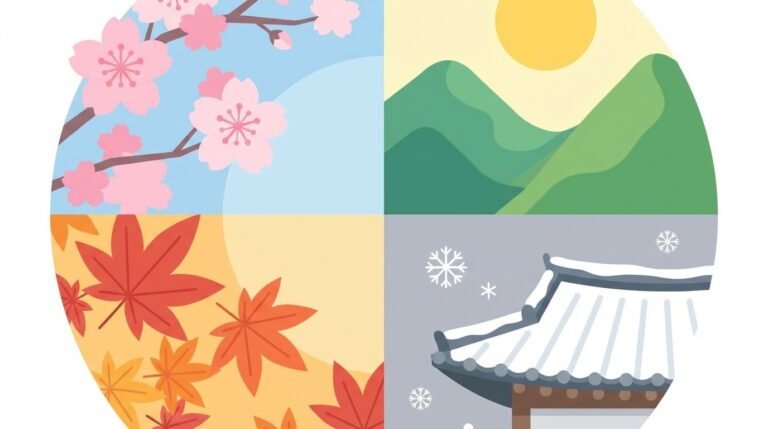
Phase 1: Empathy (Immersive K-Culture Open)
Hello there! I’m the lead editor of Daily Hangul, your personal guide to the Korean language and culture.
Picture this: You’re watching a K-Drama. The main characters are standing outside, suddenly looking up at the sky. A single snowflake falls on the protagonist’s eyelash. The romantic OST kicks in, and they say something like, “It’s the first snow…” Or maybe it’s pouring rain, and suddenly, everyone in the drama is eating crispy Pajeon (scallion pancakes) and drinking Makgeolli (rice wine).
Have you ever wondered why weather is such a huge deal in Korea? Weather isn’t just small talk here; it’s a lifestyle, a romantic plot device, and even a menu decider!
As a tutor who has lived in Seoul for over 10 years, I’ve seen countless students learn to say “It is sunny” from a textbook, but then freeze up when a local barista makes a joke about the Jangma (monsoon season) humidity. In this unit, we’re going to look at how to describe Korea’s four seasons (사계절) like a true local at an A2 (Beginner) level.
Note: The insights below are gathered from real A2 learners who survived their first Korean summer and winter!
Phase 2: Core Expressions Deep Dive
1. 한국은 사계절이 뚜렷해요.
- Pronunciation: hangugeun sagyejeori tturyeotaeyo. (The ‘eu’ in hangugeun sounds like the disgusted sound you make when you step in wet gum!)
- Meaning: Korea has four distinct seasons. (Literal: Korea’s four seasons are distinct.)
- K-Culture Moment: If you talk to a Korean local for more than 5 minutes about your home country, there is a 99% chance they will proudly tell you this exact sentence. It is a source of national pride!
- Editor’s Insight: This isn’t just a weather fact; it’s a social icebreaker. Memorize this phrase, and you will instantly impress any Korean taxi driver or restaurant owner.
- Situation Spectrum:
- Casual with friends: ✅ (Though you might say 뚜렷해 instead of 뚜렷해요)
- Semi-formal with colleagues: ✅
- Formal with elders: ✅
- 🤔 Think About It: Why do you think Koreans are so proud of having four distinct seasons? Could it be related to how dynamically their fashion and seasonal foods change every 3 months?
2. 여름은 너무 덥고 습해요.
- Pronunciation: yeoreumeun neomu deopgo seuphaeyo.
- Meaning: Summer is too hot and humid.
- K-Culture Moment: In July and August, you’ll hear this phrase echoed everywhere—from crowded subways to K-Pop idols’ live streams when they complain about shooting MVs outdoors.
- Editor’s Insight: The keyword here is 습해요 (humid). Knowing the word for hot (덥다) is A1, but knowing the word for humid (습하다) elevates you to a true survivor of the Korean summer.
- Situation Spectrum:
- Casual with friends: ✅
- Semi-formal with colleagues: ✅
- Formal with elders: ⚠️ (Better to say “여름 날씨가 무덥습니다” in a very formal setting)
- 🤔 Think About It: In many Western cultures, complaining about the weather can seem negative. In Korea, complaining about the heat together is actually a bonding activity. Do you bond over weather complaints in your country?
3. 겨울에는 눈이 와서 예뻐요.
- Pronunciation: gyeoureneun nuni waseo yeppeoyo.
- Meaning: In winter, it snows, so it’s pretty.
- K-Culture Moment: This is the ultimate K-Drama phrase. Winter isn’t just cold; it’s the season of romance, couples sharing hot packs (핫팩), and walking through snow-covered palaces in Seoul.
- Editor’s Insight: The grammar
A/V + 아/어서means “Because [A], [B] happens.” By linking “it snows” and “it’s pretty,” you sound much more natural than just saying “It snows. It is pretty.”- Situation Spectrum:
- Casual with friends: ✅
- Semi-formal with colleagues: ✅
- Formal with elders: ✅
- 🤔 Think About It: Koreans often associate the “first snow” (첫눈) with granting wishes and true love. What weather phenomenon holds magical or romantic meaning in your culture?
Phase 3: Textbook vs. Real Korean
[Describing Extreme Heat]
* 📖 Textbook Korean: 날씨가 매우 덥습니다. (The weather is very hot.)
* 🗣️ Real Korean: 오늘 진짜 쪄요! (Today is boiling/steaming!)
* 💡 Why the difference?: Koreans love using food metaphors. “쪄요” comes from “찌다” (to steam), perfectly describing the sauna-like humidity of the Korean monsoon season.
[Describing the Cold]
* 📖 Textbook Korean: 겨울은 춥습니다. (Winter is cold.)
* 🗣️ Real Korean: 오늘 완전 칼바람이에요. (Today is a knife-wind.)
* 💡 Why the difference?: The Siberian winds in January feel like they are cutting your skin, so locals use the vivid slang “칼바람” (knife + wind).
[Talking About Autumn]
* 📖 Textbook Korean: 가을 날씨가 좋습니다. (Autumn weather is good.)
* 🗣️ Real Korean: 날씨가 딱 좋아요! (The weather is exactly/perfectly good!)
* 💡 Why the difference?: “딱” is a magical adverb that means “exactly” or “just right.” It adds a satisfying emotional flavor to your sentence.
Bottom Note: At an A2 level, you don’t need to use intense slang. Slipping in a simple “진짜” (really) or “딱” (exactly) will make you sound 10x more natural than a textbook!
Phase 4: Cultural Context — K-Culture Deep Dive
4-1. Non-Verbal Communication: Surviving the Seasons
When talking about the weather in Korea, your actions speak as loud as words.
– In Summer: You will see everyone carrying a mini handheld fan (손선풍기). Pulling one out while saying “너무 더워요” (It’s so hot) is peak local behavior.
– In Winter: Koreans survive on “Hot Packs” (핫팩). If a Korean friend or colleague hands you a warm hot pack while saying “날씨가 춥죠?” (It’s cold, right?), it is a major sign of Jeong (정 – deep affection/connection).
4-2. K-Food Connection: Eating the Weather
Koreans eat according to the weather.
– Rainy Days: Why do Koreans eat Pajeon (pancakes) on rainy days? It’s said that the sizzling sound of the batter in the frying pan sounds exactly like raindrops hitting the roof!
– Summer Heat: Instead of eating ice cream to cool down, Koreans eat boiling hot Samgyetang (Ginseng Chicken Soup) on the hottest days of summer. This is called 이열치열 (Fighting heat with heat). The idea is that sweating out the heat restores your internal energy.
– Critical Viewpoint: Why do Koreans share these specific seasonal meals? Korea has a strong collective culture. Eating the “correct” seasonal food together reinforces a sense of belonging.
Phase 5: Real-World Roleplay Scenario
Setting: It is mid-July in Seoul. You and your Korean colleague, Minsu, just stepped out of the office for lunch. The sun is blazing, and the humidity hits you like a wet towel. Cicadas are buzzing loudly in the background.
Characters:
– YOU: An expat working in Korea, experiencing your first real Korean summer.
– Minsu (32): Your friendly Korean colleague who wants to make sure you survive the heat.
Dialogue:
YOU: 아, 밖은 너무 더워요! 🥵
(A, bakkeun neomu deowoyo!)
[Ah, it’s so hot outside!]
Minsu: 맞아요. 한국 여름은 엄청 덥고 습해요. 괜찮아요?
(Majayo. Hanguk yeoreumeun eomcheong deopgo seuphaeyo. Gwaenchanayo?)
[That’s right. Korean summer is super hot and humid. Are you okay?]
YOU: 네, 근데 땀이 너무 많이 나요.
(Ne, geunde ttami neomu mani nayo.)
[Yes, but I’m sweating so much.]
Minsu: 7월은 원래 그래요. 그래서 오늘 점심은 특별한 걸 먹어야 해요.
(Chirworeun wollae geuraeyo. Geuraeseo oneul jeomsimeun teukpyeolhan geol meogeoya haeyo.)
[July is always like this. So we have to eat something special for lunch today.]
YOU: 특별한 거요? 뭐가 좋아요?
(Teukpyeolhan geoyo? Mwoga joayo?)
[Something special? What is good?]
Minsu: 더울 때는 ‘이열치열’이에요. 뜨거운 삼계탕 어때요? 🐔
(Deoul ttaeneun ‘iyeolchiyeol’ieyo. Tteugeoun samgyetang eottaeyo?)
[When it’s hot, it’s ‘fight heat with heat’. How about hot ginseng chicken soup?]
🔀 Your Turn! How do you reply?
– A) “삼계탕 좋아요! 가요!” (Sounds good! Let’s go!)
– B) “네? 날씨가 더운데 왜 뜨거운 걸 먹어요? 전 냉면(cold noodles) 먹고 싶어요!”
– C) “삼계탕은 맛없어요.”✅ Best Choice: B — Reason: It’s perfectly fine to express your preference, and joking about the “hot soup in hot weather” culture shows you are engaging with it! Minsu will probably laugh and agree to Naengmyeon.
⚠️ Choice C Analysis: Saying food is “맛없어요” (tastes bad) directly to someone who suggested it can sound a bit rude in Korean culture. It’s better to say what you prefer instead of what you dislike.
Minsu: 하하, 아직 이열치열을 모르시네요! 그럼 오늘은 시원한 냉면 먹으러 갑시다!
(Haha, ajik iyeolchiyeoreul moreusineyo! Geureom oneureun siwonhan naengmyeon meogeureo gapsida!)
[Haha, you don’t know ‘fight heat with heat’ yet! Then let’s go eat cold noodles today!]
YOU: 와, 감사합니다. 시원한 냉면 최고예요!
(Wa, gamsahamnida. Siwonhan naengmyeon choegoyeyo!)
[Wow, thank you. Cold noodles are the best!]
Minsu: 빨리 가요. 에어컨 있는 식당이 천국이에요.
(Ppalli gayo. Eoeokeon inneun sikdangi cheongugieyo.)
[Let’s go quickly. A restaurant with AC is heaven.]
Bonus K-Culture Roleplay: The K-Drama Text Message
Setting: It’s late November. You are looking out the window, and snow is falling for the first time this year.
Friend: ❄️ 밖에 첫눈 와요!! 봤어요?
(Bakke cheonnun wayo!! Bwasseoyo?)
[The first snow is falling outside!! Did you see?]
YOU: 네! 올해 첫눈이네요. 예뻐요.
(Ne! Olhae cheonnunineyo. Yeppeoyo.)
[Yes! It’s the first snow of the year. It’s pretty.]
Friend: 첫눈 오니까 우리 치맥(Chicken & Beer) 할까요?
(Cheonnun onikka uri chimaek halkkayo?)
[Since it’s the first snow, should we have Chimaek?]
Phase 6: 10-Second Shadowing Drill
Practice speaking like a local. Follow the slashes / for pauses, and try to match the emotion!
- 😮 (Surprised by the heat): 아, / 오늘 날씨가 / 너무 덥고 / 습해요!
(A, / oneul nalssiga / neomu deopgo / seuphaeyo!) -
😌 (Proudly explaining): 한국은 / 사계절이 / 아주 뚜렷해요.
(Hangugeun / sagyejeori / aju tturyeotaeyo.) -
😊 (Romantic K-Drama vibe): 겨울에는 / 눈이 와서 / 정말 예뻐요.
(Gyeoureneun / nuni waseo / jeongmal yeppeoyo.)
Phase 7: K-Culture Mini Dictionary
| Korean | Romanization | English Translation | Context & Usage |
|---|---|---|---|
| 첫눈 | cheonnun | First snow | Culturally romanticized. People often make promises to meet loved ones on this day. |
| 장마 | jangma | Monsoon season | Usually mid-June to late July. High humidity and heavy rain. |
| 이열치열 | iyeolchiyeol | Fight heat with heat | A traditional health concept of eating hot/spicy food during summer. |
| 단풍 | danpung | Autumn foliage | Koreans love going hiking in autumn to see the red and yellow leaves (단풍놀이). |
| 핫팩 | hatpaek | Hot pack / Hand warmer | Essential winter survival item sold in every convenience store. |
Phase 8: Traveler’s Survival Kit
If you are traveling to Korea, the weather can drastically change your plans. Here are the survival phrases you need:
🆘 Survival Expression #1: Buying an Umbrella
– 🇰🇷 “우산 하나 주세요.” (usan hana juseyo.)
– 🗣️ English Pronunciation: Oo-san ha-na joo-se-yo.
– 📍 Where to use: Convenience stores (CU, GS25, 7-Eleven) during unexpected monsoon rain.
– 💡 Pro Tip: Convenience stores sell transparent plastic umbrellas (비닐우산) very cheaply!🆘 Survival Expression #2: Asking for AC
– 🇰🇷 “에어컨 좀 틀어주세요.” (eeokeon jom teureojuseyo.)
– 🗣️ English Pronunciation: Eh-eo-keon jom teu-reo-joo-se-yo.
– 📍 Where to use: Taxis, small restaurants.🆘 Survival Expression #3: Wanting something cold
– 🇰🇷 “시원한 물 있어요?” (siwonhan mul isseoyo?)
– 🗣️ English Pronunciation: Shi-won-han mool is-seo-yo?
– 📍 Where to use: Cafes, restaurants in summer.📌 Editor’s Travel Note
– Weather Apps: Don’t just use your default phone app. Download Naver Weather (네이버 날씨) for hyper-local accuracy in Korea, especially for checking fine dust (미세먼지) levels!
– Fine Dust: In Spring, you might hear “미세먼지 조심하세요” (Be careful of fine dust). Always buy a KF94 mask at the pharmacy if the sky looks hazy.
Phase 9: Critical Thinking Corner — “A Step Deeper”
🧠 Think Deeper: Food & Identity (음식과 정체성)
Why do Koreans share hot soup in the dead of summer, or universally crave pancakes when it rains? In Korea, food is rarely just fuel—it is a deeply ingrained communal ritual. The seasons dictate these rituals. By participating in Iyeolchiyeol (eating Samgyetang in summer), you aren’t just adjusting to the weather; you are aligning your body’s rhythm with the community’s rhythm. It’s a way of saying, “We are enduring this harsh season together.”
💬 Your Turn: Does your culture have specific foods that everyone absolutely must eat during a certain season or weather condition? Share it in the comments below!
Phase 10: FAQ & Avoiding Mistakes
Q: Can I use “더워요” to describe my hot coffee?
No! This is the most common A2 mistake.
– 덥다 (deopda): Hot weather/temperature of the air.
– 뜨겁다 (tteugeopda): Hot to the touch (like coffee, soup, or a stove).
Q: Is it okay to talk about the weather with a taxi driver I just met?
Yes! In fact, it is highly encouraged. Saying “오늘 날씨가 정말 좋네요” (The weather is really nice today) is the safest and most polite icebreaker in Korea.
❌ Common Mistake #1: Saying “여름 덥습니다” without subject particles.
✅ Do this instead: Always say “여름은 덥습니다” (As for summer, it is hot). The topic particle ‘은/는’ is crucial when comparing the four seasons.❌ Common Mistake #2: Complaining about the cold by saying “나 추워요” (I am cold) to a boss.
✅ Do this instead: “나” is informal. If you are talking to someone older, say “저(는) 추워요” or simply “날씨가 춥네요” (The weather is cold, isn’t it?).
Phase 11: Summary & Action Items
One-Liner Summary: To connect with locals, remember that Korea takes immense pride in its four distinct seasons (사계절), and describing them is your ultimate conversation starter!
Action Mission 3 Steps:
– 🥉 Bronze (Solo): Look out your window right now and describe the season in Korean out loud using the Noun + 은/는 + Adjective + 아/어요 structure.
– 🥈 Silver (Online): Go to your favorite K-Pop idol’s social media. If they post a picture outside, comment: “날씨가 좋네요!” (The weather is nice!).
– 🥇 Gold (Real World): Next time you enter a Korean restaurant or cafe, say “아~ 너무 더워요/추워요” (Ah~ it’s so hot/cold) to the owner. Watch how quickly they nod in agreement!
🎬 K-Culture Mission:
Watch one episode of any K-Drama today. I guarantee you will spot at least one scene where characters comment on the first snow, the rain, or the summer heat. Take a screenshot and mentally translate it!
Phase 12: Quiz — Interactive Challenge
1. Situational Judgment:
You are in a taxi in August. You are sweating a lot. What is the most natural thing to say to the driver?
– A) 기사님, 뜨거워요. (Driver, it’s hot.)
– B) 기사님, 에어컨 좀 틀어주세요. (Driver, please turn on the AC.)
– C) 기사님, 겨울이 좋아요. (Driver, I like winter.)
Hint: Remember the difference between air temperature and touching something hot! (Answer: B)
2. Fill in the Blank:
한국은 봄, 여름, 가을, 겨울이 있어요. 한국은 ( _____ )이 뚜렷해요.
Hint: The word for “Four Seasons”. (Answer: 사계절)
3. True or False — K-Culture Edition:
“Koreans eat cold ice cream as their primary traditional method to beat the extreme summer heat.” (True / False)
Hint: Remember the concept of 이열치열 (Fighting heat with heat). (Answer: False. They traditionally eat hot Samgyetang!)
4. Roleplay Prediction:
If you complain about the rain to a Korean friend, what food are they most likely to suggest for dinner?
Hint: Think about the sizzling sound. (Answer: Pajeon / Scallion Pancakes!)
Frequently Asked Questions (FAQ)
Q: What does "한국은 사계절이 뚜렷해요." mean in Korean and how do you pronounce it?
A: In Korean, "한국은 사계절이 뚜렷해요." is pronounced [hangugeun sagyejeori tturyeotaeyo. (The 'eu' in hangugeun sounds like the disgusted sound you make when you step in wet gum!] and means: Korea has four distinct seasons. (Literal: Korea's four seasons are distinct.)
Q: What does "여름은 너무 덥고 습해요." mean in Korean and how do you pronounce it?
A: In Korean, "여름은 너무 덥고 습해요." is pronounced [yeoreumeun neomu deopgo seuphaeyo.] and means: Summer is too hot and humid.
Q: What does "겨울에는 눈이 와서 예뻐요." mean in Korean and how do you pronounce it?
A: In Korean, "겨울에는 눈이 와서 예뻐요." is pronounced [gyeoureneun nuni waseo yeppeoyo.] and means: In winter, it snows, so it's pretty.







