

Phase 1: Empathy (The K-Culture Cold Open)
Hello, C2 learners! I’m your Head Editor at Daily Hangul, your veteran tutor and local Seoulite navigator.
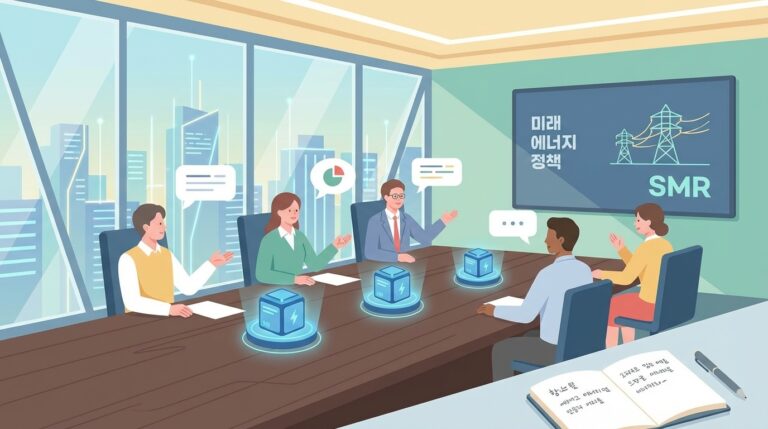
Picture this: You are watching a high-stakes corporate K-Drama like Misaeng or Itaewon Class. The executives are sitting around a sleek boardroom table in Yeouido, or perhaps in a private room of a high-end Hanwoo (Korean beef) restaurant. The tension is palpable. The topic? The future of the company’s energy infrastructure. The subtitles simply read: “Is this really profitable?” But the Korean spoken was: “이게 타산이 맞습니까? (Ige tasani matseumnikka?)”
If you are operating at a C2 level in Korea—whether as a business consultant, a tech researcher, or an advanced language enthusiast—you aren’t just ordering coffee anymore. You are discussing global paradigm shifts, such as the Energy Policy (에너지 정책) and the Safety and Economics of Small Modular Reactors (소형 모듈 원자로 – SMR).
Discussing nuclear tech in Korean might sound intimidating, but don’t worry. I’ve designed this guide based on real experiences of foreign executives and diplomats I’ve tutored. We are going to blend high-level technical vocabulary with the subtle art of Korean Nunchi (눈치) so you can command the room like a true K-Drama protagonist. Let’s dive in!
Phase 2: Core Expressions Deep Dive
To discuss SMRs at a master level, you need to understand both the technical jargon and the rhetorical devices used to persuade Korean professionals.
1. 타산이 맞다 / 경제성이 확보되다
- Pronunciation: [tasan-i mat-da] / [gyeongje-seong-i hwakbo-doeda]
- Sound-alike guide: Ta-san sounds like “Tah-san” (rhymes with Tarzan). Hwak-bo sounds like a quick “hwak” (like clearing your throat) + “bow.”
- Meaning: (Literal) Calculations match / Economic nature is secured. (Real nuance) It is economically viable / It makes business sense.
- K-Culture Moment: In a corporate K-Drama, an older, skeptical executive will cross his arms, lean back, and ask, “근데, 이거 타산이 맞긴 합니까?” (But, does this actually make financial sense?) It’s the ultimate test of your proposal.
- Editor’s Insight: 타산이 맞다 is a slightly more colloquial but highly respected idiom in business. 경제성이 확보되다 is what you write in your official PowerPoint deck regarding the lower initial capital costs of SMRs.
- Situation Spectrum:
- Casual Business (with close colleagues): ✅
- Semi-formal (Team meetings): ✅
- Formal (Boardroom presentations): ⚠️ (Use ‘경제성이 확보되다’ for the presentation, ‘타산이 맞다’ during the Q&A).
- 🤔 Think About It: Why does Korean business language differentiate so heavily between spoken boardroom debate (타산이 맞다) and written reports (경제성을 확보하다)? Does your language have a similar split?
2. 안전망을 겹겹이 구축하다
- Pronunciation: [anjeonmang-eul gyeopgyeobi guchuk-hada]
- Sound-alike guide: Gyeop-gyeop-i sounds like “gyup-gyup-ee” (yup with a G).
- Meaning: (Literal) To build safety nets layer by layer. (Real nuance) To implement multi-layered, robust safety measures.
- K-Culture Moment: Imagine a press conference. After a controversy, the CEO steps up, bowing slightly, and uses this exact phrase to reassure the public. It evokes a sense of meticulous, painstaking care.
- Editor’s Insight: SMRs are praised for their passive safety systems. Using the adverb 겹겹이 (layer by layer) adds a highly sophisticated, almost poetic emphasis to your technical explanation, showing you understand the emotional weight of safety in Korean society.
- Situation Spectrum:
- Casual: 🚫 (Too formal/poetic for daily life)
- Semi-formal: ✅
- Formal: ✅
- 🤔 Think About It: “겹겹이” is an evocative mimetic word (의태어). Why do you think high-level Korean rhetoric still heavily relies on poetic mimetic words even in hard science and engineering?
3. 판도를 뒤바꿀 게임 체인저
- Pronunciation: [pando-reul dwibakkul geim cheinjeo]
- Sound-alike guide: Pan-do (like pan + dough).
- Meaning: (Literal) A game changer that will flip the board state. (Real nuance) A revolutionary shift in the industry.
- K-Culture Moment: This is the headline of every major Korean economic newspaper (Maeil Business, Hankyung) when discussing tech innovations.
- Editor’s Insight: The word 판도 (pando) comes from the state of a Go (Baduk) board. Saying SMRs will “flip the Baduk board” of energy policy shows a deep integration of traditional Korean strategic thinking with modern tech.
- Situation Spectrum:
- Casual: ✅ (Usually jokingly, e.g., “This new fried chicken flavor is a game changer”)
- Semi-formal/Formal: ✅
Phase 3: Textbook vs. Real Korean
Let’s compare how a textbook teaches SMR concepts versus how Korean executives actually speak.
| Situation | 📖 Textbook Korean | 🗣️ Real Korean | 💡 Why the difference? |
|---|---|---|---|
| Discussing Profitability | 이 원자로는 이익이 많습니다. (This reactor has much profit.) | 수익 모델이 탄탄하네요. 돈이 좀 되겠습니다. | “탄탄하다” (solid/sturdy) implies reliability, which C-levels value more than just “making money.” |
| Explaining Modularity | 공장에서 부품을 만듭니다. (They make parts in a factory.) | 마치 밀키트(Meal Kit)처럼 조립만 하면 되는 구조죠. | Koreans love fast, relatable lifestyle analogies (like Meal Kits or Dosirak) to explain complex engineering. |
| Debating Risks | 위험할 수도 있습니다. (It could be dangerous.) | 리스크를 안고 가기엔 부담이 적지 않습니다. | Indirectness! Instead of saying “it’s dangerous,” you say “the burden of carrying the risk is not small.” |
Phase 4: Cultural Context — K-Culture Deep Dive
4-1. Non-Verbal Elements: High-Stakes Nunchi
When debating something as critical as Energy Policy and nuclear safety, Nunchi (눈치) is your greatest weapon. In a Korean boardroom, direct confrontation is a rookie mistake. If a senior executive expresses concern about the safety of an SMR, never say “아닙니다. 틀렸습니다” (No. You are wrong). Instead, lean forward slightly, nod, and use the “Yes, But…” technique: “전무님 우려도 십분 이해합니다만…” (I fully understand your concerns, VP, however…)
4-2. SMRs as the “Meal Kits” of Energy (K-Food Connection)
How do you explain the economics of SMRs (modularity, factory-built, easy transport) to a Korean audience? Use K-Food!
Traditional large nuclear reactors are like a massive royal banquet (수라상)—expensive, takes years to prepare, and requires a massive kitchen. SMRs, on the other hand, are like a Premium Meal Kit (프리미엄 밀키트). The components are pre-manufactured in a factory, shipped to the location, and “cooked” (assembled) quickly with guaranteed quality and lower upfront costs. Using this analogy in a Korean business meeting will instantly win over the room.
Phase 5: Real-Life Roleplay Scenario
Setting: A rainy Friday evening, 7 PM. You are at a premium Hanwoo restaurant in Yeouido. Sizzling marble-grade beef is on the grill. You, an energy policy consultant, are having a semi-formal dinner (회식) with VP Kim from a major Korean energy corporation.
Characters:
– YOU: A brilliant foreign consultant pitching SMR investments.
– VP Kim (김 전무 – 55, Male): Shrewd, experienced, slightly skeptical but respects good arguments.
– Manager Lee (이 과장 – 35, Female): Your ally, trying to keep the mood smooth.
Dialogue:
VP Kim: (Pours you a shot of Soju) 아무리 소형이라고 해도, 원전은 원전 아닙니까? 주민 수용성 문제가 클 텐데요.
(Amuri sohyeong-irago haedo, wonjeon-eun wonjeon animnikka? Jumin suyongseong munje-ga keul tendeyo.)
[Translation] Even if it’s small, a nuclear plant is a nuclear plant, right? The issue of resident acceptance (NIMBY) will be huge.
(🎭 Stage Direction: VP Kim looks at you piercingly over his Soju glass.)
Manager Lee: (Nervously flipping the meat) 전무님, 그래도 SMR은 기존 원전보다 안전망이…
(Jeonmunim, geuraedo SMR-eun gijon wonjeon-boda anjeonmang-i…)
[Translation] VP, still, compared to existing reactors, SMR’s safety nets are…
VP Kim: 이 과장, 내가 [YOU] 님 의견을 듣고 싶어서 그래. 자, 어떻게 설득할 겁니까?
(I gwajang, naega [YOU] nim uigyeon-eul deutgo sipeoseo geurae. Ja, eotteoke seoldeukhal geomnikka?)
[Translation] Manager Lee, I want to hear [YOU]’s opinion. Well, how are you going to persuade me?
🔀 Your Turn! How do you respond?
– A) “전무님이 틀렸습니다. SMR은 완벽하게 안전합니다.” (VP, you are wrong. SMRs are perfectly safe.)
– B) “전무님 말씀이 맞습니다. 하지만 SMR은 밀키트처럼 공장 제작이라 사고 확률이 희박합니다.” (You are right, VP. However, because SMRs are factory-made like meal kits, the probability of an accident is extremely rare.)
– C) “대박! 전무님 예리하시네요!” (Jackpot! You are sharp, VP!)✅ Best Choice: B — Acknowledge his concern first (Nunchi/Face-saving), then pivot using a relatable cultural analogy (Meal kit) to explain the technical safety and economics.
⚠️ Choice A Analysis: Direct contradiction (“You are wrong”) will instantly destroy the business relationship.
⚠️ Choice C Analysis: “대박” is way too casual for a C-level executive.
YOU: (With polite confidence) 전무님 우려도 십분 이해합니다. 하지만 SMR은 마치 잘 짜여진 ‘밀키트’ 같습니다. 공장에서 겹겹이 안전망을 구축해 완성품으로 나오기 때문에, 기존 패러다임을 뒤바꿀 게임 체인저가 될 것입니다.
(Jeonmunim uryeodo sipbun ihaehamnida. Hajiman SMR-eun machi jal jjayeojin ‘milkiteu’ gatseumnida…)
[Translation] I fully understand your concerns, VP. However, SMRs are like a well-prepared ‘meal kit.’ Because they are manufactured in a factory with multi-layered safety nets built in, they will be a game changer that flips the existing paradigm.
VP Kim: (Pauses, then smiles) 밀키트라… 하하! 비유가 아주 찰지네요. 좋습니다. 한 잔 합시다!
(Milkiteu-ra… Haha! Biyu-ga aju chaljineyo. Joseumnida. Han jan hapsida!)
[Translation] A meal kit… Haha! That analogy is very sticky (catchy). Good. Let’s have a drink!
Phase 6: 10-Second Shadowing Drill
Let’s practice the “Yes, But…” persuasive technique. Pay attention to the pauses!
😤 진지하게 / 전무님 우려도 / 십분 이해합니다만, / 이것은 판도를 뒤바꿀 / 게임 체인저입니다.
(Jeonmunim uryeodo / sipbun ihaehamnidaman, / igeoseun pando-reul dwibakkul / geim cheinjeo-imnida.)
Phase 7: K-Culture Mini Dictionary (Corporate Edition)
| 한국어 | Romanization | English | Context |
|---|---|---|---|
| 주민 수용성 | jumin suyongseong | Resident Acceptance | A critical term in Korean infrastructure policy (NIMBY issues). |
| 십분 이해하다 | sipbun ihae-hada | To fully understand | ‘십분’ literally means ’10 parts’ (100%). Used to validate the other person’s feelings professionally. |
| 회식 | hoesik | Company Dinner | Where the real business decisions and bonding happen in Korea. |
| 비유가 찰지다 | biyu-ga chaljida | The analogy is catchy/perfect | ‘찰지다’ originally describes sticky, delicious rice, but is used metaphorically for a perfect choice of words. |
Phase 8: Traveler/Expediter Survival Kit
Are you traveling to Seoul for an energy conference at COEX or a tech meeting in Pangyo? You need these.
🆘 Survival Phrases for the Business Traveler
– 🇰🇷 “여기서 코엑스 행사장까지 얼마나 걸릴까요?” (yeogiseo koekseu haengsajang-kkaji eolmana geollilkkayo?)
– 🗣️ Meaning: How long will it take to get to the COEX venue from here?
– 📍 Where to use: Taxis, Hotel Concierge.
– 💡 Pro Tip: Traffic in Gangnam during rush hour is a nightmare. Always add 30 minutes to whatever the map says!📌 Editor’s Travel Note
– Useful Apps: Kakao T (for taxis—essential for business travelers), Naver Map (Google Maps doesn’t work well in Korea).
– Business Card Etiquette: Always give and receive business cards with two hands. Take a moment to read it before putting it away. It shows respect, which is just as important as your SMR knowledge!
Phase 9: Critical Thinking — “One Step Deeper”
🧠 Think Deeper: Language & Power in Corporate Korea
At the C2 level, you must navigate the intricate web of Korean honorifics (높임말). In Western business culture, challenging a senior’s idea directly (e.g., “I disagree because the data shows…”) is often seen as confident leadership. In Korea, direct contradiction can be perceived as an attack on the senior’s Gibun (기분 – mood/face). Therefore, advanced Korean rhetoric relies heavily on linguistic cushions: acknowledging the senior’s wisdom first (“말씀도 일리가 있습니다만” – Your words have validity, but…), and then presenting the counter-argument as an objective, external fact rather than your personal victory. This isn’t just a language rule; it’s a reflection of Confucian hierarchical harmony embedded in modern capitalism.💬 Your Turn: In your home country, what is the most polite yet effective way to tell your boss that their technical strategy is wrong? Share in the comments!
Phase 10: FAQ & Avoiding Common Mistakes
Q: Can I use “게임 체인저 (Game Changer)” in a very formal government presentation?
Yes! Interestingly, Korean government and corporate presentations love incorporating English loanwords for tech and business concepts. It makes the proposal sound global and cutting-edge.
Q: I want to sound smart. Should I use complex Hanja (Chinese characters) for everything?
Maybe. While Hanja words like 경제성 (economics) and 타당성 (viability) are necessary, overusing them makes you sound like a robot. Mix them with vivid analogies (like the meal kit) and native Korean adverbs (like 겹겹이) for true C2 mastery.
❌ Common Mistake #1: Saying “당신 (Dang-sin – You)” to a business partner.
✅ Do This Instead: NEVER use “당신” in business. Always use their title: “전무님” (VP), “과장님” (Manager), or “대표님” (CEO).
Phase 11: Summary & Action Items
One-Liner Summary: To master high-level Korean energy policy discussions, wrap your robust technical arguments (경제성, 안전망) in the polite, face-saving velvet glove of Korean Nunchi.
Action Mission:
– 🥉 Bronze: Say “전무님 우려도 십분 이해합니다만…” 3 times in the mirror with a confident, consultant-like smile.
– 🥈 Silver: Find a Korean news article (Naver News) about SMRs and highlight words like “수용성” or “타당성.”
– 🥇 Gold: Use the “Yes, But…” (이해합니다만) technique the next time you disagree with a Korean friend or colleague!
K-Culture Mission: Watch an episode of a corporate K-Drama (like Stranger or Misaeng). Look for scenes where subordinates disagree with bosses. Observe their eye contact and sentence endings!
Phase 12: Quiz — Interactive Challenge
1. Situational Judgment: You are presenting the safety features of a new SMR to a skeptical local government official. Which phrasing is most culturally and linguistically appropriate for a C2 speaker?
– A) 우리 원자로는 절대 안 터집니다. 걱정 마세요. (Our reactor will never explode. Don’t worry.)
– B) 다중 안전망을 겹겹이 구축하여 만약의 사태에 대비했습니다. (We have implemented multiple safety nets layer by layer to prepare for any contingency.)
– C) 안전성은 대박입니다. (The safety is jackpot.)
(Toggle for Answer)
Answer: B. A is too colloquial and sounds untrustworthy. C is slang. B uses high-level vocabulary (다중 안전망, 만약의 사태) and the poetic emphasis (겹겹이) perfect for persuasion.
2. True or False – K-Culture Edition: When a Korean executive says “검토해 보겠습니다” (I will review it) at the end of your SMR pitch, it means they are 100% going to invest.
(Toggle for Answer)
Answer: False. In Korean business culture, “검토해 보겠습니다” is often a polite, face-saving way to say “No” or “We need a lot more time,” avoiding direct rejection in the meeting room.
Frequently Asked Questions (FAQ)
Q: What does "타산이 맞다 / 경제성이 확보되다" mean in Korean and how do you pronounce it?
A: In Korean, "타산이 맞다 / 경제성이 확보되다" is pronounced [tasan-i mat-da] and means: (Literal) Calculations match / Economic nature is secured. (Real nuance) It is economically viable / It makes business sense.
Q: What does "안전망을 겹겹이 구축하다" mean in Korean and how do you pronounce it?
A: In Korean, "안전망을 겹겹이 구축하다" is pronounced [anjeonmang-eul gyeopgyeobi guchuk-hada] and means: (Literal) To build safety nets layer by layer. (Real nuance) To implement multi-layered, robust safety measures.
Q: What does "판도를 뒤바꿀 게임 체인저" mean in Korean and how do you pronounce it?
A: In Korean, "판도를 뒤바꿀 게임 체인저" is pronounced [pando-reul dwibakkul geim cheinjeo] and means: (Literal) A game changer that will flip the board state. (Real nuance) A revolutionary shift in the industry.







