

Phase 1: Empathy
Hello! I’m the Lead Editor of Daily Hangul, your veteran Korean tutor and local culture navigator.
Picture this: You are watching a K-Drama. The main characters enter a cozy traditional restaurant, sit cross-legged on the floor, and pour Soju for each other. It looks so authentic! Inspired, during your trip to Seoul, you find a similar local spot. You push the sliding door, proudly step inside, and suddenly—the restaurant owner shouts in panic, waving her hands.
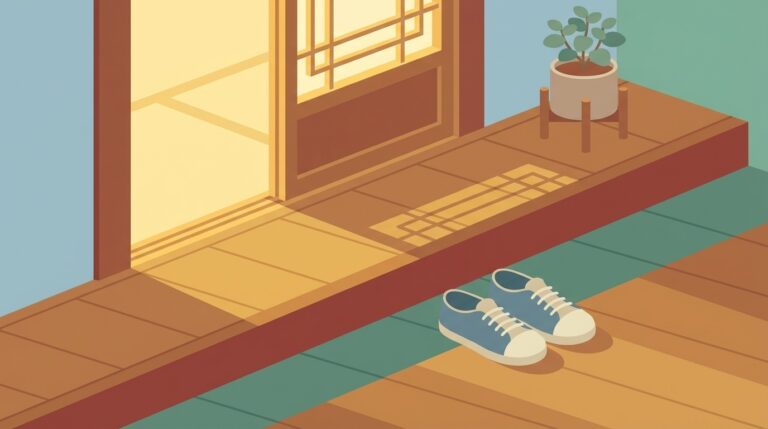
What went wrong? You just walked onto their pristine wooden floor with your dirty sneakers!
Taking off your shoes in Korea isn’t just about cleanliness; it’s a deeply ingrained cultural rule. If you don’t know the cues, you might end up in a very awkward (and slightly embarrassing) situation. But don’t worry! This guide is built from the real experiences of my students. Today, we’ll learn exactly how to read the room (and the floor!) so you can step into any Korean space like a true insider.
Phase 2: Core Expressions Deep Dive
Here are the top 3 survival phrases you need to know when entering a Korean space.
1. 신발 벗으세요.
- Pronunciation: sinbal beoseuseyo [Sheen-bal buh-suh-seh-yo]
- Tutor’s Tip: The ‘eo’ (어) sounds like the “uh” in “uh-oh.” The ‘eu’ (으) sounds like the disgusted sound you make when stepping in something sticky!
- Meaning: Please take off your shoes.
- K-Culture Moment: You’ll hear this at traditional restaurants, guesthouses, or if you visit a Korean friend’s apartment. In dramas, you often see characters taking off their shoes in the entryway (현관, hyeongwan) before stepping up into the house.
- Editor’s Insight: This isn’t a suggestion; it’s a polite command. If you hear this, stop immediately and unlace those boots!
- Situation Spectrum:
- Casual (Friends): 🚫 (Friends will use a shorter form)
- Semi-formal (Restaurant staff): ✅
- Formal (Elders): ✅
- 🤔 Think About It: Why does Korean culture emphasize separating the outside shoes from the inside floor? How does this reflect the way Koreans view the concept of “home”?
2. 여기 신발 벗어요?
- Pronunciation: yeogi sinbal beoseoyo? [Yuh-gee sheen-bal buh-suh-yo?]
- Meaning: Do I take off my shoes here?
- K-Culture Moment: You walk into a cool indie cafe in Mangwon-dong, and they have a slightly raised wooden floor. It looks clean, but some people are wearing sneakers. This is your magic phrase to check!
- Editor’s Insight: Koreans love it when foreigners try to respect their culture. Asking this simple question shows great nunchi (social awareness) and will instantly earn you smiles.
- Situation Spectrum:
- Casual: ✅
- Semi-formal: ✅
- Formal: ✅ (Just add “yo” at the end!)
- 🤔 Think About It: In your culture, is asking for rules at the door common, or do you just observe what others are doing?
3. 신발 신고 들어오세요.
- Pronunciation: sinbal singo deureo-oseyo [Sheen-bal sheen-go deu-ruh-oh-seh-yo]
- Meaning: Please come in with your shoes on.
- K-Culture Moment: Many traditional restaurants recently changed from floor seating to table seating to protect people’s knees. However, the old wooden floors remain! Confused guests keep taking their shoes off, so the owners put up signs or yell this phrase.
- Editor’s Insight: Notice the word “singo” (신고 – to wear). It sounds similar to “bingo!” When you hear it, it’s a bingo! You don’t have to untie your shoes!
- Situation Spectrum:
- Casual: 🚫
- Semi-formal: ✅
- Formal: ✅
Phase 3: Textbook vs. Real Korean
| Situation | 📖 Textbook Korean | 🗣️ Real Korean | 💡 Why is it different? |
|---|---|---|---|
| Written on a restaurant door | 신발을 벗어 주십시오. (Please take off your shoes.) | 신발 벗는 곳 (Shoe taking-off place) | Signage uses short noun phrases for quick reading. |
| Owner rushing you in | 안으로 들어오세요. (Please come inside.) | 신발 벗고 올라가세요! (Take off shoes and step up!) | Korean houses/restaurants have a literal step up into the living area. |
| Telling you to keep them on | 신발을 신고 들어오십시오. | 신고 들어오세요! (Just wear and come in!) | Koreans value speed (Ppalli-ppalli culture); unnecessary words are dropped. |
Phase 4: K-Culture Deep Dive — Cultural Context
4-1. Non-verbal Cues: The Art of Nunchi
When entering a Korean home or restaurant, look down. Is there a slightly lower area right at the door? That’s the Hyeongwan (현관). Is there a shoe rack (신발장, sinbaljang) nearby? Are there pairs of shoes scattered around? Use your nunchi. If you see a step up and shoes on the lower level, do not cross that border with your shoes on!
4-2. The Root of it All: Ondol Culture (온돌)
The reason Koreans take off their shoes is heavily linked to Ondol, the traditional underfloor heating system. Because the floor is warm, Koreans historically slept on the floor, ate on the floor, and sat on the floor. Would you walk on your dining table or your bed with muddy sneakers? Exactly! Even today, with modern heating, the floor is considered an extension of the living space, a clean zone.
Phase 5: Real-Life Roleplay
Setting: Friday night, 7 PM. A famous K-BBQ place in a traditional Hanok alley in Seoul. You arrive with your Korean friend, Min-su. You open the door, and there is a small step up to a pristine wooden floor.
Characters:
– YOU: A traveler exploring Seoul, excited for some pork belly.
– Min-su (32): Your local Korean friend. Friendly, loves to eat.
Dialogue:
Min-su: 아, 배고프다. 빨리 들어가자!
(a, baegopeuda. ppalli deureogaja!)
[Ah, I’m hungry. Let’s go in quickly!]
YOU: 우와, 여기 분위기 진짜 좋다.
(uwa, yeogi bunwigi jinjja jota.)
[Wow, the atmosphere here is really good.]
(🎭 Stage Direction: You are about to step onto the wooden floor with your shoes)
Min-su: 어? 잠깐만! 너 신발 벗어야 돼!
(eo? jamkkanman! neo sinbal beoseoya dwae!)
[Oh? Wait! You have to take off your shoes!]
🔀 Your Turn! How should you react?
– A) “아, 맞다! 미안해.” (Ah, right! Sorry.)
– B) “왜? 바닥이 더러운데?” (Why? The floor is dirty?)
– C) “여기 신발 벗어요?” (Do I take off shoes here?)✅ Best Choice: A or C.
A is a great casual apology to your friend. C is the perfect phrase if you were asking the restaurant staff.
⚠️ Choice B Analysis: Never say this! Korean floors are generally very clean, and questioning the rule might offend the owner.
YOU: 아, 맞다! 깜빡했어. (a, matda! kkamppakaesseo.) [Ah, right! I forgot.]
Min-su: 괜찮아. 저기 신발장에 넣어.
(gwaenchana. jeogi sinbaljange neoeo.)
[It’s okay. Put them in that shoe rack over there.]
Phase 6: 10-Second Shadowing Drill
Practice these sentences out loud to get the natural rhythm and intonation!
- 😳 (Confused) 저기요, / 여기 / 신발 / 벗어요?
(jeogiyo, / yeogi / sinbal / beoseoyo?)
Excuse me, do I take off my shoes here? -
😊 (Polite & Bright) 네, / 신발 벗고 / 들어오세요~
(ne, / sinbal beotgo / deureo-oseyo~)
Yes, please take off your shoes and come in~
Phase 7: K-Culture Mini Dictionary
| Korean | Romanization | English | Context |
|---|---|---|---|
| 눈치 | nunchi | Social sense | The ability to “read the room.” Crucial for knowing when to take shoes off! |
| 현관 | hyeongwan | Entryway | The small sunken area at the entrance where shoes are left. |
| 신발장 | sinbaljang | Shoe rack | Usually located right next to the hyeongwan. |
| 맨발 | maenbal | Barefoot | Going barefoot in someone’s home can be seen as slightly rude. Wear socks! |
| 온돌 | ondol | Floor heating | The traditional Korean heating system that makes floors warm and cozy. |
Phase 8: Traveler Survival Kit
🆘 Survival Phrases for the Entrance
– 🇰🇷 “여기 신발 벗어요?” (yeogi sinbal beoseoyo?) – Do I take off shoes here?
– 🇰🇷 “신발은 어디에 둬요?” (sinbareun eodie dwoyo?) – Where do I put my shoes?
– 🇰🇷 “슬리퍼 있어요?” (seullipeo isseoyo?) – Do you have slippers?📌 Editor’s Travel Note
– Socks are your best friend: Because you’ll take your shoes off often (at restaurants, cafes, and homes), always wear clean socks without holes! In summer, if you wear sandals, it’s polite to carry a pair of socks in your bag to slip on when entering someone’s home.
– Bathroom Slippers: If you see plastic slippers in a bathroom, wear them! They are meant to keep your socks dry. But DO NOT wear them out of the bathroom!
Phase 9: Critical Thinking — “One Step Deeper”
Language & Lifestyle Space (The Inside vs. Outside World)
In Korean culture, the physical act of stepping up from the hyeongwan (entryway) onto the main floor symbolizes moving from the chaotic, dirty “outside world” into the safe, clean “inner sanctum.” This is why the boundary is strictly respected. The language reflects this transition: you don’t just “come in” (들어오세요), you often “step up and come in” (올라오세요). By taking off your shoes, you are showing respect for the sanctity and cleanliness of that space.
💬 Your Turn: Does your culture have a strict rule about shoes indoors? If not, how do you keep the floors clean? Let us know in the comments!
Phase 10: FAQ & Avoiding Misunderstandings
Q: I have a hole in my sock! What do I do?
Hide your toe! Just kidding. It happens to the best of us (it’s a classic K-Drama comedy trope). But to avoid embarrassment, check your socks before heading out in Korea!
Q: Do I take my shoes off in a fitting room at a clothing store?
Yes! If the fitting room has a slightly raised floor or a carpet, you should leave your shoes outside the curtain or right at the edge.
❌ Common Mistake #1: Walking into a temple with your shoes on.
✅ Do this instead: Always, always take off your shoes before stepping onto the wooden floors of a Buddhist temple hall.
Phase 11: Summary & Action Items
One-Liner Summary: Look at the floor, check for a step-up or a shoe rack, and when in doubt, ask: “여기 신발 벗어요?”
Action Mission 3 Steps:
– 🥉 Bronze (Solo): Look at your own front door. Say “신발 벗으세요” out loud as if you are welcoming guests.
– 🥈 Silver (Online): Find a scene in a K-Drama where someone enters a house. Notice what they do with their shoes!
– 🥇 Gold (Real Life): Visit a Korean restaurant and check if they have a shoe-free zone. Use your nunchi!
K-Culture Mission:
Go to Google Images or Pinterest and search for “Korean Hyeongwan” (한국 현관). Look at how modern Korean homes design this shoe area. It’s a whole interior design trend!
Phase 12: Quiz — Interactive Challenge
1. Situational Judgment:
You enter a restaurant. There is a wooden floor, but you see a sign that says “신발 신고 들어오세요.” What do you do?
– A) Take off your shoes immediately.
– B) Keep your shoes on and walk in.
– C) Ask for slippers.
2. True or False — K-Culture Edition:
It is completely fine to walk barefoot in an older Korean person’s house during the summer because it’s hot. (True / False)
(Answers: 1. B – “신고” means to wear them! 2. False – It is considered polite to wear socks when visiting someone’s home, especially elders.)
Frequently Asked Questions (FAQ)
Q: What does "신발 벗으세요." mean in Korean and how do you pronounce it?
A: In Korean, "신발 벗으세요." is pronounced [sinbal beoseuseyo [Sheen-bal buh-suh-seh-yo] and means: a key conversational Korean expression covered in this lesson.
Q: What does "여기 신발 벗어요?" mean in Korean and how do you pronounce it?
A: In Korean, "여기 신발 벗어요?" is pronounced [yeogi sinbal beoseoyo? [Yuh-gee sheen-bal buh-suh-yo?] and means: Do I take off my shoes here?
Q: What does "신발 신고 들어오세요." mean in Korean and how do you pronounce it?
A: In Korean, "신발 신고 들어오세요." is pronounced [sinbal singo deureo-oseyo [Sheen-bal sheen-go deu-ruh-oh-seh-yo] and means: Please come in with your shoes on.







