

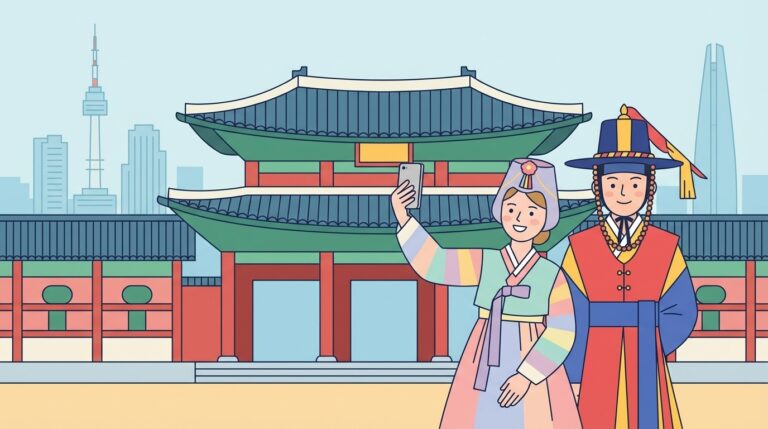
Phase 1: Empathy (Welcome to the Heart of Seoul!)
Hello there! I’m your Daily Hangul Editor, your friendly neighborhood language tutor and Seoul local.
Imagine this: You are standing in front of the majestic Gyeongbokgung Palace. The grand gates are towering over you. Suddenly, you hear the deep, resonant beat of a traditional drum. It feels exactly like a scene out of a historical K-Drama like Kingdom or Love in the Moonlight—minus the zombies and the dramatic rain, of course!
You see the Royal Guards standing there, looking incredibly cool in their vibrant Hanbok uniforms, holding tall flags. You want to know when the main changing ceremony starts, or maybe you want to ask if you can take a picture with them. But your mind goes blank. You freeze. “How do I say this politely? Can I even approach them?”
Don’t worry! This is a completely normal panic moment for travelers. In this guide, I’ll teach you exactly what to say to navigate this beautiful K-Culture moment like a true insider.
(And yes, this guide is built from the real, slightly embarrassing, but totally relatable experiences of my students!)
Phase 2: Core Expressions Deep Dive
Let’s learn the 3 survival phrases you absolutely need at the palace!
1. 수문장 교대식 언제 해요? (When is the Royal Guard Changing Ceremony?)
- Pronunciation: sumunjang giodaesik eonje haeyo? [soo-moon-jang gyo-dae-shik un-je hae-yo?]
- Meaning: Literal: Guard changing ceremony when do? / Real nuance: What time does the ceremony start?
- K-Culture Moment: You are waiting in the courtyard, looking at your watch. You ask a volunteer guide or a staff member. It’s polite, natural, and straight to the point.
- Editor’s Insight: Koreans love efficiency in language. Instead of a long, complicated sentence like “At what time will the event commence?”, we just slap the word “when” (언제) and “do” (해요) together.
- Situation Spectrum:
- Casual (Friends): ⚠️ (Friends would just say “언제 해?”)
- Semi-formal (Staff/Strangers): ✅ (Perfect!)
- Formal (Elders/Boss): ✅
- 🤔 Think About It: Notice how the subject “they” or “the event” is often dropped in Korean? Why do you think Korean is such a “context-heavy” language? Does your language require you to mention the subject every single time?
2. 같이 사진 찍어도 돼요? (Can I take a picture with you?)
- Pronunciation: gachi sajin jjigeodo dwaeyo? [ga-chi sa-jin jji-guh-do dway-yo?]
- Meaning: Literal: Together picture take okay? / Real nuance: May I take a photo with you?
- K-Culture Moment: The ceremony is over, and the guards are standing still. You want that insaeng-syat (shot of a lifetime) for your Instagram. You slowly approach a guard and ask this.
- Editor’s Insight: The grammar
-아/어도 돼요?(Is it okay if I…?) is your best friend in Korea! Use it to ask for permission anywhere—at cafes, shops, or palaces.- Situation Spectrum:
- Casual (Friends): ⚠️ (To a friend you’d say “찍어도 돼?”)
- Semi-formal (Staff/Guards): ✅
- Formal (Elders): 🚫 (Use “찍어도 될까요?” instead)
- 🤔 Think About It: In Korea, asking for permission before taking someone’s photo is highly valued due to strict privacy laws (portrait rights). Have you noticed Koreans often blur out strangers’ faces in their vlogs?
3. 표는 어디서 사요? (Where do I buy the ticket?)
- Pronunciation: pyoneun eodiseo sayo? [pyo-neun uh-di-suh sa-yo?]
- Meaning: Literal: Ticket where buy? / Real nuance: Where is the ticket office?
- K-Culture Moment: You’ve watched the free ceremony outside the gate, but now you want to go inside the palace to explore. You need a ticket!
- Editor’s Insight: “어디서” (Where at) + “사요?” (Do I buy?) is a magical combo. You can replace “표” (ticket) with anything! “Coffee 어디서 사요?”, “Souvenir 어디서 사요?”
- Situation Spectrum:
- Casual (Friends): ⚠️
- Semi-formal (Staff/Strangers): ✅
- Formal (Elders): ✅
Phase 3: Textbook vs. Real Korean
Why sound like an old textbook when you can sound like a Seoul local?
| Situation | 📖 Textbook Korean | 🗣️ Real Korean | 💡 Why is it different? |
|---|---|---|---|
| Asking where the ticket office is | 매표소는 어디에 있습니까? (Where is the ticket booth located?) | 표 어디서 사요? (Where do I buy tickets?) | Real spoken Korean skips formal nouns and uses simple action verbs (buy) instead. |
| Asking for the time | 행사는 몇 시에 시작합니까? (At what time does the event begin?) | 교대식 언제 해요? (When does the ceremony happen?) | “해요” (do) is a universal verb in daily Korean that replaces complex verbs. |
| Asking to take a photo | 사진을 함께 찍어 주시겠습니까? (Would you kindly take a picture together?) | 같이 사진 찍어도 돼요~? (Can we take a pic together?) | The tone makes it polite! A slightly raised pitch at the end sounds friendly and soft. |
Phase 4: Cultural Context — K-Culture Deep Dive
4-1. Non-Verbal Nunchi (눈치) at the Palace
When you ask “표 어디서 사요?”, don’t point with one index finger! In Korea, pointing with one finger can feel a bit aggressive or rude. Instead, gesture toward the general direction with an open palm facing up. Also, a slight, gentle nod (a mini-bow) while asking instantly makes you look like a polite, cultured traveler.
4-2. K-Travel & K-Drama Connection: The Magic of Hanbok
Have you noticed people walking around Seoul in beautiful traditional dresses?
If you rent and wear a Hanbok (한복), admission to the major grand palaces (like Gyeongbokgung and Changdeokgung) is 100% FREE! It’s a brilliant K-Travel hack. Plus, taking a photo with the Royal Guards while you are also wearing Hanbok makes you feel like you’ve time-traveled straight into a K-Drama. Just remember: in historical K-Dramas, commoners use highly formal language to guards, but in modern Seoul, our polite “해요” (haeyo) form is perfect.
Phase 5: Real-Life Roleplay Scenario
Setting: It’s a sunny Wednesday morning, 9:50 AM at the Gwanghwamun Gate of Gyeongbokgung Palace. You are wearing a beautiful rented Hanbok. You see a friendly Korean volunteer guide holding an information sign.
Characters:
– YOU: A traveler excited to see the 10 AM ceremony.
– Guide (Ji-hoon, 20s): A cheerful university student volunteering at the palace.
Dialogue:
YOU: 저기요! 수문장 교대식 언제 해요?
(jeogiyo! sumunjang giodaesik eonje haeyo?)
[Excuse me! When does the guard changing ceremony start?]
Ji-hoon: 아, 10시에 시작해요. 10분 남았어요!
(a, yeolsie sijakaeyo. sipbun namasseoyo!)
[Ah, it starts at 10. There are 10 minutes left!]
YOU: 아, 다행이다. 표는 어디서 사요?
(a, dahaengida. pyoneun eodiseo sayo?)
[Oh, what a relief. Where do I buy tickets?]
Ji-hoon: (Smiling and pointing with an open hand) 저기 매표소요. 어? 그런데 한복 입으셨네요?
(jeogi maepyosoyo. eo? geureonde hanbok ibeusyeonneyo?)
[The ticket office is over there. Oh? But you are wearing a Hanbok!]
YOU: 네! 예쁘죠?
(ne! yeppeujyo?)
[Yes! Pretty, right?]
Ji-hoon: 한복 입으면 표 안 사도 돼요. 무료예요!
(hanbok ibeumyeon pyo an sado dwaeyo. muryoyeyo!)
[If you wear Hanbok, you don’t have to buy a ticket. It’s free!]
🔀 Your Turn! How do you reply?
– A) “그래요? 그럼 사진 찍어도 돼요?” (Really? Then can I take a picture?)
– B) “진짜요? 대박! 감사합니다!” (Really? Awesome! Thank you!)
– C) “아니요, 저는 표 살 거예요.” (No, I will buy a ticket.)✅ Best Choice: B — “대박” (Daebak – Awesome) shows you know real Korean slang, and thanking them is always the right move!
⚠️ Choice A Analysis: You skipped thanking them! It’s better to express gratitude first before asking for another favor.
(🎭 Stage Direction: The drums start beating loudly. The ceremony begins!)
Phase 6: 10-Second Shadowing Drill
Let’s practice! Speak out loud right now. Pay attention to the slash (/) for pausing.
- 😊 Friendly inquiry: 수문장 교대식 / 언제 해요?
(sumunjang giodaesik / eonje haeyo?) - 🥺 Polite request: 저기요, / 같이 사진 / 찍어도 돼요?
(jeogiyo, / gachi sajin / jjigeodo dwaeyo?) - 🤔 Slightly confused: 표는 / 어디서 사요?
(pyoneun / eodiseo sayo?)
Phase 7: K-Culture Mini Dictionary
| Korean | Romanization | English | Context |
|---|---|---|---|
| 수문장 | sumunjang | Royal Guard Captain | The leader of the guards you see at the palace gates. |
| 한복 | hanbok | Traditional Korean Clothing | Renting this gets you free palace entry! |
| 고궁 | gogung | Ancient Palace | Refers to historical palaces like Gyeongbokgung. |
| 인생샷 | insaeng-syat | Shot of a lifetime | That one perfect photo for your social media. |
| 무료 | muryo | Free of charge | The sweetest word for any traveler. |
Phase 8: Traveler’s Survival Kit
🆘 Survival Phrases for Palaces & Tourism
– 🇰🇷 “입구가 어디예요?” (ipguga eodiyeyo?)
– 🗣️ Pronunciation: [ip-goo-ga uh-di-ye-yo?]
– 📍 Meaning: Where is the entrance?
– 🇰🇷 “화장실 어디예요?” (hwajangsil eodiyeyo?)
– 🗣️ Pronunciation: [hwa-jang-shil uh-di-ye-yo?]
– 📍 Meaning: Where is the restroom? (Crucial!)
– 🇰🇷 “영어 팸플릿 있어요?” (yeongeo paempeullit isseoyo?)
– 🗣️ Pronunciation: [yung-uh pam-peul-lit is-suh-yo?]
– 📍 Meaning: Do you have an English pamphlet?📌 Editor’s Travel Note
– Best App: Download Naver Map or KakaoMap. Google Maps doesn’t work well for walking directions in Korea!
– Timing: The Guard Changing Ceremony is usually at 10 AM and 2 PM, but Gyeongbokgung is closed on Tuesdays (Deoksugung is closed on Mondays). Always check online before you go!
– Respect: The guards are performing a serious cultural duty. Do not touch them or block their path while they are marching.
Phase 9: Critical Thinking Corner — “One Step Deeper”
🧠 Think Deeper: Media vs. Reality
When you watch a historical K-Drama, the palace is a world of its own, surrounded by mountains and quiet forests. But when you visit Gyeongbokgung today, you’ll see a fascinating juxtaposition. Right behind the 600-year-old wooden pavilions, massive glass skyscrapers and busy coffee shops dominate the skyline. Korea didn’t isolate its history; it built the modern world right around it. The past and the hyper-modern future breathe the exact same air in Seoul.💬 Your Turn: Does your country preserve historical sites inside the busy city center, or are they kept separate from modern life? Let us know in the comments!
Phase 10: FAQ & Avoiding Mistakes
Q: Can I touch the guards or make them smile?
A: No! Just like the King’s Guard in London, they are performing a solemn duty. Do not touch them, their weapons, or try to distract them.
Q: Should I ask “사진 찍어도 돼요?” to the guard directly?
A: The guards usually cannot speak while on duty. If you stand politely next to them (without touching), it is generally understood that you are taking a photo. If there is a staff member nearby, you can ask them!
❌ Common Mistake: Standing right in the middle of the gate when the drums start.
✅ Do this instead: Follow the staff’s instructions and stay behind the designated ropes. The guards need a clear path to march. Use your Nunchi (social awareness) by observing where the locals are standing!
Phase 11: Summary & Action Items
One-Liner Summary: Use “언제 해요?” (When is it?) to check the time, and “찍어도 돼요?” (Can I take a photo?) to politely capture your unforgettable palace memories!
Action Mission 3 Steps:
– 🥉 Bronze (Solo): Say “교대식 언제 해요?” out loud 3 times while looking at a picture of a Korean palace.
– 🥈 Silver (Online): Go to YouTube, search for “Gyeongbokgung Guard Changing Ceremony,” and leave a comment saying “진짜 멋있어요!” (Really cool!)
– 🥇 Gold (Real Life): Next time you visit a tourist spot (anywhere in the world!), ask for a photo using the Korean gesture (open palm, slight nod) and think “사진 찍어도 돼요?” in your head.
K-Culture Mission:
Go to Google Street View or KakaoMap Road View, drop the pin in front of Gwanghwamun Gate in Seoul, and “walk” around. Imagine where you would stand to watch the ceremony!
Phase 12: Quiz — Interactive Challenge
1. Situational Judgment: You want to know where to buy tickets to enter the palace. What do you say?
– A) 표 어디서 사요? (pyo eodiseo sayo?)
– B) 같이 사진 찍어도 돼요? (gachi sajin jjigeodo dwaeyo?)
– C) 수문장 언제 해요? (sumunjang eonje haeyo?)
2. True or False – K-Culture Edition:
If you wear a traditional Hanbok, you still have to pay full price to enter Gyeongbokgung Palace. (T / F)
3. Fill in the Blank:
Excuse me! Can I take a picture with you?
저기요, 같이 사진 ( ______ ) 돼요?
(Scroll down for answers!)
Answers: 1. A (B is asking for a photo, C is asking when the guard does something) / 2. False (It’s 100% free!) / 3. 찍어도 (jjigeodo)
Frequently Asked Questions (FAQ)
Q: What does "수문장 교대식 언제 해요? (When is the Royal Guard Changing Ceremony?)" mean in Korean and how do you pronounce it?
A: In Korean, "수문장 교대식 언제 해요? (When is the Royal Guard Changing Ceremony?)" is pronounced [sumunjang giodaesik eonje haeyo? [soo-moon-jang gyo-dae-shik un-je hae-yo?] and means: Literal: Guard changing ceremony when do? / Real nuance: What time does the ceremony start?
Q: What does "같이 사진 찍어도 돼요? (Can I take a picture with you?)" mean in Korean and how do you pronounce it?
A: In Korean, "같이 사진 찍어도 돼요? (Can I take a picture with you?)" is pronounced [gachi sajin jjigeodo dwaeyo? [ga-chi sa-jin jji-guh-do dway-yo?] and means: Literal: Together picture take okay? / Real nuance: May I take a photo with you?
Q: What does "표는 어디서 사요? (Where do I buy the ticket?)" mean in Korean and how do you pronounce it?
A: In Korean, "표는 어디서 사요? (Where do I buy the ticket?)" is pronounced [pyoneun eodiseo sayo? [pyo-neun uh-di-suh sa-yo?] and means: Literal: Ticket where buy? / Real nuance: Where is the ticket office?







