

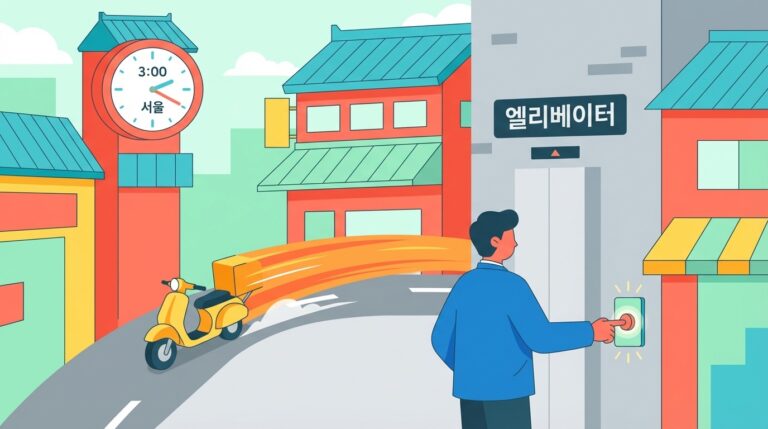
Surviving Korea’s “Ppalli-Ppalli” Culture: Why Is Everyone in a Hurry?
Phase 1: Empathy (Welcome to the Fast Lane!)
안녕하세요! I’m the head editor of Daily Hangul.
Have you ever watched a K-Drama where the main character aggressively taps the elevator ‘close’ button five times in three seconds? Or maybe you’ve tried buying K-Pop concert tickets, only to find them sold out in 0.5 seconds. Perhaps you ordered delivery food (배달), and it arrived hot and fresh in just 15 minutes!
Welcome to Korea’s legendary 빨리빨리 (Ppalli-Ppalli / Hurry-Hurry) culture.
For a beginner living in or visiting Korea, this speed can feel overwhelming. You might wonder, “Why is everyone rushing? Did I do something wrong?” Don’t worry! You didn’t. This speed is just the heartbeat of modern Korea. Today, as your veteran tutor and local guide, I’ll teach you exactly how to understand and survive this high-speed culture using simple, A2-level Korean!
Phase 2: Core Expressions Deep Dive
Here are the top three expressions you will hear when Koreans are in “speed mode.”
1. 빨리빨리!
- Pronunciation: [ppal-li ppal-li] Think of the ‘pp’ as a sharp, popping ‘P’ sound you make when you are out of breath from running!
- Meaning: (Literal) Fast fast! / (Real nuance) Hurry up! Do it immediately!
- K-Culture Moment: You are trying to catch the last subway in Seoul. Your friend grabs your wrist and yells, “빨리빨리!”
- Editor’s Insight: This isn’t always an angry phrase. It’s often just a habit. But be careful—it sounds demanding if used to a stranger!
- Situation Spectrum:
- 친구 사이 (Casual friends): ✅
- 직장 동료 (Co-workers): ⚠️ (Only if you are close)
- 직장 상사·어른 (Boss/Elders): 🚫 (Never!)
- 🤔 Think About It: Why do Koreans repeat the word twice? Does your native language have a phrase that you repeat to show urgency?
2. 다 왔어요.
- Pronunciation: [da wat-seo-yo] ‘wat’ sounds like the English word ‘what’.
- Meaning: (Literal) I completely arrived. / (Real nuance) I’m almost there. (Usually a lie!)
- K-Culture Moment: You are waiting at a café. Your friend is late. You text them, and they reply, “다 왔어요!” (Spoiler: They just got off the bus 3 blocks away.)
- Editor’s Insight: Koreans feel guilty for making you wait, so they use “다 왔어요” to comfort you. It actually means “I’m trying my best to get there!”
- Situation Spectrum:
- 친구 사이 (Casual): ✅
- 직장 동료 (Semi-formal): ✅
- 직장 상사·어른 (Formal): ✅ (Used politely)
- 🤔 Think About It: Is it better to give an exact time (e.g., “I will be there in 7 minutes”) or say “I’m almost there” to make the other person feel less frustrated?
3. 금방 나와요.
- Pronunciation: [geum-bang na-wa-yo]
- Meaning: (Literal) It comes out shortly. / (Real nuance) The food will be ready very soon!
- K-Culture Moment: You are at a busy K-BBQ restaurant. You ask the busy owner where your soup is, and they shout over the noise, “금방 나와요!”
- Editor’s Insight: ‘금방’ means ‘soon’. You will hear this everywhere in Korean restaurants. It means you just need to wait 2-3 more minutes.
- Situation Spectrum:
- 식당/카페 (Restaurants/Cafes): ✅
- 친구 사이 (Casual): ✅
- 직장 상사·어른 (Formal): ⚠️ (Use ‘곧 준비됩니다’ for very formal situations)
- 🤔 Think About It: Food service in Korea is famously fast. Do you prefer eating slowly in a relaxed environment, or getting your food instantly?
Phase 3: Textbook vs. Real Korean
| 상황 (Situation) | 📖 교과서 한국어 (Textbook) | 🗣️ 진짜 한국어 (Real Korean) | 💡 왜 다를까? (Why is it different?) |
|---|---|---|---|
| Telling a friend to hurry | 서두르세요. (Please hurry.) | 빨리빨리! / 뛰어가자! (Run!) | ‘서두르세요’ is too formal for friends. ‘빨리빨리’ shows closeness. |
| Asking someone to wait | 조금만 기다려 주세요. (Please wait a little.) | 잠시만요! (Just a second!) | ‘잠시만요’ is faster to say and implies immediate action! |
| Running late | 5분 후에 도착합니다. (I will arrive in 5 mins.) | 다 왔어요! (I’m almost there!) | Emotional reassurance is prioritized over factual accuracy. |
Bottom Note: As an A2 learner, stick to 잠시만요 when asking people to wait. It is polite, natural, and makes you sound like a true local!
Phase 4: Cultural Context — K-Culture Deep Dive
4-1. Non-Verbal “Ppalli-Ppalli” Cues
It’s not just about language; it’s body language!
– Elevator Button Tapping: Koreans will press the ‘Close Door’ (닫힘) button repeatedly. (Some elevators even have worn-out close buttons!)
– Subway Card Hovering: People will hover their transportation cards over the scanner before the gate even opens.
– Standing Up on Planes: The moment the airplane tire touches the runway, you will hear the sound of 100 seatbelts unclicking simultaneously.
4-2. The K-Food & Delivery Connection
If there is one industry where “Ppalli-Ppalli” shines, it’s K-Food.
Korea is the land of 로켓배송 (Rocket Delivery) and 배달의민족 (Baedal Minjok – Delivery Nation). You can order iced Americanos, ice cream, and hot fried chicken to the park, and it will arrive in 20 minutes. At restaurants, side dishes (반찬) are served the moment you sit down. The phrase “금방 나와요” (It will be right out) is the golden rule of Korean hospitality. They know you are hungry, and making you wait is considered bad service!
Phase 5: Real-Life Roleplay Scenario
Setting: Friday, 7 PM. Gangnam Station Exit 11. It’s crowded, noisy, and you are starving. You are waiting for your Korean friend, Minsu, who is late for your K-BBQ dinner.
Characters:
– YOU: An A2 Korean learner, very hungry.
– Minsu (28): Your Korean friend. Energetic but currently stressed because he is late.
Dialogue:
YOU: 민수 씨, 어디예요? 저 배고파요. 😭
(Min-su ssi, eo-di-ye-yo? Jeo bae-go-pa-yo.)
[Minsu, where are you? I’m hungry.]
Minsu: 미안해! 진짜 미안해! 나 다 왔어!
(Mi-an-hae! Jin-jja mi-an-hae! Na da wat-seo!)
[Sorry! Really sorry! I’m almost there!]
YOU: 다 왔어요? 지금 강남역이에요?
(Da wat-seo-yo? Ji-geum Gang-nam-yeok-i-e-yo?)
[You’re almost there? Are you at Gangnam station now?]
Minsu: 아니, 버스에서 내렸어. 지금 뛰어가고 있어!
(A-ni, beo-seu-e-seo nae-ryeot-seo. Ji-geum ttwi-eo-ga-go it-seo!)
[No, I got off the bus. I’m running right now!]
(🎭 Stage Direction: Minsu is literally sprinting past the crowds.)
🔀 Your Turn! How should you reply?
– A) “빨리빨리 와요!” (Hurry up!)
– B) “천천히 오세요.” (Take your time.)
– C) “진짜요? 대박.” (Really? Awesome.)✅ Best Choice: B — 천천히 오세요.
Why? Even though you want him to hurry, telling a rushing Korean to “take your time” (천천히 오세요) is considered very warm and polite. Don’t worry, because he is Korean, he will still run anyway! 😂
⚠️ Choice A Analysis: Saying “빨리빨리 와요” might make him feel even more stressed. Use it only if you are very close friends joking around.
Phase 6: 10-Second Shadowing Drill
Let’s practice the best response to a rushing Korean! Read this out loud, following the pauses (/) and the emotion.
😊 괜찮아요! / 천천히 / 오세요. (gwaen-chan-a-yo! / cheon-cheon-hi / o-se-yo.)
Emotion: Warm, reassuring, smiling.
😤 사장님, / 저희 음식 / 언제 나와요? (sa-jang-nim, / jeo-hui eum-sik / eon-je na-wa-yo?)
Emotion: Desperate, hungry. (When your food is taking more than 15 minutes!)
Phase 7: K-Culture Mini Dictionary
| 한국어 | Romanization | English | Cultural Context |
|---|---|---|---|
| 빨리빨리 | ppal-li ppal-li | Hurry, hurry | The core philosophy of modern Korean speed and efficiency. |
| 배달 | bae-dal | Delivery | Korea’s world-class delivery culture. Anywhere, anytime. |
| 다 왔어요 | da wat-seo-yo | Almost there | Often used as a white lie to calm someone waiting for you. |
| 눈치 | nun-chi | Social sense | The ability to ‘read the room’. Essential when others are rushing! |
Phase 8: Traveler’s Survival Kit
Navigating Korea’s fast transportation and food scenes? You need these A2 survival phrases!
🆘 Survival Phrases TOP 3
– 🇰🇷 “이거 얼마나 걸려요?” (i-geo eol-ma-na geol-lyeo-yo?)
– 🗣️ English: How long will this take?
– 📍 Where to use: Ordering food, buying train tickets, asking a taxi driver.
- 🇰🇷 “잠시만요!” (jam-si-man-yo!)
- 🗣️ English: Just a moment! / Excuse me!
- 📍 Where to use: When trying to get off a crowded subway fast, or asking a busy waiter to wait.
🇰🇷 “천천히 해 주세요.” (cheon-cheon-hi hae ju-se-yo.)
- 🗣️ English: Please take your time.
- 📍 Where to use: When a cashier is scanning your items too fast and you can’t put them in your bag quickly enough!
📌 Editor’s Travel Note
– Escalator Etiquette: In Korea, stand on the RIGHT side of the escalator. The LEFT side is for people who are walking/running up (빨리빨리!).
– Bus Etiquette: Koreans stand up and move to the bus door before the bus stops. If you wait until it fully stops, the doors might close!
Phase 9: Critical Thinking Corner — “한 발 더 깊이”
🧠 Think Deeper: Language & Culture (The Global Era)
Korea was completely rebuilt after the Korean War in the 1950s. The “Ppalli-Ppalli” culture was the secret weapon that transformed Korea into a global IT and economic powerhouse in just a few decades. Speed equals efficiency and success here! However, this constant rushing also creates high stress levels in modern Korean society. Because everyone is always moving fast, the language evolved to match—using short, direct phrases and immediate feedback.
💬 Your Turn: Does your home country have a “fast” culture, or a “slow and relaxed” culture? How does that affect your native language? Share in the comments!
Phase 10: FAQ & Avoiding Mistakes
Q: Can I yell “빨리빨리” at a restaurant waiter if my food is late?
NO! 🚫 This is extremely rude. Instead, raise your hand, say “저기요!” (Excuse me), and ask politely: “음식 언제 나와요?” (When is the food coming out?).
Q: If someone says “다 왔어요” (I’m almost there), should I look around for them?
Maybe. ⚠️ Usually, it means they are still 5 to 10 minutes away. Take a seat and enjoy your coffee!
❌ Common Mistake #1: Trying to use exact minutes (e.g., “I will be there in 4 minutes and 30 seconds.”)
✅ Do This Instead: Just say “다 왔어요!” or “금방 가요!” It sounds much more natural to a Korean ear.
Phase 11: Summary & Action Items
- One-Liner Summary: Korea runs on “빨리빨리” (Hurry up), but you can handle it by using “잠시만요” (Just a moment) and “천천히 오세요” (Take your time)!
🎬 Action Missions:
– 🥉 Bronze (Solo): Look in the mirror and practice saying “천천히 오세요” with a warm smile.
– 🥈 Silver (Online): Text a Korean friend who is always busy and say, “바쁘죠? 천천히 해요!” (You’re busy, right? Take your time!)
– 🥇 Gold (Real Life): Next time you are at a Korean cafe or restaurant, ask the staff, “얼마나 걸려요?” (How long will it take?).
🌸 K-Culture Mission:
Watch one episode of any K-Drama today. Try to spot at least ONE scene where a character is rushing, looking at their watch, or pressing a button rapidly. (Hint: It happens in almost every modern drama!)
Phase 12: Quiz — Interactive Challenge
1. You are waiting for your friend. They text you: “미안! 나 다 왔어!” What does this truly mean?
A) They are standing right behind you.
B) They are not coming.
C) They are still on the way, but want you to feel better.
2. Fill in the blank!
You are ordering food at a busy market. You want to ask how long it takes.
“사장님, 이거 얼마나 _________?”
(Hint: g___-lyeo-yo?)
3. True or False?
In Korea, it is polite to tell the waiter “빨리빨리 해 주세요!” (Please do it hurry-hurry!) to show you are hungry. (T/F)
👀 Click here for Answers!
1. C! It’s a comforting white lie.
2. 걸려요 (geol-lyeo-yo)
3. False! Never say ‘빨리빨리’ to service workers. It’s rude. Use ‘금방 나와요?’ instead.
Frequently Asked Questions (FAQ)
Q: What does "빨리빨리!" mean in Korean and how do you pronounce it?
A: In Korean, "빨리빨리!" is pronounced [ppal-li ppal-li] and means: (Literal) Fast fast! / (Real nuance) Hurry up! Do it immediately!
Q: What does "다 왔어요." mean in Korean and how do you pronounce it?
A: In Korean, "다 왔어요." is pronounced [da wat-seo-yo] and means: (Literal) I completely arrived. / (Real nuance) I'm almost there. (Usually a lie!)
Q: What does "금방 나와요." mean in Korean and how do you pronounce it?
A: In Korean, "금방 나와요." is pronounced [geum-bang na-wa-yo] and means: (Literal) It comes out shortly. / (Real nuance) The food will be ready very soon!






