

Phase 1: Empathy (Welcome to the K-BBQ Magic!)
Hello there! I’m the lead editor of Daily Hangul, your veteran tutor and local cultural navigator in Korea.
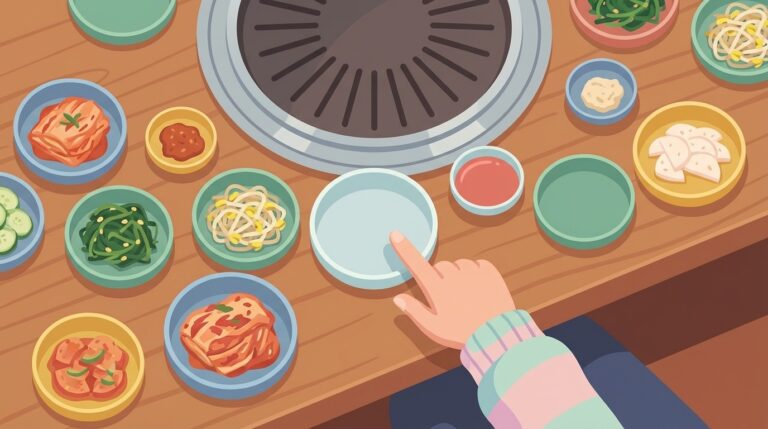
Picture this: You are watching your favorite K-Drama. The main characters are sitting at a cozy, slightly noisy pork belly (Samgyeopsal) restaurant. The table is entirely covered with tiny, colorful dishes—kimchi, bean sprouts, spinach, pickled radishes. They finish a bowl of kimchi, and suddenly, they call out to the staff and—poof!—the bowl is magically refilled. For free!
When I first take my international students to a traditional Korean restaurant, their eyes always widen at the sheer amount of side dishes (반찬, banchan). But then comes the real panic: “I ate all the spicy fish cakes. Can I get more? Will it cost extra? How do I even ask without sounding rude?”
Don’t worry! Today, we are going to learn the golden phrases that will unlock the magic of unlimited Korean side dishes. This guide is built strictly from real-world survival moments of my A1 beginner students. Let’s dive in!
Phase 2: Core Expressions Deep Dive
Here are the only three phrases you need to become a Banchan Master.
1. 저기요! (Excuse me! / Over here!)
- Pronunciation: [jeo-gi-yo]
- Tutor’s Tip: ‘Jeo’ sounds like the ‘jo’ in ‘jog’, ‘gi’ like ‘geese’, and ‘yo’ like ‘yo-yo’.
- Meaning: Literal = “Over there!” / Real nuance = “Excuse me, staff! I need your attention!”
- K-Culture Moment: You’ve definitely seen this in K-Dramas. The hero raises their hand confidently in a crowded pojangmacha (tent pub) and shouts this to order more Soju.
- Editor’s Insight: Forget the English “Excuse me” used for apologizing when bumping into someone. In a Korean restaurant, 저기요 is your magic wand to summon the staff. It’s not rude; it’s exactly how the system works!
- Situation Spectrum:
- Friendly restaurant staff: ✅
- Fine dining/Michelin restaurant: ⚠️ (Better to make eye contact or raise a hand quietly)
- Bumping into someone on the street: 🚫 (Use 죄송합니다 – I’m sorry instead)
- 🤔 Think About It: Why do Koreans shout across the restaurant instead of waiting for a waiter to check on them? How does this reflect Korea’s “Pali-pali” (Hurry-hurry) culture?
2. 반찬 더 주세요 (Please give me more side dishes)
- Pronunciation: [ban-chan deo ju-se-yo]
- Tutor’s Tip: ‘Deo’ sounds exactly like ‘duh’ but cut a bit shorter.
- Meaning: Literal = “Side dishes more give please” / Real nuance = “Could I get a refill on the side dishes, please?”
- K-Culture Moment: This is the ultimate “Insider” phrase. In a bustling market restaurant, knowing this phrase instantly makes the grandmas (이모님, Imonim) smile and pile up your plate.
- Editor’s Insight: Notice how there’s no “Can you…” or “Would it be possible…”? Korean is highly context-based. Simply saying “Noun + more + please give” is perfectly polite!
- Situation Spectrum:
- Casual restaurants (K-BBQ, Soups): ✅
- Talking to a close Korean friend: 🚫 (Drop the ‘yo’ and say “Banchan deo jwo”)
- 🤔 Think About It: The word ‘Juseyo’ (Please give) is used everywhere. Is there a similar “magic word” in your language that fits almost every situation?
3. 이거 더 주세요 (Please give me more of this)
- Pronunciation: [i-geo deo ju-se-yo]
- Tutor’s Tip: ‘I’ sounds like the ‘ee’ in ‘see’. ‘Geo’ sounds like ‘gaw’ in ‘gawk’.
- Meaning: Literal = “This more give please” / Real nuance = “I’d like a refill of this specific dish.”
- K-Culture Moment: You are pointing at that delicious garlic stem side dish. You have no idea what it’s called in Korean. Just point and say “Igeo” (This)!
- Editor’s Insight: This is your ultimate A1 survival hack. You don’t need to memorize the names of 50 different Korean side dishes. Your index finger + 이거 (Igeo) is a foolproof combination.
Phase 3: Textbook vs. Real Korean
| Situation | 📖 Textbook Korean | 🗣️ Real Korean | 💡 Why the difference? |
|---|---|---|---|
| Calling staff | 종업원님! (Waiter/Waitress!) | 저기요~ (Jeogiyo~) / 사장님! (Sajangnim! – Boss) | Calling someone “Waiter” sounds a bit too formal or distant. Calling them “Boss” (Sajangnim) builds instant rapport! |
| Asking for more | 반찬을 더 주시겠습니까? (Would you kindly give more side dishes?) | 이거 좀 더 주세요~ (Igeo jom deo juseyo~) | Textbooks love complete sentences with particles (을/를). Real Koreans drop particles for efficiency! |
| Saying thanks | 대단히 감사합니다. (Thank you very much.) | 감사합니다! (Gamsahamnida!) | Keep it simple. A bright, cheerful “Gamsahamnida” with a slight bow is perfect. |
Phase 4: Cultural Context — K-Culture Deep Dive
4-1. Non-Verbal Magic: The “Call Bell”
Before you shout “Jeogiyo!”, look at your table. Does it have a small plastic button? That’s the Call Bell (호출벨). Korean restaurants are masters of efficiency. You don’t need to try and catch a waiter’s eye (using your Nunchi). Just press the bell once—”Ding-dong!”—and they will come right over.
4-2. The Spirit of “Jeong” and Unlimited Refills 🍲
If you love K-Food, here’s the best news: Banchan refills are almost always FREE.
Why? In Korean culture, food is heavily tied to the concept of 정 (Jeong)—a deep sense of connection, generosity, and community affection. Korean restaurant owners take pride in their generosity (인심, In-sim). Leaving a guest hungry or rationing side dishes goes against this cultural DNA. So, never feel shy about asking for more Kimchi!
Phase 5: Real-Life Roleplay Scenario
Setting: It’s 7:00 PM on a Friday near Gangnam Station. The K-BBQ place is packed, smoky, and loud with the clinking of Soju glasses. You are sitting with Minsoo (32, your friendly Korean coworker).
Characters:
– YOU: A beginner Korean learner, visiting Seoul for a business trip.
– Minsoo (민수): Your local buddy who just grilled the perfect piece of pork belly for you.
– Staff (직원): Very busy, moving fast.
Dialogue:
Minsoo: 자, 고기 다 익었어요! 많이 먹어요!
(Ja, gogi da igeosseoyo! Mani meogeoyo!)
[Here, the meat is fully cooked! Eat up!]
YOU: 우와, 감사합니다! (Takes a bite with Kimchi) 음! 너무 맛있어요.
(Uwa, gamsahamnida! Eum! Neomu masisseoyo.)
[Wow, thank you! Mmm! It’s so delicious.]
(🎭 Stage Direction: You realize your favorite spicy radish salad plate is completely empty.)
🔀 YOUR TURN! What is your next move?
– A) Wait silently until Minsoo or the staff notices your empty plate.
– B) Grab the empty plate, press the table bell, and when the staff comes, say: “저기요! 이거 더 주세요!” (Jeogiyo! Igeo deo juseyo!)
– C) Yell “KIMCHI MORE!” in English.✅ Best Choice: B — Perfect execution! Press the bell, use “Igeo” (This), and end with “Juseyo” (Please give).
⚠️ Why not A? In Korea’s fast-paced dining culture, waiting silently means you don’t want anymore. You have to speak up!
Staff: 네, 손님~ (Arrives at the table)
(Ne, sonnim~)
[Yes, customer~]
YOU: 이거 조금 더 주세요.
(Igeo jogeum deo juseyo.)
[Please give me a little more of this.]
Staff: 네, 바로 가져다 드릴게요!
(Ne, baro gajyeoda deurilgeyo!)
[Yes, I’ll bring it right away!]
Phase 6: 10-Second Shadowing Drill
Let’s practice your pronunciation! Follow the slashes (/) for pauses and match the emotion tag.
- 🙋♂️ (Confidently calling out) 저기요! / 사장님!
(jeo-gi-yo! / sa-jang-nim!) - 😊 (Politely pointing) 이거 / 더 / 주세요.
(i-geo / deo / ju-se-yo.) - 🙏 (With gratitude) 잘 / 먹겠습니다!
(jal / meok-get-seum-ni-da!) = “I will eat well!” (Said before eating)
Phase 7: K-Culture Mini Dictionary
| Korean | Romanization | English | Context |
|---|---|---|---|
| 반찬 | banchan | Side dishes | Small dishes served alongside rice in Korean cuisine. |
| 리필 | ri-pil | Refill | Konglish for “refill.” Yes, you can literally say “Kimchi ri-pil juseyo!” |
| 인심 | in-sim | Generosity | The warm-hearted generosity of giving plenty of food. |
| 정 | jeong | Affection / Bonding | A complex Korean emotion of deep bonding and communal sharing. |
Phase 8: Traveler’s Survival Kit
Navigating a restaurant in Seoul? Keep these flashcards handy!
🆘 Survival Phrases TOP 3
– 🇰🇷 메뉴판 주세요. (Menyupan juseyo.) = Please give me the menu.
– 🇰🇷 물 좀 주세요. (Mul jom juseyo.) = Please give me some water.
– 🇰🇷 화장실 어디에요? (Hwajangsil eodieyo?) = Where is the restroom?📌 Editor’s Travel Note
– Self-Service: If you see a sign that says “물/반찬은 셀프입니다” (Water/Banchan is Self), it means you have to walk up to the counter and refill it yourself! Don’t shout “Jeogiyo” here, or you might look a bit silly.
– Tipping: THERE IS NO TIPPING IN KOREA! Please don’t leave cash on the table; the staff will literally run down the street to return it to you thinking you forgot your money.
Phase 9: Critical Thinking — “One Step Deeper”
🧠 Think Deeper: Food & Identity
Have you noticed that in a Korean restaurant, everyone shares the same big pot of stew and the same small banchan plates? Unlike Western dining where everyone gets their own distinct plate, traditional Korean dining is incredibly communal. Sharing side dishes isn’t just about saving space on the table; it represents Jeong (정) and the idea that eating together makes you “식구” (Sik-gu), which literally translates to “mouths that eat together”—the Korean word for family.💬 Your Turn: Does your culture have a tradition of sharing food from the same plate, or is dining strictly individualized? Share your thoughts in the comments!
Phase 10: FAQ & Avoiding Mistakes
Q: Can I use “이거 더 주세요 (Igeo deo juseyo)” to someone older than me?
Yes! Because it ends with 요 (-yo), it is polite formal language (존댓말, Jondaetmal). It is perfectly fine to use with restaurant owners or staff of any age.
❌ Common Mistake #1: Saying “You” (당신, Dangsin)
Never call a waiter “You” in Korean! “Dangsin” is only used between married couples or when you are aggressively fighting someone on the street. Always use 저기요 (Jeogiyo) or 사장님 (Sajangnim).❌ Common Mistake #2: Feeling guilty for asking for refills.
Some tourists feel they are being annoying by asking for 3 plates of garlic. Don’t worry! Unless it’s an expensive meat dish, vegetable banchan are meant to be refilled.
Phase 11: Summary & Action Items
One-Liner Summary: To get unlimited delicious side dishes, simply point, smile, and say: “이거 더 주세요! (Igeo deo juseyo!)”
Take Action Today!
– 🥉 Bronze (Solo): Stand in front of your mirror, raise your hand, and confidently say “Jeogiyo!” 3 times.
– 🥈 Silver (Online): Find a photo of Korean food on Instagram, leave a comment saying “반찬 더 주세요! 😋”
– 🥇 Gold (Real World): Visit your local Korean restaurant, ask for a refill entirely in Korean, and enjoy your extra Kimchi!
🎬 K-Culture Mission:
Watch one episode of any K-Drama today (especially Let’s Eat or Reply 1988). Count how many times you hear the word “Jeogiyo” or “Sajangnim” when characters are eating out!
Phase 12: Interactive Quiz
1. You are at a busy Korean BBQ restaurant and want more spicy bean sprouts. Which is the most natural thing to do?
A) Wait for the waiter to make eye contact, then nod.
B) Press the table bell, point to the dish, and say “이거 더 주세요.”
C) Shout “Dangsin! More banchan!”
2. True or False – K-Culture Edition:
“If the staff brings you three extra plates of side dishes, you must leave a 15% tip on the table.”
(Scroll down for answers)
(Answers)
1. B (A is too passive for Korea, C uses the forbidden word ‘Dangsin’.)
2. False! (Tipping does not exist in Korea. The extra banchan is just pure Korean generosity!)
Frequently Asked Questions (FAQ)
Q: What does "저기요! (Excuse me! / Over here!)" mean in Korean and how do you pronounce it?
A: In Korean, "저기요! (Excuse me! / Over here!)" is pronounced [jeo-gi-yo] and means: a key conversational Korean expression covered in this lesson.
Q: What does "반찬 더 주세요 (Please give me more side dishes)" mean in Korean and how do you pronounce it?
A: In Korean, "반찬 더 주세요 (Please give me more side dishes)" is pronounced [ban-chan deo ju-se-yo] and means: a key conversational Korean expression covered in this lesson.
Q: What does "이거 더 주세요 (Please give me more of this)" mean in Korean and how do you pronounce it?
A: In Korean, "이거 더 주세요 (Please give me more of this)" is pronounced [i-geo deo ju-se-yo] and means: a key conversational Korean expression covered in this lesson.







