

Phase 1: Empathy (The Coffee Shop Confession)
Hello there! It’s your Head Editor at Daily Hangul.
Picture this: You’re sitting in a trendy cafe in Seongsu-dong, the Brooklyn of Seoul. At the table next to you, two tech-bros in their 30s aren’t scrolling through Instagram or watching the latest K-Pop music video. They are staring intensely at a red-lined chart on their phones. One of them lets out a deep sigh, takes a sip of his iced Americano, and mutters, “아… 진짜 이제는 옥석 가리기네.” (Ah… it’s really time to separate the jade from the stones.)
If you’re studying at a C2 level, you already know how to order your coffee and talk about your favorite K-Drama. But when the conversation shifts to the economy, investments, or the spectacular burst of the NFT and crypto bubble—which swept through South Korea’s youth like wildfire—even advanced learners hit a wall.
Why does mastering this specific jargon matter? Because in Korea, investing wasn’t just a hobby; for the “2030 generation” (people in their 20s and 30s), it was seen as the only ladder to wealth in a society plagued by skyrocketing real estate prices. Understanding how Koreans talk about the “crypto winter” isn’t just about vocabulary; it’s about deeply understanding the societal zeitgeist, their anxieties, and their humor in the face of despair.
Everything in this guide is based on real conversations overheard in the boardrooms of Pangyo (Korea’s Silicon Valley) and the late-night drinking sessions in Gangnam. Let’s dive in.
Phase 2: Deep Dive into Core Expressions
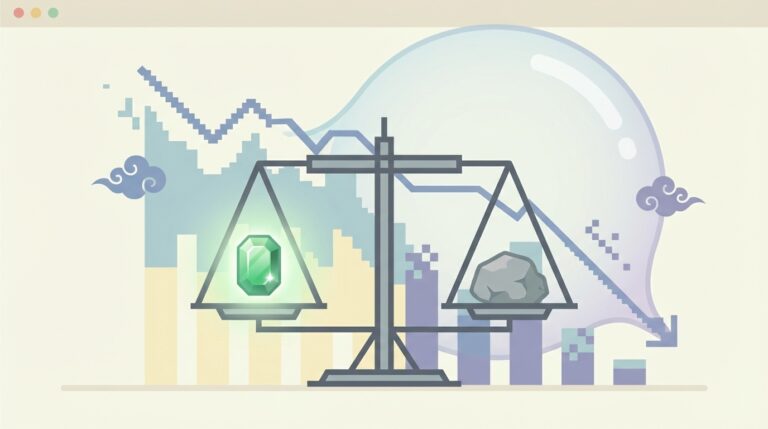
1. 옥석을 가리다 (To separate the wheat from the chaff)
- Pronunciation: [ok-sseo-geul ga-ri-da] + [oak-suck-eul gah-ree-dah]
- Meaning: (Literal) To separate jade from stone / (Real nuance) To distinguish what is truly valuable from the worthless hype.
- K-Culture Moment: You’ll hear this non-stop on Korean economic YouTube channels (like Syuka World) or news reports analyzing the aftermath of the NFT crash. When the “Meta Kongz” or “P2E (Play to Earn)” bubbles popped, experts kept repeating this phrase.
- Editor’s Insight: This isn’t just for crypto. You can use it when evaluating job candidates, startup pitches, or even dating prospects. It implies a chaotic period has ended, and now, critical judgment is required.
- Situation Spectrum:
- Casual with friends: ✅
- Coworkers (Semi-formal): ✅
- Boss/Elders (Formal): ✅ (Highly professional!)
- 🤔 Think About It: Why “jade” (옥) and “stone” (석)? Jade has historically been the ultimate symbol of purity and wealth in East Asian culture. How does your native language express the idea of finding true value among garbage?
2. 거품이 꺼지다 (The bubble bursts / deflates)
- Pronunciation: [geo-pu-mi kkeo-ji-da] + [guh-poom-ee kkuh-jee-dah]
- Meaning: (Literal) The foam turns off/goes out / (Real nuance) The economic bubble bursts.
- K-Culture Moment: In K-Dramas featuring chaebols (conglomerates) or financial crises (like Default), the stern-faced CEO looking out his penthouse window will inevitably say, “거품이 꺼지고 있어” (The bubble is deflating).
- Editor’s Insight: While textbook Korean might teach you “경제 거품이 붕괴되다” (economic bubble collapses), “꺼지다” (to extinguish/go out, like a fire or a light) is much more visually evocative and commonly used in both news and daily life.
- Situation Spectrum:
- Casual with friends: ✅
- Coworkers (Semi-formal): ✅
- Boss/Elders (Formal): ✅
- 🤔 Think About It: Notice how Koreans use verbs related to fire or light (꺼지다) for bubbles, rather than “popping” (터지다)? “터지다” is used too, but “꺼지다” implies a slow, depressing deflation—exactly how a bear market feels.
3. 물리다 (To be stuck / bitten)
- Pronunciation: [mul-li-da] + [mool-lee-dah]
- Meaning: (Literal) To be bitten (by a dog, mosquito, etc.) / (Real nuance) To have bought an asset at its peak price and now be trapped because the value plummeted.
- K-Culture Moment: At a company dinner (회식), someone checks their Upbit (Korean crypto exchange) app, turns pale, and downs a shot of Soju. “나 또 물렸어…” (I got bitten again / I’m trapped again).
- Editor’s Insight: This is top-tier native slang. If you use this correctly as a foreigner, Koreans will instantly treat you as an insider. The imagery is brutal—you are “bitten” by the market and can’t escape without losing a limb (your money).
- Situation Spectrum:
- Casual with friends: ✅
- Coworkers (Semi-formal): ⚠️ (Okay with close peers, not in an official meeting)
- Boss/Elders (Formal): 🚫
- 🤔 Think About It: Does your language have a similarly physical, painful metaphor for losing money in the stock market?
Phase 3: Textbook vs. Real Korean
| Situation | 📖 Textbook Korean | 🗣️ Real Korean | 💡 Why the difference? |
|---|---|---|---|
| The market price dropped heavily. | 가격이 크게 하락했습니다. | 완전 떡락했어. (It totally nosedived) | “떡” (rice cake) is added as a prefix to emphasize extreme degree in modern slang. |
| I will hold onto my investment. | 투자를 계속 유지하겠습니다. | 나 무조건 존버한다. (I’m holding on for dear life) | “존버” is a visceral slang born from the sheer desperation of retail investors. |
| I am stuck and waiting to recover. | 원금을 회복할 때까지 기다립니다. | 구조대 언제 오냐? (When is the rescue team arriving?) | Turning financial loss into a dramatic narrative (being stranded) is a common Korean coping mechanism. |
(Bottom Note for C2 Learners: Words like ‘떡락’ and ‘존버’ are ubiquitous online and among friends, but keep them completely out of formal business emails!)
Phase 4: Cultural Context — K-Culture Deep Dive
4-1. The Non-Verbal “Nunchi” of Losing Money
When someone says they are “물렸어” (stuck/bitten) or that their NFTs have become “휴지조각” (pieces of tissue paper), your non-verbal reaction is crucial. Do not give financial advice. Do not say, “I told you so.” The Korean cultural response here relies heavily on Nunchi (눈치). You must read the room. The appropriate response is a slow, empathetic nod, a heavy sigh, and offering to pour them a drink. Shared misery is a bonding experience in Korean corporate culture.
4-2. The “Young-geul” Generation and the Crypto Boom
Why did South Korea become one of the biggest crypto and NFT markets in the world? It wasn’t just a love for tech. It was driven by the “Young-geul” (영끌 – pulling even your soul together) phenomenon. With Seoul apartment prices requiring decades of untouched salary to afford, the 2030 generation felt immense FOMO (Fear Of Missing Out). If you didn’t invest, you became a “벼락거지” (Lightning beggar – someone who suddenly became relatively poor because they didn’t invest while assets inflated).
When you hear K-Drama characters lamenting their “dirt spoon” (흙수저) status, remember that crypto was viewed as the only way to buy a “gold spoon.” Understanding this socioeconomic despair is essential to truly grasping the weight behind the joke when a Korean friend says their NFT monkey is now just an overpriced JPEG.
Phase 5: Interactive Roleplay Scenario
Setting: Friday, 7 PM. A crowded Samgyeopsal (pork belly) restaurant near Gangnam Station. The air is thick with the smell of roasting meat and the clinking of Soju glasses. You are out with your Korean team members after a long week of tech meetings.
Characters:
– YOU (The Reader): A foreign expat working in a Korean tech firm. You speak excellent Korean.
– Minsu (32): Your coworker. Friendly, a bit of a risk-taker. He bought a famous NFT project at its peak last year.
(The conversation begins…)
Minsu: 아, 오늘 고기는 제가 구울게요. 스트레스 받아서 고기라도 씹어야겠어요.
(A, oneul gogineun jega guulgeyo. Seuteureseu badaseo gogirado ssibeoyagesseoyo.)
[Ah, I’ll grill the meat today. I’m so stressed I need to chew on some meat at least.]
(🎭 Stage Direction: Minsu grabs the tongs and aggressively flips the pork belly)
YOU: 민수 씨, 무슨 일 있어요? 오늘 회의 때부터 표정이 안 좋으시던데.
(Minsu ssi, museun il isseoyo? Oneul hoeui ttaebuteo pyojeongi an joseusideonde.)
[Minsu, is something wrong? You haven’t looked well since the meeting today.]
Minsu: 하아… 제 지갑에 있던 NFT들요. 완전히 반토막 났어요. 아니, 휴지조각 됐어요.
(Haa… je jigabe itdeon NFT-deullyo. Wanjeonhi bantomak nasseoyo. Ani, hyujijogak dwaesseoyo.)
[Sigh… The NFTs in my wallet. They got cut in half. No, they became tissue paper.]
YOU: 헐… 그 원숭이 그림이요? 작년에 엄청 비싸게 사셨잖아요.
(Heol… geu wonsungi geurimiyo? Jangnyeone eomcheong bissage sasyeotjanayo.)
[OMG… The monkey picture? You bought that for a really high price last year.]
Minsu: 네, 완전히 고점에 물렸죠. 뉴스 보니까 이제 거품 다 꺼지고 옥석 가리기 장세라는데… 제 건 그냥 ‘돌맹이’였나 봐요.
(Ne, wanjeonhi gojeome mullyeotjyo. Nyuseu bonikka ije geopum da kkeojigo okseok garigi jangseraneunde… je geon geunyang ‘dolmaengi’yeonna bwayo.)
[Yeah, I got totally bitten at the peak. I saw the news saying the bubble burst and it’s time to separate jade from stone… I guess mine was just a ‘pebble’.]
🔀 YOUR TURN! How do you respond?
– A) “그러길래 제가 위험하다고 했잖아요. 손절하세요.” (I told you it was dangerous. Cut your losses.)
– B) “진짜 안타깝네요. 그래도 경제는 사이클이니까 기다려봐요.” (That’s really unfortunate. But the economy is a cycle, so wait it out.)
– C) “아이고… 민수 씨, 오늘 소주는 제가 쏠게요. 마시고 잊어버려요!” (Oh man… Minsu, the Soju is on me tonight. Drink and forget about it!)✅ Best Choice: C — In Korean drinking culture, offering to “shoot” (buy) the drinks and providing emotional solidarity (마시고 죽자/잊자) is the highest form of comfort.
⚠️ Choice A Analysis: Brutally honest, but catastrophic for your relationship (Nunchi fail).
⚠️ Choice B Analysis: Too textbook and logical. When someone is mourning their portfolio, they want empathy, not an economics lecture.
(Continuing with Choice C…)
YOU: 아이고… 민수 씨, 오늘 소주는 제가 쏠게요. 마시고 잊어버려요!
(Aigo… Minsu ssi, oneul sojuneun jega ssolgeyo. Masigo ijeobeoryeoyo!)
[Oh man… Minsu, the Soju is on me tonight. Drink and forget about it!]
Minsu: 진짜요? 아, 눈물 나네. 좋아요, 오늘 무조건 각 2병씩 갑시다!
(Jinjjayo? A, nunmul nane. Joayo, oneul mujogeon gak ibyeongssik gapsida!)
[Really? Ah, I could cry. Okay, we are absolutely going for two bottles each today!]
Phase 6: 10-Second Shadowing Drill
To sound like a native C2 speaker, you need to master the cadence of economic commentary. Practice this sentence out loud.
😤 단호하게 (Firmly, like an expert):
“이제는 / 단순한 기대감이 아니라, / 진짜 가치 있는 것만 살아남는 / 옥석 가리기의 / 시간입니다.”(ijeneun / dansunhan gidaegami anira, / jinjja gachi inneun geonman sarananneun / okseok garigiui / siganimnida.)
[Now / it is not about simple expectations, / but a time to separate the jade from the stone / where only things with true value survive.]
Phase 7: K-Culture Mini Dictionary (Crypto/Finance Edition)
| Korean | Romanization | English | Contextual Meaning |
|---|---|---|---|
| 영끌 | yeongkkeul | Pulling one’s soul | Taking out every possible loan to invest in real estate or crypto. A symbol of generational desperation. |
| 벼락거지 | byeorakgeoji | Lightning beggar | Feeling suddenly impoverished because your peers got rich off investments and you didn’t. |
| 김치 프리미엄 | Gimchi peurimieom | Kimchi Premium | The phenomenon where crypto trades at a higher price on Korean exchanges due to massive local demand. |
| 손절 | sonjeol | Cutting hands | Cutting your losses and selling at a lower price. Also used in daily life for cutting off toxic people! |
| 떡락 / 떡상 | tteongnak / tteoksang | Nosedive / Mooning | Extreme drop or rise in price. Very casual slang. |
Phase 8: Traveler Survival Kit (Small Talk Edition)
Even if you aren’t investing in Korea, the economy is the #1 topic of small talk. Whether you are chatting with a taxi driver on the way from Incheon Airport or making small talk with a barista, knowing how to lament the economy is a survival skill for building rapport.
🆘 Survival Expression #1: The Universal Icebreaker
– 🇰🇷 “요즘 물가가 너무 올랐죠? 다들 힘들다더라고요.”
– (yojeum mulgaga neomu ollatjyo? dadeul himdeuldadeoragoyo.)
– [Prices have gone up so much lately, right? Everyone says it’s tough.]
– 📍 Where to use: Taxis, local markets, small talk with shop owners.
– 💡 Pro Tip: Korean taxi drivers love a passenger who sympathizes with the tough economy. Drop this line, and you’ll likely get a fascinating (and free!) 30-minute Korean listening lesson on the state of the nation.📌 Editor’s Culture Note
When discussing money or prices with older Koreans, maintaining a humble, slightly sympathetic tone is key. Avoid bragging about how “cheap” Korea is due to a strong foreign exchange rate, as locals are currently feeling the heavy burden of inflation and burst asset bubbles.
Phase 9: Critical Thinking Corner — “Going Deeper”
Language & Societal Pressure: The FOMO Vocabulary
🧠 Think Deeper:
Let’s look critically at the vocabulary that emerged during Korea’s crypto and NFT boom. Words like “벼락거지” (Lightning beggar) and “구조대” (Rescue team) aren’t just funny slang; they are deeply psychological. They reflect a hyper-competitive society where staying still equals falling behind. The Korean language quickly adapted to express the profound anxiety of the 2030 generation, turning a digital asset crash into a shared linguistic trauma. When a society creates a dozen specific words to describe losing money or feeling left behind, the language becomes a mirror of its collective economic despair.💬 Your Turn: Does your culture have a unique vocabulary tied to a specific economic bubble or generational financial anxiety? How do people in your country express the feeling of “missing out” on wealth? Share your thoughts below!
Phase 10: FAQ & Avoiding Mistakes
Q: Can I tell my boss “주식에 물렸어요” (I’m stuck in stocks)?
A: NO. While it’s a great C2 expression, “물리다” is too casual and slightly unprofessional for a boss. Instead, say with a polite, self-deprecating laugh: “최근 투자한 게 성과가 안 좋네요” (My recent investments aren’t performing well).
Q: My Korean friend keeps talking about ‘Kimchi Premium’. Is that an insult?
A: No! It’s an actual, widely accepted financial term used even on the mainstream news to describe the price gap between Korean crypto exchanges and global ones.
❌ Common Mistake #1: Translating “Bursting the bubble” literally as “거품을 터뜨리다” (to pop a bubble physically) when referring to the economy.
✅ Do this instead: Use “거품이 꺼지다” (the bubble extinguishes/deflates) or “거품이 빠지다” (the bubble drains out).
Phase 11: Summary & Action Items
- One-Liner Summary: The crypto winter is a time of “옥석 가리기” (separating jade from stone), and if you got “물렸어” (bitten/stuck) before the “거품이 꺼지다” (bubble burst), the best remedy is a shot of Soju with a friend.
Action Mission:
– 🥉 Bronze (Solo): Read the Shadowing sentence (Phase 6) out loud three times, focusing on the serious, expert intonation.
– 🥈 Silver (Online): Go to a Korean YouTube video about the economy or crypto, and see if you can spot the word “물렸다” or “존버” in the comments.
– 🥇 Gold (Real World): Next time you are out with a Korean friend or colleague, casually ask them: “요즘 코인이나 주식 하는 분들 많이 물렸다던데, 진짜인가요?” (I heard a lot of people doing crypto or stocks got stuck lately, is that true?)
Special K-Culture Mission:
Watch an episode of a Korean drama involving corporate takeovers or startups (like Start-Up or Reborn Rich). Count how many times they use metaphors related to bubbles or survival of the fittest!
What’s the most interesting investment slang in your native language? Let me know in the comments! Let’s separate the jade from the stones together in our language learning journey. 화이팅! (You got this!)
Frequently Asked Questions (FAQ)
Q: What does "옥석을 가리다 (To separate the wheat from the chaff)" mean in Korean and how do you pronounce it?
A: In Korean, "옥석을 가리다 (To separate the wheat from the chaff)" is pronounced [ok-sseo-geul ga-ri-da] and means: (Literal) To separate jade from stone / (Real nuance) To distinguish what is truly valuable from the worthless hype.
Q: What does "거품이 꺼지다 (The bubble bursts / deflates)" mean in Korean and how do you pronounce it?
A: In Korean, "거품이 꺼지다 (The bubble bursts / deflates)" is pronounced [geo-pu-mi kkeo-ji-da] and means: (Literal) The foam turns off/goes out / (Real nuance) The economic bubble bursts.
Q: What does "물리다 (To be stuck / bitten)" mean in Korean and how do you pronounce it?
A: In Korean, "물리다 (To be stuck / bitten)" is pronounced [mul-li-da] and means: (Literal) To be bitten (by a dog, mosquito, etc.) / (Real nuance) To have bought an asset at its peak price and now be trapped because the value plummeted.







