

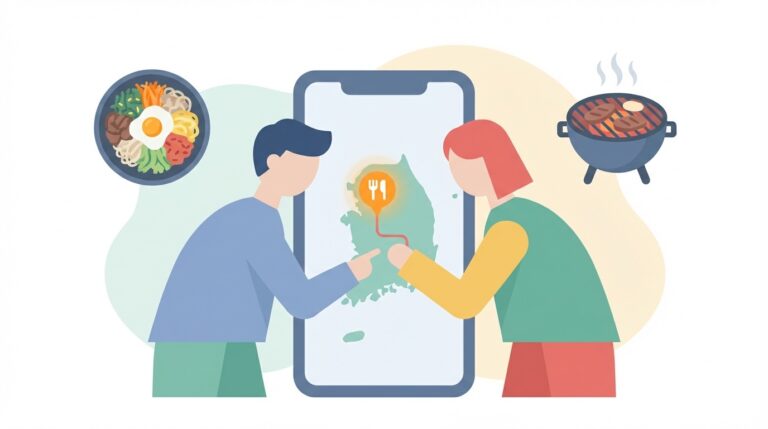
Phase 1: Empathy (Immersive Open)
Hello! This is your Daily Hangul Editor.
Picture this K-Drama scene: The main characters are huddled over a smartphone screen at work, furiously scrolling. One of them sighs and says, “No, not there. That’s just a tourist trap.” They tap the screen a few more times, their eyes light up, and they immediately send a KakaoTalk message to the group chat. They’ve just found it—the holy grail of dining out in Korea.
When you plan a trip to Korea, your first instinct might be to open Google Maps and search for “good restaurants in Seoul.” But here’s the secret: Koreans don’t do that. If you only rely on English searches, you’ll end up waiting in line for places locals haven’t visited in years.
Today, we are going to learn how to search for, evaluate, and share the real local spots—the places your Korean friends will actually want to go to. This guide is built directly from the panicked questions of my B1 students who found themselves in Seoul, staring at a map app entirely in Korean. Let’s dive in!
Phase 2: In-Depth Analysis of Core Expressions
1. 찐맛집 (The Real Deal Restaurant)
- Pronunciation: [jjin-matjib] + [Sound-alike: jjin (sounds like ‘jean’ but with a tight, tense ‘J’) – mat (like the English word ‘mat’ but stop the ‘t’ sharply) – jeep (like the car, but shorter)]
- Meaning: Literal: Steamed delicious house / Real nuance: An authentic, undeniably fantastic restaurant.
- K-Culture Moment: You’ll see this word everywhere in Korean vlog titles and Instagram hashtags. When a Korean friend takes you to a tiny, rundown alleyway and says, “Trust me, this is a jjin-matjib,” you know you’re about to have the best meal of your life.
- Editor’s Insight: Matjib (맛집) simply means “good restaurant.” But adding jjin (찐, slang for ‘real’ or ‘authentic’) elevates it. It means “I stake my reputation on this place.”
- Situation Spectrum:
- Casual with friends: ✅
- Semi-formal with coworkers: ✅
- Formal with strict bosses: ⚠️ (Stick to ‘유명한 맛집’ – famous restaurant)
- 🤔 Think About It: Why do Koreans have a specific, highly-used compound word just for “a good place to eat”? Does your native language have a single word that carries this exact weight?
2. 별점/리뷰 어때요? (How are the ratings/reviews?)
- Pronunciation: [byeoljeom/ribyu eottaeyo?] + [Sound-alike: byull-jum (rhymes with ‘dull plum’) / ree-byu uh-ttae-yo?]
- Meaning: Literal: Star-points/reviews how are they? / Real nuance: Does this place actually have good ratings?
- K-Culture Moment: Before stepping foot inside any restaurant, a Korean will almost instinctively check Naver or Kakao Maps. If the rating is below 4.0, you might see them hesitate at the door.
- Editor’s Insight: Koreans are highly analytical diners. We don’t just walk into a random place; we crowd-source our decisions. Asking this shows you understand the “verification” process of Korean dining.
- Situation Spectrum:
- Casual with friends: ✅
- Semi-formal with coworkers: ✅
- Formal with strict bosses: ✅
- 🤔 Think About It: In Korea, a beautiful interior with terrible food often gets a “Good for photos” review rather than a harsh critique. Why do you think indirect criticism is common in Korean reviews?
3. 카톡으로 링크 보낼게요. (I’ll send you the link via KakaoTalk.)
- Pronunciation: [katogeuro ringkeu bonaelgeyo] + [Sound-alike: ka-tok-eu-ro leen-keu bo-nel-geh-yo]
- Meaning: Literal: By KakaoTalk, link I will send. / Real nuance: I’ll share the map location with you on KakaoTalk.
- K-Culture Moment: You’ve decided on the restaurant. Now, you need to share it. In Korea, you don’t copy-paste an address; you hit the “Share” button on Naver Maps and send it directly to the group’s KakaoTalk chat.
- Editor’s Insight: This is the ultimate “I am a functional member of Korean society” phrase. Knowing how to send a map link instead of just giving the name saves everyone time and prevents getting lost.
- Situation Spectrum:
- Casual with friends: ✅
- Semi-formal with coworkers: ✅
- Formal with strict bosses: ✅ (You can use ‘보내드리겠습니다’ for extra respect)
- 🤔 Think About It: Korea relies heavily on its own domestic apps (Naver, Kakao) rather than global giants (Google, WhatsApp). How does this affect a foreigner’s experience when first arriving in Seoul?
Phase 3: Textbook vs. Real Korean
| Situation | 📖 Textbook Korean | 🗣️ Real Korean | 💡 Why the difference? |
|---|---|---|---|
| Looking for a place | 맛있는 식당을 찾고 있어요. (Looking for a delicious restaurant.) | 찐맛집 찾고 있어요. (Looking for a true matjib.) | “식당” feels a bit formal and clinical; “맛집” is the cultural standard for dining out. |
| Asking for opinions | 이 식당의 평가가 좋습니다. (The evaluation of this restaurant is good.) | 여기 리뷰 대박이에요. / 여기 평점 높아요. (The reviews here are crazy / Ratings are high.) | Daily conversations favor fast, impactful slang like “대박” (daebak) over formal nouns. |
| Sharing the location | 인터넷 주소를 주겠습니다. (I will give you the internet address.) | 카톡으로 링크 보낼게요. (I’ll send the link via KakaoTalk.) | Koreans use specific app names (Kakao/Naver) as verbs and nouns, prioritizing efficiency. |
Phase 4: Cultural Context — K-Culture Deep Dive
4-1. Non-Verbal Cues: The Art of Map-Sharing Nunchi
When planning a meal, Nunchi (눈치, the subtle art of gauging others’ moods) plays a huge role. If you suggest a restaurant and your Korean friend says, “Ah… the reviews say the waiting line is very long,” that is often a polite, indirect way of saying, “I really don’t want to go there.” Don’t push it; gracefully suggest, “그럼 다른 데 찾아볼까요?” (Should we look for another place?).
4-2. The K-Travel Connection: Navigating the “Korean App Ecosystem”
If you’ve watched any travel variety show like Welcome, First Time in Korea?, you’ve seen foreigners struggle with Google Maps. Due to national security laws, Google Maps cannot store local map data on foreign servers, making it practically useless for walking or driving directions in Korea.
To survive, you must download Naver Map or KakaoMap. When searching for a restaurant on these apps, you don’t just type “food.” You type specific keywords like “홍대 맛집” (Hongdae matjib) or “강남역 삼겹살” (Gangnam station pork belly). Understanding how to search within these domestic apps is the true mark of an integrated traveler.
Phase 5: Interactive Roleplay Scenario
Setting: Thursday evening, 5:30 PM. You are wrapping up a meeting at a trendy cafe in Seongsu-dong. You and your Korean friend/coworker, Minsu, are starving and need to figure out where to eat dinner before the weekend rush begins.
Characters:
– YOU: A B1-level Korean learner, determined to eat something amazing and local tonight.
– Minsu (29): Your Korean friend. He is famously picky about food and a master of Naver Maps.
Dialogue:
Minsu: 아, 배고프다. 우리 저녁 뭐 먹을까요? 🤤
(a, baegopeuda. uri jeonyeok mwo meogeulkkayo?)
[Ah, I’m hungry. What should we eat for dinner?]
YOU: 성수동에 왔으니까, 찐맛집 가고 싶어요!
(seongsudonge wasseunikka, jjin-matjib gago sipeoyo!)
[Since we’re in Seongsu-dong, I want to go to a real authentic restaurant!]
Minsu: 오, 찐맛집? 좋아요. 혹시 먹고 싶은 메뉴 있어요?
(o, jjin-matjib? joayo. hoksi meokgo sipeun menyu isseoyo?)
[Oh, a jjin-matjib? Sounds good. Is there any menu you want to eat?]
YOU: 음… 고기 어때요? 한국 바베큐요!
(eum… gogi eottaeyo? hanguk babekyuyo!)
[Hmm… how about meat? Korean BBQ!]
Minsu: (Typing fast on his phone) 잠깐만요, 네이버 지도에서 찾아볼게요. 음… 여기 어때요?
(jamkkanmanyo, neibeo jidoeseo chajabolgeyo. eum… yeogi eottaeyo?)
[Wait a second, I’ll search on Naver Map. Hmm… how about here?]
YOU: 거기 별점 어때요? 리뷰 좋아요?
(geogi byeoljeom eottaeyo? ribyu joayo?)
[How are the ratings there? Are the reviews good?]
Minsu: 평점 4.5점이에요! 리뷰도 대박이에요. 고기가 입에서 녹는대요.
(pyeongjeom 4.5jeomieyo! ribyudo daebak-ieyo. gogiga ibeseo nongneundaeyo.)
[The rating is 4.5! The reviews are amazing too. They say the meat melts in your mouth.]
YOU: 와, 맛있겠다! 근데 거기서 멀어요?
(wa, masitgetda! geunde geogiseo meoreoyo?)
[Wow, sounds delicious! But is it far from here?]
Minsu: 걸어서 10분 정도 걸려요. 카톡으로 링크 보낼게요. 확인해 보세요!
(georeoseo sipbun jeongdo geollyeoyo. katogeuro ringkeu bonaelgeyo. hwaginhae boseyo!)
[It takes about 10 minutes on foot. I’ll send you the link via KakaoTalk. Check it out!]
(🎭 Stage Direction: Minsu sends the link. You open it and notice a red warning banner on the app.)
🔀 Your Turn! The app says “Current Waiting Time: 50 minutes.” How do you respond?
– A) “웨이팅이 너무 길어요. 그냥 배달 시킬까요?” (The wait is too long. Should we just order delivery?)
– B) “50분? 찐맛집이니까 기다릴까요?” (50 minutes? Since it’s a true matjib, should we wait?)
– C) “저기요, 다른 데 가요!” (Hey you, let’s go somewhere else!)✅ Best Choice: B or A, depending on your hunger level! Koreans are surprisingly willing to endure a “웨이팅” (waiting) for a famous spot.
⚠️ Choice C Analysis: “저기요” (Excuse me/Hey you) is used to call a waiter, NOT to address your friend. It sounds rude and dismissive here. Say “다른 데 찾아볼까요?” (Should we look for another place?) instead.
Phase 6: 10-Second Shadowing Drill
Practice reading these out loud, focusing on the pauses (/) and the emotional tone.
- 🤩 (Excitedly) 여기 / 찐맛집이래요! / 우리 / 여기 가요!
(yeogi / jjin-matjibiraeyo! / uri / yeogi gayo!)
[They say this is a real authentic place! Let’s go here!] -
🧐 (Curiously) 혹시 / 네이버 별점 / 확인했어요?
(hoksi / neibeo byeoljeom / hwaginhaesseoyo?)
[By any chance, did you check the Naver rating?] -
📱 (Helpfully) 제가 / 카톡 단톡방에 / 링크 보낼게요!
(jega / katok dantokbange / ringkeu bonaelgeyo!)
[I will send the link to the KakaoTalk group chat!]
Phase 7: K-Culture Mini Dictionary
| Korean | Romanization | English | Context |
|---|---|---|---|
| 내돈내산 | naedonnaesan | Bought with my own money | Used in reviews to prove it’s NOT a sponsored ad. Crucial for finding honest reviews. |
| 단톡방 | dantokbang | Group chat room | Short for 단체 카톡방. Where all links and plans are shared. |
| 웨이팅 | weiting | Waiting in line | Koreans use the English word “waiting” specifically to describe queuing at a popular restaurant. |
| 핫플 | hatpeul | Hot place | Short for “hot place.” Trendy, highly Instagrammable locations. |
Phase 8: Traveler Survival Kit
🆘 Map & Restaurant Survival Phrases
– 🇰🇷 “여기서 멀어요?” (yeogiseo meoreoyo?) – Is it far from here?
– 🇰🇷 “여기 웨이팅 있어요?” (yeogi weiting isseoyo?) – Is there a wait here?
– 🇰🇷 “영업 시간 언제까지예요?” (yeongeop sigan eonjekkajiyeyo?) – Until when are you open?
– 💡 Pro Tip: In front of a jjin-matjib, you will often see a tablet on a stand (like ‘Catchtable’ or ‘Tableling’). You must type in your Korean phone number to join the digital queue. If you only have a tourist SIM without a number, politely go inside and ask: “외국인인데, 번호가 없어요. 어떻게 대기해요?” (I’m a foreigner and don’t have a number. How can I wait in line?)
📌 Editor’s Travel Note:
– Must-have Apps: Naver Map (네이버 지도), KakaoMap (카카오맵), MangoPlate (망고플레이트 – good for restaurant discovery in English).
– Payment: Korea is a cashless society. Even tiny alleyway restaurants accept credit cards. T-money cards are for transport, not usually for restaurants.
– Tipping: DO NOT TIP! It will cause confusion, and the waiter might chase you down the street thinking you forgot your change.
Phase 9: Critical Thinking Corner — “One Step Deeper”
🧠 Think Deeper: Food & Identity (The Culture of ‘We’)
Have you noticed how much effort Koreans put into deciding where to eat together? In Korea, food is rarely just fuel; it is the ultimate social glue. The concept of Jeong (정, deep emotional connection and affection) is built over shared meals. Searching for a matjib, sending the link, waiting in line for an hour, and grilling meat at the same table aren’t just logistical steps—they are a ritual of bonding. The time spent struggling to find the perfect restaurant reflects how much you value the people you are eating with.
💬 Your Turn: How does your culture handle finding places to eat? Do people usually search for highly-rated places in advance, or do you prefer to just walk around and pick whatever looks good? Share your thoughts in the comments!
Phase 10: FAQ & Avoiding Common Mistakes
Q: Can I use “찐맛집” with my boss or a teacher?
A: No. While it’s great for friends and close coworkers, jjin-matjib is slang. If you are recommending a place to a senior executive or your professor, say, “여기 아주 유명한 식당입니다” (This is a very famous restaurant) or “여기 평가가 아주 좋습니다” (The evaluation here is very good).
Q: Should I trust Naver blog reviews?
A: Yes and No. Many blogs are sponsored. Look for the keyword “내돈내산” (bought with my own money) or “솔직 리뷰” (honest review) to filter out the ads. Map ratings are generally more reliable than blog posts.
❌ Common Mistake #1: Saying “구글 맵으로 찾아볼게요” (I’ll search on Google Maps).
✅ Do This Instead: Say “네이버 지도로 찾아볼게요” (I’ll search on Naver Map). Unless you are looking for international reviews, Naver is the king of local data.❌ Common Mistake #2: Sending a raw URL address in a text message to a Korean.
✅ Do This Instead: Always use the KakaoTalk share button. A raw URL looks suspicious (phishing) or just messy. Koreans love the neat little preview boxes KakaoTalk generates.
Phase 11: Summary & Action Items
One-Liner Summary: Ditch the tourist traps by asking for a “jjin-matjib” (찐맛집), checking the “byeoljeom” (별점), and sharing the “link via Katalk” (카톡으로 링크) like a true local!
Action Mission:
– 🥉 Bronze (Solo): Look at a Korean map app and say “여기 별점 어때요?” out loud 3 times.
– 🥈 Silver (Online): Find a Korean restaurant in your home country on Google Maps and write a short review ending with “여기 찐맛집이에요!”
– 🥇 Gold (Real World): Next time you meet a Korean friend, open your map app and say, “카톡으로 링크 보낼게요!”
K-Culture Mission:
Download Naver Map (it supports English!). Change the location to ‘Hongdae’ or ‘Gangnam’ and search for “맛집”. Click on the top result and try to spot the word “웨이팅” (waiting) in the reviews!
Phase 12: Quiz — Interactive Challenge
1. Situational Judgment: You want to ask your Korean friend if the cafe they suggested has good ratings. What is the most natural B1-level phrase to use?
– A) 이 식당은 좋은 곳입니까?
– B) 별점 어때요?
– C) 카톡으로 링크 보낼게요.
2. Fill in the Blank:
“This place isn’t just a regular restaurant. It’s a real authentic spot!”
=> “여기는 그냥 식당이 아니에요. 완전 ______이에요!”
3. True or False – K-Culture Edition:
“If a Korean restaurant is very famous, it is polite to leave a 10% tip for the good service.” (T/F)
(Click to reveal answers below!)
Check Answers
1. B (‘별점 어때요?’ is the exact natural way to ask about ratings. A is too textbook, C is about sending a link.)
2. 찐맛집 (jjin-matjib)
3. False! Korea has absolutely no tipping culture. Tipping will cause confusion.
Frequently Asked Questions (FAQ)
Q: What does "찐맛집 (The Real Deal Restaurant)" mean in Korean and how do you pronounce it?
A: In Korean, "찐맛집 (The Real Deal Restaurant)" is pronounced [jjin-matjib] and means: Literal: Steamed delicious house / Real nuance: An authentic, undeniably fantastic restaurant.
Q: What does "별점/리뷰 어때요? (How are the ratings/reviews?)" mean in Korean and how do you pronounce it?
A: In Korean, "별점/리뷰 어때요? (How are the ratings/reviews?)" is pronounced [byeoljeom/ribyu eottaeyo?] and means: Literal: Star-points/reviews how are they? / Real nuance: Does this place actually have good ratings?
Q: What does "카톡으로 링크 보낼게요. (I'll send you the link via KakaoTalk.)" mean in Korean and how do you pronounce it?
A: In Korean, "카톡으로 링크 보낼게요. (I'll send you the link via KakaoTalk.)" is pronounced [katogeuro ringkeu bonaelgeyo] and means: Literal: By KakaoTalk, link I will send. / Real nuance: I'll share the map location with you on KakaoTalk.







