

Phase 1: Empathy (The K-Culture Cold Open)
Hello! It’s your Daily Hangul Editor.
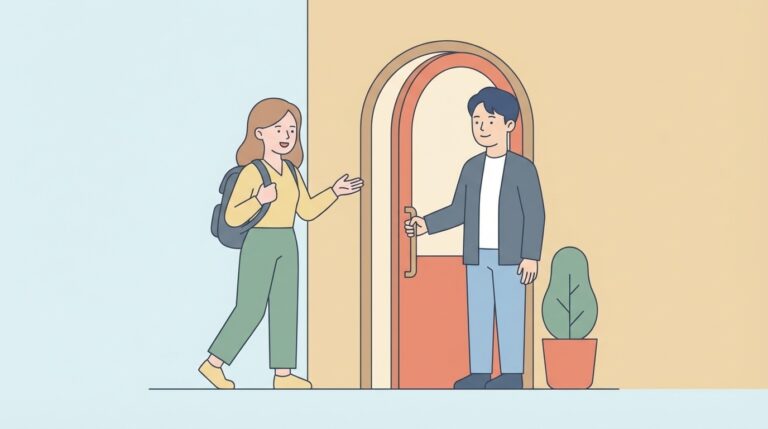
Picture this: You’re walking into a trendy café in Seongsu-dong. A man is walking slightly ahead of you. In your home country, you’d naturally expect him to hold the door open for you—”Ladies first,” right? But here, he simply pushes the door, walks in, and the glass door swings right back toward your face. Ouch.
Was he being rude? Is chivalry dead in Korea?
Not at all! Before you get offended and cancel your K-Drama subscriptions, let’s take a deep breath. As a veteran tutor who has seen countless foreign students experience this exact “door-to-the-face” culture shock, I’m here to let you in on a little secret: In Korea, hierarchy (age and status) almost always trumps gender.
The Western concept of “Ladies First” is relatively modern in Korea. While younger generations are adopting global etiquette, traditional Korean “chivalry” is shown in entirely different ways—like taking care of the group’s meals or carrying your heavy bags. Today, we are going to decode the Korean spatial etiquette, learn the expressions to navigate it gracefully, and turn you into a true cultural insider. Let’s dive in!
Phase 2: Core Expressions Deep Dive
Let’s look at the essential phrases you need when navigating physical spaces, offering help, and showing politeness in Korea.
1. 먼저 들어가세요 (You go in first / After you)
- Pronunciation: meon-jeo deu-reo-ga-se-yo [Sounds like: mun-juh dro-gah-seh-yo]
- Meaning: (Literal) Please enter first. / (Real Nuance) After you. I am yielding to you out of respect.
- K-Culture Moment: Imagine waiting for the elevator at your Seoul office. The doors open. Instead of letting the women go first, the youngest employee (regardless of gender) will hold the elevator open and say this to the older or higher-ranking colleagues.
- Editor’s Insight: This phrase is less about gender and everything about age and rank. If you are the youngest, you say this. If you are a woman but you are the youngest, people might actually feel awkward if you wait for them to hold the door for you!
- Situation Spectrum:
- Casual (Friends): ✅ (You would say: 먼저 가 – meon-jeo ga)
- Semi-formal (Co-workers): ✅
- Formal (Boss/Elders): ✅
- 🤔 Think About It: Why does Korean culture prioritize age over gender when yielding space? How does this reflect the Confucian ideals of maintaining social order?
2. 제가 할게요 (I’ll do it / Let me take care of that)
- Pronunciation: je-ga hal-ge-yo [Sounds like: jeh-gah hal-geh-yo]
- Meaning: (Literal) I will do it. / (Real Nuance) Please relax, let me take on the physical burden for you.
- K-Culture Moment: This is the ultimate “Korean Boyfriend” phrase in K-Dramas. When the female lead has a heavy handbag, the male lead snatches it and says “제가 들게요” (I’ll carry it). But it’s also the ultimate “Junior Colleague” phrase at a Korean BBQ restaurant when it’s time to grill the meat.
- Editor’s Insight: True Korean chivalry is about acts of service. Holding a door takes two seconds, but grilling meat for 30 minutes or carrying a heavy bag shows true dedication.
- Situation Spectrum:
- Casual (Friends): ✅ (내가 할게 – nae-ga hal-ge)
- Semi-formal (Co-workers): ✅
- Formal (Boss/Elders): ✅
- 🤔 Think About It: In your culture, is it common for men to carry their girlfriend’s purse in public? In Korea, it’s a very common sign of affection and care!
3. 제가 낼게요 / 제가 살게요 (I’ll pay / It’s on me)
- Pronunciation: je-ga nael-ge-yo / je-ga sal-ge-yo [Sounds like: jeh-gah nel-geh-yo / sal-geh-yo]
- Meaning: (Literal) I will pay/buy. / (Real Nuance) I am treating you today.
- K-Culture Moment: The classic “Wallet War” at the restaurant counter. Two older Korean men physically wrestling over the bill.
- Editor’s Insight: While dating etiquette often sees men paying (or taking turns), in general society, the older person or the inviter pays. If an older male colleague pays for your lunch, he isn’t hitting on you; he’s just fulfilling his role as the “Sunbae” (senior).
- Situation Spectrum:
- Casual (Friends): ✅ (내가 살게 – nae-ga sal-ge)
- Semi-formal (Co-workers): ✅
- Formal (Boss/Elders): ⚠️ (Use carefully. Elders usually insist on paying. Say “제가 대접하고 싶습니다” – I want to treat you.)
- 🤔 Think About It: Have you ever experienced the awkwardness of trying to split the bill in Korea (Dutch pay)?
Phase 3: Textbook vs. Real Korean
| Situation | 📖 Textbook Korean | 🗣️ Real Korean | 💡 Why is it different? |
|---|---|---|---|
| Letting someone pass | 먼저 가십시오 (meon-jeo ga-sip-si-o) | 먼저 가세요~ (meon-jeo ga-se-yo) | The “-십시오” ending is too military/news-anchor rigid for daily life. |
| Volunteering to help | 제가 돕겠습니다 (je-ga dop-get-seum-ni-da) | 아, 제가 할게요! (a, je-ga hal-ge-yo!) | “돕겠습니다” sounds like a formal pledge. “제가 할게요” is natural and proactive. |
| Getting past someone | 실례하겠습니다 (sil-lye-ha-get-seum-ni-da) | 잠시만요~ (jam-si-man-yo) | “Excuse me” vs “Just a moment.” Koreans use “Just a moment” to navigate crowds. |
Phase 4: Cultural Context — K-Culture Deep Dive
4-1. Non-Verbal Elements & Nunchi (눈치)
When yielding a door or an elevator, words aren’t always necessary. A slight bow and extending your hand open toward the doorway is the universal Korean gesture for “After you.” But here is where Nunchi (the art of reading the room) kicks in. If you are a B2 learner, you already know about Korean hierarchy. If you are a young female professional and you are standing at the elevator with a 50-year-old male CEO, do not wait for him to let you in first. Your gender does not override his status. Step aside, gesture, and let him enter.
4-2. The K-Drama Illusion vs. Reality
K-Dramas have beautifully exported the image of the ultra-romantic, hyper-chivalrous Korean man. He opens the car door, shields the female lead from the rain with an umbrella, and ties her shoelaces.
Critical View: While younger Korean men are indeed very romantic with their partners, this is dating etiquette, not global social etiquette. A Korean man will tie his girlfriend’s shoelaces, but he might accidentally let a café door close on a female stranger behind him simply because he isn’t checking his blind spots. It’s not malice; it’s just a different baseline of public awareness.
4-3. The “Chivalry” of K-Food
If you want to see true Korean politeness, look at the dining table. The youngest person (often female if dealing with older men, but strictly based on age/rank) will perform the “Sujeo Setting” (수저 세팅)—laying out the spoons, chopsticks, and napkins for everyone, pouring the water, and grilling the meat. In the West, serving a woman first at a restaurant is polite. In Korea, the highest-ranking person is served first, and the youngest does the serving.
Phase 5: Real-Life Roleplay Scenario
Setting: Friday at 1 PM. A crowded café near Gangnam Station after a team lunch. You are with your Korean team.
Characters:
– YOU: A foreign female employee (age 26).
– Min-su: A male junior colleague (age 24).
– Manager Kim: Your male boss (age 45).
Manager Kim: 커피 한 잔씩 하고 들어갑시다. 내가 살게요.
(keo-pi han jan-ssik ha-go deu-reo-gap-si-da. nae-ga sal-ge-yo.)
[Let’s grab a cup of coffee before heading back. It’s on me.]
Min-su: 아, 부장님! 감사합니다!
(a, bu-jang-nim! gam-sa-ham-ni-da!)
[Oh, Manager! Thank you!]
(🎭 Stage Direction: You all reach the café entrance. The door is heavy. You are standing right in front of it.)
🔀 YOUR TURN! What do you do?
– A) Wait for Manager Kim or Min-su to open the door for you because you are the only woman.
– B) Open the door, walk in first, and let it close behind you.
– C) Open the door, hold it, and say to Manager Kim: “먼저 들어가세요!” (meon-jeo deu-reo-ga-se-yo!)✅ Best Choice: C.
Reason: By opening the door and letting the boss enter first, you are showing excellent Korean etiquette. Min-su (the youngest) should ideally be doing this, but since you are at the door, doing this shows great Nunchi. Waiting for them (Choice A) might cause an awkward traffic jam, as they expect the younger staff to handle the door!
Bonus K-Culture Scenario: The Heavy Bag
You are on a date with a Korean guy. You have a somewhat heavy backpack.
Him: 어휴, 가방 무거워 보이네요. 제가 들게요. (Wow, your bag looks heavy. I’ll carry it.)
You: (Smiling gently) 괜찮아요! 그렇게 안 무거워요. (It’s okay! It’s not that heavy.)
Pro Tip: He will likely insist. Let him carry it! It’s a prime way to show affection in Korea.
Phase 6: 10-Second Shadowing Drill
Let’s practice the intonation for when you want to politely yield to an elder or your boss.
😊 아, / 부장님! / 먼저 / 들어가세요~ (a, / bu-jang-nim! / meon-jeo / deu-reo-ga-se-yo~)
(Oh, Manager! Please go in first~)
– Pause slightly after “Ah” to sound natural, not robotic.
– Extend the “yo~” at the end slightly to soften the tone and make it sound friendly.
😤 아니에요, / 제가 / 할게요! / 쉬세요. (a-ni-e-yo, / je-ga / hal-ge-yo! / swi-se-yo.)
(No, I’ll do it! Please rest.)
– Say “I’ll do it” with confident, upbeat energy to show you are happy to help.
Phase 7: K-Culture Mini Dictionary
| Korean | Romanization | English | Context/Meaning |
|---|---|---|---|
| 매너 | mae-neo | Manners / Etiquette | In Korea, saying someone has “good manners” (매너가 좋다) often refers to them being considerate, paying for meals, or reading the room well. |
| 눈치 | nun-chi | Social tact / Wits | The quintessential Korean ability to read social situations, hierarchy, and moods without words. |
| 막내 | mang-nae | The youngest | The youngest person in a group, family, or office. They traditionally handle small chores (setting tables, getting water). |
| 수저 세팅 | su-jeo se-ting | Utensil setting | The act of laying out spoons and chopsticks for others at a restaurant. A key display of basic office/social etiquette. |
Phase 8: Traveler’s Survival Kit
If you are traveling in Korea, you will be navigating crowded subway stations, busy markets, and packed cafes. Here is your survival kit for physical space etiquette.
🆘 Survival Phrases for Navigating Spaces
– 🇰🇷 “잠시만요!” (jam-si-man-yo!)
– 🗣️ Meaning: Just a moment! / Excuse me (when passing through a crowd).
– 📍 Where to use: Exiting a crowded subway, pushing past people in Myeongdong.
– 💡 Pro Tip: Koreans rarely say “Sorry” when slightly bumping shoulders in a busy street. Don’t take it personally! It’s just big-city survival. Instead of “Excuse me,” they announce “I am passing through” by saying 잠시만요.📌 Editor’s Travel Note: The Elevator Rule
When you get into an elevator, the person standing closest to the buttons becomes the unofficial “captain.” If you are near the buttons, hold the “Open” (열림) button until everyone is in, regardless of your gender. It’s the polite thing to do!
Phase 9: Critical Thinking — “One Step Deeper”
🧠 Think Deeper: Language, Power, and Spatial Chivalry
The clash between Western “Ladies First” and the Korean hierarchical system reveals a fascinating truth about societal values. In Western history, chivalry stemmed from a code protecting the “vulnerable” (women and children), manifesting in gestures like holding doors or pulling out chairs.In contrast, traditional Korean society is rooted in Confucianism, where social harmony is maintained by respecting age and authority. Therefore, the highest form of respect isn’t based on gender, but on ensuring the comfort of the elders or superiors. A Korean man might not hold the door for a female stranger, but he will immediately stand up, bow, and yield his seat to an elderly woman on the subway. The “politeness” is still there; the trigger is just different.
💬 Your Turn: Does your home culture prioritize gender, age, or something else when it comes to social etiquette? Have you ever had a misunderstanding because of it? Let us know in the comments!
Phase 10: FAQ & Avoiding Common Mistakes
Q: Is it weird if I (a foreign woman) hold the door for a Korean man?
A: Not at all! Actually, holding the door for the person directly behind you is becoming common global etiquette in Korea, especially among younger generations. They will appreciate it and usually give a quick nod or “Thank you” (감사합니다).
Q: At a K-BBQ restaurant, should I let the man grill the meat?
A: If he is older than you or hosting the meal, he might insist on doing it to take care of you. If you are the youngest, it’s polite to offer: “제가 구울게요” (I’ll grill). But if a restaurant staff member comes to grill it, just sit back and enjoy!
❌ Common Mistake #1: Expecting strangers to hold the door for you.
✅ Do this instead: Always be prepared to catch the door yourself. If someone does hold it, consider it a nice bonus, not a baseline expectation.❌ Common Mistake #2: Refusing to let an older person pay for your meal because you want to be “independent” or egalitarian.
✅ Do this instead: In Korea, accepting the treat graciously is part of the relationship building. Say “잘 먹겠습니다!” (I will eat well!), and next time, you can buy the coffee.
Phase 11: Summary & Action Items
One-Liner Summary: In Korea, polite etiquette is driven by age and status (hierarchy) rather than the Western concept of “Ladies First”—so don’t wait for the door, grab the tongs at K-BBQ, and show your Nunchi!
Your Action Missions:
– 🥉 Bronze (Solo): Stand in front of a mirror, gesture with your hand, and confidently say, “먼저 들어가세요!” 3 times.
– 🥈 Silver (Online): Next time you watch a K-Drama, count how many times the youngest person sets the table or the male lead carries a woman’s handbag.
– 🥇 Gold (Real Life): The next time you are at a café or restaurant with Korean friends or colleagues, offer to grab the napkins and utensils first: “제가 세팅할게요!” (I’ll set the table!). Watch their faces light up.
Engagement: Have you ever experienced a “culture shock” moment regarding doors, elevators, or paying for meals in Korea? Share your story below! 👇
Phase 12: Interactive Quiz
Let’s test your B2-level cultural Nunchi!
1. Situational Judgment: You (a 25-year-old female) are walking into a restaurant with your 50-year-old male boss. Who should enter first?
– A) You, because ladies go first.
– B) Your boss, because of his rank and age.
– C) Whoever walks faster.
2. Fill in the Blank: You want to offer to carry a heavy box for your older colleague.
“과장님, 무거워 보이네요. ______ 들게요!”
– A) 제가 (je-ga)
– B) 너가 (neo-ga)
– C) 먼저 (meon-jeo)
3. True or False (K-Culture Edition):
“If a Korean man does not hold the door for a woman he doesn’t know, it means he is poorly educated and rude.” (T / F)
(Answers: 1. B – Age/rank comes first! 2. A – 제가 들게요. 3. False – It’s just a difference in cultural spatial awareness, not malice!)
Frequently Asked Questions (FAQ)
Q: What does "먼저 들어가세요 (You go in first / After you)" mean in Korean and how do you pronounce it?
A: In Korean, "먼저 들어가세요 (You go in first / After you)" is pronounced [meon-jeo deu-reo-ga-se-yo [Sounds like: mun-juh dro-gah-seh-yo] and means: (Literal) Please enter first. / (Real Nuance) After you. I am yielding to you out of respect.
Q: What does "제가 할게요 (I'll do it / Let me take care of that)" mean in Korean and how do you pronounce it?
A: In Korean, "제가 할게요 (I'll do it / Let me take care of that)" is pronounced [je-ga hal-ge-yo [Sounds like: jeh-gah hal-geh-yo] and means: (Literal) I will do it. / (Real Nuance) Please relax, let me take on the physical burden for you.
Q: What does "제가 낼게요 / 제가 살게요 (I'll pay / It's on me)" mean in Korean and how do you pronounce it?
A: In Korean, "제가 낼게요 / 제가 살게요 (I'll pay / It's on me)" is pronounced [je-ga nael-ge-yo / je-ga sal-ge-yo [Sounds like: jeh-gah nel-geh-yo / sal-geh-yo] and means: (Literal) I will pay/buy. / (Real Nuance) I am treating you today.







