

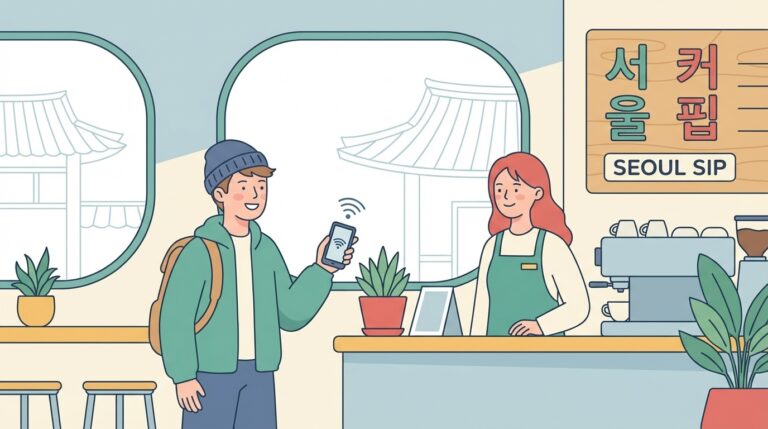
Phase 1: Empathy (Welcome to the Land of Fast Internet!)
Hello! I’m your Daily Hangul Editor.
Picture this: You are traveling in Seoul. You just found a stunning Hanok (traditional Korean house) cafe in Bukchon. You order a beautiful Matcha Einspänner, take the perfect aesthetic photo, and you are ready to upload it to your Instagram or send it to your mom back home.
But wait… your data is slow. You need Wi-Fi. You look at the friendly barista, but your mind goes blank. How do I ask for the password?
Korea is world-famous for its lightning-fast internet. Whether you are in a subway, a restaurant, or even on top of a mountain, Koreans are always connected. If you don’t know how to ask for the Wi-Fi, you are missing out on one of the best perks of visiting Korea!
Don’t worry. Today, we are going to learn exactly how to connect to the internet like a true local. This guide is built from the real experiences of my beginner students who survived the ‘no-data panic’ in Seoul!
Phase 2: Core Expressions Deep Dive
1. 와이파이 비밀번호가 뭐예요?
- Pronunciation: wa-i-pa-i bi-mil-beon-ho-ga mwo-ye-yo?
- Sound-alike guide: “wa-ee-pie bee-meal-bun-ho-gah mwo-yeh-yo”
- Meaning: What is the Wi-Fi password?
- K-Culture Moment: You will hear this in literally every cafe in Korea. University students, freelancers, and K-Drama writers all sit in cafes with their laptops. Asking this question is basically a greeting to the cafe staff!
- Editor’s Insight: ‘비밀번호’ literally means ‘secret number’. Just point to your phone and ask this, and they will immediately understand.
- Situation Spectrum:
- Friends (Casual): ✅ (Drop the ‘요’ -> 와이파이 비밀번호가 뭐야?)
- Cafe Staff (Semi-formal): ✅
- Formal/Elders (Formal): ⚠️ (Better to use: 와이파이 비밀번호가 어떻게 되나요?)
- 🤔 Think About It: Why does Korean use the English word “Wi-Fi” but a Korean word for “password”? How do you say “password” in your language?
2. 인터넷이 안 돼요.
- Pronunciation: in-teo-ne-si an dwae-yo.
- Sound-alike guide: “in-tuh-neh-shee ahn dway-yo”
- Meaning: The internet is not working. (Literal: Internet cannot be done.)
- K-Culture Moment: Imagine you are in an Airbnb in Hongdae. You want to watch Netflix, but the TV won’t connect. You message your host: “인터넷이 안 돼요 ㅠㅠ”.
- Editor’s Insight: “안 돼요” is a magic phrase for A2 learners! It means “doesn’t work” or “I can’t.” Phone broken? 핸드폰이 안 돼요. Card declined? 카드가 안 돼요.
- Situation Spectrum:
- Friends (Casual): ✅ (안 돼)
- Service Staff (Semi-formal): ✅
- Formal (Formal): 🚫 (인터넷 연결에 문제가 있습니다)
- 🤔 Think About It: Koreans use “안 돼요” for almost any broken machine or rule violation. It’s a very indirect, polite way to say “there is a problem.”
3. 와이파이 연결 어떻게 해요?
- Pronunciation: wa-i-pa-i yeon-gyeol eo-tteo-ke hae-yo?
- Sound-alike guide: “wa-ee-pie yun-gyul uh-ttuh-keh hey-yo”
- Meaning: How do I connect to the Wi-Fi?
- Editor’s Insight: Sometimes you have the password, but there are 5 different networks with similar names (e.g., Cafe_5G, Cafe_2.4G, Cafe_Guest). This is when you ask for help!
- Situation Spectrum:
- Friends (Casual): ✅
- Cafe Staff (Semi-formal): ✅
- Formal (Formal): ⚠️
Phase 3: Textbook vs. Real Korean
| Situation | 📖 Textbook Korean | 🗣️ Real Korean | 💡 Why is it different? |
|---|---|---|---|
| Asking for password | 와이파이 비밀번호가 무엇입니까? | 와이파이 비번 뭐예요? | Koreans love shrinking words! “비밀번호” becomes “비번(bi-beon)” for speed. |
| Reporting a problem | 인터넷 연결이 불가능합니다. | 인터넷이 안 돼요. | “안 돼요” is much more natural and covers all “out of order” situations. |
| Asking for help | 인터넷을 연결해 주시겠습니까? | 이거 연결 어떻게 해요? | Pointing and saying “이거(this)” is the ultimate survival shortcut. |
Bottom Note: For A2 learners, using “비번(bi-beon)” instead of “비밀번호(bi-mil-beon-ho)” will instantly make you sound like a local insider!
Phase 4: Cultural Context — K-Culture Deep Dive
4-1. Non-verbal Cues (The “Phone Point”)
When asking about the internet, body language is your best friend. Hold your phone up, look slightly confused (like a cute K-Drama lead facing a minor problem), and point at the Wi-Fi screen. Even if your pronunciation isn’t perfect, the staff’s Nunchi (눈치, situational awareness) will instantly kick in, and they will help you.
4-2. K-Travel: The Cafe Office Culture (카공족)
Have you noticed in K-Dramas that characters are always having serious meetings or studying in cafes? In Korea, cafes are not just for drinking coffee; they are second offices. People who study in cafes are called Kagongjok (카공족 – Cafe Study Tribe).
Because of this, free Wi-Fi is considered a basic human right in Korea.
Where is the password usually hiding?
1. On the receipt (Usually at the very bottom: WIFI PW: 12345678)
2. Near the POS/Register (Look for a small cute sign)
3. On your table (Sometimes printed on a small sticker)
Phase 5: Real-Life Roleplay Scenario
Setting: It’s 2 PM on a Saturday. You are at a trendy, bustling cafe in Seongsu-dong (the Brooklyn of Seoul). The music is loud, and you just ordered an Iced Americano.
Characters:
– YOU: A traveler who desperately needs to check Google Maps.
– Staff (지훈, 25): A busy but polite part-time barista.
(Dialogue)
지훈: 안녕하세요, 주문하시겠어요?
(an-nyeong-ha-se-yo, ju-mun-ha-si-ge-sseo-yo?)
[Hello, would you like to order?]
YOU: 아이스 아메리카노 한 잔 주세요.
(a-i-seu a-me-ri-ka-no han jan ju-se-yo.)
[One iced Americano, please.]
지훈: 네, 4,500원입니다. 드시고 가시나요?
(ne, sa-cheon-o-baeg-won-im-ni-da. deu-si-go ga-si-na-yo?)
[Yes, that’s 4,500 won. Are you having it here?]
YOU: 네. 저기요, 와이파이 비번이 뭐예요?
(ne. jeo-gi-yo, wa-i-pa-i bi-beon-i mwo-ye-yo?)
[Yes. Excuse me, what’s the Wi-Fi password?]
지훈: 아, 영수증 하단에 있습니다.
(a, yeong-su-jung ha-dan-e it-seum-ni-da.)
[Ah, it’s at the bottom of the receipt.]
(🎭 Stage Direction: You look at your hands. You didn’t take the receipt!)
YOU: 어… 영수증 안 받았어요.
(eo… yeong-su-jung an ba-da-sseo-yo.)
[Uh… I didn’t get the receipt.]
지훈: 아! 다시 출력해 드릴까요?
(a! da-si chul-ryeok-hae deu-ril-kka-yo?)
[Ah! Shall I print it again for you?]
🔀 Your Turn! How should you answer?
– A) 아니요, 그냥 말해주세요. (No, just tell me. – A bit rude!)
– B) 네, 감사합니다! (Yes, thank you! – Safe and polite!)
– C) 대박! (Awesome! – Too casual for a barista!)✅ Best Choice: B — Always be polite to service workers. If they offer to print it, say “네, 감사합니다!” (Yes, thank you!).
Phase 6: 10-Second Shadowing Drill
Speak out loud! Follow the pauses (/) and the emotion.
😊 저기요, / 와이파이 비번이 / 뭐예요?
(jeo-gi-yo, / wa-i-pa-i bi-beon-i / mwo-ye-yo?)
Excuse me, what’s the Wi-Fi password?
😢 인터넷이 / 안 돼요.
(in-teo-ne-si / an dwae-yo.)
The internet is not working.
Phase 7: K-Culture Mini Dictionary
| Korean | Romanization | English | Context |
|---|---|---|---|
| 비번 | bi-beon | Password | Short for 비밀번호. Used daily by young Koreans. |
| 데이터 | de-i-teo | Mobile Data | If you have no Wi-Fi, you use your “data”. |
| 카톡 | ka-tok | KakaoTalk | The #1 messenger app in Korea. You need Wi-Fi for this! |
| 공유기 | gong-yu-gi | Router | The physical Wi-Fi box. You might hear: “공유기 껐다 켜보세요” (Try turning the router off and on). |
Phase 8: Traveler’s Survival Kit
Since connecting to the internet is a top priority for travelers, here are your essential survival cards!
🆘 Survival Phrase #1: Finding the network
– 🇰🇷 “어떤 와이파이 써야 돼요?” (eo-tteon wa-i-pa-i sseo-ya dwae-yo?)
– 🗣️ “uh-tton wa-ee-pie ssuh-ya dway-yo?”
– 📍 Use when: There are 10 different networks and you don’t know which one belongs to the cafe.🆘 Survival Phrase #2: Free Public Wi-Fi
– 🇰🇷 “여기 무료 와이파이 있어요?” (yeo-gi mu-ryo wa-i-pa-i i-sseo-yo?)
– 🗣️ “yuh-gee moo-ryo wa-ee-pie ee-sso-yo?”
– 📍 Use when: At a park, library, or museum.📌 Editor’s Travel Note: Wi-Fi on the Go
– Subways & Buses: Korea has free Wi-Fi on public transport! Look for networks namedPublic WiFi FreeorSeoul_Secure.
– The “KT/SKT/LG” Trap: Sometimes you see networks named ‘KT_starbucks’. These are usually locked for specific telecom users. Ask the staff for the store’s dedicated Wi-Fi!
Phase 9: Critical Thinking — “One Step Deeper”
The “Pali-pali” (Hurry Up) Culture and the Internet
Have you ever wondered why Korean internet is so fast? It’s deeply rooted in the 빨리빨리 (Pali-pali, Hurry hurry) culture. Koreans value speed and efficiency in everything—from food delivery to internet connections. This cultural mindset even changes the language! That’s why a long word like 비밀번호 (Password) is quickly chopped down to 비번 (Bibeon). Why waste time saying four syllables when you can say two?
💬 Your Turn:
Does your culture have a similar “need for speed,” or is it more relaxed? How does it affect your internet or the way you speak? Share in the comments!
Phase 10: FAQ & Mistake Prevention
Q: Can I ask a stranger on the street to share their mobile hotspot?
No, please don’t! In Korea, personal boundaries regarding digital privacy are strong. Asking a stranger for a hotspot is considered very strange. Instead, step into the nearest convenience store (CU, GS25) or cafe to find Wi-Fi.
Q: The cafe password is “소문자 아이디(somunja ID)”. What does that mean?
소문자 (so-mun-ja) means “lowercase letters”. 대문자 (dae-mun-ja) means “uppercase letters”. This is super common on cafe receipts!
❌ Common Mistake #1: Mispronouncing Wi-Fi
Do not say “wee-fee” or “wah-fee”. Koreans pronounce it exactly like the English word, but with Korean syllables: 와.이.파.이 (wa-i-pa-i).❌ Common Mistake #2: Forgetting to add ‘-요 (-yo)’
If you just say “비번 뭐 야?” to a cafe worker, it sounds rude (like you are talking to a child). Always remember the magical polite ending: “비번 뭐예요?”
Phase 11: Summary & Action Items
One-Liner Summary: When you need the internet, confidently ask, “와이파이 비번이 뭐예요?” (wa-i-pa-i bi-beon-i mwo-ye-yo?).
Action Mission:
– 🥉 Bronze: Say “와이파이 비번이 뭐예요?” 3 times out loud right now.
– 🥈 Silver: Change your smartphone’s Wi-Fi setting menu to Korean for one day to get used to words like 연결 (Connect).
– 🥇 Gold: Next time you are at a cafe (even in your home country!), pretend the barista is Korean and ask for the password in your head in Korean!
K-Culture Mission:
Next time you watch a K-Drama, look closely at the cafe scenes. Can you spot the little Wi-Fi sign next to the cash register?
Phase 12: Quiz — Interactive Challenge
1. You are at a cafe and the barista hands you a receipt. Where should you look for the Wi-Fi password?
A) On the back of the receipt.
B) Usually at the very bottom of the receipt.
C) Inside the coffee cup.
2. Fill in the blank (Casual slang):
“와이파이 [ _____ ] 뭐예요?” (Hint: Short for password)
3. True or False:
“If the subway Wi-Fi isn’t working, it is completely normal to ask the person sitting next to you to turn on their mobile hotspot for you.”
(Answers: 1: B, 2: 비번, 3: False! Respect digital boundaries in Korea!)
Frequently Asked Questions (FAQ)
Q: What does "와이파이 비밀번호가 뭐예요?" mean in Korean and how do you pronounce it?
A: In Korean, "와이파이 비밀번호가 뭐예요?" is pronounced [wa-i-pa-i bi-mil-beon-ho-ga mwo-ye-yo?] and means: What is the Wi-Fi password?
Q: What does "인터넷이 안 돼요." mean in Korean and how do you pronounce it?
A: In Korean, "인터넷이 안 돼요." is pronounced [in-teo-ne-si an dwae-yo.] and means: The internet is not working. (Literal: Internet cannot be done.)
Q: What does "와이파이 연결 어떻게 해요?" mean in Korean and how do you pronounce it?
A: In Korean, "와이파이 연결 어떻게 해요?" is pronounced [wa-i-pa-i yeon-gyeol eo-tteo-ke hae-yo?] and means: How do I connect to the Wi-Fi?






