

Phase 1: Empathy (Welcome to the Real Seoul!)
Hello! I’m your Daily Hangul Editor, your personal guide to navigating both the Korean language and its vibrant culture.
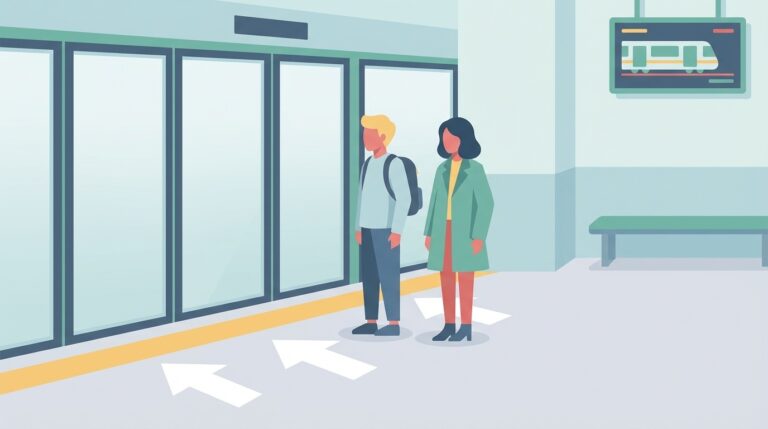
Picture this: You are at Gangnam Station. It’s 6:00 PM on a Friday. The subway platform is packed with people. In K-Dramas, this is usually the moment when the male lead romantically pulls the female lead out of the crowd. But in reality? You are just trying to figure out where the line starts so you don’t accidentally cut off an exhausted office worker. You stand near a door, and suddenly, you feel the piercing gazes of three people behind you. Oops.
Welcome to the unspoken rules of Korean public transit! Knowing how to line up (줄 서기) and board gracefully isn’t just about good manners—it’s about surviving the rush hour without becoming the villain of someone else’s day.
Today, I’m sharing the absolute must-know phrases for queuing up and boarding transit in Korea. These are the exact expressions my students use to navigate Seoul like true locals. Let’s dive in!
Phase 2: Core Expressions Deep Dive
1. 혹시 여기 줄이에요?
- Pronunciation: hok-si yeo-gi ju-ri-e-yo? [hoak-shee yuh-gee joo-ree-eh-yo?]
- Meaning: Is this the line (by any chance)?
- K-Culture Moment: You are standing at a busy bus stop. There’s a loose group of people, and you can’t tell if they are waiting for your bus or a different one. You tap the person lightly on the shoulder and ask this. It’s the ultimate icebreaker to avoid a faux pas.
- Editor’s Insight: The magic word here is 혹시 (hok-si), meaning “by any chance.” Koreans love softening their questions to avoid sounding confrontational. Adding “혹시” instantly makes you sound polite and considerate, rather than demanding.
- Situation Spectrum:
- Casual (Friends): ✅ (Without ‘yo’: 여기 줄이야?)
- Semi-formal (Strangers/Colleagues): ✅
- Formal (Elders/Bosses): ✅ (Safe to use!)
- 🤔 Think About It: Why do Koreans prefer asking “Is this the line?” instead of “Are you in line?” It shifts the focus away from the person and onto the situation, maintaining social harmony. Does your native language do something similar?
2. 먼저 타세요.
- Pronunciation: meon-jeo ta-se-yo [mun-juh tah-seh-yo]
- Meaning: Please go ahead / You can board first.
- K-Culture Moment: The subway doors open. You and a sweet elderly lady step forward at the exact same time. You take a step back, gesture with your hand, and say, “먼저 타세요.” You’ve just earned major respect points!
- Editor’s Insight: This phrase is pure Nunchi (social tact). It shows you are aware of your surroundings and are yielding your space. It’s short, sweet, and incredibly effective.
- Situation Spectrum:
- Casual: ✅ (먼저 타)
- Semi-formal: ✅
- Formal: ✅
- 🤔 Think About It: Age and hierarchy play a big role in Korean society. Yielding to older people on public transit is deeply ingrained. How does this compare to public transit etiquette in your country?
3. 내리고 탈게요!
- Pronunciation: nae-ri-go tal-ge-yo [nae-ree-go tal-geh-yo]
- Meaning: I will get on after people get off!
- K-Culture Moment: This is the Golden Rule of the Korean subway. The doors open, and people are pouring out. Someone behind you tries to push forward. You stand your ground, block the entrance slightly, and say this. It means, “Hold your horses, let them out first!”
- Editor’s Insight: You might not say this out loud often, but it’s the mindset you must adopt. If someone tries to board before passengers exit, they will get scolded (often by a fiery middle-aged Ajumma!).
- Situation Spectrum:
- Casual: ✅
- Semi-formal: ✅
- Formal: ⚠️ (Usually said to the general crowd, not directly to a boss)
- 🤔 Think About It: Efficiency is key in Korea (the “Ppalli-Ppalli” culture). Letting people off first actually speeds up the boarding process. It’s organized chaos at its finest!
Phase 3: Textbook vs. Real Korean
| Situation | 📖 Textbook Korean | 🗣️ Real Korean | 💡 Why is it different? |
|---|---|---|---|
| Asking if someone is in line | 여기에 줄을 서야 합니까? (Must I stand in line here?) | 혹시 줄 서신 건가요? / 줄이에요? | Textbooks are too rigid; locals use “혹시” to soften the question. |
| Telling someone to go ahead | 먼저 탑승하시길 바랍니다. (I wish for you to board first.) | 먼저 타세요~ | Real life requires quick, conversational syllables, not formal announcements. |
| Needing to get past someone | 길 좀 비켜 주시겠습니까? (Would you please step aside?) | 잠시만요~ / 내릴게요! | “Excuse me” (잠시만요) is the universal remote control for moving through crowds. |
Bottom Note for B1 Learners: You don’t need overly complex grammar to be polite. Tone of voice and a slight bow of the head do 50% of the work!
Phase 4: Cultural Context — K-Culture Deep Dive
4-1. Non-verbal Queuing (The Magic Arrows)
If you look down at the platform of a Korean subway station, you will see triangles or arrows painted on the floor (usually numbered, like 4-1, 4-2). This is where the magic happens. Koreans will form two neat, parallel lines right behind these arrows, leaving the center clear for exiting passengers. If you stand in the center, you’re breaking the unspoken Nunchi rule!
4-2. The K-Drama vs. Reality Disconnect
Have you ever seen a K-Drama where the main characters are sitting on an empty, sunlit bus, having a deep conversation? In reality, Seoul’s transit during peak hours is affectionately called 지옥철 (Jiok-cheol), a combination of ‘Jiok’ (Hell) and ‘Jihacheol’ (Subway). During these hours, personal space doesn’t exist. The strict lining-up etiquette isn’t just about being polite; it’s a vital survival mechanism for a city of 10 million people to move efficiently.
Phase 5: Practical Roleplay Scenario
Setting: It’s 8:30 AM on a Tuesday. You are at the bustling Seoul Station transfer tunnel. You need to catch Line 1, but the platform is swarming with people. You see a vague line forming near door 5-2, but someone is standing slightly off to the side, looking at their phone.
Characters:
– YOU: An exchange student who is already running 5 minutes late for class.
– Ji-hoon (20s): A tired office worker holding an iced Americano.
Dialogue:
YOU: (Approaching the door) 어… 여기가 줄의 끝인가?
(eo… yeogiga jurui kkeusinga?)
[Uh… is this the end of the line?]
(🎭 Stage Direction: You look at Ji-hoon, who is standing somewhat near the line but not clearly in it.)
Ji-hoon: (Sighs, looking at his watch) 하아… 열차 왜 이렇게 안 와.
(haa… yeolcha wae ireoke an wa.)
[Sigh… why is the train taking so long.]
🔀 Your Turn! How should you ask him if he’s in line?
– A) 비켜주세요! 저 타야 돼요.
– B) 혹시… 여기 줄 서신 건가요?
– C) 줄이에요? 대박!
✅ Best Choice: B — “혹시… 여기 줄 서신 건가요?” (By any chance… are you in line?). It’s polite, non-accusatory, and perfect for strangers.
⚠️ Choice A Analysis: “Move! I need to board.” – Extremely rude! You will definitely get glared at.
⚠️ Choice C Analysis: “Is this the line? Awesome!” – Too casual and weirdly enthusiastic for a tired morning commute.
(Continuing with Choice B)
YOU: 저기요, 혹시 여기 줄 서신 건가요?
(jeogiyo, hoksi yeogi jul seosin geongayo?)
[Excuse me, by any chance are you in line here?]
Ji-hoon: 아, 아니요. 저는 다음 열차 탈 거예요. 먼저 서세요.
(a, aniyo. jeoneun daeum yeolcha tal geoeyo. meonjeo seoseyo.)
[Oh, no. I’m going to take the next train. You can stand ahead of me.]
YOU: 아, 네. 감사합니다!
(a, ne. gamsahamnida!)
[Ah, okay. Thank you!]
[Bonus K-Culture Scenario: The Crowded Bus Exit]
You are on a packed bus, and your stop is coming up.
Bus Driver: 이번 정류장은 홍대입구역입니다.
YOU (Pushing through): 잠시만요! 내릴게요!! (Excuse me! Getting off!!)
Passenger (Making room): 아, 네네. (Ah, yes yes.)
Phase 6: 10-Second Shadowing Drill
Practice reading this aloud to nail the natural rhythm and intonation!
🥺 저기요, / 혹시 / 여기 / 줄이에요?
(jeo-gi-yo / hok-shi / yeo-gi / ju-ri-e-yo?)
(Excuse me, by any chance, is this the line?)
Tip: Say it slightly apologetically, with a soft voice. Don’t bark it like a military command!
Phase 7: K-Culture Mini Dictionary
| Korean | Romanization | English | Context |
|---|---|---|---|
| 눈치 | nunchi | Social tact / awareness | The ability to read the room. Crucial for knowing when to board and when to wait. |
| 지옥철 | jiok-cheol | Hell train | The nickname for the subway during rush hour (usually lines 2 and 9). |
| 환승 | hwan-seung | Transfer | Changing buses or subways. You have 30 minutes to do this for a free transfer! |
| 스크린도어 | seu-keu-rin-do-eo | Screen doors | The glass safety doors on subway platforms where the queues form. |
Phase 8: Traveler Survival Kit
🆘 Survival Expressions for Transit
– 🇰🇷 “이번 역은 어디예요?” (i-beon yeo-geun eo-di-ye-yo?)
– 🗣️ Meaning: What station is this?
– 🇰🇷 “잠시만요, 내릴게요!” (jam-si-man-yo, nae-ril-ge-yo!)
– 🗣️ Meaning: Excuse me, I’m getting off! (Yell this if you are trapped on a bus!).
– 🇰🇷 “충전해 주세요.” (chung-jeon-hae ju-se-yo)
– 🗣️ Meaning: Please recharge (my transit card).📌 Editor’s Travel Note
– Essential Apps: Download KakaoMetro or Naver Map. Google Maps does not give accurate walking or transit directions in Korea!
– The T-Money Card: Buy this at any convenience store. Tap it when you get ON, and you MUST tap it when you get OFF, even if it’s your final destination. If you don’t, you get charged extra!
– Backpacks: If you wear a large backpack on a crowded train, take it off and hold it in front of you. It’s basic Nunchi!
Phase 9: Critical Thinking Corner — “One Step Deeper”
🧠 Think Deeper: Media vs. Reality – The Romance of Public Transit
If your knowledge of Korea comes purely from K-Dramas, you might think public transportation is a quiet, romantic space where protagonists share an umbrella or fall asleep on each other’s shoulders. While those moments exist, the reality of Seoul’s transit system is a hyper-efficient, highly regulated machine. The strict queuing etiquette (줄 서기) is a reflection of a society that values collective efficiency over individual convenience. Breaking the queue isn’t just rude; it disrupts a system designed to move millions of people flawlessly every single day.
💬 Your Turn: Have K-dramas given you a different impression of Korean daily life? How does queuing in your home country reflect your society’s values? Share in the comments!
Phase 10: FAQ & Common Mistakes
Q: Can I just push my way onto the train if I’m in a hurry?
A: No! Even if you are late, you must let exiting passengers off first. If you push in, you will face the collective wrath of the commuters.
Q: Do I need to greet the bus driver when boarding?
A: It’s not required, but saying a quiet “안녕하세요” (Hello) or “감사합니다” (Thank you) when tapping your card is always appreciated!
Q: What if I don’t see a clear line?
A: Follow the floor markers. If there are none, use your Nunchi and stand behind the person who looks like they’ve been waiting the longest.
❌ Common Mistake: Blocking the subway doors while waiting to board.
✅ Do This Instead: Stand to the sides of the doors, directly behind the floor arrows. Leave the center completely clear for people to exit.
Phase 11: Summary & Action Items
- One-Liner Summary: Soften your questions with “혹시” (by any chance) to master the art of polite queuing and navigate Seoul’s transit like a local!
-
Action Mission:
- 🥉 Bronze (Solo): Stand in front of a mirror and practice saying “잠시만요, 내릴게요!” three times with urgency.
- 🥈 Silver (Online): Comment below with the name of the subway station you want to visit first in Seoul!
- 🥇 Gold (Real Life): The next time you are in Korea, successfully ask a local “혹시 여기 줄이에요?” at a café or transit stop.
- K-Culture Mission: Open YouTube and search for “신도림역 지옥철” (Sindorim Station Hell Train). Watch how people queue and board. Can you spot the Nunchi at work?
Phase 12: Quiz — Interactive Challenge
1. You are running late for class. The subway doors open, but people are still getting off. What should you do?
– A) Push through quickly to secure a seat.
– B) Wait on the side (behind the arrows) until everyone has exited.
– C) Yell “먼저 타세요!”
2. Fill in the blank: To ask someone politely if they are in line, you say: “[_______] 여기 줄 서신 건가요?”
– A) 빨리 (Quickly)
– B) 대박 (Awesome)
– C) 혹시 (By any chance)
3. True or False: You don’t need to tap your T-Money card when getting OFF the bus if you aren’t transferring.
– A) True
– B) False
(Scroll down for answers!)
Answers: 1) B (Efficiency through order!), 2) C (The magic softening word), 3) False (Always tap out, or you’ll get a penalty charge!)
Frequently Asked Questions (FAQ)
Q: What does "혹시 여기 줄이에요?" mean in Korean and how do you pronounce it?
A: In Korean, "혹시 여기 줄이에요?" is pronounced [hok-si yeo-gi ju-ri-e-yo? [hoak-shee yuh-gee joo-ree-eh-yo?] and means: Is this the line (by any chance)?
Q: What does "먼저 타세요." mean in Korean and how do you pronounce it?
A: In Korean, "먼저 타세요." is pronounced [meon-jeo ta-se-yo [mun-juh tah-seh-yo] and means: Please go ahead / You can board first.
Q: What does "내리고 탈게요!" mean in Korean and how do you pronounce it?
A: In Korean, "내리고 탈게요!" is pronounced [nae-ri-go tal-ge-yo [nae-ree-go tal-geh-yo] and means: I will get on after people get off!







