

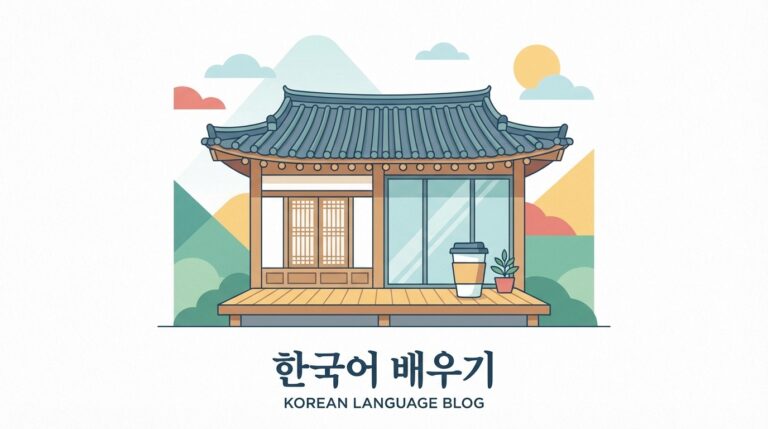
🏡 Experience Hanok Like a Local: Navigating Korea’s Traditional Yet Trendy Villages
Phase 1: Empathy
Hello! Daily Hangul Editor here.
Imagine this: You’re wandering through the winding alleyways of Bukchon Hanok Village. The elegant curved roofs (Giwa) and wooden doors make you feel like you’ve time-traveled straight into a historical K-Drama like Mr. Queen or Love in the Moonlight. You pose for a photo, and suddenly, a high-tech electronic lock on a wooden gate beeps open, and a person in a business suit steps out holding an iced Americano.
Welcome to the beautiful contradiction of Korean architecture! Hanok (한옥) villages today aren’t just open-air museums; they are living, breathing neighborhoods where centuries-old tradition meets ultra-modern lifestyle.
Many intermediate (B2) learners know how to say “This is a traditional house” (이것은 전통 집입니다). But what happens when you want to express the awe of finding a trendy fusion pasta restaurant hidden inside a 100-year-old courtyard? Or when you need to navigate the unspoken rules of a neighborhood that is both a global tourist hotspot and a quiet residential area?
This guide is built from the real experiences of my students who wanted to talk about Korea’s unique architectural blend without sounding like a textbook. Let’s dive in!
Phase 2: Core Expressions Deep Dive
1. 겉은 한옥인데 속은 완전 현대식이네요.
- Pronunciation: geoteun hanoginde sogeun wanjeon hyundaesigineyo. [geo-teun ha-no-gin-de / so-geun wan-jeon hyun-dae-shi-gi-ne-yo] (Tip: ‘겉은’ sounds like ‘guh-teun’, blending smoothly.)
- Meaning: Literal: The outside is Hanok, but the inside is completely modern type. / Real Nuance: Wow, it looks traditional on the outside, but the inside is totally modern!
- K-Culture Moment: You walk through heavy wooden doors into a cafe in Ikseon-dong, expecting floor cushions, but instead find sleek stainless steel counters, air conditioning, and an espresso machine. You say this to your Korean friend, and they’ll instantly agree with a nod!
- Editor’s Insight: This expression perfectly captures the ‘New-tro’ (New + Retro) vibe of modern Korea. The word 완전 (completely/totally) adds a natural, conversational flavor that makes you sound like a local.
- Situation Spectrum:
- Casual with friends: ✅ (Drop the ‘요’: 현대식이네!)
- Semi-formal (Co-workers): ✅
- Formal (Boss/Elders): ⚠️ (Use ‘현대적이네요’ instead of ‘완전 현대식이네요’)
- 🤔 Think About It: Why is Korea so obsessed with mixing the old and the new? How does architecture reflect a country’s rapid economic growth while trying to hold onto its roots?
2. 이 건물은 한옥을 개조해서 만들었어요.
- Pronunciation: i geonmureun hanogeul gaejohaeseo mandeureosseoyo. [ee geon-mu-reun / ha-no-geul gae-jo-hae-seo / man-deu-reos-seo-yo]
- Meaning: Literal: This building was made by remodeling a Hanok. / Real Nuance: They renovated a traditional Hanok to build this place.
- K-Culture Moment: Think of K-Pop idol vlog shoots! Many idols visit aesthetic bakeries in Seochon. When explaining the location to your fellow fandom friends, this is the exact sentence you’d use.
- Editor’s Insight: The verb 개조하다 (to remodel/renovate) is a fantastic B2-level vocabulary word. It shows you understand that these buildings weren’t just preserved in glass boxes; they were actively transformed for modern use.
- Situation Spectrum:
- Casual with friends: ✅
- Semi-formal (Co-workers): ✅
- Formal (Boss/Elders): ✅
- 🤔 Think About It: Does remodeling a traditional house to sell modern desserts ruin its historical value, or does it keep the tradition alive by making it relevant to the younger generation?
3. 여기 실제 주민들이 거주하는 곳이니까 조용히 해야 돼.
- Pronunciation: yeogi silje jumindeuri geojuhaneun gosinikka joyonghi haeya dwae. [yeo-gi shil-je ju-min-deu-ri / geo-ju-ha-neun go-shi-ni-kka / jo-yong-hi hae-ya dwae]
- Meaning: Literal: Because this is a place where actual residents reside, we must do quietly. / Real Nuance: Real people live here, so we need to keep our voices down.
- K-Culture Moment: You’re walking through Bukchon with a tourist map. A friend starts speaking loudly. You grab their arm and whisper this. You’ve just demonstrated perfect Korean Nunchi (social awareness).
- Editor’s Insight: 거주하다 is the slightly more formal/written version of 살다 (to live). Using it here makes you sound educated and respectful of the area’s designation as a residential zone.
- Situation Spectrum:
- Casual with friends: ✅ (As written)
- Semi-formal (Co-workers): ⚠️ (Change to ‘조용히 해야 해요’)
- Formal (Boss/Elders): 🚫 (You usually wouldn’t instruct an elder to be quiet!)
- 🤔 Think About It: In many tourist spots worldwide, locals are pushed out. In Bukchon, locals still live there. How does language help enforce the boundaries between ‘tourist attraction’ and ‘home’?
Phase 3: Textbook vs. Real Korean
| Situation | 📖 Textbook Korean | 🗣️ Real Korean | 💡 Why is it different? |
|---|---|---|---|
| Marveling at the vibe | 이 건물은 전통적입니다. (This building is traditional.) | 여기 뉴트로 감성 대박이에요! (The New-tro vibe here is insane!) | ‘감성’ (vibe/aesthetic) is the most used word by Korean Millennials/Gen Z when judging a cafe or space. |
| Warning someone to be quiet | 소음을 내지 마십시오. (Do not make noise.) | 쉿! 여기 사람 사는 동네야. (Shh! People live in this neighborhood.) | Real speech uses empathetic language (‘people live here’) rather than sterile commands. |
| Asking about the structure | 이 집은 오래되었습니까? (Is this house old?) | 이거 원래 한옥이었어요? (Was this originally a Hanok?) | Locals focus on the transformation of the space rather than just its age. |
Phase 4: Cultural Context — K-Culture Deep Dive
4-1. Non-Verbal Elements: Watch Your Step!
When navigating a Hanok, whether preserved or modernized, there is a crucial non-verbal rule: Do not step on the teok (문지방 – wooden threshold). Always step over it. In traditional Korean folklore, stepping on the threshold brings bad luck (it’s believed to be the neck of the house spirit). Even in a modernized Hanok cafe, stepping on the beautifully preserved wooden thresholds is considered rude and damaging to the architecture. Combine this with classic Korean Nunchi—read the room. If the cafe has beautiful wooden floors (마루), look around to see if others have taken off their shoes before you barge in!
4-2. K-Travel & K-Food Connection
If you visit the trendy Ikseon-dong Hanok Village, you’ll notice a brilliant architectural hack. The traditional Hanoks feature a ‘Madang’ (마당), an open central courtyard. Modern cafe owners have covered these open courtyards with transparent glass roofs. This means you can sit in the ‘outdoors’ of a traditional house, eating modern fusion K-Food (like Gochujang Rosé Pasta), while enjoying the air conditioning and watching the rain fall on the glass above you. It is the ultimate collision of K-Travel aesthetics and K-Food innovation!
Phase 5: Interactive Roleplay Scenario
Setting: Saturday afternoon, 2:00 PM. The narrow, winding alleys of Bukchon Hanok Village. The autumn breeze is crisp. You and your Korean friend, Min-ji, are looking for a famous modernized Hanok tea house.
Characters:
– YOU: An exchange student who loves architecture and photography.
– Min-ji (25): Your Korean friend. She’s navigating with KakaoMap but getting a bit lost in the alleys.
Dialogue:
Min-ji: 아, 지도 앱에서 분명히 이 근처라고 했는데… 골목이 다 비슷하게 생겼어. 📱
(a, jido aebeseo bunmyeonghi i geuncheorago haenneunde… golmogi da biseutage saenggyeosseo.)
[Ah, the map app definitely said it was around here… all the alleys look the same.]
YOU: 저기 예쁜 문 열려 있다! 저긴가?
(jeogi yeppeun mun yeollyeo itda! jeoginga?)
[There’s a pretty open door over there! Is that it?]
Min-ji: (Looking closely at a small sign on the wall) 앗, 아니야. 여긴 일반 가정집이야. 팻말 안 보여?
(at, aniya. yeogin ilban gajeongjibiya. paetmal an boyeo?)
[Oops, no. This is a regular residential house. Don’t you see the sign?]
YOU: 헐, 진짜네. 완전 카페처럼 생겼는데. 😲
(heol, jinjja-ne. wanjeon kapecheoreom saenggyeonneunde.)
[Whoa, really. It looks exactly like a cafe.]
Min-ji: 겉은 한옥인데 속을 예쁘게 고쳐서 그래. 여기는 실제 주민들이 거주하는 곳이니까 우리 조용히 지나가자.
(geoteun hanoginde sogeul yeppeuge gochyeoseo geurae. yeogineun silje jumindeuri geojuhaneun gosinikka uri joyonghi jinagaja.)
[It’s because the outside is Hanok but they renovated the inside beautifully. Actual residents live here, so let’s walk past quietly.]
🔀 Your Turn! How do you respond to Min-ji?
– A) “그래? 그럼 빨리 사진만 한 장 찍고 가자!” (Really? Then let’s just take one quick photo and go!)
– B) “미안, 몰랐어. 목소리 낮출게.” (Sorry, I didn’t know. I’ll lower my voice.)
– C) “주민들한테 길을 물어볼까?” (Should we ask the residents for directions?)✅ Best Choice: B — Reason: Acknowledging the residential nature and actively lowering your voice shows immense cultural respect (Nunchi).
⚠️ Choice A Analysis: Taking photos of private, open gates in Bukchon is a major point of conflict between residents and tourists. Even a quick photo can be seen as invasive.
(🎭 Stage Direction: You both lower your voices and quietly turn the corner, finally spotting the cafe with a glass roof.)
YOU: 찾았다! 와, 이 카페 한옥을 개조해서 만들었나 봐.
(chajatda! wa, i kape hanogeul gaejohaeseo mandeureonna bwa.)
[Found it! Wow, it looks like they made this cafe by renovating a Hanok.]
Min-ji: 대박! 마당에 유리 지붕 덮은 거 완전 센스 있다. 들어가자!
(daebak! madange yuri jibung deopeun geo wanjeon senseu itda. deureogaja!)
[Insane! Covering the courtyard with a glass roof is so tasteful. Let’s go in!]
Phase 6: 10-Second Shadowing Drill
Let’s practice your awe-struck reaction! Pay attention to the pauses (/) and the excited intonation.
😲 와! / 겉은 한옥인데 / 속은 완~~~전 / 현대식이네요!
(wa! / geo-teun ha-no-gin-de / so-geun wan~~~jeon / hyun-dae-shi-gi-ne-yo!)
Tip: Stretch out the ‘완~~~전’ to sound truly impressed, just like a local discovering a hidden gem!
Phase 7: K-Culture Mini Dictionary
| Korean | Romanization | English | Cultural Context |
|---|---|---|---|
| 기와 | giwa | Traditional roof tiles | The iconic dark, curved tiles that define the silhouette of a Hanok. |
| 마당 | madang | Courtyard | The open center of a Hanok. Modern cafes often glass this over to create an indoor-outdoor space. |
| 뉴트로 | nyuteuro | New-tro (New + Retro) | A massive cultural trend in Korea where vintage aesthetics are modernized for Gen Z. |
| 개조하다 | gaejohada | To renovate/remodel | A crucial verb when talking about modern urban regeneration in Seoul. |
| 정숙 | jeongsuk | Silence / Quietness | Often seen on signs in Bukchon (정숙해주세요). It means maintaining a respectful, quiet demeanor. |
Phase 8: Traveler’s Survival Kit
If you are visiting a Hanok Village (Bukchon, Jeonju, or Ikseon-dong), you absolutely need these expressions to navigate politely.
🆘 Survival Phrases for Hanok Villages
– 🇰🇷 “신발 벗고 들어가나요?” (sinbal beotgo deureoganayo?)
– 🗣️ English: Do I need to take off my shoes to go in?
– 📍 Where to use: At the entrance of any traditional-looking cafe, restaurant, or tea house.
– 🇰🇷 “여기 사진 찍어도 돼요?” (yeogi sajin jjigeodo dwaeyo?)
– 🗣️ English: Is it okay to take pictures here?
– 📍 Where to use: Before snapping a pic of an aesthetically pleasing door or interior (to ensure it’s not a private residence).
– 🇰🇷 “마루에 앉아도 돼요?” (marue anjado dwaeyo?)
– 🗣️ English: Can I sit on the wooden porch?
– 📍 Where to use: When you see a traditional outdoor seating area (마루) at a cafe.📌 Editor’s Travel Note
– Useful Apps: KakaoMap is a lifesaver. Google Maps doesn’t work well in the tiny, labyrinth-like alleys of Korean Hanok villages.
– Respecting the Paper: Never poke or touch the traditional paper windows (Changhoji). They tear easily, and it’s a headache for the owners to fix!
Phase 9: Critical Thinking — “One Step Deeper”
🧠 Think Deeper: Global Era & Identity (Tradition vs. Commercialization)
The modernization of Hanok villages sparks a passionate debate in Korea. On one hand, gentrification (젠트리피케이션) pushes out original residents because the quiet neighborhoods turn into bustling, noisy cafe streets. The ‘authenticity’ is sometimes lost when a 100-year-old house is gutted just to sell expensive lattes. On the other hand, traditional Hanoks are very difficult and expensive to maintain (poor insulation, plumbing issues). By allowing businesses to renovate them with modern interiors, the exterior architecture is preserved, and the younger generation—who might otherwise ignore traditional history—flocks to these areas to appreciate their beauty.💬 Your Turn: Does transforming a historical home into a trendy, commercial cafe destroy its soul, or is it a necessary evolution to keep the culture alive? How does your country handle historic residential areas? Let me know in the comments!
Phase 10: FAQ & Avoiding Mistakes
Q: “Can I just peek into an open wooden gate if it looks beautiful?”
No. Unless there is a clear business sign (like a menu board or cafe logo), an open gate means a resident is just airing out their courtyard. Entering or taking photos of the inside is considered trespassing.
Q: “If I see an elderly resident, can I use the expression ‘쉿! 조용히 해’ (Shh! Be quiet)?”
Absolutely not! If you need to remind your friends to be quiet, that is fine. But never direct a command to be quiet towards an elder in Korea.
❌ Common Mistake: Yelling across the alleyway to your friends.
✅ Do This Instead: Hanok walls are relatively low, and sound travels fast. Text your friends or walk over to them. Treat the residential alleys like a library.
Phase 11: Summary & Action Items
- One-Liner Summary: Hanok villages are living spaces where traditional exteriors house modern lives, so use “겉은 한옥인데 속은 현대식이네요” to praise the architecture, while maintaining respectful Nunchi!
Action Mission:
– 🥉 Bronze (Solo): Read the 10-second shadowing drill out loud in front of a mirror with genuine surprise on your face.
– 🥈 Silver (Online): Find a picture of a modern Hanok cafe on Instagram (search #익선동카페) and comment: “한옥을 개조해서 정말 예뻐요!” (It’s so pretty because they renovated a Hanok!)
– 🥇 Gold (Real Life): Next time you visit a traditional spot in Korea, ask the staff “신발 벗고 들어가나요?” before entering.
K-Culture Mission:
Watch an episode of Our Beloved Summer or Itaewon Class and try to spot the modern elements attached to traditional buildings (like CCTV cameras on tiled roofs or digital keypads on wooden doors)!
Phase 12: Quiz — Interactive Challenge
1. Situational Judgment: You and your co-workers (including your boss) visit a Hanok restaurant that has robot servers inside. What is the most natural and polite thing to say?
– A) 여기 완전 뉴트로 감성 대박이야!
– B) 겉은 한옥인데 속은 현대적이네요.
– C) 실제 주민들이 거주하는 곳이네요.
2. True or False – K-Culture Edition:
In Bukchon Hanok Village, all the houses are museums owned by the government, so you don’t need to worry about making noise during the day. (T / F)
3. Fill in the Blank:
“Wow, they turned this old Hanok into a bakery!”
-> 우와, 이 베이커리는 한옥을 [ _______ ]해서 만들었나 봐!
(Check your answers by highlighting the invisible text below!)
[Answers: 1. B (Polite and appropriate for a boss), 2. False (Real people live there!), 3. 개조 (Gaejo / renovate)]
Frequently Asked Questions (FAQ)
Q: What does "겉은 한옥인데 속은 완전 현대식이네요." mean in Korean and how do you pronounce it?
A: In Korean, "겉은 한옥인데 속은 완전 현대식이네요." is pronounced [geoteun hanoginde sogeun wanjeon hyundaesigineyo. [geo-teun ha-no-gin-de / so-geun wan-jeon hyun-dae-shi-gi-ne-yo] and means: Literal: The outside is Hanok, but the inside is completely modern type. / Real Nuance: Wow, it looks traditional on the outside, but the inside is totally modern!
Q: What does "이 건물은 한옥을 개조해서 만들었어요." mean in Korean and how do you pronounce it?
A: In Korean, "이 건물은 한옥을 개조해서 만들었어요." is pronounced [i geonmureun hanogeul gaejohaeseo mandeureosseoyo. [ee geon-mu-reun / ha-no-geul gae-jo-hae-seo / man-deu-reos-seo-yo] and means: Literal: This building was made by remodeling a Hanok. / Real Nuance: They renovated a traditional Hanok to build this place.
Q: What does "여기 실제 주민들이 거주하는 곳이니까 조용히 해야 돼." mean in Korean and how do you pronounce it?
A: In Korean, "여기 실제 주민들이 거주하는 곳이니까 조용히 해야 돼." is pronounced [yeogi silje jumindeuri geojuhaneun gosinikka joyonghi haeya dwae. [yeo-gi shil-je ju-min-deu-ri / geo-ju-ha-neun go-shi-ni-kka / jo-yong-hi hae-ya dwae] and means: Literal: Because this is a place where actual residents reside, we must do quietly. / Real Nuance: Real people live here, so we need to keep our voices down.







