

Phase 1: Empathy (The K-Drama Moment)
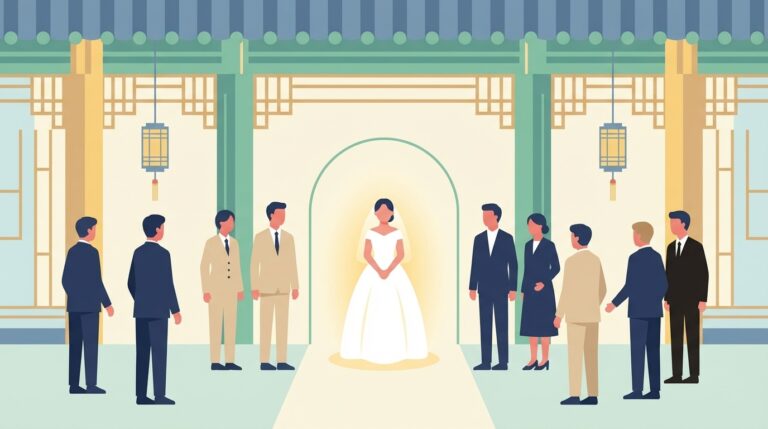
Hello! I’m the Senior Editor of Daily Hangul. Have you ever watched a K-Drama where the main character goes to her ex-boyfriend’s wedding? She struts into the wedding hall wearing a bright, flashy white dress, and everyone in the room gasps. In the subtitles, people are just whispering, but culturally, she just committed the ultimate ‘fashion crime’ in Korea.
Getting invited to a Korean wedding is an exciting milestone! But as soon as you get that beautiful mobile invitation, panic sets in: “What do I wear? Is this dress too bright? Is this suit too casual?” In Korea, wedding guest fashion is so important that there’s even a specific word for it: 하객룩 (Hagaek-look). If you don’t know the unwritten rules, you might accidentally become the ‘nuisance guest’ everyone whispers about.
Don’t worry! This guide is based on real panicked texts I’ve received from my expat students. Today, we’ll learn exactly what to say and how to dress so you can celebrate like a true local.
Phase 2: Core Expressions Deep Dive
Let’s look at the top 3 expressions you need when discussing wedding outfits.
1. 뭐 입고 갈까요? (What should I wear?)
- Pronunciation: mwo ip-go gal-kka-yo? [mwo sounds like ‘mo’ in more; ip like ‘eep’; go like ‘go’; gal like ‘gal’; kka like a sharp ‘gah’; yo like ‘yo’]
- Meaning: Literal: What wear and go? / Real nuance: What should I wear to the event?
- K-Culture Moment: You just got a wedding invitation from your co-worker. You lean over to another Korean colleague and whisper this to check the vibe.
- Editor’s Insight: This isn’t just asking for fashion advice; it’s a ‘Nunchi’ check. You are asking your peer to establish the baseline so you don’t overdress or underdress compared to the group.
- Situation Spectrum:
- Friends (Casual): ✅ (Drop the ‘yo’: 뭐 입고 갈까?)
- Co-workers (Semi-formal): ✅
- Boss/Elders (Formal): ⚠️ (Better to say: 정장을 입는 게 좋을까요? – Would it be better to wear a suit?)
- 🤔 Think About It: In Korean, we often use the verb pattern “~고 가다/오다” (do something AND go/come). Why do you think Koreans emphasize the ‘movement’ to the destination when talking about clothes?
2. 하얀색은 피하세요. (Please avoid white.)
- Pronunciation: ha-yan-saeg-eun pi-ha-se-yo. [ha as in haha, yan as in yawn, saek sounds like ‘sack’, pi-ha-se-yo sounds like pee-ha-say-yo]
- Meaning: Literal: Avoid white color. / Real nuance: White is an absolute no-no.
- K-Culture Moment: A helpful Korean friend grabbing a white blouse out of your hands while you are shopping for a wedding outfit.
- Editor’s Insight: The verb 피하다 (to avoid) is a very soft, polite way of saying “Don’t do it.” It sounds much friendlier than “입지 마세요” (Don’t wear it).
- Situation Spectrum:
- Friends (Casual): ✅ (하얀색은 피해~)
- Co-workers (Semi-formal): ✅
- Boss/Elders (Formal): 🚫 (You wouldn’t usually give fashion advice to a boss!)
- 🤔 Think About It: The bride in Korea is the undisputed star of the day. Have you ever experienced a culture where trying not to look your best is actually a sign of respect?
3. 그냥 깔끔하게 입으세요. (Just dress neatly.)
- Pronunciation: geu-nyang kkal-kkeum-ha-ge i-beu-se-yo. [geu sounds like ‘good’ without the d; kkal-kkeum is a sharp, tight ‘gal-geum’]
- Meaning: Literal: Just dress cleanly. / Real nuance: Wear something smart-casual, modest, and put-together.
- K-Culture Moment: When you ask a guy what he’s wearing to a wedding, 99% of the time, this is his answer.
- Editor’s Insight: ‘깔끔하다’ (neat/clean) is the golden rule of Korean fashion. It means no wrinkles, muted colors, and nothing too revealing. It’s the ultimate safe zone.
- Situation Spectrum:
- Friends (Casual): ✅
- Co-workers (Semi-formal): ✅
- Boss/Elders (Formal): ✅
- 🤔 Think About It: ‘Cleanliness’ in style is deeply rooted in Korean society. How does your culture define ‘dressing appropriately’ for formal events?
Phase 3: Textbook vs. Real Korean
| Situation | 📖 Textbook Korean | 🗣️ Real Korean | 💡 Why is it different? |
|---|---|---|---|
| Asking what to wear | 저는 무엇을 입어야 합니까? (What must I wear?) | 뭐 입고 갈까요? (What wear and go?) | Real conversation uses softer suggestions (‘~ㄹ까요?’) rather than rigid demands. |
| Telling someone not to wear white | 하얀색 옷을 입지 마십시오. (Do not wear white clothes.) | 흰옷은 피하는 게 좋아요. (It’s better to avoid white clothes.) | Koreans prefer indirect, softening phrases (‘~하는 게 좋아요’) to preserve harmony. |
| Promising to dress well | 저는 정장을 입겠습니다. (I will wear a suit.) | 그냥 깔끔하게 입고 갈게요. (I’ll just dress neatly.) | ‘Suit’ feels too stiff for modern weddings; ‘neat’ is the universal modern dress code. |
Bottom Note: For A2 learners, simply adding ‘~는 게 좋아요’ (It is good to…) turns a harsh command into friendly advice!
Phase 4: Cultural Context — K-Culture Deep Dive
4-1. Non-Verbal Elements: The ‘Nunchi’ of Group Photos
At the end of every Korean wedding, there is a 원판 사진 (Wonpan sajin)—the formal group photo. First family, then relatives, then friends and colleagues. This is where Nunchi (social awareness) kicks in. If you wear a bright neon pink dress, your pink silhouette will be immortalized forever next to the bride in her photo album. This is why everyone opts for navy, black, or beige. You want to blend in, not stand out.
4-2. K-Culture Connection: The ‘Minpye’ Guest Trope
In K-Dramas, the ultimate revenge against a toxic ex is showing up to their wedding looking drop-dead gorgeous in a bright white or fiery red dress. This is called a 민폐 하객 (Minpye Hagaek – Nuisance Guest). But in reality? If you do this, people won’t think you are a cool drama heroine; they will genuinely think you lack basic social manners.
Critical View: While K-Dramas show dramatic fashion, real Korean wedding guests look almost like they are going to a chic corporate meeting. The contrast between TV drama drama and real-life conformity is huge!
Phase 5: Interactive Roleplay Scenario
Setting: Thursday afternoon. The office pantry. You are making instant coffee. You and your team are attending Assistant Manager Kim’s wedding this Saturday.
Characters:
– YOU: A foreign employee in Korea, invited to your first Korean wedding.
– Min-su (32): Your friendly, slightly chatty Korean co-worker.
Dialogue:
Min-su: 이번 주 토요일에 김 대리님 결혼식 가죠? 😊
(ibeon ju to-yo-il-e Kim dae-ri-nim gyeol-hon-sik ga-jyo?)
[You’re going to Assistant Manager Kim’s wedding this Saturday, right?]
YOU: 네, 가요. 그런데 한국 결혼식은 처음이라서요. 😅
(ne, ga-yo. geu-reon-de han-guk gyeol-hon-sig-eun cheo-eum-i-ra-seo-yo.)
[Yes, I’m going. But it’s my first Korean wedding.]
Min-su: 아, 진짜요? 축의금은 준비했어요?
(a, jin-jja-yo? chu-gui-geum-eun jun-bi-haess-eo-yo?)
[Oh, really? Did you prepare the wedding envelope/money?]
YOU: 네, 준비했어요. 그런데 옷은 뭐 입고 갈까요? 🤔
(ne, jun-bi-haess-eo-yo. geu-reon-de os-eun mwo ip-go gal-kka-yo?)
[Yes, I prepared it. But as for clothes, what should I wear?]
Min-su: 음… 옷 샀어요?
(eum… ot sass-eo-yo?)
[Hmm… did you buy clothes?]
🔀 YOUR TURN! How do you answer?
– A) “네! 예쁜 하얀색 원피스를 샀어요!” (Yes! I bought a pretty white dress!)
– B) “아니요, 그냥 평소에 입는 청바지 입을 거예요.” (No, I’ll just wear the jeans I usually wear.)
– C) “네, 어두운 색 정장을 입고 갈게요.” (Yes, I will wear a dark-colored suit.)✅ Best Choice: C — A dark suit or dark neat clothes is perfect.
⚠️ Choice A Analysis: Min-su will probably drop his coffee cup. White is reserved ONLY for the bride!
⚠️ Choice B Analysis: Jeans are considered too casual for weddings in Korea, even though they are becoming more relaxed.
(Assuming you chose A just to tease him…)
Min-su: 헉! 😱 하얀색은 피하세요! 신부랑 똑같잖아요.
(heok! ha-yan-saeg-eun pi-ha-se-yo! sin-bu-rang ttok-gat-ja-na-yo.)
[Gasp! Please avoid white! You’ll look exactly like the bride.]
YOU: 아, 농담이에요! 그냥 깔끔하게 입고 갈게요. 😉
(a, nong-dam-i-e-yo! geu-nyang kkal-kkeum-ha-ge ip-go gal-ge-yo.)
[Ah, just kidding! I’ll just dress neatly.]
Phase 6: 10-Second Shadowing Drill
Read out loud and follow the pauses (/) and the emotion tags!
😟 주말에 / 결혼식이 있는데, / 뭐 입고 가요?
(ju-mal-e / gyeol-hon-sig-i in-neun-de, / mwo ip-go ga-yo?)
😤 다른 색은 다 괜찮은데, / 하얀색은 / 절대 피하세요!
(da-reun saeg-eun da gwaen-chan-eun-de, / ha-yan-saeg-eun / jeol-dae pi-ha-se-yo!)
😊 그냥 / 어두운 색으로 / 깔끔하게 입고 갈게요.
(geu-nyang / eo-du-un saeg-eu-ro / kkal-kkeum-ha-ge ip-go gal-ge-yo.)
Phase 7: K-Culture Mini Dictionary
| Korean | Romanization | English | Contextual Meaning |
|---|---|---|---|
| 하객룩 | hagaeng-nuk | Guest look | The specific neat, muted fashion style worn by guests at a Korean wedding. |
| 민폐 | min-pye | Nuisance | Causing an inconvenience. Often used as ‘민폐 하객’ for someone who dresses inappropriately. |
| 축의금 | chu-gui-geum | Congratulatory money | Cash given in a white envelope. Usually 50k, 100k, or 150k KRW depending on closeness. |
| 정장 | jeong-jang | Suit / Formal wear | A standard suit. Nowadays, smart-casual is replacing full formal suits. |
Phase 8: Traveler Survival Kit (Shopping for Clothes)
What if you are traveling in Korea, get a sudden invite, and only packed sweatpants? You need to hit a Korean mall!
🆘 Survival Expressions for Clothes Shopping
– 🇰🇷 “이거 입어봐도 돼요?” (i-geo ib-eo-bwa-do dwae-yo?)
– 🗣️ Meaning: Can I try this on?
– 🇰🇷 “조금 더 큰/작은 사이즈 있어요?” (jo-geum deo keun/jag-eun sa-i-jeu iss-eo-yo?)
– 🗣️ Meaning: Do you have a slightly bigger/smaller size?
– 🇰🇷 “어두운 색깔 있어요?” (eo-du-un saek-kkal iss-eo-yo?)
– 🗣️ Meaning: Do you have a dark color?📌 Editor’s Travel Note
– Trying on clothes: In Korean fitting rooms, you must take your shoes off. Also, if you are trying on a top, the staff will give you a ‘face cover’ (a sheer white hood) so your makeup doesn’t stain the clothes. Always use it!
Phase 9: Critical Thinking — A Step Deeper
Language & Conformity: Why blend in?
In many Western cultures, dressing up for a wedding means expressing your best, most glamorous self to celebrate the joy. However, in Korea, wedding fashion is highly tied to the concept of 배려 (Baeryeo – Consideration).
Looking too flashy or standing out is seen as ‘stealing the spotlight’ from the hosts. The Korean societal value of group harmony over individual expression is vividly displayed here. By intentionally choosing muted colors (navy, beige, black), guests collectively create a visual background that makes the bride’s white dress pop. It’s a visual form of respect.
💬 Your Turn: Does your culture have a strict rule about what NOT to wear to a wedding? Tell us in the comments!
Phase 10: FAQ & Avoiding Mistakes
Q: Is it okay to wear black to a Korean wedding?
Yes! Absolutely. In some cultures, black is only for funerals, but in Korea, a sleek black suit or a black dress is considered very chic, neat, and polite for a wedding.
Q: What about bare shoulders or short skirts?
Korean weddings are usually quite conservative (often attended by elderly relatives). Shoulders are generally covered. If you wear a sleeveless dress, bring a cardigan or jacket.
❌ Common Mistake #1: Wearing a white blouse or white shirt with nothing over it.
✅ Do this instead: A white shirt is fine ONLY if you wear a dark jacket or cardigan over it. The overall look should not read as ‘white’.❌ Common Mistake #2: Wearing jeans.
✅ Do this instead: Slacks, trousers, or a neat skirt. Denim is still considered too casual for weekend weddings.
Phase 11: Summary & Action Items
One-Liner Summary: For a Korean wedding, avoid white, embrace dark/neutral colors, and remember the golden rule: “깔끔하게 (Neatly)”!
Action Mission:
– 🥉 Bronze (Solo): Stand in front of your closet, point to an outfit, and ask yourself aloud: “뭐 입고 갈까요?”
– 🥈 Silver (Online): Comment below with the color of the outfit you would wear to a Korean wedding using the word “[Color] 입고 갈게요!”
– 🥇 Gold (Real World): Next time you meet a Korean friend, ask them what they usually wear to weddings!
K-Culture Mission: Search “연예인 하객룩” (Celebrity wedding guest look) on Google or Pinterest. You will notice how even top K-Pop stars dress down in simple black or navy when attending their friends’ weddings!
Phase 12: Interactive Quiz
1. You are invited to a wedding. Which outfit is the BEST choice for a female guest in Korea?
– A) A stunning, sparkly white dress.
– B) Ripped jeans and a nice top.
– C) A neat navy dress with a beige cardigan.
2. Fill in the blank: “하얀색은 _________.” (Please avoid white.)
– A) 입으세요 (Wear it)
– B) 피하세요 (Avoid it)
– C) 좋아요 (It’s good)
3. True or False – K-Culture Edition:
“It is perfectly fine to wear black to a Korean wedding.”
– True / False
Answers (Click to reveal!)
1. C (Neat and muted colors are best. A is a ‘Minpye’ guest, B is too casual!)
2. B (피하세요 – Avoid it)
3. True (Black is very common and considered polite/chic at Korean weddings!)
Frequently Asked Questions (FAQ)
Q: What does "뭐 입고 갈까요? (What should I wear?)" mean in Korean and how do you pronounce it?
A: In Korean, "뭐 입고 갈까요? (What should I wear?)" is pronounced [mwo ip-go gal-kka-yo? [mwo sounds like 'mo' in more; ip like 'eep'; go like 'go'; gal like 'gal'; kka like a sharp 'gah'; yo like 'yo'] and means: Literal: What wear and go? / Real nuance: What should I wear to the event?
Q: What does "하얀색은 피하세요. (Please avoid white.)" mean in Korean and how do you pronounce it?
A: In Korean, "하얀색은 피하세요. (Please avoid white.)" is pronounced [ha-yan-saeg-eun pi-ha-se-yo. [ha as in haha, yan as in yawn, saek sounds like 'sack', pi-ha-se-yo sounds like pee-ha-say-yo] and means: Literal: Avoid white color. / Real nuance: White is an absolute no-no.
Q: What does "그냥 깔끔하게 입으세요. (Just dress neatly.)" mean in Korean and how do you pronounce it?
A: In Korean, "그냥 깔끔하게 입으세요. (Just dress neatly.)" is pronounced [geu-nyang kkal-kkeum-ha-ge i-beu-se-yo. [geu sounds like 'good' without the d; kkal-kkeum is a sharp, tight 'gal-geum'] and means: Literal: Just dress cleanly. / Real nuance: Wear something smart-casual, modest, and put-together.






