

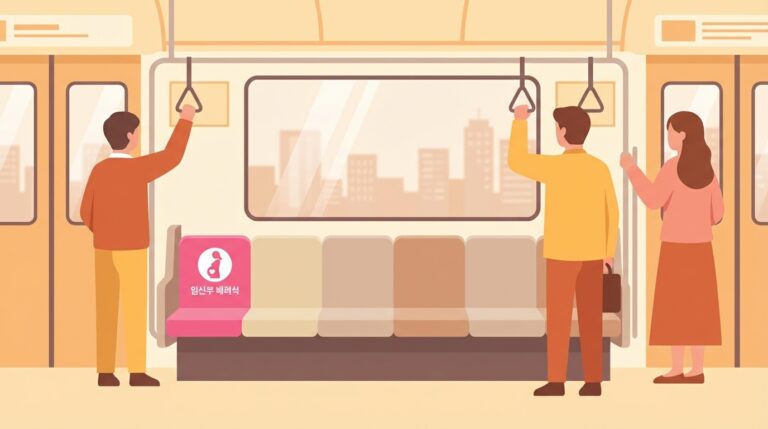
The Unwritten Rules of the Korean Subway: Why You Shouldn’t Sit in That Empty Seat
Phase 1: Empathy (The Korean Subway Illusion)
Hello! I’m your Daily Hangul Editor. Picture this: It’s 7 PM on a Friday. You’ve just spent the whole day walking around Myeongdong, and your legs feel like jelly. You tap your T-money card, get onto the subway, and a miracle happens. There’s an empty seat at the far end of the train! You rush over, sit down with a sigh of relief… but suddenly, you feel it. The heavy, burning gaze of the people around you.
You look up, and an elderly Korean woman is staring at you with a slight frown. In K-Dramas, the subway is where romantic leads fall asleep on each other’s shoulders. But in reality? It’s the ultimate test of Korean Nunchi (눈치). Today, we are going to talk about the golden rule of Korean public transportation: The Priority Seating. If you don’t know this, you might accidentally become the “rude foreigner.” But if you master this, you’ll earn the silent, approving nods of every Korean local around you. Let’s dive in!
Phase 2: Core Expressions Deep Dive
1. 노약자석 (Priority Seating)
- Pronunciation: no-yak-ja-seok [The ‘no’ sounds exactly like English ‘no’, and ‘yak’ sounds like ‘yuck’.]
- Meaning: Priority seating for the elderly, disabled, and pregnant women.
- K-Culture Moment: You’ll see these seats at the very ends of every subway car. Even during the dreaded morning commute (지옥철, Hell Subway), you will often see young Koreans standing shoulder-to-shoulder while these corner seats remain completely empty.
- Editor’s Insight: The rule here isn’t just “give it up if someone needs it.” In Korea, the unwritten rule is to leave it empty in the first place, so the elderly don’t have to ask or feel awkward.
- Situation Spectrum:
- Casual friends: N/A (It’s a noun for a place)
- 🤔 Think About It: Why do Koreans prefer to leave the seat completely empty rather than sitting and offering it later? How does this reflect the Korean concept of avoiding making others uncomfortable (눈치)?
2. 여기 앉으세요 (Please sit here)
- Pronunciation: yeo-gi an-jeu-se-yo [‘yeo-gi’ sounds like Yogi Bear, ‘an-jeu’ sounds like ‘Ahn-joo’]
- Meaning: (Literal) Sit here / (Real nuance) Please take my seat, I insist.
- K-Culture Moment: You are sitting in a normal seat, and a grandmother gets on the bus. You stand up, point to your seat, and say this with a warm smile and a slight bow. Instant K-Drama protagonist energy!
- Editor’s Insight: You must use this polite form (하세요). Never just say “앉아” (Sit) to a stranger, unless you want to sound like you are commanding a dog!
- Situation Spectrum:
- Strangers/Elders (Formal): ✅
- Friends (Casual): 🚫 (Too formal, use “여기 앉아” instead)
- 🤔 Think About It: In your culture, do you usually speak to strangers on transit, or is it mostly non-verbal?
3. 임산부 배려석 (Pregnant Women’s Seat)
- Pronunciation: im-san-bu bae-ryeo-seok
- Meaning: Seat reserved for pregnant women.
- K-Culture Moment: This is the bright pink seat you see in the middle of the subway rows. Sometimes there’s a pink plush toy sitting on it.
- Editor’s Insight: Just like the 노약자석, never sit here if you are not pregnant. Not even for “just one stop.” Koreans take this pink seat very seriously!
- Situation Spectrum: N/A (Noun)
- 🤔 Think About It: Some early-stage pregnant women wear a pink “Pregnancy Badge” (임산부 배지) because their pregnancy isn’t visible yet. How does this pink seat system protect them from misunderstandings?
Phase 3: Textbook vs. Real Korean
| Situation | 📖 Textbook Korean | 🗣️ Real Korean | 💡 Why is it different? |
|---|---|---|---|
| Offering your seat | 제가 자리를 양보하겠습니다. (I will yield my seat.) | (Stands up silently) + 여기 앉으세요. (Please sit here.) | Koreans prefer actions over grand statements. Standing up speaks louder! |
| Declining an offered seat | 아니요, 괜찮습니다. (No, I am fine.) | 아유, 괜찮아요~ 금방 내려요. (Oh, it’s okay~ I’m getting off soon.) | Adding a white lie (“I’m getting off soon”) softens the rejection and saves face for both people. |
| Asking someone to move | 비켜주세요. (Please move out of the way.) | 잠시만요~ / 내릴게요! (Excuse me~ / I’m getting off!) | “비켜주세요” sounds aggressive. “잠시만요” (Just a moment) is the polite transit standard. |
Phase 4: Cultural Context — K-Culture Deep Dive
4-1. The Non-Verbal “Silent Stand-Up”
When offering your seat in Korea, eye contact is brief. You don’t need to make a big speech. The standard etiquette is to catch the elderly person’s eye, stand up, gesture to the seat with an open hand, and say “여기 앉으세요.” Then, you physically step away from the seat. This prevents the awkward “No, you take it,” “No, I insist” dance.
4-2. K-Drama Tropes vs. Reality
In K-Dramas, you often see the male lead protecting the female lead from getting pushed in a crowded subway by caging her with his arms. It looks incredibly romantic on screen! But in a real Seoul subway during rush hour, people are just trying to survive. If someone gets too close, it’s not a K-Drama romance; it’s just the reality of the 지옥철 (Hell Subway). And remember, the characters never sit in the pink or corner seats to film those scenes!
Phase 5: Real-life Roleplay Scenario
Setting: It’s a rainy Tuesday morning on Subway Line 2 heading to Hongdae. The train is packed. You are lucky enough to be sitting in a regular seat.
Characters:
– YOU: A foreign traveler who has been walking all day.
– Grandpa (할아버지): An elderly Korean man in his 70s, holding a wet umbrella, who just boarded the train.
Dialogue:
(🎭 Stage Direction: The train doors close. Grandpa stands near you, holding the handle, looking tired.)
YOU: (Noticing the Grandpa) 아, 할아버지. 여기 앉으세요.
(a, ha-ra-beo-ji. yeo-gi an-jeu-se-yo.)
[Ah, Grandpa. Please sit here.]
Grandpa: 아유, 괜찮은데… 학생 앉아.
(a-yu, gwaen-chan-eun-de… hak-saeng an-ja.)
[Oh, it’s fine… You sit, student.]
🔀 Your Turn! How do you respond?
– A) “네, 알겠습니다!” (Okay, I understand!) and sit back down.
– B) “아닙니다. 저 금방 내려요. 앉으세요!” (No, I’m getting off soon. Please sit!) and step away.
– C) “할아버지 다리 아프잖아요!” (Your legs hurt, Grandpa!)✅ Best Choice: B — Koreans will almost always decline the first offer out of politeness. You must insist a second time. Stepping away makes it easy for him to accept without guilt.
⚠️ Choice A Analysis: If you sit back down immediately, you’ll look insincere.
⚠️ Choice C Analysis: A bit too blunt and casual for an elder you just met.
(🎭 Stage Direction: You step away. Grandpa smiles warmly.)
Grandpa: 고마워요, 학생. 복 받을 거야.
(go-ma-wo-yo, hak-saeng. bok ba-deul geo-ya.)
[Thank you, student. You will be blessed.]
Phase 6: 10-Second Shadowing Drill
Time to practice! Follow the intonation marks (/) and match the emotion.
😊 할아버지, / 여기 / 앉으세요!
(ha-ra-beo-ji, / yeo-gi / an-jeu-se-yo!)
😊 저 / 금방 / 내려요. / 앉으세요~
(jeo / geum-bang / nae-ryeo-yo. / an-jeu-se-yo~)
Phase 7: K-Culture Mini Dictionary
| Korean | Romanization | English | Context |
|---|---|---|---|
| 눈치 | nunchi | Social awareness | The ability to read the room. Crucial for subway survival! |
| 지옥철 | ji-ok-cheol | Hell subway | Rush hour subway packed with commuters. |
| 임산부 배지 | im-san-bu bae-ji | Pregnancy badge | A pink tag attached to bags to show the woman is expecting. |
| 양보하다 | yang-bo-ha-da | To yield | The act of giving up your seat or place for someone else. |
Phase 8: Traveler’s Survival Kit
🆘 Survival Expression #1: Making your way out
– 🇰🇷 “잠시만요! 내릴게요!” (jam-si-man-yo! nae-ril-ge-yo!)
– 🗣️ Meaning: Excuse me! I’m getting off!
– 📍 Where to use: Packed subways or buses when you need to push through the crowd to reach the door.
– 💡 Pro Tip: Say this loudly but politely. Koreans will part like the Red Sea for you!📌 Editor’s Travel Note
– Useful Apps: KakaoMetro or Naver Map are absolute must-haves for navigating the subway.
– The Transfer (환승): Don’t forget to tap your T-money card when getting OFF the bus or subway! If you tap off, your transfer to the next bus/subway within 30 minutes is free or heavily discounted.
– Backpacks: If the subway is crowded, take your backpack off and hold it down by your legs. It’s basic subway Nunchi!
Phase 9: Critical Thinking — “One Step Deeper”
🧠 Think Deeper: Architecture of Respect (Language & Power)
In many Western cultures, giving up a seat is seen as a polite, individual choice. In Korea, however, respect for elders (효, Hyo) and care for the vulnerable is physically built into the infrastructure. The priority seats (노약자석) and pink seats are designated spaces that reflect social hierarchy and community values. It shows that caring for elders isn’t just a personal favor; it’s a societal obligation woven into the very fabric of public spaces.💬 Your Turn: Does your country have specific seats for the elderly or pregnant women? Are people strict about leaving them empty? Let us know in the comments!
Phase 10: FAQ & Avoiding Misunderstandings
Q: The subway is completely empty. Can I sit in the priority seat (노약자석)?
Editor: Technically, yes, you can sit and move when an elder boards. BUT! As a foreigner, it’s safer to just avoid it. Some older folks might judge you, and it’s better to avoid the uncomfortable Nunchi.
Q: What about the pink pregnant seat? If it’s empty, can I sit?
Editor: Absolutely NO. 🚫 Never sit in the pink seat if you are not pregnant. Koreans are extremely strict about this, and you might even get your picture taken and posted online as a “rude passenger.”
❌ Common Mistake #1: Arguing if an elder asks for your seat.
✅ Do this instead: Even if you feel it’s unfair, it’s a massive cultural taboo to argue with an elder in public. Just smile, say “아, 죄송합니다” (Ah, I’m sorry), and stand up.
Phase 11: Summary & Action Items
- One-Liner Summary: Never sit in the corner seats or pink seats, and use “여기 앉으세요” to master Korean transit etiquette!
-
Action Mission:
- 🥉 Bronze: Say “여기 앉으세요” out loud 3 times right now.
- 🥈 Silver: Next time you watch a K-Drama, look closely at the subway scenes. Can you spot the empty pink or corner seats?
- 🥇 Gold: When you visit Korea, successfully offer your seat to an elder on the subway using today’s expression!
Phase 12: Interactive Quiz
1. You are tired and the subway is packed. The bright pink seat is empty. What should you do?
– A) Sit down, but stay alert to give it up if a pregnant woman boards.
– B) Stand in front of it, but DO NOT sit down.
– C) Put your heavy shopping bags on it.
2. Fill in the blank: You want to offer your seat. You stand up and say, “할아버지, _____ 앉으세요.”
– A) 저기 (over there)
– B) 여기 (here)
– C) 빨리 (quickly)
3. True or False: In Korea, it’s polite to quietly accept an offered seat on the very first try without saying anything.
– A) True
– B) False
(Answers: 1: B – Never sit in the pink seat! / 2: B – 여기 앉으세요 / 3: False – It’s polite to decline once before accepting!)
Loved this lesson? Share your subway stories in the comments below! Stay tuned for more daily survival Hangul.
Frequently Asked Questions (FAQ)
Q: What does "노약자석 (Priority Seating)" mean in Korean and how do you pronounce it?
A: In Korean, "노약자석 (Priority Seating)" is pronounced [no-yak-ja-seok [The 'no' sounds exactly like English 'no', and 'yak' sounds like 'yuck'.] and means: Priority seating for the elderly, disabled, and pregnant women.
Q: What does "여기 앉으세요 (Please sit here)" mean in Korean and how do you pronounce it?
A: In Korean, "여기 앉으세요 (Please sit here)" is pronounced [yeo-gi an-jeu-se-yo ['yeo-gi' sounds like Yogi Bear, 'an-jeu' sounds like 'Ahn-joo'] and means: (Literal) Sit here / (Real nuance) Please take my seat, I insist.
Q: What does "임산부 배려석 (Pregnant Women's Seat)" mean in Korean and how do you pronounce it?
A: In Korean, "임산부 배려석 (Pregnant Women's Seat)" is pronounced [im-san-bu bae-ryeo-seok] and means: Seat reserved for pregnant women.







