

Phase 1: Empathy & Immersion (Cold Open)
Hello! I’m your Daily Hangul Editor, your veteran tutor and local culture navigator here in Seoul.
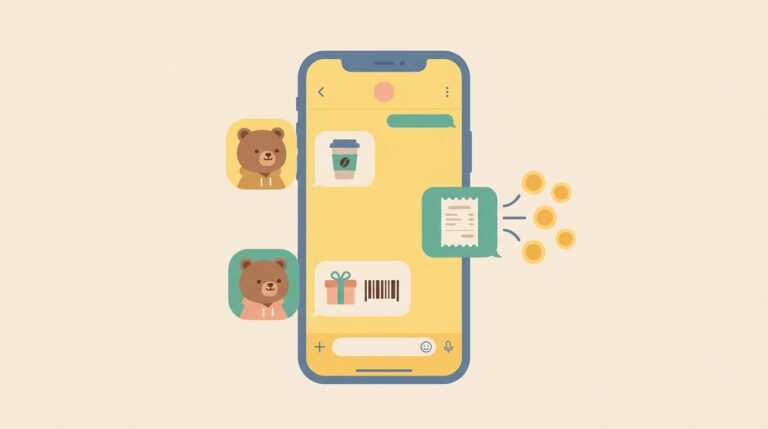
Picture this: It’s your birthday. You meet your Korean friend for coffee. You’re secretly expecting a beautifully wrapped present, but instead, your friend just taps their phone, smiles, and says, “Check your KakaoTalk.” You look down and see a barcode for a fancy cake and a digital coupon for a massage. Welcome to the modern Korean smartphone life!
Or how about this? You just finished a delicious Samgyeopsal (Korean pork belly) dinner with three friends. The bill is 80,000 KRW. In many countries, you’d awkwardly ask the waiter to split it four ways, handing over four different credit cards. But in Korea? The restaurant owner yells, “Next customer!” The line is out the door. One friend quickly slaps their card on the counter and says, “I’ll pay first, let’s Kakao later.”
If you don’t understand the culture of KakaoTalk’s 선물하기 (Seonmulhagi – Gifting) and 송금/정산 (Money Transfer/Splitting), you might feel confused or even think Koreans are being impersonal. But once you master these features, you’ll unlock the ultimate insider level of K-Culture. This guide is based on real struggles my students face when adapting to Seoul’s lightning-fast digital life. Let’s dive in!
Phase 2: Core Expressions Deep Dive
1. 카톡으로 기프티콘 보냈어
- Pronunciation: [katogeuro gipeutikon bonaesseo] (ka-to-geu-ro / gi-peu-ti-kon / bo-naet-sseo)
- Meaning: Literal: I sent a Gifticon via KakaoTalk. / Real nuance: “I sent you a digital gift on Kakao, check it out!”
- K-Culture Moment: It’s your birthday, or maybe you helped a coworker with a project. A few minutes later, you receive a Kakao message with a cute Ryan emoticon holding a Starbucks coffee and a cake. This “Gifticon” (Gift + Icon) is the modern way Koreans show appreciation without the pressure of a physical exchange.
- Editor’s Insight: This phrase is extremely casual and warm. It feels like a lighthearted tap on the shoulder.
- Situation Spectrum:
- Casual (Friends): ✅
- Semi-formal (Close Colleagues): ✅
- Formal (Boss/Elders): 🚫 (Use: 카카오톡으로 작은 선물 하나 보냈습니다 – I sent a small gift via KakaoTalk.)
- 🤔 Think About It: Why did digital gifts become so popular in Korea? Could it be tied to the fast-paced Ppalli-ppalli (hurry up) culture, where convenience meets the traditional desire to show Jeong (affection)?
2. 내가 먼저 계산하고 카톡으로 정산 요청할게
- Pronunciation: [naega meonjeo gyesanhago katogeuro jeongsan yocheonghalge] (nae-ga / meon-jeo / gye-san-ha-go / ka-to-geu-ro / jeong-san / yo-cheong-hal-ge)
- Meaning: Literal: I will calculate first and request settlement via KakaoTalk. / Real nuance: “I’ll cover the bill now, and send you a split-request on Kakao later.”
- K-Culture Moment: After a loud, soju-filled Hoesik (team dinner) or a hangout at a busy cafe. Korean cashiers hate splitting bills across multiple cards because it holds up the line. One person takes the hit for efficiency, and later, you’ll get a polite little Kakao notification asking for exactly 23,450 KRW.
- Editor’s Insight: 정산 (Jeongsan) literally means “settlement of accounts.” It sounds like accounting jargon, but it’s used every single day by young Koreans to mean “splitting the bill.”
- Situation Spectrum:
- Casual (Friends): ✅
- Semi-formal (Colleagues): ✅
- Formal (Boss/Elders): 🚫 (Usually, the boss or elder pays for everything!)
- 🤔 Think About It: Does the ease of digital money transfer change the way we interact socially? In your culture, do people prefer splitting the bill at the table, or having one person pay and sorting it out later?
3. 아유, 마음만 받을게
- Pronunciation: [ayu, maeumman badeulge] (a-yu / ma-eum-man / ba-deul-ge)
- Meaning: Literal: Oh, I will only receive your mind. / Real nuance: “Oh, you shouldn’t have! I appreciate the thought, but I can’t accept this.”
- K-Culture Moment: Sometimes, a friend might send a surprisingly expensive Kakao gift (like a 100,000 KRW Hanwoo beef set). Because Korean relationships are built on reciprocity, an expensive gift can feel like a burdan (burden). This phrase is the ultimate polite decline.
- Editor’s Insight: The soft sigh “아유 (Ayu)” at the beginning is crucial. It shows that your heart is touched, but you feel apologetic.
- Situation Spectrum:
- Casual (Friends): ✅
- Semi-formal (Colleagues): ✅
- Formal (Boss/Elders): ⚠️ (Use: 마음만 감사히 받겠습니다 – I will gratefully accept just the thought.)
- 🤔 Think About It: Why is it considered polite to reject a gift once or twice in Korea before accepting it?
Phase 3: Textbook vs. Real Korean
| Situation | 📖 Textbook Korean | 🗣️ Real Korean | 💡 Why is it different? |
|---|---|---|---|
| Giving a gift | 생일 선물을 주겠습니다. (I will give a birthday present.) | 카톡 확인해봐! 기프티콘 보냈어. (Check Kakao! Sent you a Gifticon.) | Physical gifts are becoming rare; digital barcodes are the norm for convenience. |
| Splitting a bill | 각자 계산합시다. (Let’s pay individually.) | 엔빵하자 / 카톡 정산할게. (Let’s N-bbang / I’ll Kakao-split it.) | “엔빵 (N-bbang)” is slang for dividing by N (the number of people). Efficiency is key! |
| Sending money | 은행 계좌로 송금하겠습니다. (I will remit to your bank account.) | 카카오페이로 쏠게. (I’ll shoot it via KakaoPay.) | “쏘다” literally means to shoot, but here it means to send money instantly. |
Phase 4: Cultural Context — K-Culture Deep Dive
4-1. The Non-Verbal “Nunchi” of Digital Gifting
In Korea, reading the room (Nunchi) applies to smartphones, too! When you send a Kakao gift, do not send a blank message. It feels cold. Always attach one of the animated Kakao Friends emoticons (like Choonsik dancing or Ryan giving a thumbs up). The emoticon acts as digital body language, softening the transaction and adding warmth.
4-2. K-Food Connection: The “Hurry Up” Checkout
Have you ever noticed a scene in a K-Drama where friends almost get into a physical fight at the cash register, both shoving their credit cards at the cashier, yelling “내가 낼게!” (I’ll pay!)?
This is a classic display of Korean generosity. But behind the scenes, if they actually agree to split the cost, they never do it at the counter. Korean restaurants are fast-paced. Holding up the line to split a 40,000 KRW bill three ways is considered lacking Nunchi. The modern solution? One person “wins” the card battle, pays the whole thing, and casually taps the “1/N 정산하기” (Request 1/N Split) button on KakaoTalk on the subway ride home.
Phase 5: Real-Life Roleplay Scenario
Setting: Friday 8 PM, near Gangnam Station. The air is thick with the smell of roasting pork belly and garlic. You just finished a heavy, delicious meal with your Korean language exchange partner, Min-su. You both walk up to the busy counter to pay. The cashier looks impatient.
Characters:
– YOU: A B2-level Korean learner, living in Seoul, trying to be polite.
– Min-su (28): Your friendly Korean buddy, always looking out for you.
Dialogue:
Min-su: 배부르다! 오늘 고기 진짜 맛있었지?
(baebureuda! oneul gogi jinjja masisseotji?)
[I’m so full! The meat was really good today, right?]
YOU: 네, 진짜 최고였어요! 제가 계산할게요.
(ne, jinjja choegoyosseoyo! jaega gyesanhalgeyo.)
[Yes, it was truly the best! I’ll pay.]
(🎭 Stage Direction: You reach for your wallet)
Min-su: 에이, 아니야. 오늘 내가 고기 굽느라 고생했으니까 내가 먼저 결제할게!
(ei, aniya. oneul naega gogi gumneura gosaenghaesseunikka naega meonjeo gyeoljehalge!)
[Hey, no way. I suffered roasting the meat today, so I’ll pay first!]
YOU: 아, 안 되는데… 그럼 반반 나눠요.
(a, an doeneunde… geureom banban nanwoyo.)
[Ah, you shouldn’t… Then let’s split it half and half.]
Min-su: 알았어! 사장님, 여기 계산이요! (Taps his card) 내가 이따 카톡으로 정산 요청 보낼게!
(arasseo! sajangnim, yeogi gyesaniyo! naega itta katogeuro jeongsan yocheong bonaelge!)
[Alright! Boss, check please! I’ll send you a split request via Kakao later!]
🔀 Your Turn! How should you respond to Min-su?
– A) “지금 바로 현금으로 줄게요!” (I’ll give you cash right now!)
– B) “네, 알겠어요! 카톡 보내주세요!” (Yes, understood! Please send me the Kakao!)
– C) “아싸, 개이득! 고마워!” (Yay, sweet deal! Thanks!)✅ Best Choice: B — Wait for the Kakao request. It’s the most natural, stress-free response in modern Korea.
⚠️ Choice A Analysis: Pulling out cash and doing math in front of a busy cashier will make Min-su panic. Koreans rarely carry cash anyway!
⚠️ Choice C Analysis: “개이득” (Gae-i-deuk – huge profit/luck) means you are jokingly assuming he’s treating you to the whole meal, ignoring his mention of “정산” (splitting). It’s funny, but you still owe him money!
Phase 6: 10-Second Shadowing Drill
Let’s practice the rhythm of modern Korean splitting! Pay attention to the pauses (/) and the emotion.
😊 내가 / 먼저 계산하고 / 카톡으로 / 정산 요청할게!
(nae-ga / meon-jeo gye-san-ha-go / ka-to-geu-ro / jeong-san yo-cheong-hal-ge!)
[I’ll pay first and request a Kakao split!]
Tip: Speak the last part (정산 요청할게!) quickly and cheerfully, so it doesn’t sound like you’re aggressively demanding money!
Phase 7: K-Culture Mini Dictionary
| Korean | Romanization | English | Contextual Meaning |
|---|---|---|---|
| 기프티콘 | gipeutikon | Digital barcode gift | A portmanteau of Gift + Icon. The default way to give casual gifts in Korea. |
| 정산 | jeongsan | Settling accounts | Used casually to mean “splitting the bill” via banking apps. |
| 엔빵 | enppang | Dutch pay (1/N) | Slang for splitting the bill equally by the number (N) of people. |
| 쏘다 | ssoda | To treat (someone) | Literally “to shoot.” Used when someone pays for the whole meal: “오늘 내가 쏜다!” (It’s on me today!) |
| 눈치 | nunchi | Social sense | The ability to read the room. Not holding up the line to split bills is good Nunchi. |
Phase 8: Traveler’s Survival Kit
Are you traveling to Korea soon? You might notice that setting up KakaoPay requires a Korean Alien Registration Card (ARC) and a local bank account. If you’re a tourist, you can’t use these digital features easily! Don’t panic; here is your survival kit.
🆘 Survival Phrases for Tourists
– 🇰🇷 “따로 결제할 수 있을까요?” (ttaro gyeoljehal su isseulkkayo?)
– 🗣️ Meaning: Can we pay separately?
– 📍 Where to use: Cafes, quiet restaurants, or shopping malls.
– 💡 Pro Tip: If the restaurant is super busy, just have one friend pay with a travel card (like Wowpass or a foreign credit card) and settle up on your own apps (like Venmo, Splitwise, or Revolut) later.📌 Editor’s Travel Note
– Cash vs. Card: Korea is a near-cashless society. Cards are accepted for a 1,000 KRW pack of gum.
– Splitting: If you must split at the counter, hand the cashier all the cards at once and say “반반해 주세요” (Ban-ban-hae juseyo – Please do half and half).
Phase 9: Critical Thinking — “One Step Deeper”
🧠 Think Deeper: Technology vs. Jeong (정)
In the past, Koreans showed Jeong (deep emotional connection and affection) by physically handing over gifts, or fighting to pay the bill with cash to show generosity. Today, sending a digital coffee barcode might seem “cold” or transactional to a foreigner.
However, in modern Korean society, KakaoTalk gifting has actually expanded the culture of Jeong. Because it’s so easy, people send small 4,000 KRW coffee coupons for trivial things: “Good luck on your test,” “Sorry I was late today,” or “Cheer up on this rainy Monday.” Technology didn’t kill the warmth of Korean relationships; it just made it digital, frequent, and incredibly efficient.
💬 Your Turn: Does a digital gift feel less sincere than a physical one in your culture? Share your thoughts in the comments!
Phase 10: FAQ & Avoiding Misunderstandings
Q: “Can I send a Kakao gift to my boss or professor?”
Yes, but be careful! Don’t send a casual iced Americano barcode with a dancing bear emoticon. In the Kakao Gift shop, there is a section called “명품선물” (Luxury/Premium Gifts). Sending a box of premium red ginseng (홍삼) or a high-end tea set with a formal message (e.g., “항상 감사드립니다” – Thank you always) is perfectly acceptable.
Q: “Someone sent me a Kakao gift, but I don’t drink coffee. What do I do?”
Don’t worry! Kakao Gifticons hold a monetary value. You can take that 4,500 KRW Americano barcode to Starbucks, show it to the cashier, and use it to buy a 6,000 KRW Frappuccino (you just pay the 1,500 KRW difference!).
❌ Common Mistake: Trying to calculate exactly who ate what at a Korean BBQ.
✅ Do this instead: In Korea, the culture is highly communal. Everyone shares the meat, the stews, and the side dishes. Therefore, bills are almost always split straight down the middle (엔빵/1/N), regardless of who ate one more piece of pork. Don’t be the person calculating individual lettuce wraps!
Phase 11: Summary & Action Items
One-Liner Summary: Skip the awkward math at the counter; let one person pay, and use KakaoTalk’s “정산” (settlement) and “기프티콘” (digital gifts) to navigate Korean social life like a true local.
Action Mission:
– 🥉 Bronze (Solo): Stand in front of a mirror and say, “내가 먼저 계산하고 카톡으로 정산할게!” three times with a confident smile.
– 🥈 Silver (Online): Go to your language exchange app (like HelloTalk) and ask a Korean partner: “요즘 친구들끼리 카톡 정산 자주 해요?” (Do you often do Kakao splits with friends these days?)
– 🥇 Gold (Real Life): Next time you are out with a Korean friend, beat them to the cashier, pay first, and say, “내가 쏠게!” (It’s on me!) or “카톡으로 정산하자!” (Let’s split on Kakao!)
📱 K-Culture Mission:
Open the KakaoTalk app, go to the “선물하기” (Gift) tab (the little present icon). Browse the “생일” (Birthday) section. Look at what kinds of gifts Koreans are currently buying the most (Rankings). You’ll learn a lot about Korean consumer trends!
Phase 12: Quiz — Interactive Challenge
1. Situational Judgment:
You just had lunch with three Korean colleagues. The bill is 40,000 KRW. The cashier looks busy. What is the most “Korean” way to handle this?
– A) Everyone hands the cashier exactly 10,000 KRW in cash.
– B) One colleague pays with a corporate/personal card and sends a Kakao split request later.
– C) You tell the cashier exactly what you ordered and pay only your portion.
2. Fill in the Blank:
“Happy Birthday! I couldn’t meet you today, so I sent you a ( ________ ) on KakaoTalk!”
– A) 정산 (Jeongsan)
– B) 엔빵 (N-bbang)
– C) 기프티콘 (Gifticon)
3. True or False – K-Culture Edition:
“If someone sends you a Kakao gift for a Starbucks Americano, you are strictly required to only buy an Americano with it.” (T/F)
(Answers: 1. B – Efficiency is key!, 2. C – Gifticon!, 3. False – You can use it as cash value toward any menu item of equal or greater value!)
Frequently Asked Questions (FAQ)
Q: What does "카톡으로 기프티콘 보냈어" mean in Korean and how do you pronounce it?
A: In Korean, "카톡으로 기프티콘 보냈어" is pronounced [katogeuro gipeutikon bonaesseo] and means: Literal: I sent a Gifticon via KakaoTalk. / Real nuance: "I sent you a digital gift on Kakao, check it out!"
Q: What does "내가 먼저 계산하고 카톡으로 정산 요청할게" mean in Korean and how do you pronounce it?
A: In Korean, "내가 먼저 계산하고 카톡으로 정산 요청할게" is pronounced [naega meonjeo gyesanhago katogeuro jeongsan yocheonghalge] and means: Literal: I will calculate first and request settlement via KakaoTalk. / Real nuance: "I'll cover the bill now, and send you a split-request on Kakao later."
Q: What does "아유, 마음만 받을게" mean in Korean and how do you pronounce it?
A: In Korean, "아유, 마음만 받을게" is pronounced [ayu, maeumman badeulge] and means: Literal: Oh, I will only receive your mind. / Real nuance: "Oh, you shouldn't have! I appreciate the thought, but I can't accept this."







