

Phase 1: Empathy & The “Aha!” Moment
Hello! I’m your Daily Hangul Editor.
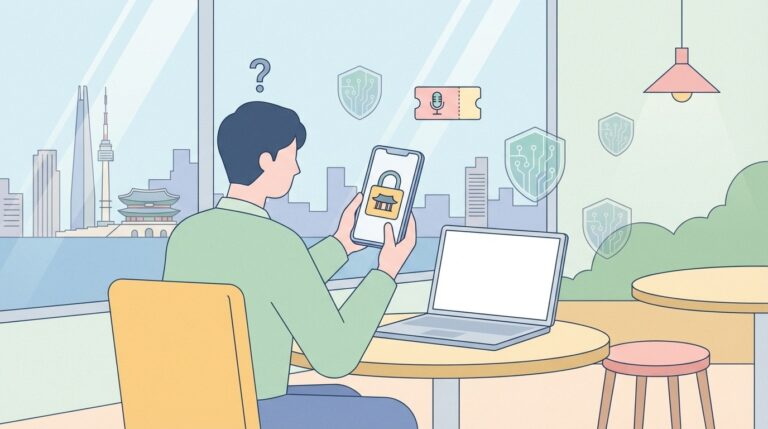
Picture this: You’re at a trendy cafe in Seongsu-dong. You need to use the restroom, so you leave your brand-new $2,000 MacBook right on the table. You come back ten minutes later, and it’s untouched. Korea’s physical security is legendary.
But the moment you sit down, connect to the cafe’s public Wi-Fi, and try to buy a K-Pop concert ticket or order spicy Tteokbokki on a delivery app, you hit a massive wall: 본인 인증 (Identity Verification). Suddenly, your screen is flooded with security plugin requests, and you get a suspicious text message claiming your “package was delayed” with a weird link attached.
In K-Dramas, elite hackers type furiously in dark rooms to track down villains. But in real-life Korea, the true cyber battle is everyday citizens dodging Voice Phishing scams and fighting the bureaucratic final boss of online identity checks.
If you’re an advanced (C1) Korean learner living in or traveling to Korea, textbook phrases like “비밀번호를 입력하세요” (Please enter your password) won’t save you when your coworker panics because their “account got dusted.” This guide is based on real struggles expats face in Korea’s hyper-connected digital society. Let’s upgrade your cyber-survival skills to native level!
Phase 2: Core Expressions Deep Dive
1. 본인 인증 (bonin injeung)
- Pronunciation: bonin injeung [Sounds like: bone-in (like a steak) + in-joong]
- Meaning: Identity verification (Literal: Self authentication)
- K-Culture Moment: This is the gatekeeper of Korean society. Want to order delivery? 본인 인증. Want to use a PC Bang? 본인 인증. Buying K-Pop tickets on Interpark? You guessed it. It usually requires a Korean phone number tied to your ARC (Alien Registration Card).
- Editor’s Insight: This isn’t just a tech term; it’s an emotional trigger for expats. When you hear this word, you automatically feel a mix of dread and exhaustion. It represents Korea’s highly centralized digital infrastructure.
- Situation Spectrum:
- Casual (Friends): ✅ (e.g., “Ah, I can’t do the bonin injeung!”)
- Semi-formal (Coworkers): ✅
- Formal (Official): ✅
- 🤔 Think About It: Why does Korea tie nearly every online action to a real-world identity? How does this reflect the Korean cultural emphasis on social accountability versus the Western value of online anonymity?
2. 털리다 (teollida)
- Pronunciation: teollida [Sounds like: tull-lee-da, where ‘tull’ rhymes with hull]
- Meaning: To be hacked / To have your data leaked (Literal: To be dusted off or shaken empty)
- K-Culture Moment: Imagine a K-Drama where the protagonist’s bank account is emptied by a scammer. They wouldn’t stiffly say, “I was cyber-attacked.” They’d grab their hair and yell, “내 계좌 다 털렸어!” (My account got totally wiped out!).
- Editor’s Insight: Koreans love physical, tactile metaphors. You “shake the dust off” a rug. If a hacker gets your data, your account was “shaken empty.” We also use this when we are mentally exhausted: “오늘 멘탈 털렸어” (My mental state got dusted today).
- Situation Spectrum:
- Casual (Friends): ✅
- Semi-formal (Coworkers): ⚠️ (Okay with close peers, but a bit informal)
- Formal (Boss/Elders): 🚫 (Use ‘해킹 당했습니다’ instead)
- 🤔 Think About It: Does your native language use physical metaphors for digital crimes? What does the imagery of “being shaken empty” tell us about the emotional impact of a data leak?
3. 보이스피싱 (boiseupising) & 스미싱 (seumising)
- Pronunciation: boiseupising [Boy-seu-pee-shing]
- Meaning: Voice phishing & SMS phishing (Smishing)
- K-Culture Moment: It’s a national pastime to warn your parents about this. In dramas, a crying mother gets a call: “Mom, I dropped my phone, I need you to transfer money to this account to fix it!” That’s classic Voice Phishing.
- Editor’s Insight: It’s so common that it’s become a verb. “나 보이스피싱 당할 뻔했어” (I almost got voice-phished). If a deal looks too good to be true, Koreans jokingly say, “이거 피싱 아니야?” (Isn’t this phishing?).
- Situation Spectrum:
- Casual (Friends): ✅
- Semi-formal (Coworkers): ✅
- Formal (Boss/Elders): ✅
Phase 3: Textbook vs. Real Korean
| Situation | 📖 Textbook Korean | 🗣️ Real Native Korean | 💡 Why the difference? |
|---|---|---|---|
| Asking for the Wi-Fi password | 와이파이 비밀번호가 무엇입니까? | 여기 와이파이 비번 뭐예요? | “비번” is the universal abbreviation for 비밀번호 (password). Efficiency is key! |
| Realizing you got hacked | 제 계정이 해킹을 당했습니다. | 아, 내 계정 털렸어. | Physical metaphors (털리다) express the emotional devastation much better than clinical terms. |
| Warning about a scam text | 사기 문자 메시지를 조심하십시오. | 저거 스미싱이니까 절대 누르지 마! | English loanwords (Smishing/Phishing) have completely taken over Korean cybersecurity jargon. |
Bottom Note for C1 Learners: Using abbreviations like “비번” (bi-beon) or “공인인증서” (gong-in in-jeung-seo – joint certificate) instantly makes you sound like a local who has fought the Korean IT system and survived.
Phase 4: Cultural Context — K-Culture Deep Dive
4-1. The “Nunchi” of Digital Privacy
In Korea, we don’t usually use privacy screens on our laptops, but there is a strict unwritten rule of Nunchi (social tact) regarding digital privacy. If your friend or coworker is unlocking their phone by drawing their pattern, or typing in their 6-digit banking pin (which we use for everything), you must actively look away. Staring at someone’s screen during authentication is considered highly rude and “눈치가 없다” (lacking social awareness).
4-2. The Tech Reality behind K-Dramas
In K-Dramas, the tech-savvy hacker friend types three lines of code and instantly finds the killer’s exact GPS location. Reality Check: While Korea is a CCTV superpower (which makes tracking physical crime highly efficient), the digital side is weighed down by heavy security protocols.
For example, during the holidays (Chuseok or Seollal), cyber criminals send out millions of fake “delivery tracking” text messages (스미싱). Because Korea is a hyper-delivery society (thanks, K-Food and Coupang!), people click these links without thinking, expecting their gift sets. The drama hacking is fast; real-life hacking targets our cultural habits of speed (빨리빨리) and convenience.
Phase 5: Real-life Roleplay Scenario
Setting: Friday afternoon at a tech office in Pangyo (Korea’s Silicon Valley). You and your Korean coworker, Min-su (32, friendly but a bit gullible when it comes to tech), are wrapping up work.
Min-su: 아, 이번 주말에 대학 동기 결혼식이 있네. 청첩장이 문자로 왔어.
(Ah, ibeon jumare daehak donggi gyeolhonsigi inne. Cheongcheopjangi munjaro wasseo.)
[Ah, I have a college friend’s wedding this weekend. The invitation came via text.]
(🎭 Stage Direction: Min-su holds up his phone, showing a text from an unknown number with a shortened URL link.)
YOU: 어? 번호가 저장 안 되어 있네요? 누구 결혼식인데요?
(Eo? Beonhoga jeojang an doeo inneyo? Nugu gyeolhonsigindeyo?)
[Huh? The number isn’t saved. Whose wedding is it?]
Min-su: 몰라, 일단 링크 눌러서 확인해 보려고.
(Molla, ildan ringkeu nulleoseo hwaginhae boryeogo.)
[I don’t know, I’m just going to click the link to check.]
🔀 Your Turn! How do you react?
* A) “그래요. 확인해 보세요.” (Sure, go ahead and check.)
* B) “잠깐만요! 그거 절대 누르지 마세요! 요즘 모바일 청첩장 스미싱 엄청 많아요!”
* C) “와, 대박. 해킹 축하해요.”✅ Best Choice: B — Reason: Mobile wedding invitations (모바일 청첩장) are currently the #1 method for Smishing in Korea. Clicking that link installs malware. You just saved Min-su’s bank account!
⚠️ Choice C Analysis: Highly sarcastic. Might be funny with a best friend, but inappropriate for a coworker about to lose their life savings.
Min-su: 헉, 진짜? 아… 내 개인정보 털릴 뻔했네. 고마워요!
(Heok, jinjja? Ah… Nae gaeinjeongbo teollil ppeonhaenne. Gomawoyo!)
[Gasp, really? Ah… my personal data almost got wiped out. Thank you!]
Phase 6: 10-Second Shadowing Drill
Master the rhythm and intonation! Follow the slash marks for pausing.
😤 잠깐만요! / 그거 절대 / 누르지 마세요! / 요즘 / 스미싱 엄청 많아요!
(jamkkanmanyo! / geugeo jeoldae / nureuji maseyo! / yojeum / seumising eomcheong manayo!)
[Wait! / Absolutely do not / click that! / Lately / there’s so much smishing!]
Pro-tip: Put heavy emphasis on “절대” (jeol-dae / absolutely) to sound genuinely urgent.
Phase 7: K-Culture Mini Dictionary (Cyber Edition)
| 한국어 (Korean) | Romanization | English | Cultural Context |
|---|---|---|---|
| 비번 | bibeon | Password | Short for 비밀번호. Used in every casual conversation about tech. |
| 스팸 | seupaem | Spam | Yes, it’s the canned meat we love during Chuseok, but it’s also the word for junk mail/calls. |
| 모바일 청첩장 | mobail cheongcheopjang | Mobile Wedding Invite | A beautifully designed web link Koreans send to invite people to weddings. Sadly, now heavily weaponized by hackers. |
| 로그인 연장 | logeuin yeonjang | Extend Login | For security, Korean banking and official sites automatically log you out after 10 minutes. You must click this to stay alive. |
Phase 8: Traveler’s Survival Kit
Even if you’re just visiting Korea, you’ll engage with its digital infrastructure immediately. Here is your survival kit for public Wi-Fi and cafes.
🆘 Survival Phrases TOP 3
1. 🇰🇷 “여기 와이파이 비번 뭐예요?” (yeogi waipai bibeon mwoyeyo?)
🗣️ Meaning: What’s the Wi-Fi password here?
2. 🇰🇷 “영수증 밑에 와이파이 비번 있어요.” (yeongsujeung mite waipai bibeon isseoyo.)
🗣️ Meaning: The Wi-Fi password is at the bottom of the receipt. (What the cashier will usually reply!)
3. 🇰🇷 “본인 인증을 할 수 없는데, 다른 방법이 있나요?” (bonin injeungeul hal su eomneunde, dareun bangbeobi innayo?)
🗣️ Meaning: I can’t do the identity verification, is there another way? (Use this at PC bangs or kiosks).
📌 Editor’s Tech Note:
* Public Wi-Fi: Korea has free Wi-Fi everywhere (subways, buses, streets). Look for “Public WiFi Free”. However, because it’s open, your data can easily be “털리다” (hacked). Always use a VPN if you are logging into your bank on a Seoul subway!
* Kiosk Culture: You rarely talk to cashiers now. But many kiosks don’t accept foreign cards easily without an IC chip. Have physical cash as a backup.
Phase 9: Critical Thinking — “One Step Deeper”
🧠 Think Deeper: Security through Centralization vs. Privacy
When dealing with Korean cybersecurity, you’ll notice a glaring paradox. To protect your data, the Korean system demands more of your data. You cannot be a ghost on the Korean internet. To leave a comment on a major news site or buy a simple item online, you must verify your identity using your mobile carrier, which is linked to your government-issued ID.
From a Western perspective, this feels like an invasion of privacy—a surveillance state. But from a Korean perspective, this system (while annoying) creates a high-trust digital society where cyberbullying is slightly deterred (because anonymity is hard) and financial fraud can be traced. It’s the ultimate trade-off: giving up individual anonymity for the sake of the collective community’s security.
💬 Your Turn: How does your country handle online identity? Can you buy things online completely anonymously? Share your thoughts in the comments!
Phase 10: FAQ & Avoiding Common Mistakes
Q: If I get a phishing call, should I curse at them in Korean?
Editor’s Advice: While it might be tempting to use K-Drama curse words, don’t do it. Voice phishing organizations are dangerous and can use your voice recording against you. Just hang up immediately and block the number (차단하세요).
Q: My Korean friend keeps saying my account is “털렸다”. Is my physical wallet gone?
Editor’s Advice: No! Remember the metaphorical slang. If your physical wallet is gone, they would say “지갑 잃어버렸어” (I lost my wallet). “털렸다” in a tech context always means digital hacking or data leaks.
❌ Common Mistake: Translating “Identity Verification” as “아이덴티티 확인” (Identity hwagin).
✅ Do This Instead: Always use the set legal/cultural term: 본인 인증 (bonin injeung). The tech system won’t understand anything else.
Phase 11: Summary & Action Items
🎯 One-Liner Summary: To survive Korea’s digital landscape, master the art of bonin injeung (identity verification), protect your passwords (bibeon), and don’t let your data get dusted (teollida) by smishing links!
🚀 Action Mission:
* 🥉 Bronze (Solo): Look at your phone’s SMS inbox and practice saying “이거 스미싱 아니야?” (Isn’t this smishing?) out loud.
* 🥈 Silver (Online): Change your phone or social media language to Korean for one day. Try to find the word “비밀번호” (Password) or “보안” (Security) in the settings.
* 🥇 Gold (Real World): Next time you are at a Korean cafe, confidently ask the barista: “와이파이 비번 뭐예요?”
💻 K-Culture Mission: Watch a modern K-Drama thriller (like Voice or Taxi Driver). Spot the exact moment the characters use GPS tracking or mention a “보이스피싱” scam. You’ll notice it everywhere now!
Phase 12: Interactive Challenge — Quiz Time!
1. Situational Judgment: Your Korean friend receives a text message with a link saying: “[택배 배송 지연] 주소를 다시 입력해주세요” (Package delivery delayed, please re-enter address). You know they didn’t order anything. What should you say?
* A) “빨리 확인해 봐!” (Check it quickly!)
* B) “오, 내 선물이야?” (Oh, is it a gift for me?)
* C) “그거 누르지 마! 스미싱 같아.”
2. Fill in the Blank (Slang Edition): “I used the same password everywhere, and my account got totally _________!”
* Korean: “비번 똑같은 거 썼더니 내 계정 다 [ ______ ]!”
3. True or False (K-Culture Edition):
“In Korea, you can easily order food online or buy concert tickets using just an email address, without needing a phone number for verification.”
(Answers: 1. C / 2. 털렸어 / 3. False. You absolutely need 본인 인증 via a Korean phone number!)
Frequently Asked Questions (FAQ)
Q: What does "본인 인증 (bonin injeung)" mean in Korean and how do you pronounce it?
A: In Korean, "본인 인증 (bonin injeung)" is pronounced [bonin injeung [Sounds like: bone-in (like a steak] and means: Identity verification (Literal: Self authentication)
Q: What does "털리다 (teollida)" mean in Korean and how do you pronounce it?
A: In Korean, "털리다 (teollida)" is pronounced [teollida [Sounds like: tull-lee-da, where 'tull' rhymes with hull] and means: To be hacked / To have your data leaked (Literal: To be dusted off or shaken empty)
Q: What does "보이스피싱 (boiseupising) & 스미싱 (seumising)" mean in Korean and how do you pronounce it?
A: In Korean, "보이스피싱 (boiseupising) & 스미싱 (seumising)" is pronounced [boiseupising [Boy-seu-pee-shing] and means: Voice phishing & SMS phishing (Smishing)







