

Hello! I’m your Daily Hangul Editor, your friendly veteran tutor and local culture navigator in Seoul.
Phase 1: Empathy – Lost in a K-Drama Scene
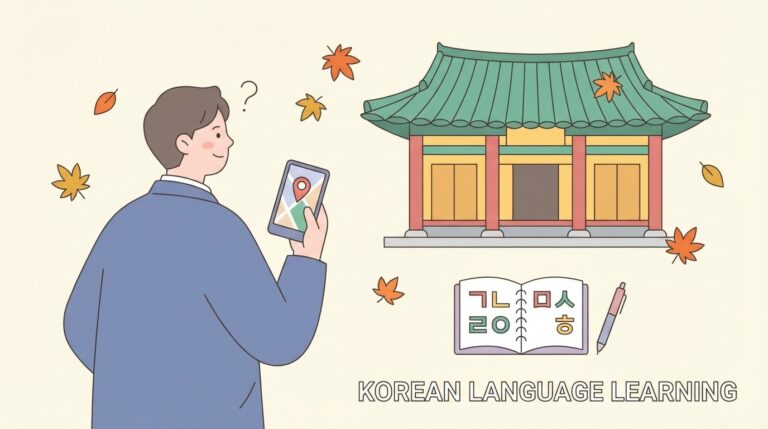
Imagine this: You’ve just watched a breathtaking historical K-Drama (Sageuk), where the main character walks gracefully through an ancient temple surrounded by autumn leaves. Inspired, you pack your bags and take the KTX train to Gyeongju, the ancient capital of Korea. You step out of Singyeongju Station, breathe in the fresh air, and suddenly realize… Wait, which bus goes to Bulguksa Temple?
Google Maps isn’t giving you the exact walking route (welcome to Korea!), and a line of green and blue buses is waiting. A friendly-looking bus driver is looking right at you. What do you say?
If you don’t know the right phrases, you might end up on a bus heading to the opposite side of the city! Don’t worry. This guide is built from the real panics and triumphs of my past students. Let’s learn how to navigate your way to Bulguksa Temple like a true local!
Phase 2: Core Expressions Deep Dive
Let’s master the 3 essential phrases you need to conquer Gyeongju’s public transport.
1. 불국사 가는 버스 어디서 타요?
- Pronunciation: Bulguksa ganeun beoseu eodiseo tayo?
(Tip: ‘eo’ sounds like the ‘uh’ in ‘uh-oh’, and ‘eu’ in ‘beoseu’ sounds like the disgusted noise you make when stepping on gum!)- Meaning: Where do I take the bus that goes to Bulguksa? (Literal: Bulguksa-going bus, where do I ride?)
- K-Culture Moment: Picture a bustling tourist spot. A confused backpacker asks a local halmeoni (grandmother) this question. She doesn’t just point; she grabs their hand and walks them to the exact bus stop. That’s Korean Jeong (warmth/affection)!
- Editor’s Insight: You can replace ‘불국사’ with ANY destination. “서울역 가는 버스 어디서 타요?” (Where do I take the bus to Seoul Station?). It’s the ultimate plug-and-play survival sentence.
- Situation Spectrum:
- Casual with friends: ⚠️ (Use ‘어디서 타?’ instead)
- Strangers/Bus Drivers (Polite): ✅
- Very Formal (Elders/Boss): ✅ (Perfectly fine for travel!)
- 🤔 Think About It: Notice how the destination comes before the word ‘bus’? In Korean, modifiers always come before the noun. How does the word order change the way you think about the sentence in your native language?
2. 불국사까지 얼마나 걸려요?
- Pronunciation: Bulguksa-kkaji eolmana geollyeoyo?
- Meaning: How long does it take to get to Bulguksa?
- K-Culture Moment: Koreans are famous for our “Ppalli-Ppalli” (hurry, hurry) culture. We love knowing exactly how many minutes something will take. If you ask a taxi driver this, they might proudly tell you they can get you there in half the normal time!
- Editor’s Insight: ‘-까지 (-kkaji)’ means ‘until’ or ‘up to’. ‘얼마나 걸려요’ is your magic phrase for time. Memorize it like a single word!
- Situation Spectrum:
- Casual with friends: ⚠️ (Use ‘얼마나 걸려?’)
- Strangers/Bus Drivers (Polite): ✅
- Very Formal: ✅
- 🤔 Think About It: Why do you think knowing the exact travel time is so important in modern Korean culture?
3. 여기서 내려요?
- Pronunciation: Yeogiseo naeryeoyo?
- Meaning: Do I get off here?
- K-Culture Moment: The bus is packed. The automated voice announces the stop, but you missed it. You tap the shoulder of the kind-looking student next to you, point out the window, and ask, “여기서 내려요?” They nod enthusiastically and hit the stop bell for you.
- Editor’s Insight: ‘내리다 (naerida)’ means to get off or go down. Say this with a rising intonation at the end to make it a question.
- Situation Spectrum:
- Casual with friends: ⚠️ (Use ‘여기서 내려?’)
- Strangers/Fellow Passengers: ✅
- Very Formal: 🚫 (Use ‘여기서 내립니까?’)
- 🤔 Think About It: Getting off a crowded Korean bus requires a bit of courage and pushing. Is public transport in your country quiet and orderly, or loud and fast-paced?
Phase 3: Textbook vs. Real Korean
| Situation | 📖 Textbook Korean | 🗣️ Real Spoken Korean | 💡 Why the difference? |
|---|---|---|---|
| Asking if this bus goes to the temple | 이 버스는 불국사에 갑니까? | 이거 불국사 가요? | Koreans drop subject particles (은/는) and speak faster in daily life. |
| Buying 2 tickets | 어른 표 두 장 주십시오. | 어른 두 명이요. (Adult, two people) | In real life, we just state the category (adult) and the number of people to save time! |
| Excuse me (to get off the bus) | 실례합니다. 지나가겠습니다. | 잠시만요! / 내릴게요! (Just a moment! / I’m getting off!) | “잠시만요” is the absolute standard for moving through a crowd in Korea. |
Phase 4: Cultural Context — K-Culture Deep Dive
4-1. Non-verbal Communication: The Art of Pointing
When asking a bus driver a question in Korea, don’t just use words. Hold up your phone with the map open to Bulguksa, make eye contact, and ask your question. If the driver gives a quick nod or waves you in, hop on! Also, remember the Korean Nunchi (reading the room): if the bus is crowded, move to the back quickly so others can board.
4-2. The “School Trip” Capital of Korea
Why is Bulguksa so famous? For almost every Korean adult, Bulguksa Temple isn’t just a historical site; it’s a nostalgic memory of their middle or high school 수학여행 (suhak-yeohaeng – school trip).
If you watch K-Dramas like Reply 1988 or Twenty-Five Twenty-One, you’ll see students taking group photos in front of historic temples or pagodas. In front of Bulguksa sits the famous Dabotap pagoda. When you visit, you’re not just seeing Buddhist history; you are standing in the exact spot where millions of Koreans took their awkward teenage photos!
Phase 5: Practical Role-play Scenario
Setting: A sunny Friday morning at the bus stop outside Singyeongju KTX Station. You want to visit Bulguksa Temple, but there are three different buses arriving at the same time. You decide to ask a local standing next to you.
Characters:
– YOU: A foreign traveler eager to explore Gyeongju.
– Minho (20s): A local university student wearing AirPods, holding an iced americano.
Minho: (Takes off one AirPod, seeing you look confused)
혹시… 길 찾으세요?
(Hoksi… gil chajeuseyo?)
(By any chance… are you looking for directions?)
YOU: 네! 저… 불국사 가는 버스 어디서 타요?
(Ne! jeo… Bulguksa ganeun beoseu eodiseo tayo?)
(Yes! Um… where do I take the bus to Bulguksa?)
Minho: 아, 불국사요? 여기서 700번 버스 타시면 돼요.
(Ah, Bulguksa-yo? Yeogiseo chil-baek-beon beoseu tasimyeon dwaeyo.)
(Ah, Bulguksa? You can take bus number 700 from here.)
YOU: 감사합니다! 불국사까지 얼마나 걸려요?
(Gamsahamnida! Bulguksa-kkaji eolmana geollyeoyo?)
(Thank you! How long does it take to get to Bulguksa?)
Minho: 한 40분 정도 걸려요. 저기 마침 버스 오네요!
(Han sasip-bun jeongdo geollyeoyo. Jeogi machim beoseu oneyo!)
(It takes about 40 minutes. Oh, the bus is coming right there!)
🔀 Your Turn! How should you respond as you get on the bus?
– A) “안녕히 계세요!” (Goodbye! – standard textbook)
– B) “감사합니다! 좋은 하루 보내세요!” (Thank you! Have a good day!)
– C) “대박! 짱이다!” (Awesome! Best!)✅ Best Choice: B — While A is grammatically correct, B adds a warm, friendly touch that Koreans love hearing from foreigners.
⚠️ Choice C Analysis: This is too casual slang for someone who just helped you. Save “대박” for when you see the beautiful temple itself!
K-Culture Bonus Role-play: Buying the Ticket
Ticket Clerk: 어서 오세요. (Welcome.)
YOU: 안녕하세요. 어른 두 명이요. (Hello. Two adults, please.)
Ticket Clerk: 네, 만 이천 원입니다. 카드 꽂아주세요. (Yes, that’s 12,000 won. Please insert your card.)
YOU: 네, 감사합니다! (Yes, thank you!)
(🎭 Stage Direction: You confidently take your tickets and walk toward the beautiful temple gates!)
Phase 6: 10-Second Shadowing Drill
Listen to the rhythm of Korean. Practice these sentences out loud, focusing on the pauses (/) and the emotion tags!
- 🥺 (Slightly confused, asking for help)
저기요, / 불국사 가는 버스 / 어디서 타요?
(Jeogiyo, / Bulguksa ganeun beoseu / eodiseo tayo?) -
🤔 (Curious about the schedule)
여기서 / 불국사까지 / 얼마나 걸려요?
(Yeogiseo / Bulguksa-kkaji / eolmana geollyeoyo?) -
😤 (Determined, moving through a crowded bus)
잠시만요! / 저 여기서 / 내려요!
(Jamsimanyo! / jeo yeogiseo / naeryeoyo!)
Phase 7: K-Culture Mini Dictionary
| Korean | Romanization | English | Context |
|---|---|---|---|
| 눈치 | nunchi | Social sense | The vital Korean skill of reading the room (e.g., knowing when to offer your bus seat to an elder). |
| 수학여행 | suhak-yeohaeng | School trip | A right of passage for Korean students. Gyeongju is the #1 destination. |
| 사극 | sageuk | Historical Drama | Dramas set in historical periods, often filmed in places like Gyeongju. |
| 불국사 | Bulguksa | Bulguksa Temple | A UNESCO World Heritage site and a masterpiece of Buddhist art. |
| 핫플 | hat-peul | Hot place (Hotspot) | Trendy places. The street outside Bulguksa is full of modern cafe ‘hat-peuls’! |
Phase 8: Traveler’s Survival Kit
🆘 Survival Phrases for the Bus
– 🇰🇷 “이거 불국사 가요?” (Igeo Bulguksa gayo?)
– 🗣️ Pronunciation: [Ee-geo Bul-guk-sa ga-yo?]
– 📍 Where to use: Asking the bus driver as the doors open.
– 💡 Pro Tip: Short, sweet, and perfectly polite. It literally means “Does this go to Bulguksa?”📌 Editor’s Travel Note: Conquering Korean Transit
– Useful Apps: Google Maps is notoriously bad for walking/bus routes in Korea. Download Naver Map or KakaoMap! They have English settings and are lifesavers.
– The Magic Card: Get a T-money card at any convenience store. You tap it when you get ON the bus, and—this is crucial—you MUST tap it again when you get OFF the bus to avoid extra charges!
– Cash vs. Card: Temples used to be cash-only, but almost everywhere in Korea accepts credit cards now, even the ticket booths at historical sites.
Phase 9: Critical Thinking Corner — “One Step Deeper”
Media vs. Reality: The Gyeongju Experience
🧠 Think Deeper:
If your only exposure to ancient Korea is through K-Dramas (Sageuks), you might expect Gyeongju to be a quiet, untouched village filled with monks and scholars in Hanbok. The reality is a fascinating clash of old and new. Right outside the 1,200-year-old Bulguksa Temple, you will find modern LED signs, bustling Starbucks, and teenagers eating Tanghulu.Instead of being disappointed that it doesn’t look exactly like a TV set, appreciate how Korea seamlessly integrates its hyper-modern lifestyle with its deep historical roots.
💬 Your Turn: Have you ever visited a historical site in your country that looked totally different from how it was portrayed in movies? Share your experience in the comments!
Phase 10: FAQ & Mistake Prevention
Q: Can I just speak English in Gyeongju?
A: In tourist spots like Bulguksa, many signs are in English. However, local bus drivers or elderly shop owners might not speak it. Using simple Korean phrases like “불국사 가요?” will instantly make them smile and help you!
Q: Do I need to bow when I ask a question?
A: A full 90-degree bow isn’t necessary! A slight nod of the head when you say “안녕하세요” (Hello) or “감사합니다” (Thank you) is the perfect amount of politeness.
❌ Common Mistake #1: Forgetting to tap your T-money card when getting OFF the bus.
✅ Do this instead: Keep your card handy. When you hear the announcement for your stop, press the red STOP button, stand by the back door, and tap your card on the machine before stepping off.
Phase 11: Summary & Action Items
One-Liner Summary: Today, we learned how to confidently find the right bus, ask about travel time, and know when to get off at Bulguksa Temple!
Action Mission:
– 🥉 Bronze (Solo): Stand in front of a mirror and ask your reflection: “불국사 가는 버스 어디서 타요?” 3 times.
– 🥈 Silver (Online): Open Naver Map, search for the route from ‘Singyeongju Station’ to ‘Bulguksa’, and find out which bus numbers pop up!
– 🥇 Gold (Real World): The next time you are in Korea or at a Korean restaurant, try asking “여기서 [Place]까지 얼마나 걸려요?” (How long does it take from here to [Place]?).
K-Culture Mission: Go to Google Maps or Naver Map’s Street View and virtually “walk” around the entrance of Bulguksa Temple. Can you spot the ticket booth where you would say “어른 두 명이요”?
Phase 12: Quiz — Interactive Challenge
1. Situational Judgment: You are on the bus and you see the Bulguksa Temple gates approaching. The bus is crowded. What is the most natural thing to say to move past people?
– A) 안녕히 계세요! (Goodbye!)
– B) 잠시만요! 내릴게요! (Just a moment! I’m getting off!)
– C) 불국사 가요? (Does it go to Bulguksa?)
2. Fill in the Blank:
You want to know where to take the bus to Seoul.
“서울역 가는 버스 어디서 ______?”
– A) 걸려요 (takes)
– B) 내려요 (get off)
– C) 타요 (ride/take)
3. True or False – K-Culture Edition:
You don’t need to tap your transit card when getting off a bus in Korea, only when getting on.
– T / F
4. Role-play Consequence:
If you ask a Korean “불국사까지 얼마나 걸려요?”, what kind of answer are you most likely to get?
– A) The exact time in minutes (e.g., “About 40 minutes”).
– B) The distance in kilometers.
– C) They will ignore you.
Answers (Click to reveal!)
1. B – “잠시만요!” is your magic phrase to part the Red Sea of people on a Korean bus. A is for saying goodbye to someone staying behind, and C is asking the destination.
2. C – 타요 (tayo) means to ride or take transport.
3. False – Always tap your card when getting OFF! Otherwise, you’ll be charged an extra distance fee on your next ride.
4. A – Due to the “Ppalli-Ppalli” culture, Koreans usually estimate travel by time, not distance!
Ready for your Gyeongju adventure? Leave a comment below with the historical site in Korea you want to visit most!
Frequently Asked Questions (FAQ)
Q: What does "불국사 가는 버스 어디서 타요?" mean in Korean and how do you pronounce it?
A: In Korean, "불국사 가는 버스 어디서 타요?" is pronounced [Bulguksa ganeun beoseu eodiseo tayo?] and means: Where do I take the bus that goes to Bulguksa? (Literal: Bulguksa-going bus, where do I ride?)
Q: What does "불국사까지 얼마나 걸려요?" mean in Korean and how do you pronounce it?
A: In Korean, "불국사까지 얼마나 걸려요?" is pronounced [Bulguksa-kkaji eolmana geollyeoyo?] and means: How long does it take to get to Bulguksa?
Q: What does "여기서 내려요?" mean in Korean and how do you pronounce it?
A: In Korean, "여기서 내려요?" is pronounced [Yeogiseo naeryeoyo?] and means: Do I get off here?






