

Phase 1: Empathy (Immersive Open)
Hello! I’m the Senior Editor at Daily Hangul.
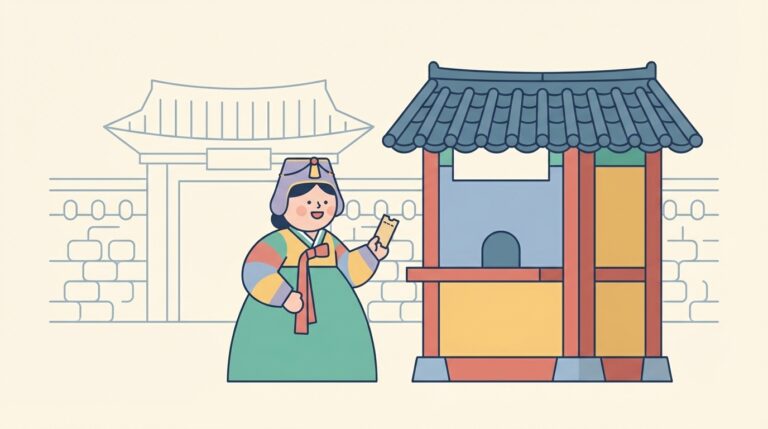
Imagine this: You are standing in front of the majestic Gyeongbokgung Palace in Seoul. The sun is shining, you are wearing a beautiful, colorful Hanbok, and you are ready to explore. You walk up to the ticket booth (매표소). The staff smiles warmly at you. You want to ask, “How much is the entrance fee?”
But… your mind goes blank. You end up just holding out your credit card and hoping for the best. Sound familiar?
Don’t worry! Every traveler experiences this “ticket booth freeze.” While many places in Korea have English signs, knowing how to ask about prices in Korean not only saves you from anxiety but also earns you huge, welcoming smiles from the locals.
Today, we are going to learn the absolute magic phrase for shopping and sightseeing in Korea. This guide is based on real struggles from my A1 beginner students who wanted to navigate Seoul like a pro. Let’s dive in!
Phase 2: Core Expressions Deep Dive
1. 얼마예요? (How much is it?)
- Pronunciation: [eol-ma-ye-yo?] Think of it sounding like “All my yellow?”
- Meaning: Literal: How much is it? / Real nuance: The ultimate magic word for buying anything.
- K-Culture Moment: Picture a bustling traditional market like Gwangjang Market. A tourist points to a delicious plate of spicy rice cakes (Tteokbokki) and asks, “얼마예요?” The vendor auntie (이모님) beams and gives them an extra piece!
- Editor’s Insight: This is the most versatile phrase in Korean. You don’t even need a full sentence. Just point at an item, or a ticket, and say “얼마예요?”
- Situation Spectrum:
- Casual with friends: ✅ (Usually just “얼마야?” – eol-ma-ya?)
- Staff at shops/booths (Semi-formal): ✅ (Perfect!)
- Highly formal situations: ⚠️ (They might use ‘얼마입니까?’, but ‘얼마예요’ is 100% fine for tourists!)
- 🤔 Think About It: Notice the “yo” (요) at the end? In Korean, attaching “yo” is like an instant politeness filter. Why do you think the Korean language has so many different levels of politeness compared to your native language?
2. 입장료 얼마예요? (How much is the entrance fee?)
- Pronunciation: [ib-jang-nyo eol-ma-ye-yo?]
- Meaning: Literal: Entrance fee, how much is it?
- K-Culture Moment: You are at the base of N Seoul Tower, ready to see the night view of the city (a classic K-Drama date spot!). You walk to the counter and confidently ask this phrase.
- Editor’s Insight: The word 입장료 (ib-jang-nyo) looks like ib-jang-ryo, but because of Korean pronunciation rules, it sounds like nyo. Say it smoothly like a sigh: ib-jang-nyooo.
- Situation Spectrum:
- Casual: ✅
- Tourist spots: ✅
- Formal: 🚫 (Not applicable)
- 🤔 Think About It: In English, we say “How much IS the entrance fee?” with the question word first. In Korean, the topic (Entrance fee) comes first. Korean is a very context-heavy language. We present the topic first, then ask about it!
3. 성인 두 명이요. (Two adults, please.)
- Pronunciation: [seong-in du myeong-i-yo]
- Meaning: Literal: Adult two people. / Real nuance: I need two adult tickets, please.
- K-Culture Moment: Buying movie tickets to see the latest Korean blockbuster. The staff asks “How many?” and you smoothly reply with this phrase.
- Editor’s Insight: Instead of saying “Two tickets,” Koreans naturally say “Two people” (두 명). It sounds much more native!
- Situation Spectrum:
- Casual: ✅
- Ticket booths: ✅
- Formal: ⚠️
- 🤔 Think About It: Why count the people instead of the tickets? It reflects a subtle cultural focus on the humans involved rather than the transaction items.
Phase 3: Textbook vs. Real Korean
| Situation | 📖 Textbook Korean | 🗣️ Real Korean | 💡 Why is it different? |
|---|---|---|---|
| Asking the price | 입장료가 얼마입니까? (ib-jang-nyo-ga eol-ma-im-ni-kka?) | 입장료 얼마예요? (ib-jang-nyo eol-ma-ye-yo?) | Dropping the subject particle (가) makes it sound much more natural and relaxed. |
| Asking for 2 tickets | 티켓 두 장 주세요. (ti-ket du jang ju-se-yo.) | 두 명이요. (du myeong-i-yo.) | Real life is about efficiency! Just saying “Two people” is shorter and sounds like a local. |
| Showing your card | 카드로 결제하겠습니다. (ka-deu-ro gyeol-je-ha-get-seum-ni-da.) | 카드 돼요? (ka-deu dwae-yo?) | “Does card work?” is the ultimate daily phrase. No one uses the long textbook version for small purchases. |
Phase 4: Cultural Context — K-Culture Deep Dive
4-1. The “Two-Hand” Rule (Non-verbal Magic)
Language is only half the battle. When you pay for your entrance fee, hand over your credit card or cash using both hands, or support your right arm with your left hand. This is a massive sign of respect in Korea. If you do this while saying “얼마예요?”, the staff will immediately think, “Wow, this foreigner really understands our culture!”
4-2. K-Travel Connection: The Hanbok Hack!
Did you know that if you wear a Hanbok (traditional Korean clothing), the entrance fee to major palaces like Gyeongbokgung and Changdeokgung is 100% FREE?
In K-Dramas, you often see characters time-traveling back to the Joseon Dynasty. Renting a Hanbok near the palace is a huge trend. If you wear one, you don’t even need to ask “입장료 얼마예요?”. You just walk right through the gate like royalty! (Though it’s still good to know the phrase for other places like museums or theme parks).
Phase 5: Real-Life Roleplay Scenario
Setting: Saturday afternoon. The ticket booth at the bustling Lotte World theme park. You are with your friend, excited to ride the rollercoasters.
Characters:
– YOU: A tourist ready for some K-Theme Park fun.
– Staff (직원 – Jik-won): A friendly ticketing agent.
Dialogue:
Staff: 안녕하세요! (An-nyeong-ha-se-yo!)
[Hello!]
YOU: 안녕하세요, 입장료 얼마예요? (An-nyeong-ha-se-yo, ib-jang-nyo eol-ma-ye-yo?)
[Hello, how much is the entrance fee?]
Staff: 성인은 6만 2천 원입니다. 몇 분이세요? (Seong-in-eun yung-man i-cheon won-im-ni-da. Myeot bun-i-se-yo?)
[Adults are 62,000 won. How many people?]
(🎭 Stage Direction: The staff looks at you and your friend, waiting for the number of tickets)
🔀 YOUR TURN! How do you answer?
– A) 우리 두 명입니다. (u-ri du myeong-im-ni-da.)
– B) 두 명이요. (du myeong-i-yo.)
– C) 둘! (dul!)✅ Best Choice: B — It’s short, polite, and exactly what a Korean would say!
⚠️ Choice A Analysis: A bit too robotic and formal, like reading from a book.
⚠️ Choice C Analysis: Dropping the “yo” makes it informal (반말). You shouldn’t use this with service staff!
YOU: 두 명이요. (Du myeong-i-yo.)
[Two people, please.]
Staff: 네, 결제 도와드리겠습니다. (Ne, gyeol-je do-wa-deu-ri-get-seum-ni-da.)
[Yes, I’ll help you with the payment.]
(🎭 Stage Direction: You hand over your credit card with two hands!)
🎁 Bonus K-Culture Scenario: At the Traditional Market
YOU: 이모님, 떡볶이 얼마예요? (I-mo-nim, tteok-bok-ki eol-ma-ye-yo?)
[Auntie, how much is the Tteokbokki?]
Auntie: 4천 원이에요~ (Sa-cheon won-i-e-yo~)
[It’s 4,000 won~]
YOU: 카드 돼요? (Ka-deu dwae-yo?)
[Do you take cards?]
Auntie: 그럼요! (Geu-reom-yo!)
[Of course!]
Phase 6: 10-Second Shadowing Drill
Let’s practice the rhythm! Pay attention to the pauses (/) and the feeling.
😊 밝게 (Brightly): 입/장/료 / 얼/마/예/요? (ib-jang-nyo / eol-ma-ye-yo?)
💳 부드럽게 (Smoothly): 성/인 / 두/명/이/요~ (seong-in / du-myeong-i-yo~)
🤔 궁금하게 (Curiously): 카/드 / 돼/요? (ka-deu / dwae-yo?)
Phase 7: K-Culture Mini Dictionary
| Korean | Romanization | English | Context |
|---|---|---|---|
| 입장료 | ib-jang-nyo | Entrance fee | Used at palaces, museums, clubs, and parks. |
| 성인 / 소인 | seong-in / so-in | Adult / Child | Found on ticket boards everywhere. |
| 무료 | mu-ryo | Free (of charge) | Your favorite word! Look for this sign. |
| 매표소 | mae-pyo-so | Ticket booth | Usually has a little window and a price board. |
| 한복 | han-bok | Traditional clothes | Wearing this gets you ‘mu-ryo’ (free) entry to palaces! |
Phase 8: Traveler’s Survival Kit
🆘 Survival Expression #1: 이거 얼마예요? (How much is this?)
– 🗣️ Pronunciation: [i-geo eol-ma-ye-yo?]
– 📍 Where to use: Souvenir shops, convenience stores, markets.
– 💡 Pro Tip: If you don’t understand the number they say in Korean, just politely hand them your phone with the calculator app open. They will happily type the price for you!📌 Editor’s Travel Note
– Card vs. Cash: Korea is a “Card Heaven.” You can pay for almost a $1 bottle of water with a credit card. However, keep some cash for street food or small traditional market stalls!
– Tipping Culture: There is absolutely NO tipping culture in Korea. If you leave money on the counter at a ticket booth or restaurant, the staff will chase you down the street to return it!
Phase 9: Critical Thinking — “A Step Deeper”
Language & Social Harmony (Nunchi in Transactions)
Why do Koreans rarely say “I want to buy two tickets” (티켓 두 장 사고 싶어요) and instead just say “Two people” (두 명이요)? Korean society highly values efficiency, context, and a smooth flow of interactions, often referred to as Nunchi (reading the room). At a busy ticket booth, the staff already knows why you are there. Stating the obvious wastes time. By simply stating the variable—how many people—you are being considerate of the staff’s time and keeping the line moving quickly.
💬 Your Turn:
In your country, do people use full, polite sentences at ticket counters, or do they use short, efficient phrases? Let me know in the comments!
Phase 10: FAQ & Avoiding Misunderstandings
Q: Can I bargain or ask for a discount at a ticket booth?
No. Prices at museums, palaces, and theme parks are strictly fixed. However, you can bargain slightly at traditional clothing markets like Dongdaemun using cute phrases like “조금 깎아주세요” (Please give me a small discount), but never at an official ticket office!
Q: What if I don’t know how to say numbers in Korean?
Don’t panic! Koreans are very used to tourists. You can say “입장료 얼마예요?” to be polite, and then simply hold up your fingers (e.g., 2 fingers for 2 people). It’s the effort to speak Korean that they appreciate!
❌ Common Mistake: Throwing your credit card or cash on the counter.
✅ Do this instead: Hand the card directly to the cashier’s hand using both of your hands. Throwing money on the counter is considered very rude in Korea!
Phase 11: Summary & Action Items
- One-Liner Summary: To buy anything or enter anywhere in Korea, just point and say “얼마예요?” (eol-ma-ye-yo?).
Your Action Missions:
– 🥉 Bronze (Solo): Stand in front of a mirror, hold a random card, and practice saying “입장료 얼마예요?” 3 times with a confident smile.
– 🥈 Silver (Online): Look up the official website for ‘N Seoul Tower’ and find out how much the current “입장료” is in Won!
– 🥇 Gold (Real Life): Next time you visit a Korean restaurant or grocery store in your area, point to an item and ask the staff “이거 얼마예요?”
✨ K-Travel Mission:
Go to Google Street View, drop the little yellow person right in front of Gyeongbokgung Palace’s main gate. Look around for the Ticket Booth (매표소). Imagine yourself walking up and saying today’s phrase!
Phase 12: Quiz — Interactive Challenge
1. Situational Judgment: You are at a museum in Seoul. You need one ticket for yourself. What is the most natural way to ask the staff?
– A) 나 티켓 원해요. (I want ticket.)
– B) 한 명이요. (One person.)
– C) 입장료가 얼마입니까? (How much is the entrance fee exactly?)
2. True or False — K-Culture Edition:
If you wear Hanbok to a traditional Korean palace, the entrance fee (입장료) is completely free. (T/F)
3. Fill in the Blank:
At a market, you want to know the price of a cute keychain. You point and say:
“이거 [ ]?” (How much is this?)
(Answers below!)
Click to see answers!
1. B (Saying “한 명이요” is the most natural and efficient way at a booth.)
2. True! It’s a great way to save money and take amazing photos.
3. 얼마예요 (eol-ma-ye-yo)
Frequently Asked Questions (FAQ)
Q: What does "얼마예요? (How much is it?)" mean in Korean and how do you pronounce it?
A: In Korean, "얼마예요? (How much is it?)" is pronounced [eol-ma-ye-yo?] and means: Literal: How much is it? / Real nuance: The ultimate magic word for buying anything.
Q: What does "입장료 얼마예요? (How much is the entrance fee?)" mean in Korean and how do you pronounce it?
A: In Korean, "입장료 얼마예요? (How much is the entrance fee?)" is pronounced [ib-jang-nyo eol-ma-ye-yo?] and means: Literal: Entrance fee, how much is it?
Q: What does "성인 두 명이요. (Two adults, please.)" mean in Korean and how do you pronounce it?
A: In Korean, "성인 두 명이요. (Two adults, please.)" is pronounced [seong-in du myeong-i-yo] and means: Literal: Adult two people. / Real nuance: I need two adult tickets, please.







