

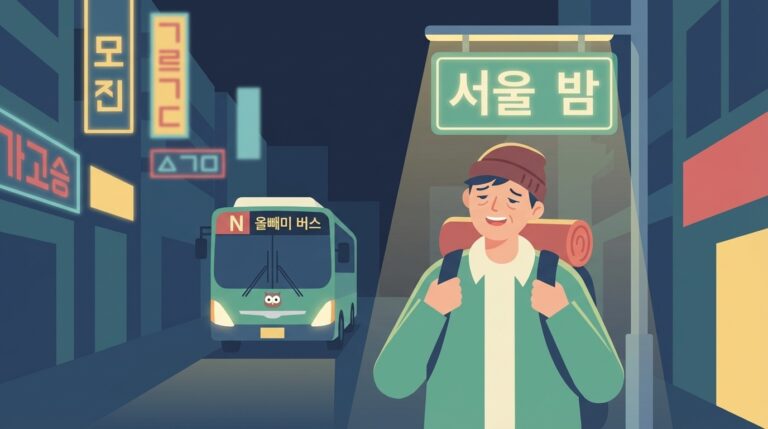
Phase 1: Empathy & K-Culture Cold Open
Hello! I’m your Daily Hangul Editor.
Picture this: You’re in the heart of Gangnam or Hongdae. You just had an amazing time at a K-Pop concert or a late-night Soju and Samgyeopsal session with friends. You check your watch—it’s 1:30 AM. You confidently open your map app to catch the subway, only to realize… the screen is gray. The subway is closed.
You try to hail a cab, but the iconic Kakao T app just keeps loading, and the empty taxis zooming by mysteriously ignore your frantic hand-waving. It feels like a scene straight out of a K-Drama where the main character is left freezing on the sidewalk, right?
But wait! Before you panic or pay a fortune for a premium taxi, look up. Do you see a bus with an ‘N’ in front of its number? Welcome to the Seoul Owl Bus (올빼미버스, N-Bus).
Knowing how to navigate the night bus is the ultimate flex for any expat or traveler in Korea. It means you’ve leveled up from a standard tourist to a true local insider. Today, we’re going to learn the essential survival Korean for conquering public transportation after midnight!
(Note: This guide is crafted from the real, slightly panicked midnight messages I’ve received from my B2-level students over the years!)
Phase 2: Deep Dive into Core Expressions
Here are the exact phrases you need when the night is late, but you still need to get back to your hotel or apartment.
1. 막차 끊겼어요 (The last train/bus stopped running)
- Pronunciation: makcha kkeungyeosseoyo / [mak-cha kkun-gyuh-sso-yo]
- Meaning: Literal: The last vehicle got cut off. / Real nuance: I missed the last train/bus, or it’s no longer running.
- K-Culture Moment: You’ll hear this constantly at Hoesik (company dinners) around 11:30 PM. People will suddenly check their phones and announce this to excuse themselves from the third round of drinks.
- Editor’s Insight: Notice how we don’t always say “I missed it” (놓쳤어요)? By using the passive voice “it got cut off” (끊겼어요), it feels more like an unavoidable situation rather than your own fault for losing track of time while eating spicy Tteokbokki.
- Situation Spectrum:
[🚫 Never] ———— [⚠️ Caution] ———— [✅ Freely]
- Close Friends (Casual): ✅ (막차 끊겼어! – makcha kkeungyeosseo!)
- Colleagues (Semi-formal): ✅
- Boss/Elders (Formal): ⚠️ (Better to say: 막차 시간이 다 되어서요 – The time for the last bus is almost up)
- 🤔 Think About It: Why does Korean use the passive voice (“it was cut off”) instead of the active voice (“I missed it”) in this situation? Does your native language shift the “blame” to the transportation system too?
2. N번 버스 어디서 타요? (Where do I catch the N-bus?)
- Pronunciation: en-beon beoseu eodiseo tayo? / [en-bun buh-suh uh-dee-suh ta-yo?]
- Meaning: Literal: N-number bus, where do I ride? / Real nuance: Where is the stop for the Night bus?
- K-Culture Moment: Standing at a massive intersection in Seoul (like Seoul Station) can be confusing because there are 5 different bus stops. You’ll need to ask a local convenience store worker or a passerby this exact question.
- Editor’s Insight: Drop the particles! Textbooks teach “N번 버스를 어디에서 탑니까?”, but dropping ‘를’ and ‘에서’ makes you sound instantly fluent and naturally urgent.
- Situation Spectrum:
[🚫 Never] ———— [⚠️ Caution] ———— [✅ Freely]
- Strangers on the street: ✅ (Add “저기 죄송한데요…” – Excuse me… at the start!)
- 🤔 Think About It: Koreans often omit grammatical particles (은/는/이/가/을/를) in spoken conversation. What dictates which words can be “dropped” without losing the meaning?
3. 이 버스 [목적지] 가요? (Does this bus go to [Destination]?)
- Pronunciation: i beoseu [mokjeokji] gayo? / [ee buh-suh [destination] ga-yo?]
- Meaning: Literal: This bus [destination] goes? / Real nuance: Does this bus stop at [Destination]?
- K-Culture Moment: You run toward the bus as its doors are closing. You poke your head in. You don’t have time to explain your whole itinerary. You just need a quick “Yes” or “No” from the bus driver.
- Editor’s Insight: Keep it short. Night bus drivers are focused and usually driving faster than daytime drivers. A quick eye contact and this 4-word sentence is all you need.
- Situation Spectrum:
[🚫 Never] ———— [⚠️ Caution] ———— [✅ Freely]
- To the Bus Driver: ✅ (Just make sure to bow slightly!)
Phase 3: Textbook vs. Real Korean
Let’s see how your textbook knowledge translates to the neon-lit streets of Seoul at 2 AM.
| Situation | 📖 Textbook Korean | 🗣️ Real Korean | 💡 Why the difference? |
|---|---|---|---|
| Realizing it’s late | 마지막 열차가 출발했습니다. (The last train has departed.) | 아, 막차 끊겼어. / 막차 놓쳤다. (Ah, the last one’s cut off / missed it.) | Spoken Korean favors short, emotional bursts and passive expressions. |
| Asking for directions | N37번 버스 정류장이 어디에 있습니까? (Where is the bus stop for N37?) | N37번 타려면 어디로 가야 돼요? (Where should I go to ride the N37?) | Koreans focus on the action (riding) rather than the object (the bus stop). |
| Checking the route | 이 버스는 이태원에 도착합니까? (Does this bus arrive in Itaewon?) | 기사님, 이거 이태원 가요? (Driver, does this go to Itaewon?) | Efficiency! Dropping particles and using the verb 가다 (to go) is universally understood. |
Phase 4: Cultural Context — K-Culture Deep Dive
4-1. Non-verbal Nuances & Nunchi
When waiting for the Owl Bus, Nunchi (눈치) is crucial. Unlike daytime buses that stop at almost every station because they are crowded, the night bus might blow past your stop if the driver doesn’t see anyone.
Action tip: Step forward slightly toward the curb and look directly at the approaching bus. Some Koreans even give a tiny wave or flash their smartphone screen so the driver sees them in the dark.
4-2. The K-Culture Connection: The Aftermath of Fan Meetings & Hoesik
If you’re a K-Pop fan, you know the drill. That encore stage lasted longer than expected, and you are buzzing with adrenaline outside the Olympic Gymnastics Arena (KSPO Dome). It’s midnight.
The Owl Bus (N-Bus) was practically designed for these peak K-Culture moments—whether it’s workers heading home from a late-night Hoesik (team dinner) or fans dispersing after a concert.
A Critical View: While K-Dramas often show the rich CEO pulling up in a sleek black car to rescue the protagonist, reality is different. In real-life Seoul, riding the N-Bus with your headphones on, watching the Han River pass by the window at 2 AM, is a deeply romantic and quintessential “Seoulite” experience that dramas rarely capture!
Phase 5: Real-life Roleplay Scenario
Setting: Friday, 1:15 AM. Gangnam Station, Exit 10. The streets are still packed, neon signs are glaring, and the smell of roasted pork belly lingers in the crisp night air. You just finished a welcome dinner with your Korean team.
Characters:
– YOU: A foreign expat, level B2 in Korean, exhausted but happy.
– Minsu (32): Your friendly, slightly tipsy Korean coworker.
Dialogue:
Minsu: 뫄뫄 씨, 오늘 진짜 재밌었어요! 이제 집에 가요?
(Moamoa ssi, oneul jinjja jaemisseosseoyo! ije jibe gayo?)
[Moamoa, today was really fun! Are you heading home now?]
YOU: 네, 너무 피곤하네요. 근데 지하철역 문 닫은 거 아니에요?
(Ne, neomu pigonhaneyo. geunde jihaecheollyeok mun dadeun geo anieyo?)
[Yes, I’m so tired. But isn’t the subway station closed?]
Minsu: 헐, 맞다. 1시 넘었네. 막차 끊겼어요! 택시 부를까요?
(Heol, matda. hansi neomeonne. makcha kkeungyeosseoyo! taeksi bureulkkayo?)
[Oh wow, you’re right. It’s past 1 AM. The last train is gone! Should we call a taxi?]
(🎭 Stage Direction: Minsu frantically opens his Kakao T app, but groans as the screen shows a 30-minute wait)
YOU: 택시 안 잡힐 것 같은데… N번 버스 타본 적 있어요?
(Taeksi an japhil geot gateunde… en-beon beoseu tabon jeok isseoyo?)
[I don’t think we’ll catch a taxi… Have you ever taken the N-bus?]
Minsu: 오, 올빼미버스요? 강남역 중앙차로에서 타면 될 거예요. 어디로 가시죠?
(O, olppaemibeoseuyo? gangnamyeok jungangcharoeseo tamyeon doel geoyeyo. eodiro gasijyo?)
[Oh, the Owl Bus? You can catch it at the median bus lane in Gangnam. Where are you heading?]
🔀 Your Turn! How do you respond to Minsu?
– A) “저는 종로3가로 갑니다. 같이 가시겠습니까?” (Too textbook, sounds like a robot)
– B) “저 종로3가 가요. 정류장 어딘지 아세요?” (Natural, practical, and asks for help)
– C) “알빠임? 나 혼자 갈 거임.” (Internet slang: “Who cares? I’m going alone.” Very rude!)✅ Best Choice: B — It perfectly matches the B2 level by using natural spoken forms and politely asking for the exact location of the bus stop.
⚠️ Choice C Analysis: Never use internet slang like ‘알빠임?’ with coworkers, even if they are friendly. It destroys the Nunchi of the situation!
Phase 6: 10-Second Shadowing Drill
Let’s practice the panic-to-relief transition. Read this aloud in 10 seconds!
😟 아... / 막차 끊겼는데... / (a... / makcha kkeungyeonneunde...)
🥺 혹시 / N37번 버스 / 어디서 타는지 아세요? / (hoksi / en-samsip-chil-beon beoseu / eodiseo taneunji aseyo?)
😊 아, 저기요? / 감사합니다! / (a, jeogiyo? / gamsahamnida!)
Tip: Keep the pitch slightly higher on “아세요?” to show genuine curiosity and politeness.
Phase 7: K-Culture Mini Dictionary
| 한국어 (Korean) | Romanization | English | Context/Meaning |
|---|---|---|---|
| 올빼미버스 | olppaemibeoseu | Owl Bus | The affectionate nickname for Seoul’s late-night N-buses. |
| 막차 | makcha | Last train/bus | The final run of public transport for the night. Missing this is a universal Korean tragedy. |
| 심야 | simya | Late night / Midnight | Used as a prefix for night services (e.g., 심야버스, 심야영화 – late-night movie). |
| 승차거부 | seungchageobu | Passenger refusal | When a taxi driver refuses to take you (often late at night if the distance is too short). Illegal, but happens. |
| 중앙차로 | jungangcharo | Median bus lane | Bus stops located in the middle of the road, very common in major Seoul districts. |
Phase 8: Traveler Survival Kit
🆘 Survival Expression #1
– 🇰🇷 “기사님, 이거 교통카드 되죠?” (gisanim, igeo gyotongkadeu doejyo?)
– 🗣️ Sound-alike: gee-sa-nim, ee-guh gyo-tong-ka-deu dweh-jyo?
– 📍 Where to use: Stepping onto the bus.
– 💡 Pro Tip: Night buses cost slightly more than daytime buses (around 2,500 KRW). Make sure your Tmoney card has enough balance!📌 Editor’s Travel Note
– Essential Apps: Naver Map or KakaoMap. Google Maps will NOT give you accurate bus arrival times in Korea.
– Cashless Society: Almost all Seoul buses are now “Cashless Buses” (현금 없는 버스). You CANNOT pay with coins or bills. You must have a Tmoney card or a credit card with a transit chip.
– No Food/Drinks: It is illegal to board a Seoul bus with an unsealed drink (like a takeout coffee cup). Finish your late-night Americano before boarding!
Phase 9: Critical Thinking — “One Step Deeper”
Media vs Reality: The K-Drama Taxi Illusion
In K-Dramas, the male lead effortlessly flags down an empty taxi at 2 AM to send the female lead home safely. But any local in Seoul knows the brutal reality of the “심야 택시 대란” (late-night taxi crisis). At peak times, taxis often prioritize long-distance rides, leading to subtle 승차거부 (passenger refusal).
This is exactly why the Seoul Metropolitan Government created the Owl Bus system using big data from mobile phone signals to map out where people needed to go most at night! It’s a brilliant example of technology solving a cultural pain point. While K-Dramas sell romance, the Owl Bus sells reality and safety.
💬 Your Turn: Does your city have a reliable night bus system? How do people in your country usually get home after a late night out? Share in the comments below!
Phase 10: FAQ & Avoiding Mistakes
Q: “Is it safe to ride the night bus in Seoul?”
A: Yes, absolutely! Seoul is extremely safe at night. The buses are well-lit, have CCTV, and are usually filled with tired office workers and students.
Q: “Can I use the same Tmoney card I use for the subway?”
A: Yes! The exact same card works. Just remember to tap on when you enter and tap off when you exit. If you forget to tap off, you’ll be charged a penalty fee on your next ride.
❌ Common Mistake: Trying to hand cash to the driver.
✅ Do This Instead: Look for the “현금 없는 버스” (Cashless Bus) sign. Always have your Tmoney card topped up at a convenience store before 1 AM!
Phase 11: Summary & Action Items
One-Liner Summary: When taxis fail you after midnight in Seoul, proudly look for the “N” and ask, “막차 끊겼는데 N번 버스 어디서 타요?”
Action Mission:
– 🥉 Bronze (Solo): Stand in front of your mirror and practice looking politely urgent: “이 버스 강남역 가요?”
– 🥈 Silver (Online): Open your KakaoMap app, search for your current location (or hotel) and see which ‘N’ bus passes by!
– 🥇 Gold (Real Life): Next time you’re out late in Korea, skip the expensive taxi and successfully navigate your way home on an Owl Bus!
K-Culture Mission: Watch a vlog of a K-Pop fan going home after a concert, or an episode of I Live Alone (나 혼자 산다) and spot the blue Tmoney card machines on the buses!
Did you ever get stranded because you missed the ‘makcha’? Tell me your survival story in the comments!
Phase 12: Quiz — Interactive Challenge
1. Situational Judgment:
You are running to the N37 bus. The doors are about to close. What is the fastest, most natural way to check if it goes to Seoul Station (서울역)?
A) 이 자동차는 서울역 방향으로 운행합니까?
B) 기사님, 서울역 가요?
C) 서울역 승차거부인가요?
2. True or False — K-Culture Edition:
You bought a hot cup of Tteokbokki and a sealed bottle of water at the convenience store. You can bring both onto the night bus. (T/F)
(Scroll down for answers!)
…
…
…
Answers:
1. B (Short, polite, drops the particles. A is way too robotic, C means “Are you refusing passengers?” which is aggressive!)
2. False (You can bring the sealed bottle of water, but open food like Tteokbokki is strictly forbidden on Seoul buses!)
Frequently Asked Questions (FAQ)
Q: What does "막차 끊겼어요 (The last train/bus stopped running)" mean in Korean and how do you pronounce it?
A: In Korean, "막차 끊겼어요 (The last train/bus stopped running)" is pronounced [makcha kkeungyeosseoyo / [mak-cha kkun-gyuh-sso-yo] and means: Literal: The last vehicle got cut off. / Real nuance: I missed the last train/bus, or it's no longer running.
Q: What does "N번 버스 어디서 타요? (Where do I catch the N-bus?)" mean in Korean and how do you pronounce it?
A: In Korean, "N번 버스 어디서 타요? (Where do I catch the N-bus?)" is pronounced [en-beon beoseu eodiseo tayo? / [en-bun buh-suh uh-dee-suh ta-yo?] and means: Literal: N-number bus, where do I ride? / Real nuance: Where is the stop for the Night bus?
Q: What does "이 버스 [목적지] 가요? (Does this bus go to [Destination]?)" mean in Korean and how do you pronounce it?
A: In Korean, "이 버스 [목적지] 가요? (Does this bus go to [Destination]?)" is pronounced [i beoseu [mokjeokji] and means: Literal: This bus [destination] goes? / Real nuance: Does this bus stop at [Destination]?







