

Phase 1: Empathy (Dive into the Moment)
Hello! I’m your Daily Hangul Editor, your local Korean friend and veteran tutor.
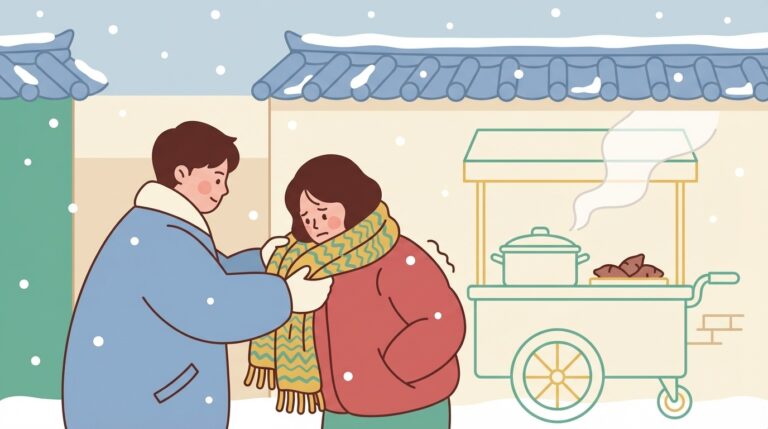
You know that classic K-Drama scene, right? The male lead looks at the heroine, who is shivering in a thin coat. He sighs with a mix of frustration and affection, dramatically wraps his giant woolen scarf around her neck, and softly scolds her. The subtitles just say, “Dress warmly.” But was it really just a fashion tip or a weather report?
Not at all! In Korea, telling someone to dress warmly is practically a love language. It’s an expression of 정 (Jeong – deep affection and connection). Whether it’s your Korean mom, a close colleague, or your favorite K-Pop idol on a live stream, you will hear this constantly as soon as the temperature drops below 15 degrees Celsius.
If you only know how to say “It’s cold” (추워요), you’re missing out on a huge cultural bonding moment. Today, based on real questions from my B1 students, we’re going to learn how to naturally advise someone to bundle up—and how to respond when someone “nags” you with love!
Phase 2: Core Expressions Deep Dive
Here are the top 3 expressions you need to know.
1. 옷 따뜻하게 입고 다녀요
- Pronunciation: [ot ttatteuthage ipgo danyeoyo]
(Tip: For ‘따’, don’t breathe out! Imagine the crisp, tight ‘t’ sound when you say ‘stop’ or the Italian word ‘pasta’.)- Meaning: Dress warmly (Literal: Wear clothes warmly and go around)
- K-Culture Moment: It’s late autumn. You’re leaving the office, and your Korean coworker notices you only have a light cardigan. They’ll say this as you part ways. It’s the ultimate “I care about your well-being” phrase.
- Editor’s Insight: We use the adverb form (따뜻하게 – warmly) instead of the adjective form (따뜻한 옷 – warm clothes). It sounds much more natural and active!
- Situation Spectrum:
[🚫 절대 금지] ———— [⚠️ 주의] ———— [✅ 자유롭게]
- Friends (Casual): ✅ (Drop the ‘요’: 옷 따뜻하게 입고 다녀!)
- Coworkers (Semi-formal): ✅ (Perfect as is)
- Strict Boss/Elders (Formal): ⚠️ (A bit too casual. See Expression 2)
- 🤔 Think About It: Why do Koreans add ‘다녀요’ (go around)? It implies they are thinking about your continuous safety as you navigate the cold world outside. Does your language have a similar nuance?
2. 감기 조심하세요
- Pronunciation: [gamgi josimhaseyo]
- Meaning: Be careful not to catch a cold.
- K-Culture Moment: This is the standard winter goodbye! From November to March, cashiers, taxi drivers, and even news anchors will end their conversations with this.
- Editor’s Insight: If you’re talking to your boss, CEO, or your partner’s grandparents, use this instead of telling them what to wear. It’s safe, respectful, and highly formal.
- Situation Spectrum:
[🚫 절대 금지] ———— [⚠️ 주의] ———— [✅ 자유롭게]
- Friends (Casual): ✅ (감기 조심해!)
- Coworkers (Semi-formal): ✅
- Strict Boss/Elders (Formal): ✅ (Perfect!)
3. 겉옷 챙겨요
- Pronunciation: [geodot chaeng-gyeoyo]
- Meaning: Make sure to bring an outerwear/jacket.
- K-Culture Moment: It’s the transitional season (환절기). The afternoon is hot, but the night is freezing. A friend texts you this before you meet up for dinner.
- Editor’s Insight: ‘챙기다’ is a magical Korean verb. It means to pack, prepare, or take care of something. Using ‘챙겨요’ makes you sound incredibly fluent!
- Situation Spectrum:
[🚫 절대 금지] ———— [⚠️ 주의] ———— [✅ 자유롭게]
- Friends (Casual): ✅ (겉옷 챙겨!)
- Coworkers (Semi-formal): ⚠️ (Only if you are close)
- Strict Boss/Elders (Formal): 🚫 (Too direct)
Phase 3: Textbook vs. Real Korean
| Situation | 📖 Textbook Korean | 🗣️ Real Korean | 💡 Why is it different? |
|---|---|---|---|
| Deep Winter | 날씨가 추우니 두꺼운 옷을 입으십시오. | 롱패딩 필수예요! (Long padding is a must!) | Koreans practically live in “Long Paddings” (long puffer jackets) during winter. Mentioning the item directly is very trendy. |
| Transitional Season | 기온 차이가 심합니다. | 아침저녁으로 추우니까 겉옷 꼭 챙겨요. | Real Korean focuses on practical advice for specific times of the day (morning/evening). |
| When someone looks cold | 춥지 않습니까? | 춥게 입고 나왔네요! 감기 걸려요. | Koreans express worry by pointing out the “cause” (dressing lightly) before warning about the “effect” (catching a cold). |
Bottom Note for B1 Learners: You don’t need heavy slang here. Just swapping “두꺼운 옷” (thick clothes) with “겉옷” (outerwear) or “따뜻하게” (warmly) will instantly upgrade your Korean!
Phase 4: K-Culture Deep Dive
4-1. Non-verbal Cue: The “Hot Pack” Pass
In Korea, words are good, but actions combined with words are better. If you really want to show you care, say “옷 따뜻하게 입고 다녀요” while handing them a 핫팩 (Hot Pack – disposable hand warmer). You will instantly win their heart.
4-2. The K-Drama & K-Pop Connection
The K-Drama Trope:
Have you noticed how Korean moms in dramas always hit their grown children on the back when they step outside without a thick coat? “멋 부리다 얼어 죽는다!” (You’ll freeze to death trying to look cool!) is a classic line. In Korean culture, health and warmth are prioritized over fashion, and “nagging” about it is a pure sign of affection.
The K-Pop Fandom Vibe:
Idols use these phrases constantly on Weverse or Bubble.
“우리 아미/엔시티즌, 오늘 날씨 엄청 추워요! 무조건 패딩 입고 나가요! 감기 걸리면 혼나요~”
(Our ARMY/NCTzen, it’s freezing today! You must wear a padding jacket! I’ll scold you if you catch a cold~).
Notice the cute threat at the end? Pretending to be “angry” that someone isn’t taking care of themselves is a very Korean way to show love.
Phase 5: Real-Life Roleplay Scenario
Setting: It’s late November. You just finished dinner at a BBQ place in Hongdae. As you step outside, a freezing gust of wind hits you. You are only wearing a light denim jacket.
Characters:
– YOU: A foreign student in Korea, trying to survive your first Korean winter.
– Minsoo (28): Your language exchange partner. Caring, a bit of a “mom” friend.
Dialogue:
Minsoo: 으악, 밖에 진짜 춥다! 🥶
(euak, bakke jinjja chupda!)
[Whoa, it’s really cold outside!]
(🎭 Stage Direction: Minsoo zips his long padding jacket all the way up to his chin.)
YOU: 맞아요, 갑자기 겨울이 됐네요.
(majayo, gapjagi gyeouri dwaenneyo.)
[You’re right, it suddenly became winter.]
Minsoo: (Looking at your outfit) 아니, 땡땡 씨! 겉옷이 그게 끝이에요?
(ani, ttaengttaeng ssi! geodosi geuge kkeuchieyo?)
[Wait, [Your Name]! Is that outerwear all you have?]
YOU: 네, 낮에는 안 추워서 이것만 입고 나왔어요.
(ne, najeneun an chuwoseo igeotman ipgo nawasseoyo.)
[Yeah, it wasn’t cold during the day, so I only wore this.]
Minsoo: 헐… 한국 겨울 무시하면 안 돼요. 내일부터는 옷 좀 따뜻하게 입고 다녀요!
(heol… hanguk gyeoul musihamyeon an dwaeyo. naeilbuteoneun ot jom ttatteuthage ipgo danyeoyo!)
[OMG… You shouldn’t underestimate the Korean winter. From tomorrow, please dress warmly!]
🔀 Your Turn! How should you respond to Minsoo’s nagging?
– A) “명령하지 마세요!” (Don’t order me around!)
– B) “네, 알겠습니다.” (Yes, understood.)
– C) “아, 생각보다 춥네요. 다음엔 롱패딩 입어야겠어요! 걱정해 줘서 고마워요.”✅ Best Choice: C — By agreeing with his assessment (it is cold!) and promising to wear a long padding next time, you validate his Jeong. You show that you appreciate his caring “nagging.”
⚠️ Choice A & B Analysis: A is aggressive and misunderstands his intent (he’s caring, not bossing you around). B sounds like a soldier talking to a commander—too stiff for a friend!
Bonus K-Culture Scenario: Buying a Hot Pack
(At the GS25 convenience store)
YOU: 사장님, 혹시 핫팩 어디 있어요?
(sajangnim, hoksi hatpaek eodi isseoyo?)
[Boss, where are the hot packs by any chance?]
Clerk: 저기 창가 쪽에 있어요. 오늘 날씨가 추워서 많이 팔렸네요. 감기 조심하세요~
(jeogi changga jjoge isseoyo… gamgi josimhaseyo~)
[They are over there by the window… Be careful of the cold~]
YOU: 감사합니다! 사장님도 따뜻하게 입고 일하세요!
(gamsahamnida! sajangnimdo ttatteuthage ipgo ilhaseyo!)
[Thank you! You dress warmly while working too!]
Phase 6: 10-Second Shadowing Drill
Speak out loud! Follow the pauses (/) and match the emotion!
🥺 (With a worried frown) 밖이 / 많이 추우니까 / 옷 / 따뜻하게 입고 다녀요!
(baki / mani chuunikka / ot / ttatteuthage ipgo danyeoyo!)
[It’s very cold outside, so please dress warmly!]
Phase 7: K-Culture Mini Dictionary
| Korean | Romanization | English | Cultural Context |
|---|---|---|---|
| 정 | jeong | Affection/Bond | The emotional bond and collective care deeply rooted in Korean society. |
| 환절기 | hwanjeolgi | Change of seasons | The period between seasons (like autumn to winter) when catching a cold is highly likely. |
| 롱패딩 | rong-paeding | Long puffer jacket | The unofficial winter uniform of South Korea. Everyone owns a black one! |
| 핫팩 | hatpaek | Hot pack | Disposable hand warmers sold at every convenience store. A cheap but meaningful winter gift. |
| 얼죽아 | eol-juk-a | Iced Americano even if I freeze to death | An acronym (얼어 죽어도 아이스 아메리카노). Koreans love iced coffee, even in the dead of winter! |
Phase 8: Traveler’s Survival Kit
Are you visiting Korea this winter? You’ll need more than just warm wishes to survive the freezing winds of Seoul!
🆘 Survival Phrases for Winter Shopping
– 🇰🇷 “가장 두꺼운 걸로 주세요.” (gajang dukkeoun geollo juseyo.)
– 🗣️ Meaning: Please give me the thickest one.
– 📍 Where to use: Buying coats, blankets, or heat-tech at UNIQLO or underground shopping malls.
– 💡 Pro Tip: If you forgot your scarf, head to underground subway malls (like Gangnam or Express Bus Terminal). They sell cheap, warm scarves and gloves everywhere!📌 Editor’s Travel Note
– Hot Drinks Cabinet: Every convenience store in Korea has a small, heated cabinet (온장고) near the register. It contains warm soy milk, canned coffee, and honey water. Grabbing one of these is a perfect way to thaw your freezing hands!
– Heating System: Korean floors are heated (온돌 – Ondol). If you stay in an Airbnb or traditional guesthouse, the floor will be boiling hot while the air might be slightly cool.
Phase 9: Critical Thinking — “One Step Deeper”
Language & Power vs. Affection (정)
🧠 Think Deeper:
In many Western cultures, telling another adult what to wear or how to manage their health might be seen as crossing a personal boundary or being overly maternal. However, in Korea, the boundaries between “self” and “others” are slightly more blurred due to the collective culture of 정 (Jeong). Pointing out that someone isn’t dressed warmly enough isn’t a critique of their life choices; it’s a verbal embrace. It means “You belong to my circle, and your health matters to me.”💬 Your Turn:
How do people in your culture show affection? Is “nagging” considered a sign of love, or is it considered rude? Share your thoughts in the comments!
Phase 10: FAQ & Avoiding Mistakes
Q: Can I say “옷 따뜻하게 입고 다녀요” to my boss?
A: NO. Even though it comes from a good place, telling a superior what to do (even gently) can sound a bit presumptuous. For anyone higher in rank or much older, strictly use: “감기 조심하세요” (Please be careful of catching a cold).
Q: Can I use this phrase in a fan letter to my favorite K-pop idol?
A: YES! Idols love this. You can write: “날씨 추운데 옷 따뜻하게 입고 다녀요!” (It’s cold, dress warmly!). It shows you are a caring fan.
❌ Common Mistake #1: Saying “따뜻한 옷을 입으세요”
✅ Do this instead: “옷 따뜻하게 입으세요”
Why? While grammatically fine, “wear warm clothes” sounds like you are ordering them to literally go find clothes that are warm. “Dress warmly” (using the adverb 따뜻하게) focuses on the action and is much more natural to native ears.
Phase 11: Summary & Action Items
One-Liner Summary: In Korea, telling someone to “dress warmly” (옷 따뜻하게 입고 다녀요) is the ultimate way to show your Jeong (affection) during the freezing winter.
Action Mission:
– 🥉 Bronze: Stand in front of a mirror, pretend you are a dramatic K-Drama lead, and say “옷 따뜻하게 입고 다녀요!” with deep concern 3 times.
– 🥈 Silver: Leave a comment on your favorite idol’s Instagram or Weverse using today’s phrase!
– 🥇 Gold: Next time you say goodbye to a Korean friend or a language exchange partner on a chilly day, use “겉옷 꼭 챙겨요!” or “감기 조심하세요!”
K-Culture Mission:
Watch one episode of any K-Drama set in winter. I guarantee you will spot at least one scene where someone hands over a hot pack or scolds someone for wearing a thin coat. When you see it, shout today’s phrase at the screen!
Phase 12: Quiz — Interactive Challenge
1. Situational Judgment: You are leaving the office on a snowy day. Your department manager (부장님) is also leaving. What is the BEST thing to say?
– A) 부장님, 롱패딩 입으세요!
– B) 부장님, 옷 따뜻하게 입고 다녀요!
– C) 부장님, 감기 조심하십시오!
2. True or False – K-Culture Edition:
In Korea, telling a friend “You’ll catch a cold dressed like that!” is considered extremely rude and insulting. (T / F)
3. Fill in the Blank:
갑자기 추워졌어요. 나갈 때 꼭 ( ____ ) 챙겨요!
(Hint: Outerwear / Jacket)
👉 Click here for Answers!
- C (For a strict boss, always stick to ‘감기 조심하십시오’ to show maximum respect without overstepping boundaries.)
- False (It’s actually a common way to show care and Jeong!)
- 겉옷 (geodot – outerwear)
Did you enjoy today’s lesson? Stay warm, everyone, and 감기 조심하세요! Let me know your score in the comments!
Frequently Asked Questions (FAQ)
Q: What does "옷 따뜻하게 입고 다녀요" mean in Korean and how do you pronounce it?
A: In Korean, "옷 따뜻하게 입고 다녀요" is pronounced [ot ttatteuthage ipgo danyeoyo] and means: Dress warmly (Literal: Wear clothes warmly and go around)
Q: What does "감기 조심하세요" mean in Korean and how do you pronounce it?
A: In Korean, "감기 조심하세요" is pronounced [gamgi josimhaseyo] and means: Be careful not to catch a cold.
Q: What does "겉옷 챙겨요" mean in Korean and how do you pronounce it?
A: In Korean, "겉옷 챙겨요" is pronounced [geodot chaeng-gyeoyo] and means: Make sure to bring an outerwear/jacket.







