

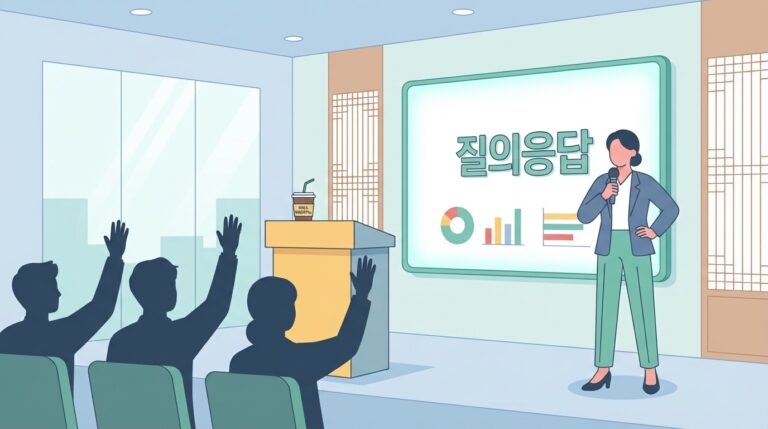
Phase 1: Welcome to the Hot Seat
Hello! I’m your Head Editor at Daily Hangul.
Picture this: You are the main character in a K-Drama like Start-Up or Misaeng. You’ve just finished a brilliant presentation. The slides were flawless, your Korean was smooth, and the room is quiet. Then, a sharp-eyed director adjusts his glasses and says, “I have a question.”
Suddenly, your mind goes blank. The subtitles at the bottom of the screen just say “Any questions?” but in real life, a Q&A session in Korea is a high-stakes dance of respect, quick thinking, and Nunchi (reading the room).
Handling a Q&A session at a C1 (Advanced) level isn’t just about having the right vocabulary; it’s about managing expectations, saving face (for both you and the questioner), and sounding incredibly competent. If you don’t know how to navigate this, you might come off as defensive or unprepared. But if you nail it? You’ll earn the ultimate insider respect.
This guide is built from the real sweat and tears of foreign professionals who survived Korean boardrooms and university defense panels. Let’s dive in!
Phase 2: Core Expressions Deep Dive
Here are the life-saving phrases you need when the spotlight is on you.
1. 핵심을 짚어 주신 좋은 질문입니다.
- Pronunciation: [haek-simeul jipeo jusin joeun jilmun-imnida]
- Sound-alike guide: ‘haek-shim’ sounds like ‘heck-seem’. ‘jipeo’ is like ‘jeep-uh’.
- Meaning: Literal: It is a good question that pointed out the core. / Real nuance: That’s a highly insightful question (and thank you for giving me a few seconds to think).
- K-Culture Moment: You’ll hear this at every major tech keynote in Seoul. When a senior executive asks a tough question, acknowledging their intelligence first is crucial for maintaining their Chemyeon (social face).
- Editor’s Insight: This is the ultimate “buy yourself time” phrase. It sounds much more professional than a simple “감사합니다.” It strokes the questioner’s ego while you scramble to form your answer.
- Situation Spectrum:
[🚫 절대 금지] ———— [⚠️ 주의] ———— [✅ 자유롭게]
- Casual Friends: 🚫 (Way too formal, they will laugh at you)
- Colleagues (Semi-formal): ⚠️ (A bit stiff, but okay for large meetings)
- Boss/Public Presentation (Formal): ✅
- 🤔 Think About It: Why is it so important to praise the question before answering in Korean corporate culture? How does this compare to how Q&A is handled in your home country?
2. 제가 아는 선에서 먼저 답변드리겠습니다.
- Pronunciation: [jega aneun seon-eseo meonjeo dapbyeon-deurigetseumnida]
- Sound-alike guide: ‘seon’ sounds like ‘sun’.
- Meaning: Literal: I will give an answer first within the line of what I know. / Real nuance: I’ll answer to the best of my current knowledge (disclaimer: I might not know everything).
- K-Culture Moment: In a fierce academic defense or a boardroom, claiming you know everything can backfire. This phrase shows humility—a highly valued trait in Korea—while still demonstrating competence.
- Editor’s Insight: Use this when a question is overly broad or slightly outside your exact data scope. It protects you from looking foolish if someone corrects you later.
- Situation Spectrum:
[🚫 절대 금지] ———— [⚠️ 주의] ———— [✅ 자유롭게]
- Casual Friends: 🚫
- Colleagues (Semi-formal): ✅
- Boss/Public Presentation (Formal): ✅
- 🤔 Think About It: “제가 아는 선에서” (within the line of what I know) visually draws a boundary. How does spatial language play a role in Korean humility?
3. 그 부분은 미처 생각하지 못했습니다만, 추후 확인하여 공유해 드리겠습니다.
- Pronunciation: [geu bubun-eun micheo saenggakhaji motaetseumnidaman, chuhu hwaginhayeo gongyuhae deurigetseumnida]
- Sound-alike guide: ‘micheo’ sounds like ‘mee-chuh’.
- Meaning: Literal: I did not reach the point of thinking about that part, but I will check later and share it with you. / Real nuance: I don’t know the answer right now, but I will find out and get back to you.
- K-Culture Moment: You are in a Friday afternoon meeting. The CFO asks for the exact Q3 projection for the Busan branch, which you didn’t prepare. Do not guess! Use this phrase. It shows you take their question seriously.
- Editor’s Insight: At a C1 level, never say “잘 모르겠습니다” (I don’t know) in a professional presentation. It sounds amateurish. “미처 생각하지 못했습니다” implies you are thorough, but this specific detail was a blind spot you are eager to fix.
- Situation Spectrum:
[🚫 절대 금지] ———— [⚠️ 주의] ———— [✅ 자유롭게]
- Casual Friends: 🚫
- Colleagues (Semi-formal): ✅
- Boss/Public Presentation (Formal): ✅
Phase 3: Textbook vs. Real Korean
| Situation | 📖 Textbook Korean | 🗣️ Real Business Korean | 💡 Why the difference? |
|---|---|---|---|
| Opening Q&A | 질문 있습니까? (Do you have questions?) | 더 궁금하신 점 있으시면 편하게 말씀해 주십시오. (If you have anything else you are curious about, please speak comfortably.) | “질문” can sound a bit like an interrogation. “궁금하신 점” (curiosities) softens the atmosphere. |
| Deferring | 나중에 이메일로 보낼게요. (I’ll send it by email later.) | 세부 데이터는 정리해서 따로 메일로 회신드리겠습니다. (I will organize the detailed data and reply via email separately.) | Professionalism. “정리해서” (organizing it) shows you are putting in effort, not just blowing them off. |
| Wrapping Up | 이제 끝내겠습니다. (I will end now.) | 시간 관계상 마지막 질문 하나만 더 받고 마무리하겠습니다. (Due to time constraints, I will take one last question and wrap up.) | Always blame “time” (시간 관계상), not your desire to finish the presentation! |
Phase 4: Cultural Context — K-Culture Deep Dive
4-1. The Non-Verbal Game of Q&A
In Korea, how you physically handle a question is just as important as your words.
– The Eye Contact Rule: When someone asks a question, look at them while they speak. But when you answer, don’t maintain aggressive eye contact with just that person. Sweep your gaze across the entire room. It diffuses tension and includes everyone.
– The Nunchi (눈치) Check: If the CEO asks a question, the whole room will go quiet. Your answer isn’t just for the CEO; it’s a performance for the entire hierarchy watching you.
4-2. The K-Drama Corporate Trope
If you’ve watched any office K-Drama, you know the “Gapjil” (갑질 – abuse of power) trope. Sometimes, an executive will ask a purposely difficult question just to test the presenter’s grace under pressure. Your goal isn’t necessarily to have the perfect factual answer, but to show an unflappable, respectful attitude. Acknowledging their “insight” before answering is your ultimate shield.
Phase 5: Real-Life Roleplay Scenario
Setting: 2:00 PM, a sleek conference room in Pangyo (Korea’s Silicon Valley). You’ve just pitched a new marketing strategy. Everyone has an iced americano in front of them.
Characters:
– YOU: A foreign project manager leading the pitch.
– Director Park: (45, sharp, slightly intimidating, likes to test people)
Dialogue:
YOU: 이상으로 발표를 마치겠습니다. 경청해 주셔서 감사합니다. (This concludes the presentation. Thank you for listening.)
Director Park: 발표 잘 들었어요. 그런데, 3분기 예산 타당성에 대한 질문이 하나 있습니다. (I enjoyed the presentation. But I have one question about the feasibility of the Q3 budget.)
YOU: 네, 본부장님. 편하게 말씀해 주십시오. (Yes, Director. Please go ahead.)
Director Park: 우리가 제시한 타겟층이 너무 좁은 것 아닌가요? 경쟁사 B의 최근 행보를 보면 좀 우려되는데요. (Isn’t the target audience we suggested too narrow? Looking at Competitor B’s recent moves, I’m a bit concerned.)
YOU: 아, 핵심을 짚어 주신 좋은 질문입니다. (Ah, that is a great question that hits the core.)
YOU: 저 역시 그 부분을 고민했습니다만, 초기 진입 단계에서는 선택과 집중이 필요하다고 판단했습니다. (I also worried about that part, but I judged that selection and focus are necessary in the initial entry stage.)
Director Park: 흠, 일리가 있네요. 그럼 경쟁사 B의 지난달 마케팅 비용 정확한 수치 아나요? (Hmm, makes sense. Then do you know the exact figure for Competitor B’s marketing cost last month?)
🔀 Your Turn! How should you respond?
– A) “잘 모르겠습니다. 제 담당이 아니라서요.” (I don’t know well. It’s not my responsibility.)
– B) “대략 5천만 원 정도 될 겁니다.” (It should be around 50 million won. – Guessing)
– C) “그 부분은 미처 정확한 수치를 확인하지 못했습니다. 회의 직후 확인하여 보고드리겠습니다.”✅ Best Choice: C — Never guess numbers in a Korean boardroom. Admitting you don’t have the exact figure on hand, but immediately offering an actionable follow-up (reporting right after the meeting) is the C1 professional standard.
⚠️ Choice A Analysis: Saying “It’s not my job” is a fatal mistake in Korean corporate culture, which highly values collective responsibility.
YOU: (Choosing C) 그 부분은 미처 정확한 수치를 확인하지 못했습니다. 회의 직후 확인하여 보고드리겠습니다. (I haven’t checked the exact figures for that part yet. I will check right after the meeting and report to you.)
Director Park: 알겠어요. 5시 전까지 메일로 보내주세요. 수고했어요. (Understood. Send it by email before 5 PM. Good job.)
YOU: 네, 알겠습니다. 시간 관계상 질의응답은 이것으로 마무리하겠습니다. (Yes, understood. Due to time constraints, we will wrap up the Q&A session here.)
🌟 Bonus Scenario: The Tourist Group Q&A
Even if you aren’t a businessperson, you might take a guided historical tour at Gyeongbokgung Palace. When the guide asks for questions:
Guide: 혹시 더 궁금하신 점 있으신가요? (Do you have any more curiosities?)
YOU: 설명 너무 잘 들었습니다. 혹시 제가 아는 선에서 하나 여쭤봐도 될까요? (I enjoyed the explanation very much. Could I ask one thing based on what I know?)
Guide: 네, 당연하죠! (Yes, of course!)
Phase 6: 10-Second Shadowing Drill
Master the rhythm. In professional Korean, speaking slightly slower with clear pauses conveys confidence.
😊 아, / 핵심을 짚어 주신 / 좋은 질문입니다.
(Ah, / haek-simeul jipeo jusin / joeun jilmun-imnida.)
Emotion: Confident, appreciative, slight nod.
😤 그 부분은 / 미처 생각하지 못했습니다만, / 추후 확인하여 / 공유해 드리겠습니다.
(Geu bubun-eun / micheo saenggakhaji motaetseumnidaman, / chuhu hwaginhayeo / gongyuhae deurigetseumnida.)
Emotion: Sincere, professional, resolute.
Phase 7: K-Culture Mini Dictionary
| 한국어 | Romanization | English | Context |
|---|---|---|---|
| 눈치 | nunchi | Social intuition | The ability to read the room. Crucial during Q&A to know when to stop talking. |
| 압박 면접 | apbak myeonjeop | Stress interview | A style of questioning in Korea where interviewers intentionally ask tough, rapid-fire questions to test your composure. |
| 회신 | hoesin | Reply (formal) | Used in business contexts instead of 대답 (answer) when referring to emails or official messages. |
| 체면 | chemyeon | Face / Reputation | Social dignity. Validating someone’s question saves their ‘chemyeon’ in front of colleagues. |
Phase 8: Traveler’s Survival Kit
As an advanced learner, you might attend seminars, exhibitions, or guided tours in Korea. Here is how to handle questions on the go!
🆘 Survival Phrases for the Curious Traveler
– 🇰🇷 “말씀 중에 죄송합니다만, 질문 하나 해도 될까요?” (Excuse me for interrupting, but may I ask a question?)
– 📍 Where to use: During a museum tour, a templestay orientation, or a cooking class.
– 💡 Pro Tip: In Korean culture, it is better to let the speaker finish their thought before raising your hand. If you must interrupt, always start with “말씀 중에 죄송합니다만…”📌 Editor’s Travel Note
– Seminars & Tech Conferences: If you visit events at COEX or KINTEX, Q&A sessions are usually done via a roving microphone. Always stand up when handed the mic, state your name/affiliation briefly, and ask your question.
– Body Language: When handing the microphone back to the staff, use two hands!
Phase 9: Critical Thinking Corner — “One Step Deeper”
🧠 Think Deeper: Language & Power in the Boardroom
Have you noticed that advanced Korean business phrases are incredibly long? “제가 아는 선에서 먼저 답변드리겠습니다.” In English, we might simply say, “Here’s what I know.”
In Korean linguistic culture, length often equals politeness. By adding buffers and conditional clauses, you are structurally lowering yourself and elevating the listener. It is a reflection of a hierarchical society where preserving the senior’s authority (even when you are the expert on stage) is paramount.💬 Your Turn: Does your native language have specific “corporate jargon” that exists purely to soften the blow or show respect? Share it in the comments!
Phase 10: FAQ & Mistake Prevention
- Q: “Can I just say ‘좋은 질문입니다’ (Good question) like in English?”
- A: Not to someone older or higher in rank! Telling a boss “Good question” can sound condescending, like a teacher praising a student. Always add a humbler preface like “핵심을 짚어 주신…” (You pointed out the core…).
- Q: “What if I can’t understand the question because they spoke too fast?”
- A: Never just say “What?” (네?). Instead use: “죄송하지만, 질문의 요지를 다시 한번 말씀해 주시겠습니까?” (I apologize, but could you please repeat the main point of the question?)
❌ Common Mistake #1: Pointing at the audience member who raised their hand with one index finger.
✅ Do This Instead: Gesturing to the person with an open palm, facing upward (like offering a tray).
Phase 11: Summary & Action Items
- One-Liner Summary: A successful Korean Q&A session is less about knowing everything and more about demonstrating respectful, professional composure.
-
Action Mission 3 Steps:
- 🥉 Bronze (Solo): Stand in front of a mirror, look at an imaginary CEO, and practice the 10-second shadowing drill smoothly.
- 🥈 Silver (Online): Go to a Korean YouTube video of a lecture or tech review (like a Samsung unboxing) and leave a comment starting with: “핵심을 짚어 주신 리뷰 감사합니다…”
- 🥇 Gold (Real World): If you are in a Korean class, study group, or workplace, use “미처 생각하지 못했습니다만…” the next time you don’t know an answer!
- K-Culture Mission: Watch an episode of a Korean office drama (like Misaeng, Start-Up, or Search: WWW). Find a presentation scene and observe the body language of the presenter during the Q&A. How do they hold their hands?
Phase 12: Quiz — Interactive Challenge
1. Situational Judgment: A senior director asks a question that is completely off-topic. You need to steer the presentation back politely. Which is the best C1-level response?
– A) 그건 오늘 주제와 상관없습니다. (That has nothing to do with today’s topic.)
– B) 말씀하신 부분도 중요하지만, 오늘은 먼저… (The part you mentioned is also important, but today, first…)
– C) 질문이 틀렸습니다. (The question is wrong.)
2. Fill in the Blank:
“시간 _____ 마지막 질문 하나만 더 받겠습니다.”
(Due to time constraints…)
– A) 때문상
– B) 관계상
– C) 이유상
3. True or False — K-Culture Edition:
In a Korean business Q&A, if you don’t know the answer, it is better to guess confidently than to admit you don’t know. (T/F)
4. Roleplay Consequence: In Phase 5, if you had chosen Option A (“It’s not my responsibility”), what would Director Park most likely think?
– A) “Ah, they have clear boundaries. How efficient!”
– B) “They lack ownership and teamwork. Unprofessional.”
– C) “I should ask someone else then.”
(Answers: 1: B – Never tell a boss they are off-topic directly. 2: B – 시간 관계상 is the set phrase. 3: False – Always admit it and offer to follow up via email. 4: B – Korean corporate culture heavily values collective responsibility.)
Frequently Asked Questions (FAQ)
Q: What does "핵심을 짚어 주신 좋은 질문입니다." mean in Korean and how do you pronounce it?
A: In Korean, "핵심을 짚어 주신 좋은 질문입니다." is pronounced [haek-simeul jipeo jusin joeun jilmun-imnida] and means: Literal: It is a good question that pointed out the core. / Real nuance: That's a highly insightful question (and thank you for giving me a few seconds to think).
Q: What does "제가 아는 선에서 먼저 답변드리겠습니다." mean in Korean and how do you pronounce it?
A: In Korean, "제가 아는 선에서 먼저 답변드리겠습니다." is pronounced [jega aneun seon-eseo meonjeo dapbyeon-deurigetseumnida] and means: Literal: I will give an answer first within the line of what I know. / Real nuance: I'll answer to the best of my current knowledge (disclaimer: I might not know everything).
Q: What does "그 부분은 미처 생각하지 못했습니다만, 추후 확인하여 공유해 드리겠습니다." mean in Korean and how do you pronounce it?
A: In Korean, "그 부분은 미처 생각하지 못했습니다만, 추후 확인하여 공유해 드리겠습니다." is pronounced [geu bubun-eun micheo saenggakhaji motaetseumnidaman, chuhu hwaginhayeo gongyuhae deurigetseumnida] and means: Literal: I did not reach the point of thinking about that part, but I will check later and share it with you. / Real nuance: I don't know the answer right now, but I will find out and get back to you.







