

Phase 1: The Ultimate K-Drama Moment
Hello! This is your Daily Hangul Editor.
Picture this: You are watching a K-Drama. The evil CEO (or the manipulative mother-in-law) has just done something completely outrageous—like handing the main character an envelope of cash to ‘disappear.’ Does the hero scream? Do they yell, “I am very angry!”?
No. They let out a short, breathy scoff—“Ha…”—look away for a second, look back, and deliver a single, chilling line. The subtitles might say, “This is ridiculous,” but the weight of that Korean phrase is so much heavier.
In Korean culture, when you cross the line of being just ‘mad’ and enter the territory of sheer, utter disbelief, words simply fail. If you only know how to say “화가 나요 (Hwaga nayo – I am angry),” you’re missing out on the most dramatic, native-sounding expressions in the Korean language. Today, we’re going to learn how to express that exact feeling: being so angry and dumbfounded that you are completely speechless.
Everything in this guide is based on real questions from our B1 (Intermediate) learners who wanted to sound less like a textbook and more like a native speaker. Let’s dive in!
Phase 2: Core Expressions – The Anatomy of Disbelief
Here are the top three expressions you need when a situation is just too ridiculous for normal words.
1. 어이가 없네 (Eoi-ga eomne)
- Pronunciation: [eo-i-ga eom-ne] — The ‘eo’ sounds like the ‘uh’ in ‘uh-oh’.
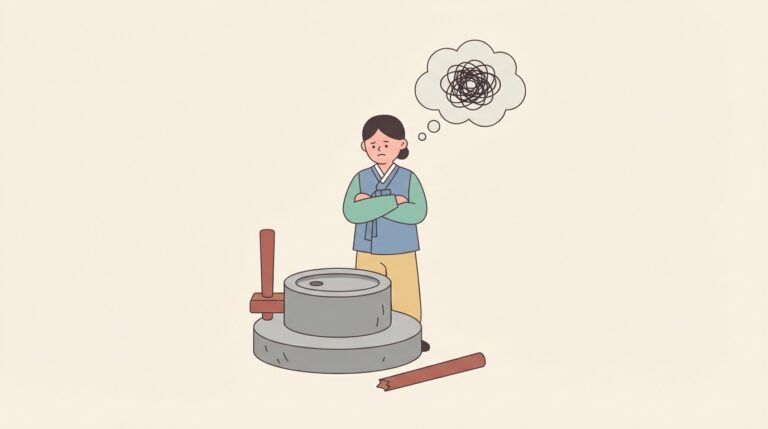
- Meaning: (Literal) The handle of the millstone is missing. / (Real Nuance) I’m dumbfounded / This is absolutely ridiculous.
- K-Culture Moment: This is arguably the most famous line from the hit Korean movie Veteran (2015). The villain utters this line when he feels completely insulted by an absurd situation. Now, all Koreans use it when someone acts shamelessly.
- Editor’s Insight: Use this when someone’s audacity leaves you speechless. It’s not just anger; it’s a mix of shock and being deeply offended by someone’s lack of common sense.
- Situation Spectrum:
[🚫 절대 금지] ———— [⚠️ 주의] ———— [✅ 자유롭게]
- Friends (Casual): ✅
- Co-workers (Semi-formal): ⚠️ (Only if you are muttering to yourself, NOT directed at them)
- Boss/Elders (Formal): 🚫 (Never say this to someone older/higher status)
- 🤔 Think About It: “Eoi (어이)” historically refers to the wooden handle of a heavy stone mill. Imagine trying to grind grains, but the handle is missing. You can’t do anything, right? How does your native language describe the feeling of helpless frustration?
2. 기가 막혀서 (Gi-ga makyeoseo)
- Pronunciation: [gi-ga ma-kyeo-seo] — ‘Gi’ is like ‘key’ but softer.
- Meaning: (Literal) My energy flow is blocked. / (Real Nuance) I am so appalled/shocked I can’t even breathe.
- K-Culture Moment: You’ll hear this in K-Dramas when a parent finds out their child did something foolish, or when a friend hears a terrible excuse. They usually put their hand on their chest or the back of their neck while saying it.
- Editor’s Insight: In traditional Asian medicine, “Gi (기)” is your life energy. When you are extremely shocked or angry, Koreans believe that energy flow is suddenly blocked. It perfectly captures the physical sensation of anger!
- Situation Spectrum:
[🚫 절대 금지] ———— [⚠️ 주의] ———— [✅ 자유롭게]
- Friends (Casual): ✅
- Co-workers (Semi-formal): ⚠️
- Boss/Elders (Formal): 🚫
- 🤔 Think About It: Why do you think the Korean language uses physical health metaphors (energy being blocked) to describe emotional states?
3. 말이 안 나오네 (Mar-i an naone)
- Pronunciation: [ma-ri an na-o-ne]
- Meaning: (Literal) Words are not coming out. / (Real Nuance) I am completely speechless.
- K-Culture Moment: Imagine sitting in a cafe during a university group project (팀플 – Team-ple), and the person who was supposed to bring the final presentation says, “Oh, I forgot my laptop.” This is the phrase that runs through everyone’s mind.
- Editor’s Insight: This is the most literal translation of “I’m speechless.” It’s slightly softer than the first two, making it a bit safer to use in general situations.
- Situation Spectrum:
[🚫 절대 금지] ———— [⚠️ 주의] ———— [✅ 자유롭게]
- Friends (Casual): ✅
- Co-workers (Semi-formal): ✅ (With polite ending: 말이 안 나오네요)
- Boss/Elders (Formal): ⚠️ (Better to stay silent!)
Phase 3: Textbook vs. Real Korean
| Situation | 📖 Textbook Korean | 🗣️ Real Korean | 💡 Why is it different? |
|---|---|---|---|
| Someone cuts in line blatantly | 저는 지금 매우 화가 납니다. (I am very angry right now.) | 아, 진짜 어이없네. (Ah, seriously ridiculous.) | Native speakers rarely declare “I am angry.” They state how absurd the situation is. |
| Hearing a ridiculous excuse | 너무 놀라서 할 말이 없습니다. (I am too surprised to speak.) | 하… 기가 막혀서 진짜. (Ha… completely appalled, really.) | The heavy sigh (하…) is mandatory. Emotion is conveyed through breath and tone! |
| Your friend did something stupid | 왜 그런 행동을 했어요? (Why did you do that?) | 너 진짜… 말이 안 나온다. (You really… I have no words.) | Leaving the sentence hanging shows that the anger is too big for words. |
Bottom Note: As a B1 learner, you don’t need to use harsh swear words to express anger. Mastering “어이가 없다” or “기가 막히다” will make you sound 100x more fluent and culturally aware than just yelling.
Phase 4: Cultural Context — K-Culture Deep Dive
4-1. Non-Verbal Cues: The “Heot-useum” (헛웃음)
When Koreans are too angry to speak, they do something that confuses many foreigners: They laugh.
But it’s not a happy laugh. It’s called 헛웃음 (Heot-useum – bitter/hollow laugh). It sounds like a short “Ha!” or “Heo…” When someone gives you a bitter smile and shakes their head while making this sound, run. They are absolutely furious. It is deeply connected to Nunchi (눈치)—suppressing explosive anger to maintain social harmony, so the anger leaks out as a sarcastic laugh.
4-2. The “Team-ple” (팀플) Trauma
In Korean universities, group projects are called 팀플 (Team-ple – Team Play). It is a universal trauma for Korean students and international exchange students alike. This is the exact environment where you will feel “too angry to speak.” When someone becomes a 프리라이더 (Free-rider)—ignoring messages and doing no work—you don’t scream at them. You look at your phone, let out a deep sigh, and mutter, “하… 진짜 기가 막혀서.”
Phase 5: Real-Life Roleplay Scenarios
Scenario A: The Disastrous Group Project
- Setting: Wednesday, 9 PM. A busy cafe near Sinchon Station. Your iced Americano is melting. You are working on a university group project.
- Characters:
- YOU: An exchange student who has been doing all the research.
- Min-su (22): Your Korean groupmate. Friendly, but famously lazy.
Min-su: 아… 미안해요. 제가 어제 술을 너무 많이 마셔서, 제 파트 조사를 하나도 못 했어요. 😅
(A… mianhaeyo. Jaega eoje sureul neomu mani masyeoseo, je pateu josareul hanado mot haesseoyo.)
[Ah… I’m sorry. I drank too much yesterday, so I couldn’t do any of my research part.]
(🎭 Stage Direction: Min-su scratches his head, looking completely unbothered.)
YOU: 네? 내일이 발표인데요?
(Ne? Naeiri balpyoinde-yo?)
[What? The presentation is tomorrow?]
Min-su: 그러니까요! 제가 이따가 밤새서 해볼게요. 아, 혹시 제 파트도 조금 도와줄 수 있어요?
(Geureonilkkayo! Jaega iddaga bamsaeseo haebolgeyo. Ah, hoksi je patedo jogeum dowajul su isseoyo?)
[I know! I’ll stay up all night later to try it. Oh, by any chance, could you help me with my part a little bit?]
🔀 Your Turn! How should you respond?
– A) “아… 네, 알겠습니다. 같이 해요.” (Ah… yes, okay. Let’s do it together.)
– B) “하… 진짜 어이가 없네요. 제가 왜 도와줘요?” (Ha… this is seriously ridiculous. Why would I help you?)
– C) “너 진짜 나쁜 놈이구나!” (You are really a bad guy!)✅ Best Choice: B — Reason: While A is too passive and C sounds like a villain from a children’s cartoon, B perfectly uses today’s expression with the polite ‘-네요’ ending to firmly but naturally express your absolute disbelief.
Scenario B: Bonus Survival Roleplay (The Line Cutter)
- Setting: Waiting in a long line for famous Hotteok (sweet pancakes) at Namdaemun Market.
- Situation: An older person blatantly pushes past you and orders first.
Person: 여기 호떡 세 개 줘!
(Yeogi hotteok se gae jwo!)
[Give me three Hotteoks here!]
YOU: (Muttering to yourself) 와… 진짜 기가 막히네. 새치기를 하시네.
(Wa… jinjja giga makhine. Saechigireul hasine.)
[Wow… unbelievable. You’re cutting the line.]
(In Korea, directly confronting elders who cut lines can lead to massive arguments. Usually, muttering your disbelief loudly enough for them to hear is the native passive-aggressive way to handle it!)
Phase 6: 10-Second Shadowing Drill
Practice speaking like a native! Pay attention to the pauses (/) and the emotion tags.
- 😤 (Disbelief) 하… / 진짜 / 어이가 없네.
(Ha… / jinjja / eo-i-ga eom-ne.) - 😠 (Frustrated) 와… / 기가 막혀서 / 말이 안 나온다.
(Wa… / gi-ga makyeoseo / ma-ri an na-on-da.) - 🥺 (Tired & Annoyed) 너무 화가 나서 / 할 말이 없어요.
(Neo-mu hwa-ga na-seo / hal ma-ri eop-seo-yo.)
Phase 7: K-Culture Mini Dictionary
| Korean | Romanization | English | Context |
|---|---|---|---|
| 눈치 | nunchi | Social intelligence / Reading the room | The art of sensing others’ moods. If someone makes you speechless, they have “눈치가 없다” (no nunchi). |
| 헛웃음 | heot-useum | Bitter/Hollow laugh | Laughing not because it’s funny, but because you are so angry and baffled. |
| 새치기 | saechigi | Cutting in line | A common situation in crowded places that will make you say “어이가 없네.” |
| 진상 | jinsang | An unreasonable/rude customer | Someone who causes a scene at a cafe or restaurant. Observing them will make you speechless. |
Phase 8: Traveler’s Survival Kit
When traveling in Korea, you might face situations that frustrate you—like a taxi driver taking the wrong route or someone bumping into you hard on the subway without apologizing.
🆘 Survival Expressions for Frustrating Moments
– 🇰🇷 “저기요, 줄 서 있는 건데요.” (Jeogiyo, jul seo inneun geondeyo.)
– 🗣️ English: Excuse me, we are standing in line.
– 📍 Where to use: Food stalls, subway lines, public restrooms.
– 💡 Pro Tip: Start with “저기요 (Excuse me)”. It grabs their attention politely but firmly.📌 Editor’s Travel Note
– Bumping Shoulders: In crowded places like Seoul subways, bumping shoulders is normal. People usually don’t say “Sorry” (죄송합니다). Don’t get too angry; it’s just the fast-paced city culture (빨리빨리 문화)!
– Taking Taxis: If you feel a taxi driver is purposefully taking a long route, load up Naver Map or Kakao T, turn the volume up slightly so the navigation voice is audible. The driver will instantly know you are tracking the route.
Phase 9: Critical Thinking — “One Step Deeper”
Language & Power: The Art of Suppressing Anger
🧠 Think Deeper:
Why does the Korean language have so many expressions for “being speechless” rather than direct insults? It all comes down to 체면 (Chemyon – Social Face) and strict social hierarchies. In Korea, directly yelling or losing your temper is often seen as a loss of control and face. If you are angry at someone older or higher in rank, you cannot curse at them. Therefore, Korean anger often turns inward—your energy gets blocked (기가 막히다), you lose your words (말이 안 나오다), and you laugh bitterly (헛웃음). It is a linguistic survival mechanism in a highly hierarchical society.💬 Your Turn: How do people in your culture show extreme anger? Do they explode directly, or do they use passive-aggressive phrases? Share in the comments!
Phase 10: FAQ & Avoiding Misunderstandings
Q: Can I use “어이가 없네” to my boss if they give me an unfair task?
NO. Absolutely not! 🚫 Even if you use the polite form (어이가 없네요), it sounds highly rebellious and offensive to a superior. With a boss, you must use indirect communication (e.g., “팀장님, 이 일정은 조금 무리일 것 같습니다” – Boss, this schedule might be a bit too much).
Q: I saw K-Pop idols saying “어이없어” to their fans playfully. Is that okay?
Yes, context matters! Fans and idols often have a mock-friendship dynamic. An idol might say “어이없어~” if a fan makes a cheesy joke. The tone is light and smiling, unlike real anger.
❌ Common Mistake #1: Translating “I have no words” literally to “저는 단어가 없습니다” (I don’t have vocabulary).
✅ Do This Instead: Say “말이 안 나오네요” (The words aren’t coming out).
Phase 11: Summary & Action Items
One-Liner Summary: When you are too angry to speak in Korea, don’t scream—just sigh and say, “기가 막히네 (Gi-ga makine).”
Take Action:
– 🥉 Bronze (Solo): Stand in front of a mirror, let out a deep sigh (하…), and say “진짜 어이가 없네” with a dramatic K-Drama stare.
– 🥈 Silver (Online): Leave a comment below using today’s expression to describe a frustrating moment in your life.
– 🥇 Gold (Real World): The next time you watch a Korean movie or drama, wait for the villain to do something awful and shout “기가 막혀서 진짜!” at your screen.
🎬 K-Culture Mission: Watch a clip of the movie Veteran on YouTube (search: 베테랑 어이가 없네). Listen closely to the actor Yoo Ah-in’s tone. Notice how quiet yet terrifying his anger is!
Phase 12: Quiz — Interactive Challenge
1. Situational Judgment: Your friend shows up 2 hours late to your dinner plan and says, “I forgot we were meeting!”
Which is the MOST natural native response?
– A) 저는 화가 납니다.
– B) 진짜 말이 안 나온다…
– C) 안녕히 계세요.
Click for Answer
Answer: B. A is too robotic. C means ‘goodbye’ formally. B perfectly captures your speechless frustration.
2. True or False – K-Culture Edition:
“If a Korean person gives a short laugh (Ha!) during an argument, it means they find your joke funny.”
Click for Answer
False. That is a 헛웃음 (bitter laugh). They are actually extremely frustrated and dumbfounded.
3. Fill in the Blank:
The literal meaning of “어이가 없다” is that the handle of a _______ is missing.
Click for Answer
Millstone. Imagine turning a heavy stone without a handle—pure frustration!
Great job today! Next time you’re speechless, you know exactly what to say. See you in the next lesson!
Frequently Asked Questions (FAQ)
Q: What does "어이가 없네 (Eoi-ga eomne)" mean in Korean and how do you pronounce it?
A: In Korean, "어이가 없네 (Eoi-ga eomne)" is pronounced [eo-i-ga eom-ne] and means: (Literal) The handle of the millstone is missing. / (Real Nuance) I'm dumbfounded / This is absolutely ridiculous.
Q: What does "기가 막혀서 (Gi-ga makyeoseo)" mean in Korean and how do you pronounce it?
A: In Korean, "기가 막혀서 (Gi-ga makyeoseo)" is pronounced [gi-ga ma-kyeo-seo] and means: (Literal) My energy flow is blocked. / (Real Nuance) I am so appalled/shocked I can't even breathe.
Q: What does "말이 안 나오네 (Mar-i an naone)" mean in Korean and how do you pronounce it?
A: In Korean, "말이 안 나오네 (Mar-i an naone)" is pronounced [ma-ri an na-o-ne] and means: (Literal) Words are not coming out. / (Real Nuance) I am completely speechless.







