

Phase 1: Empathy (The K-Culture Cold Open)
Hello! I’m your Daily Hangul Editor.
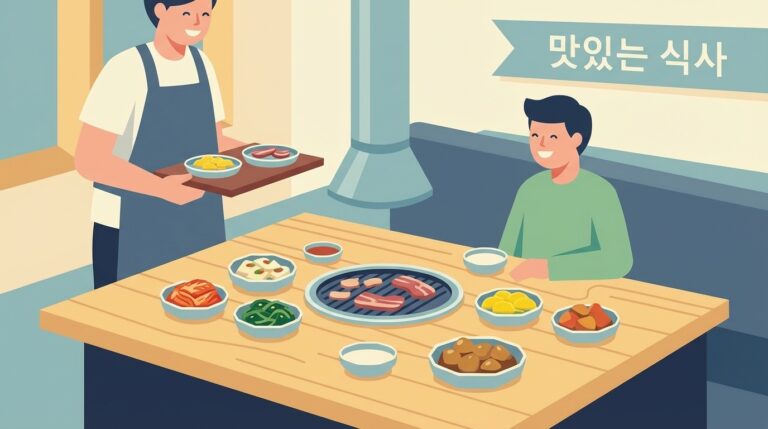
Imagine this: You’re sitting in a bustling, neon-lit K-BBQ restaurant in Seoul. The samgyeopsal (pork belly) is sizzling perfectly, and the table is covered in an overwhelming mosaic of tiny plates—spicy kimchi, sweet soy-braised potatoes, tangy pickled radishes, and seasoned bean sprouts. It’s a feast straight out of your favorite K-Drama.
But there’s a problem. The kimchi was so good that you’ve already eaten it all. You want more, but a wave of anxiety hits you. “If I ask for more, will they charge me extra? Do I have to pay per plate like in my home country? How do I even call the waiter without being rude?”
If you’ve ever nervously stared at an empty banchan plate while your Korean friends confidently yelled across the room for a refill, you are not alone! Understanding the magical world of “Infinite Banchan Refills” is your golden ticket to dining like a true local. Today, we are going to learn how to ask for more side dishes smoothly, confidently, and with the perfect touch of Korean nunchi.
(Note: This guide is crafted from the real-life panic moments of our B2-level students who were too shy to ask for more fish cakes!)
Phase 2: Core Expressions Deep Dive
Let’s break down the exact phrases you need.
1. 반찬 좀 더 주시겠어요?
- Pronunciation: Banchan jom deo jusigesseoyo? [Ban-chan johm duh joo-shee-guess-uh-yo?]
- Sound-alike guide: ‘eo’ sounds like the ‘uh’ in “uh-oh.”
- Meaning: Could you give me some more side dishes? (Polite and standard)
- K-Culture Moment: This is your safe, go-to phrase. Imagine you’re at a slightly upscale traditional Korean restaurant (Hanjeongsik) where the atmosphere is quiet and elegant. You make eye contact with the server and softly use this phrase.
- Editor’s Insight: The magic word here is 좀 (jom). It literally means “a little,” but Koreans use it to soften requests. Without it, “더 주시겠어요?” sounds a bit demanding. “좀” makes you sound like a polite, considerate guest.
- Situation Spectrum:
[🚫 Never] ———— [⚠️ Caution] ———— [✅ Freely]
- Close Friends (Casual): 🚫 (Too formal! Friends will think you’re weird)
- Restaurant Staff (Standard/Polite): ✅
- Upscale Dining (Formal): ✅
- 🤔 Think About It: Why do Koreans constantly use “좀” (a little) even when they actually want a lot of something? How does this reflect the Korean culture of not wanting to burden others?
2. 사장님/이모님, 여기 [반찬 이름] 리필이요!
- Pronunciation: Sajangnim/Imonim, yeogi [banchan name] ripiriyo! [Sah-jang-neem / Ee-mo-neem, yuh-ghee… ree-peel-ee-yo!]
- Meaning: Boss/Auntie, refill for [banchan name] here! (Real local nuance)
- K-Culture Moment: You are in a loud, crowded gukbap (soup with rice) restaurant. The TV is blaring a baseball game. You raise your hand confidently and project your voice. The server nods from across the room and brings you a mountain of radish kimchi.
- Editor’s Insight: “이모님” (Auntie) is a term of endearment for middle-aged female restaurant workers, showing a sense of community. However, never call a young waiter in their 20s “Imo-nim”! If you aren’t sure, “사장님” (Boss) or “저기요” (Excuse me) is always safer.
Situation Spectrum:
[🚫 Never] ———— [⚠️ Caution] ———— [✅ Freely]
- Trendy Cafe / Young Staff: 🚫
- Upscale Restaurant: 🚫
- Casual Local Mom-and-Pop Shop: ✅
- 🤔 Think About It: In many Western cultures, snapping or yelling for a waiter is considered rude. Why is calling out loudly totally acceptable, and even expected, in a Korean restaurant?
3. 이거 셀프인가요?
- Pronunciation: Igeo selpeuingayo? [Ee-guh self-eu-in-gah-yo?]
- Meaning: Is this self-serve?
- K-Culture Moment: You ask for more kimchi, and the waiter politely points to a corner of the restaurant and says, “반찬은 셀프입니다” (Banchan is self-serve). Due to rising labor costs, many modern Korean restaurants now have a “Self-Bar” (셀프바) where you can scoop your own banchan!
- Editor’s Insight: Before you yell for a refill, look around! If you see a salad-bar-like station with a sign that says “셀프” (Self), grab your empty plate and serve yourself.
- Situation Spectrum:
[🚫 Never] ———— [⚠️ Caution] ———— [✅ Freely]
- Any restaurant where you are unsure: ✅
Phase 3: Textbook vs. Real Korean
| Situation | 📖 Textbook Korean | 🗣️ Real Korean | 💡 Why the difference? |
|---|---|---|---|
| Calling the server | 저기요. (Excuse me.) | 사장님~! (Boss!) | Calling them “Boss” (even if they aren’t) is a form of respect and flattery. |
| Asking for more | 반찬을 더 주시겠습니까? (Would you give me more side dishes?) | 여기 김치 좀 더 주세요~ (Please give us some more kimchi here~) | Textbook is too robotic. Real Korean uses “여기” (here) to draw attention in a busy space. |
| Clarifying the rules | 반찬은 무료입니까? (Are side dishes free?) | 리필 되나요? (Can it be refilled?) | “Free” is assumed in Korea. The modern question is just whether they offer a refill or if it’s a “Self-bar.” |
Phase 4: Cultural Context — K-Culture Deep Dive
4-1. Non-verbal Nunchi (눈치)
When asking for a banchan refill, your body language matters. Don’t wave an empty plate in the air like a flag. Instead, make eye contact, raise your hand halfway, and politely point to the empty dish when the server arrives.
The Nunchi of Expensive Banchan: While things like kimchi and bean sprouts are endlessly free, expensive side dishes like Gyeran-mari (rolled omelet) or Yangnyeom Gejang (spicy marinated crab) might have a limit. If you ask for a third plate of crab, use your Nunchi. The owner might give it to you with a smile, or they might politely say, “게장은 추가 비용이 있어요” (There is an extra charge for the crab).
4-2. The “Insim” (Generosity) in K-Food
Have you noticed in K-Dramas how a grumpy-looking restaurant owner will suddenly pile a massive amount of food onto the protagonist’s plate, grumbling, “Eat up, you look too skinny”?
This perfectly captures Insim (인심)—the traditional Korean warmth and generosity, especially regarding food. The free banchan culture stems from Korea’s agrarian history, where sharing the harvest with neighbors was essential for survival. Today, a restaurant’s reputation is often judged by the generosity of its banchan. If a place charges for kimchi, it might go viral on Korean social media for all the wrong reasons!
Phase 5: Interactive Roleplay Scenario
Setting: Friday night, 7:00 PM. A lively, smoke-filled K-BBQ place near Gangnam Station. The sound of clinking soju glasses fills the air. You are out with your Korean colleagues.
Characters:
– YOU: A foreign professional working in Seoul. You love spicy food.
– Minsoo (32): Your Korean coworker. Friendly, loud, and the designated meat griller.
– The Owner: A busy but warm-hearted middle-aged woman.
Dialogue:
Minsoo: 야, 오늘 고기는 내가 쏜다! 많이 먹어! 🥩
(Ya, oneul gogineun naega ssonda! Mani meogeo!)
[Hey, the meat is on me today! Eat a lot!]
(🎭 Stage Direction: Minsoo starts grilling the pork belly with a pair of tongs)
YOU: 진짜요? 감사합니다! 잘 먹겠습니다.
(Jinjjayo? Gamsahamnida! Jal meokgetseumnida.)
[Really? Thank you! I will eat well.]
Minsoo: 고기 탈라, 빨리 먹어. 파절이랑 같이 먹으면 예술이야.
(Gogi talla, ppalli meogeo. Pajeorirang gachi meogeumyeon yesuriya.)
[The meat’s gonna burn, eat quick. It’s art if you eat it with the green onion salad.]
YOU: (Takes a bite) 와, 진짜 맛있어요! 근데 파절이를 다 먹었네요.
(Wa, jinjja masisseoyo! Geunde pajeorireul da meogeonneyo.)
[Wow, it’s really delicious! But we ate all the green onion salad.]
Minsoo: 아, 그럼 이모님한테 더 달라고 해.
(A, geureom imonimhante deo dallago hae.)
[Ah, then ask the Auntie to give us more.]
YOU: 이거 돈 더 내야 하는 거 아니에요?
(Igeo don deo naeya haneun geo anieyo?)
[Don’t we have to pay more for this?]
Minsoo: 에이~ 한국 식당이잖아! 반찬은 무한 리필이지.
(Ei~ Hanguk sikdang-ijana! Banchan-eun muhan ripiriji.)
[Hey~ It’s a Korean restaurant! Side dishes are infinitely refillable.]
YOU: 아하! 그럼 제가 한 번 해볼게요.
(Aha! Geureom jega han beon haebolgeyo.)
[Aha! Then I’ll give it a try.]
(🎭 Stage Direction: The Owner walks by holding a tray of drinks)
🔀 Your Turn! How do you ask for the refill?
- A) (Loudly) “야! 파절이 더 줘!” (Hey! Give more green onion salad!)
- B) (Politely raising hand) “사장님~ 여기 파절이 좀 더 주시겠어요?”
- C) (Whispering) “Excuse me… more salad please?”
✅ Best Choice: B — 사장님~ 여기 파절이 좀 더 주시겠어요?
Why? It perfectly balances the local way of getting attention (Sajangnim~) with the polite request for more (jom deo jusigesseoyo?).
⚠️ Choice A Analysis: This is 반말 (informal language) and incredibly rude to a stranger. Minsoo might faint from embarrassment!
⚠️ Choice C Analysis: Restaurants are loud. Whispering in English will likely result in the busy staff missing your request entirely.
The Owner: 네~ 파절이 많이 드릴게요!
(Ne~ Pajeori mani deurilgeyo!)
[Yes~ I’ll give you a lot of green onion salad!]
YOU: 와, 진짜 많이 주셨네요. 감사합니다!
(Wa, jinjja mani jusyeonneyo. Gamsahamnida!)
[Wow, you really gave us a lot. Thank you!]
Minsoo: 거봐, 내 말이 맞지? 자, 짠 하자!
(Geobwa, nae mari matji? Ja, jjan haja!)
[See, I was right? Now, let’s cheers!]
Phase 6: 10-Second Shadowing Drill
Let’s practice your flow and intonation so you sound like a local!
😊 사장님~ / 여기 / 김치 좀 / 더 주세요!
(Sajangnim~ / yeogi / kimchi jom / deo juseyo!)
Voice Acting Tips:
1. 사장님~ (Brightly, slightly prolonging the last syllable to get attention)
2. 여기 (Point to your table)
3. 김치 좀 (Slight pause, emphasize what you want)
4. 더 주세요! (End with a polite, friendly smile)
Phase 7: K-Culture Mini Dictionary
| Korean | Romanization | English | Context |
|---|---|---|---|
| 눈치 | nunchi | Social awareness / tact | The art of reading the room. Knowing when it’s okay to ask for a 4th plate of expensive banchan. |
| 인심 | insim | Generosity / big-heartedness | The warm, generous spirit of Korean merchants and restaurants giving extra food. |
| 셀프바 | selpeu-ba | Self-serve bar | A designated area in modern restaurants where you scoop your own refills to save staff time. |
| 서비스 | seobiseu | On the house / Freebie | When the owner gives you a free steamed egg or soda, they’ll say “이거 서비스예요” (This is service/on the house). |
Phase 8: Traveler’s Survival Kit
As a traveler in Korea, navigating the dining scene is an adventure. Here are your absolute survival phrases and tips for eating out!
🆘 Survival Phrases TOP 3
- 🇰🇷 “이거 얼마예요?” (Igeo eolmayeyo?)
- 🗣️ Meaning: How much is this?
- 📍 Where to use: Markets, street food stalls, cafes.
- 🇰🇷 “[메뉴] 하나 주세요.” ([Menu] hana juseyo.)
- 🗣️ Meaning: Please give me one [Menu item].
- 📍 Where to use: Ordering your main dish anywhere.
- 🇰🇷 “포장해 주세요.” (Pojanghae juseyo.)
- 🗣️ Meaning: Please pack this to-go / Takeout please.
- 📍 Where to use: When you want to take your main dish home.
📌 Editor’s Travel Note:
– The Kiosk Era: Many fast-casual Korean restaurants now use digital touch-screen kiosks. If you see a machine at the entrance, order there first! Usually, they have an English language toggle at the top right.
– Tipping: Do NOT tip in Korea! There is absolutely no tipping culture. If you leave money on the table, the staff might chase you down the street thinking you forgot your change!
Phase 9: Critical Thinking — “One Step Deeper”
Food & Identity: The Economy of “Insim” vs. Modern Reality
For decades, the infinite banchan culture was a proud symbol of Korean identity—a testament to Jeong (정, deep emotional connection) and Insim (generosity). Sharing a meal in Korea means literally sharing the side dishes from the same central plates, reinforcing a strong sense of community and equality. However, in the global era, this tradition is facing challenges. With soaring inflation and high labor costs, small business owners struggle to maintain free, unlimited refills. This has led to the rise of “Self-bars” and, in rare cases, restaurants charging for side dishes—which often sparks fierce cultural debates online about losing traditional Korean warmth.
💬 Your Turn: Does your home country have any dining traditions that are starting to disappear due to modern economic pressures? Share your thoughts in the comments!
Phase 10: FAQ & Avoiding Misunderstandings
Q: Can I take leftover banchan home in a doggy bag?
A: NO! While you can absolutely ask to pack your leftover main dish (like fried chicken or pizza), asking to pack leftover banchan is considered very strange and somewhat rude. Since it was given for free to be eaten with the meal, taking it home feels like taking advantage of the owner’s generosity.
Q: Can I ask for refills at a high-end Korean BBQ place?
A: Yes. Even at Michelin-starred Korean BBQ restaurants, banchan refills are standard. However, the server will usually notice your empty plate and refill it for you before you even have to ask! (That’s premium Nunchi!).
❌ Common Mistake: Snapping your fingers to call the waiter.
✅ Do This Instead: Press the call button on your table (the magical “Ding-dong” bell) or raise your hand and make eye contact.
Phase 11: Summary & Action Items
One-Liner Summary: In Korea, side dishes are wonderfully infinite, but remember to use polite phrases and read the room (Nunchi) to know if it’s a “Self-bar”!
Action Mission 3 Steps:
– 🥉 Bronze (Solo): Stand in front of a mirror and practice saying “사장님~ 여기 김치 좀 더 주세요!” three times with a confident smile.
– 🥈 Silver (Online): Comment below with your favorite Korean side dish using the format: “저는 [banchan] 리필을 좋아해요!”
– 🥇 Gold (Real World): Visit a local Korean restaurant (or your local K-Town) and successfully ask for a banchan refill in Korean!
🎬 K-Culture Mission: Next time you watch a K-Drama featuring a restaurant scene, look closely at the table. Try to identify at least three different banchan, and watch how the characters interact with the restaurant staff!
Phase 12: Quiz — Interactive Challenge
Test your new K-Dining survival skills!
1. Situational Judgment: You are at a trendy new Korean pasta place in Hongdae. The waiter looks like a 20-year-old college student. You need more pickles. What should you call him?
– A) 이모님! (Imo-nim!)
– B) 저기요~ (Jeogiyo~)
– C) 아저씨! (Ajeossi!)
2. Fill in the Blank: “Excuse me, is this side dish area ____________ ?”
– “저기요, 여기 반찬 ________ 인가요?”
3. True or False – K-Culture Edition: “If the service was amazing and the banchan was delicious, you should leave a 15% tip on the table.”
4. Roleplay Outcome: You eat all the expensive marinated crab (Gejang) and yell, “Boss, give me 3 more plates of this!” What is the most likely outcome?
– A) The boss gives you 3 plates for free.
– B) The boss politely tells you that Gejang has an “추가 비용” (additional charge).
– C) The boss kicks you out.
(Answers: 1: B – Never call a young person Imo/Ajeossi. 2: 셀프 (Self). 3: False! No tipping in Korea. 4: B – Expensive items usually have a limit!)
Frequently Asked Questions (FAQ)
Q: What does "반찬 좀 더 주시겠어요?" mean in Korean and how do you pronounce it?
A: In Korean, "반찬 좀 더 주시겠어요?" is pronounced [Banchan jom deo jusigesseoyo? [Ban-chan johm duh joo-shee-guess-uh-yo?] and means: a key conversational Korean expression covered in this lesson.
Q: What does "사장님/이모님, 여기 [반찬 이름] 리필이요!" mean in Korean and how do you pronounce it?
A: In Korean, "사장님/이모님, 여기 [반찬 이름] 리필이요!" is pronounced [Sajangnim/Imonim, yeogi [banchan name] and means: Boss/Auntie, refill for [banchan name] here! (Real local nuance)
Q: What does "이거 셀프인가요?" mean in Korean and how do you pronounce it?
A: In Korean, "이거 셀프인가요?" is pronounced [Igeo selpeuingayo? [Ee-guh self-eu-in-gah-yo?] and means: Is this self-serve?







