

Phase 1: Empathy (The Cold Open)
Hello! I’m your Lead Editor from Daily Hangul.
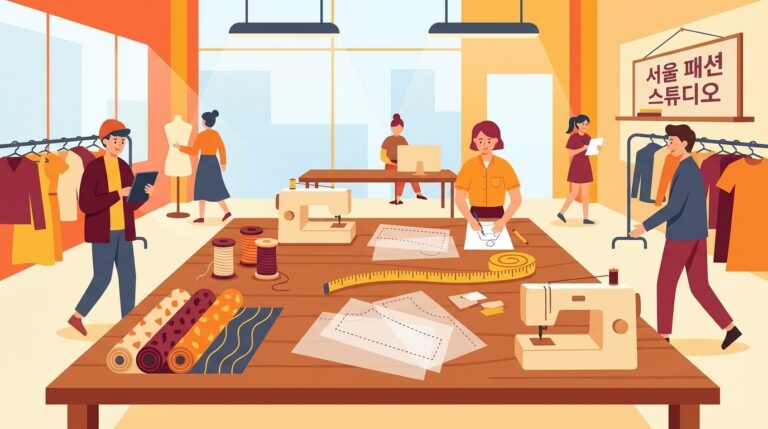
Imagine this: You are in the heart of Dongdaemun (동대문) or a trendy fashion studio in Seongsu-dong (성수동). The air smells faintly of hot steam irons and raw cotton. You’ve designed a beautiful collection, and you’re finally meeting the veteran pattern maker. You hand over your sketches, feeling confident.
But then, she glances at your design, sighs, and fires off a rapid sentence: “이거 시접을 얼마나 줄까요? 가봉은 언제 볼 거예요? 여기 암홀 쪽 핏이 우는데, 다트로 잡아야겠네.”
Wait, what? You know the Korean words for “skirt” (치마) and “shirt” (셔츠), but “crying fit”? “Seam what”? Suddenly, your C1 Korean feels like A1.
If you’re studying fashion in Korea, sourcing from Dongdaemun, or working with Korean apparel manufacturers, textbook Korean won’t save you. The Korean fashion industry operates on its own unique frequency—a mix of lightning-fast Pali-pali (빨리빨리) culture, Japanese-influenced tailoring slang, and hyper-specific technical terms.
Don’t worry. I’ve been there, translating for flustered foreign designers in cramped sample rooms. Today, we are going to learn the insider language of Korean pattern making and sewing. By the end of this guide, you won’t just speak Korean; you’ll speak K-Fashion.
Phase 2: Deep Dive into Core Expressions
Let’s break down the three most crucial expressions you need inside a Korean pattern room (패턴실).
1. 핏이 우는데요 (The fabric is puckering/gaping)
- Pronunciation: [pisi uneundeyo]
- Sound-alike guide for English speakers: pee-she oo-neun-deh-yo (‘oo’ like in ‘moon’)
- Meaning: Literal: The fit is crying. / Real nuance: The fabric is puckering, wrinkling, or not laying flat.
- K-Culture Moment: In K-Dramas featuring fashion designers (like Record of Youth or The Fabulous), you’ll often see a perfectionist designer pinning a garment on a model, frowning, and saying, “여기가 울잖아!” (It’s puckering here!). In Korean, when fabric doesn’t sit smoothly, we say it “cries” (울다).
- Editor’s Insight: This is a fantastic C1-level idiom. It sounds incredibly professional. Instead of saying “이거 안 예뻐요” (This isn’t pretty), saying “원단이 우네요” (The fabric is crying/puckering) immediately signals that you have a trained eye.
- Situation Spectrum:
[🚫 Never] ———— [⚠️ Caution] ———— [✅ Freely]
- Close friends/peers: ✅ (핏이 울어 – pisi uleo)
- Professional Pattern Maker: ✅ (핏이 웁니다 – pisi umnida)
- Criticizing a senior designer’s work directly: ⚠️ (Use softening words: 핏이 살짝 우는 것 같아요 – I think the fit is puckering a little.)
- 🤔 Think About It: Why do Koreans use the verb “to cry” (울다) for inanimate objects like fabric or wallpaper when it wrinkles? How does attributing human emotion to materials reflect the Korean linguistic mindset?
2. 시접 1cm만 남겨주세요 (Please leave a 1cm seam allowance)
- Pronunciation: [sijeop il-senti-man namgyeo-juseyo]
- Sound-alike guide for English speakers: she-jeop eel-sen-tee-mahn nahm-gyuh-joo-seh-yo
- Meaning: Literal & Real: Please leave just 1cm of seam allowance.
- K-Culture Moment: If you drop off a design at a mising-sil (sewing room) in Sindang-dong, this is the first thing they will ask you. “시접 얼마 줄까?” (How much seam allowance should I give?)
- Editor’s Insight: “시접” (sijeop) is a non-negotiable vocabulary word for pattern making. If you don’t specify this, the sample maker will assume a standard amount, which might ruin your intended fit.
- Situation Spectrum:
[🚫 Never] ———— [⚠️ Caution] ———— [✅ Freely]
- Giving instructions to a sample maker: ✅
- 🤔 Think About It: Notice the use of “~만” (only/just). Koreans often use “만” or “좀” to soften a request, making it sound less like a strict command and more like a polite favor.
3. 가봉 보러 갈게요 (I’ll come to check the basting/fitting)
- Pronunciation: [gabong boreo galgeyo]
- Sound-alike guide for English speakers: gah-bong bo-ruh gahl-ggeh-yo
- Meaning: Literal: I will go to see the temporary sewing. / Real nuance: I’ll come in for a fitting/to check the prototype.
- K-Culture Moment: Think of those luxurious bespoke suit shops in K-Dramas like Vincenzo. The tailor pins the suit before the final stitch—that process is “가봉” (basting/fitting).
- Editor’s Insight: “가봉” is a hybrid term heavily used in the Korean tailoring and wedding dress industry. “가봉 스냅” (Gabong snap) is even a popular K-Wedding trend where couples take photos while getting their dresses fitted!
- Situation Spectrum:
[🚫 Never] ———— [⚠️ Caution] ———— [✅ Freely]
- Setting an appointment with a tailor/pattern maker: ✅
Phase 3: Textbook vs. Real Korean
Let’s compare what you learned in the classroom with what you’ll actually hear over the hum of sewing machines in Dongdaemun.
| Situation | 📖 Textbook Korean | 🗣️ Real Industry Korean | 💡 Why the difference? |
|---|---|---|---|
| Measuring dimensions | 치수를 재다 (chisureul jaeda) | 사이즈 스펙을 따다 (saijeu seupegeul ttada) | “따다” (to pick/extract) implies extracting data quickly for tech packs. |
| Asking to re-sew | 바느질을 다시 해 주세요 (baneujireul dasi hae juseyo) | 뜯고 다시 박아주세요 (tteutgo dasi bagajuseyo) | “뜯다” (rip) and “박다” (punch/sew with machine) are visceral, fast-paced factory terms. |
| Cutting fabric | 천을 자르다 (cheoneul jareuda) | 재단 치다 (jaedan chida) | “치다” (to hit/strike) is added to nouns to imply fast, dynamic action in Korean labor culture. |
| Sewing machine | 재봉틀 (jaebongteul) | 미싱 (mising) | “미싱” comes from the Japanese mispronunciation of the English word “machine.” |
Bottom Note: As a C1 learner, using “미싱” instead of “재봉틀” or “재단하다” instead of “천을 자르다” instantly elevates your status from “student” to “industry insider.”
Phase 4: Cultural Context — K-Culture Deep Dive
4-1. Non-Verbal Elements: The Nunchi in the Pattern Room
In a Korean pattern room, Nunchi (눈치) is everything. You are technically the client paying for a sample, but the veteran sewers (who are usually in their 50s-70s) are highly respected artisans.
* Body Language: When handing over your sketches or fabric, always use two hands.
* Eye Contact: If they tell you your design is physically impossible to sew, do not argue aggressively. Look at the fabric, nod thoughtfully, and say, “아, 그렇군요. 그럼 어떻게 수정하는 게 좋을까요?” (Ah, I see. Then how would be best to modify it?). Ask for their wisdom.
4-2. K-Culture Connection: The Dongdaemun Ecosystem & The “선생님” Title
If you watch documentaries about Korean fashion or K-Dramas like Fashion King, you’ll notice a massive paradox. The young, trendy designers always bow deeply to the older men and women hunched over sewing machines, calling them “선생님” (Teacher) or “이모님” (Auntie).
Why? In Western business culture, a manufacturer is a contractor. In Korea, age and craftsmanship command supreme respect. Even if you are the CEO of a brand, the person making your patterns is “Teacher.” Building a good relationship with your Seonsaengnim means your samples get made overnight. Piss them off, and suddenly your fabrics are “delayed.”
Phase 5: Real-life Roleplay Scenario
Setting: A cramped, bustling pattern studio in Sindang-dong, just behind Dongdaemun. Rolls of fabric are piled to the ceiling. The rhythmic clack-clack-clack of sewing machines fills the air.
Characters:
– YOU: A foreign fashion designer preparing for your graduation show.
– Park Seonsaengnim (박 선생님 – 60s): A veteran pattern maker with 40 years of experience. Grumpy but highly skilled.
Dialogue:
박 선생님: 학생, 이거 도식화 가져온 거 봤는데, 이 원단으로 이 다트(dart)가 나올 것 같아? 😤
(haksaeng, igeo dosikhwa gajyeon-geon bwanneunde, i wondaneuro i dateuga naol geot gata?)
[Student, I looked at the technical drawing you brought, but do you think this dart will work with this fabric?]
(🎭 Stage Direction: Park Seonsaengnim aggressively taps your sketch with his red pen.)
YOU: 아, 원단이 너무 두꺼워서 그럴까요?
(a, wondani neomu dulkkeowoseo geureolkkayo?)
[Ah, is it because the fabric is too thick?]
박 선생님: 당연하지. 이거 미싱으로 박으면 핏이 다 울어. 가봉 볼 때 엉망 될 텐데.
(dangyeonhaji. igeo mising-euro bageumyeon pisi da uleo. gabong bol ttae eongmang doel tende.)
[Of course. If we run this through the machine, the fit will pucker everywhere. It’ll be a mess when we do the fitting.]
YOU: 앗… 그럼 시접을 좀 더 여유 있게 주면 어떨까요?
(at… geureom sijeobeul jom deo yeoyu itge jumyeon eotteolkkayo?)
[Oh… then what if we give a bit more ease to the seam allowance?]
박 선생님: 시접 문제가 아니지. 디자인을 살짝 수정하든가, 부자재를 바꾸든가 해야지. 어떻게 할래?
(sijeop munjega aniji. dijaineul saljjak sujeonghadeunga, bujajaereul bakkudeunga haeyaji. eotteoke hallae?)
[It’s not a seam allowance issue. You either need to tweak the design slightly or change the subsidiary materials. What do you want to do?]
🔀 Your Turn! How do you respond?
– A) “제 디자인대로 그냥 해주세요!” (Just do it exactly as my design!)
– B) “어… 제가 다시 생각해보고 올게요.” (Uh… I’ll go think about it and come back.)
– C) “선생님 보시기엔 어떻게 수정하는 게 제일 예쁠까요? 추천 부탁드려요!”✅ Best Choice: C — “How do you think it would look best if we modify it? I’d love your recommendation!”
Why? You stroke their ego and ask for their expertise. Park Seonsaengnim will likely sigh, grab the pen, and fix the pattern perfectly for you.
⚠️ Choice A Analysis: This is a disaster. Refusing a veteran’s practical advice will ruin your relationship (and your garment).
박 선생님: (허허 웃으며) 에휴, 그래. 내가 암홀 라인 좀 파서 다시 패턴 따줄게. 내일 가봉 보러 와!
(ehyu, geurae. naega amhol rain jom paseo dasi paeteon ttajulge. naeil gabong boreo wa!)
[(Chuckles) Sigh, fine. I’ll drop the armhole line a bit and re-draft the pattern. Come in for the fitting tomorrow!]
YOU: 우와, 감사합니다 선생님! 내일 뵙겠습니다!
(uwa, gamsahamnida seonsaengnim! naeil boepgetseumnida!)
[Wow, thank you Teacher! See you tomorrow!]
Phase 6: 10-Second Shadowing Drill
Let’s practice asking for a modification like a pro. Read aloud, following the intonation and pauses!
🥺 선생님, / 여기가 / 살~짝 우는데 / 다트로 / 잡아주실 수 있나요?
(seonsaengnim, / yeogiga / sal~jjak uneunde / dateuro / jabajusil su innayo?)
[Teacher, it’s puckering sl~ightly here, could you take it in with a dart?]
- Intonation Tip: Elongate the “살~짝” (sal~jjak – slightly) to sound cautious and polite. Raise your pitch at the end of the question.
Phase 7: K-Culture Mini Dictionary (Fashion Edition)
| 한국어 | Romanization | English | Context/Meaning |
|---|---|---|---|
| 도식화 | dosikhwa | Technical Drawing / Flat | The detailed blueprint of your design used by pattern makers. |
| 스와치 | seuwachi | Fabric Swatch | Small pieces of fabric you cut from Dongdaemun market to plan your designs. |
| 부자재 | bujajae | Subsidiary Materials | Zippers, buttons, threads, linings. Sold in a completely different building in Dongdaemun. |
| 객장 / 미싱사 | gaekjang / misingsa | Sample Maker / Sewer | The professionals who sew your garments. |
| 탕 차이 | tang chai | Dye-lot Difference | When the same color fabric looks slightly different because it was dyed in a different batch (탕/tang means vat/bath). |
Phase 8: Traveler/Sourcing Survival Kit
Navigating the Dongdaemun Fabric Market (동대문 종합시장) is a rite of passage for any fashion lover visiting Seoul. It is a labyrinth of thousands of tiny booths.
🆘 Survival Phrases for Dongdaemun
– 🇰🇷 “이거 스와치 좀 끊어주세요.” (igeo seuwachi jom kkeuneojuseyo.)
– 🗣️ Meaning: Please cut a swatch of this for me.
– 📍 Where to use: At any fabric stall when you want a sample.
- 🇰🇷 “소매도 하시나요?” (somaedo hasinayo?)
- 🗣️ Meaning: Do you also sell retail (in small yards)?
- 📍 Where to use: Many booths are wholesale (도매) only. You MUST ask this if you only want to buy 1 or 2 yards (야드).
🇰🇷 “이거 한 마에 얼마예요?” (igeo han ma-e eolmayeyo?)
- 🗣️ Meaning: How much is this for one yard (ma)?
- 💡 Note: In the Korean fabric market, they use the word “마” (ma) or “야드” (yard) for measurement, which is about 90cm.
📌 Editor’s Sourcing Note
– Payment: The fabric market is heavily cash-based or account transfer (계좌이체). Have your KakaoPay or a Korean bank app ready, or carry lots of 10,000 won bills.
– Timing: Swatches are usually gathered in the morning. Buying rolls of fabric often happens in the afternoon or via delivery (사입삼촌).
Phase 9: Critical Thinking — “One Step Deeper”
🧠 Think Deeper: Language & Power in the Studio
In Korean society, language reflects hierarchy, but that hierarchy isn’t always about who holds the money. As a fashion designer, you are technically the employer hiring a pattern maker. However, you must use high-level honorifics (높임말) and call them “선생님” (Teacher). This reveals a profound cultural value: Age and Mastery trump economic transactions. The Korean language forces you to verbally bow to experience. If a 20-something designer spoke down to a 60-something sewer just because they were paying them, the social contract would break instantly.
💬 Your Turn: In your culture, how do you address tradespeople, tailors, or contractors who are significantly older than you? Does the person paying the money automatically get the “upper hand” in language? Let me know in the comments!
Phase 10: FAQ & Common Mistakes
Q: If I’m paying them, can I rush a pattern maker and tell them to do it faster?
Yes and no. You can ask for a tight deadline, but how you ask matters. Don’t say “내일까지 꼭 해주세요” (You must do it by tomorrow). Instead say, “선생님, 제가 일정이 너무 급한데… 혹시 내일까지 가능할까요?” (Teacher, my schedule is so urgent… by any chance is tomorrow possible?).
Q: I saw “야드” (yard) and “마” (ma) in the market. Are they the same?
Yes! Both equal roughly 90cm (36 inches). However, “마” is the traditional Korean/Japanese market term, while “야드” is English. Older vendors prefer “마”.
❌ Common Mistake:
Pointing at a sewing mistake and saying “이거 틀렸어요” (This is wrong).
✅ Do this instead:
“틀리다” sounds like you are scolding a child for failing a test. Use “선생님, 여기가 조금 우는 것 같아요” (Teacher, I think it’s puckering a bit here) or “수정이 가능할까요?” (Is a modification possible?). Keep it objective.
Phase 11: Summary & Action Items
- One-Liner Summary: To survive the Korean fashion industry, master the technical slang (가봉, 시접) and wrap it in deep respect (선생님).
Action Mission:
– 🥉 Bronze (Solo): Look at your shirt right now. Touch the seams and say aloud, “시접 1cm” (sijeop il-senti).
– 🥈 Silver (Online): Find a behind-the-scenes video of a Korean fashion brand on YouTube. Listen closely—can you hear them say “핏이 울다” or “가봉”?
– 🥇 Gold (Real World): Next time you visit Dongdaemun Fabric Market, ask a vendor: “혹시 소매도 하시나요?” (Do you also do retail?) instead of using a translation app!
Phase 12: Interactive Quiz
1. Fill in the blank:
You are checking your garment, and the fabric near the zipper is totally wrinkled and not laying flat.
“선생님, 여기 지퍼 쪽 핏이 너무 ( _______ ).”
– A) 웃어요 (laughs)
– B) 우는데요 (cries/puckers)
– C) 자요 (sleeps)
2. True or False – K-Culture Edition:
If you are the CEO of a brand, it is perfectly fine to speak in plain/casual language (반말) to an older sample maker because you are the one paying them. (T / F)
3. Situational Judgment:
You want to get a small piece of fabric from a Dongdaemun vendor to take home and match with your designs. What should you say?
– A) 이거 하나 주세요. (Give me one of this.)
– B) 스와치 좀 끊어주세요. (Please cut a swatch for me.)
– C) 가봉 보러 갈게요. (I’ll come for a fitting.)
Answers (Click to reveal)
1. B) 우는데요 – The fabric is ‘crying’ (puckering).
2. False – Age and craftsmanship demand respect in Korea. You must use honorifics (존댓말) and respectful titles like 선생님.
3. B) 스와치 좀 끊어주세요 – This is the exact phrase used to ask for fabric samples in the market.
Frequently Asked Questions (FAQ)
Q: What does "핏이 우는데요 (The fabric is puckering/gaping)" mean in Korean and how do you pronounce it?
A: In Korean, "핏이 우는데요 (The fabric is puckering/gaping)" is pronounced [pisi uneundeyo] and means: Literal: The fit is crying. / Real nuance: The fabric is puckering, wrinkling, or not laying flat.
Q: What does "시접 1cm만 남겨주세요 (Please leave a 1cm seam allowance)" mean in Korean and how do you pronounce it?
A: In Korean, "시접 1cm만 남겨주세요 (Please leave a 1cm seam allowance)" is pronounced [sijeop il-senti-man namgyeo-juseyo] and means: Literal & Real: Please leave just 1cm of seam allowance.
Q: What does "가봉 보러 갈게요 (I'll come to check the basting/fitting)" mean in Korean and how do you pronounce it?
A: In Korean, "가봉 보러 갈게요 (I'll come to check the basting/fitting)" is pronounced [gabong boreo galgeyo] and means: Literal: I will go to see the temporary sewing. / Real nuance: I'll come in for a fitting/to check the prototype.






