

Hello! I’m the Lead Editor of Daily Hangul.
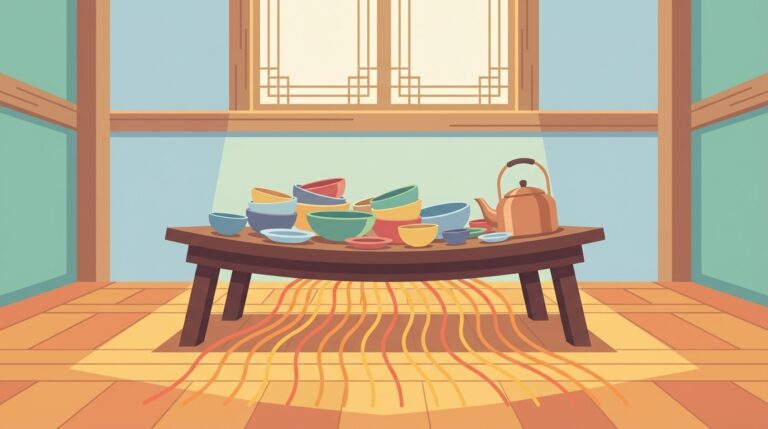
Imagine this: You’ve just arrived in Jeonju, the cultural heart of Korea. You slide open the beautiful wooden lattice doors of your traditional Hanok guesthouse. It feels exactly like stepping onto the set of a historical K-Drama. But when you lie down to sleep, the floor feels like it’s literally on fire. The next evening, you sit at a Makgeolli alley, and the owner brings out so many side dishes that the table physically bows under the weight.
Sure, you could say “The room is warm” (방이 따뜻해요) or “There is a lot of food” (음식이 많아요). But you are a C2-level speaker now. It’s time to move beyond the textbook and speak with the poetic, vivid flair of a true local.
In this unit, we’ll dive into the advanced vocabulary, deep-rooted cultural nuances, and unwritten rules of surviving—and thriving—during a Jeonju Hanok stay and food tour. This guide is built from the real experiences (and hilarious missteps) of advanced learners navigating the deep South of Korea.
Phase 2: Core Expressions Deep Dive
Here are three masterful expressions that will make any Hanok host or restaurant owner look at you with deep respect.
1. 방바닥이 절절 끓어요
- Pronunciation: bang-ba-da-gi jeol-jeol kkeu-reo-yo (Note: ‘eu’ sounds like the disgusted sound you make when stepping in gum; roll the ‘r’ slightly).
- Meaning: (Literal) The floor is boiling hot. / (Real nuance) The Ondol (underfloor heating) is wonderfully, intensely hot.
- K-Culture Moment: In winter K-Dramas, you often see characters placing a tangerine on the floor, covering themselves in thick blankets, and saying they are “roasting” (지진다) their backs. This expression praises the host for keeping the house properly heated.
- Editor’s Insight: This isn’t a complaint! In Korean culture, a scorching floor is considered healing and welcoming, especially for tired travelers. It shows the host’s immense hospitality.
- Situation Spectrum:
[🚫 Never] ———— [⚠️ Caution] ———— [✅ Freely]
- Close Friends (Casual): ✅ (방바닥이 절절 끓는다!)
- Hanok Host (Formal): ✅ (방바닥이 절절 끓어서 너무 좋아요.)
- 🤔 Think About It: Why does Korean culture associate extreme heat (both in food and floors) with the concept of “healing” or “refreshing” (시원하다)? Does your culture have a similar concept of finding comfort in extremes?
2. 상다리가 부러지겠어요 / 상다리가 휘어지겠어요
- Pronunciation: sang-da-ri-ga bu-reo-ji-ge-sseo-yo
- Meaning: (Literal) The table legs are going to break. / (Real nuance) You’ve prepared an incredibly overwhelming and generous amount of food.
- K-Culture Moment: You sit at a famous Jeonju Hanjeongsik (traditional full-course meal) restaurant. The staff brings out 20 different side dishes (banchan). Using this idiom flatters the chef immensely, acknowledging their Insim (인심, generosity).
- Editor’s Insight: Use this with an expression of pleasant shock. It’s the ultimate compliment to a host’s culinary generosity.
- Situation Spectrum:
[🚫 Never] ———— [⚠️ Caution] ———— [✅ Freely]
- Restaurant Owner (Formal/Polite): ✅
- Korean In-laws hosting dinner: ✅
3. 이모님, 알아서 맛있는 걸로 챙겨주세요
- Pronunciation: i-mo-nim, a-ra-seo ma-sin-neun geol-lo chaeng-gyeo-ju-se-yo
- Meaning: (Literal) Auntie, take care of it and give us delicious things. / (Real nuance) We trust your culinary expertise; please serve us your best dishes (Omakase style).
- K-Culture Moment: In Jeonju’s famous Makgeolli alleys, you don’t order individual dishes. You order a kettle of Makgeolli, and a completely random, spectacular array of food accompanies it.
- Editor’s Insight: “알아서” (doing something on one’s own judgment) is a high-context cultural pillar. It implies a relationship of deep trust between the customer and the owner.
- Situation Spectrum:
[🚫 Never] ———— [⚠️ Caution] ———— [✅ Freely]
- Traditional Makgeolli Alley / Local Pubs: ✅
- High-end Michelin Restaurants: 🚫 (Do not use this at a formal fine dining establishment; stick to the menu).
Phase 3: Textbook vs. Real Korean
| Situation | 📖 Textbook Korean | 🗣️ Real C2 Korean | 💡 Why the difference? |
|---|---|---|---|
| Praising a warm Hanok room | 방이 정말 따뜻하네요. (The room is warm.) | 어휴, 방바닥이 절절 끓어서 피로가 다 녹네요. (The floor is boiling, melting my fatigue away.) | Koreans view the Ondol as a physical therapy tool. Expressing physical relief shows deeper appreciation. |
| Impressed by the food spread | 음식이 정말 많습니다. (There is a lot of food.) | 와, 상다리가 부러지겠어요! 이걸 다 어떻게 먹죠? (Wow, the table legs will break! How will we eat all this?) | Idioms emphasize the emotional weight of gratitude over mere factual observation. |
| Ordering at a Makgeolli Alley | 메뉴판 주세요. 막걸리 하나 주시고요. (Menu please. Give me one Makgeolli.) | 사장님! 여기 한 주전자 더요! 안주는 알아서 주세요~ (Boss! Another kettle here! Give us whatever sides you want!) | Local drinking spots operate on Nunchi and trust, rather than strict transactional menus. |
Bottom Note for C2 Learners: Notice how advanced Korean relies heavily on sensory idioms (melting fatigue, breaking legs). Mastering these elevates your speech from “proficient foreigner” to “cultural insider.”
Phase 4: Cultural Context — K-Culture Deep Dive
4-1. The Non-Verbal Dance of the Hanok & Dinner Table
When experiencing a Hanok stay, the lack of chairs means you must master the Yangban-dari (양반다리, cross-legged sitting). If your legs fall asleep (which they will), quietly shifting to one side is acceptable. Furthermore, when the massive Hanjeongsik table is set, never start eating before the oldest person at the table picks up their spoon.
4-2. K-Food Connection: The Architecture of a Jeonju Meal
Jeolla Province (where Jeonju is located) is considered the culinary capital of Korea. There is a specific word here: 게미 (Gemi), a dialect term meaning a deeply satisfying, lingering flavor that you can’t quite describe but crave endlessly.
When you eat in Jeonju, it’s not just a meal; it’s a display of Jeong (정, deep emotional connection) and Insim (인심, generosity). In K-Dramas, you’ll often see scenes where a grandmother piles food onto a protagonist’s rice bowl. In Jeonju, that is reality. Complaining that “there is too much food” is a cultural faux pas; instead, marvel at the “breaking table legs.”
Phase 5: Real-Life Roleplay Scenario
Setting: Friday night, 8:00 PM. The vibrant, chaotic atmosphere of a Makgeolli Alley in Jeonju. The sound of copper kettles clinking and loud, cheerful dialect fills the air. You are sitting with Min-su (32, your Korean colleague) and his local uncle who is treating you to dinner.
Characters:
– YOU: An advanced Korean speaker, visiting Jeonju for the first time.
– Uncle (삼촌): A loud, warm-hearted Jeonju local who wants to feed you until you burst.
– Owner (이모님): The busy, charismatic restaurant owner.
Dialogue:
Uncle: 아따, 우리 외국인 조카님 오셨능가! 전주 막걸리 맛 좀 제대로 보여줘야지. 이모!! 여기 한 주전자 얼른 내와요!
(A-tta, uri oegugin juka-nim osyeot-neung-ga! Jeonju makgeolli mat jom jedaero boyeojwoyaji. Imo!! Yeogi han jujeonja eolleun naewayo!)
[Oh, our foreign nephew/niece is here! I need to show you the real taste of Jeonju makgeolli. Auntie!! Bring out a kettle quickly!]
YOU: 초대해 주셔서 감사합니다. 분위기가 정말 정겹네요.
(Chodaehae jusyeoseo gamsahamnida. Bunwigiga jeongmal jeonggyeomneyo.)
[Thank you for inviting me. The atmosphere is so warm and authentic.]
(🎭 Stage Direction: The owner slams down a massive copper kettle and rapidly covers every inch of the table with 15 different side dishes—from pajeon to spicy pork to raw octopus.)
Owner: 자, 맛있게들 먹어! 부족하면 말하고!
(Ja, masitgedeul meogeo! Bujokhamyeon malhago!)
[Here, eat up! Tell me if you need more!]
YOU: 와… 사장님, 상다리가 부러지겠어요. 진짜 최고네요!
(Wa… sajang-nim, sang-da-ri-ga bu-reo-ji-ge-sseo-yo. Jinjja choegoneyo!)
[Wow… Boss, the table legs are going to break. This is truly the best!]
Uncle: 하하하! 상다리 부러지면 내가 물어줄 테니까 팍팍 먹어! 자, 한잔 받으소!
(Hahaha! Sangdari bureojimyeon naega mureojul tenikka pakpak meogeo! Ja, hanjan badeuso!)
[Hahaha! If the legs break, I’ll pay for it, so eat up! Here, take a glass!]
(🎭 Stage Direction: You drink the makgeolli and eat until you are absolutely full. But the Uncle raises his hand to order another kettle… which means a whole new wave of food is coming.)
Uncle: 이모~ 여기 한 주전자 더! 안주는 알아서 싹 바꿔주쇼!
(Imo~ yeogi han jujeonja deo! Anjuneun araseo ssak bakkwojusyo!)
[Auntie~ Another kettle here! Change up the side dishes to whatever is good!]
🔀 Your Turn! How do you handle this overflowing hospitality at C2 level?
– A) “저 진짜 배불러서 더 이상 못 먹겠어요. 그만 시키세요.” (I’m really full and can’t eat anymore. Stop ordering.)
– B) “아이고, 삼촌! 상다리 부러지다 못해 이제 가라앉겠어요. 너무 맛있는데 배가 터질 것 같네요!” (Oh my, Uncle! The table isn’t just breaking, it’s sinking. It’s so delicious but I think my stomach will explode!)
– C) “대박! 또 나와요? 알아서 많이 주세요!” (Awesome! More is coming? Give us a lot!)✅ Best Choice: B — This uses humor and cultural idioms to politely soften the fact that you are too full. It acknowledges his generosity (Insim) while protecting your stomach.
⚠️ Choice A Analysis: While grammatically flawless, it is too direct and clinical. It might abruptly kill the warm, festive mood (Gabunssa – 갑분싸).
Phase 6: 10-Second Shadowing Drill
Master the intonation of a highly impressed traveler. Pay attention to the pauses (/) and emotional cues.
😲 와, / 사장님! / 상다리가 완전 / 부러지겠는데요? / 진짜 / 잘 먹겠습니다!
(Wa, / sajang-nim! / sang-da-ri-ga wan-jeon / bu-reo-ji-gen-neun-de-yo? / jin-jja / jal meok-ge-sseum-ni-da!)
Vibe: Bright, highly impressed, eyes wide in pleasant shock.
☺️ 어휴~ / 방바닥이 / 절절 끓어서 / 여행 피로가 / 다~~~ 녹네요.
(Eo-hyu~ / bang-ba-da-gi / jeol-jeol kkeu-reo-seo / yeo-haeng pi-ro-ga / da~~~ nong-ne-yo.)
Vibe: Deeply relaxed, sighing contentedly as you stretch out.
Phase 7: K-Culture Mini Dictionary
| Korean | Romanization | English | Contextual Explanation |
|---|---|---|---|
| 온돌 | ondol | Traditional floor heating | The bedrock of Korean housing culture. Heat is transferred directly through the floor, influencing the culture of sitting, sleeping, and socializing on the ground. |
| 인심 | insim | Generosity / Warm-heartedness | Often prefixed with “후하다” (generous). In Jeonju, giving huge portions of food is a direct measure of a restaurant’s insim. |
| 한정식 | hanjeongsik | Traditional full-course meal | A spectacular array of dishes served simultaneously, showcasing the peak of local seasonal ingredients and culinary balance. |
| 게미 | gemi | Deep, lingering flavor | A specific Jeolla dialect word used by gourmets to describe food that has a profound, irreplaceable depth of taste. |
Phase 8: Traveler’s Survival Kit
Even as a C2 speaker, navigating the physical spaces of a traditional Hanok village requires specific survival phrases.
🆘 Survival Phrases for Hanok & Markets
- 🇰🇷 “외풍이 좀 있는데, 혹시 담요 하나 더 얻을 수 있을까요?” (oepung-i jom inneunde, hoksi damyo hana deo eodeul su isseulkkayo?)
- 🗣️ Meaning: There’s a bit of a draft; could I possibly get one more blanket?
- 📍 Where to use: Hanok stays (traditional paper doors often let cold air in, despite the boiling floors).
- 🇰🇷 “방음이 잘 안 돼서 그런데, 조금만 조용히 해 주실 수 있나요?” (bang-eumi jal an dwaeseo geureonde, jogeumman joyonghi hae jusil su innayo?)
- 🗣️ Meaning: The soundproofing isn’t great, could you please keep it down a bit?
- 📍 Where to use: Speaking to fellow guests in a Hanok, where wooden walls carry every sound.
📌 Editor’s Travel Note: Hanok Realities
– Shoes: Never step onto the maru (wooden porch) or inside the room with shoes. Have slip-on shoes ready!
– Bathrooms: Modern Hanok stays have modernized, indoor bathrooms, but historically they were outside. Always check the listing for “개인 욕실” (private bathroom) if sharing isn’t your thing.
– Apps: KakaoMap is vastly superior to Google Maps for finding tiny alleys in the Jeonju Hanok Village.
Phase 9: Critical Thinking Corner — “One Step Deeper”
Food & Identity: The Metric of “Jeong”
In many Western cultures, dining is a highly individualized experience—you order your plate, customize your sides, and manage your own portions. In contrast, the Jeonju Makgeolli alley or Hanjeongsik experience completely removes individual choice. The host “takes care of it” (알아서), and the table shares everything communally. This overwhelming abundance (breaking the table legs) isn’t just about calories; it is a physical manifestation of Jeong (정, emotional bonding) and community. To refuse the food too strongly is to reject the emotional bond the host is offering. However, as modern Korea urbanizes and single-person households rise, this massive sharing culture is slowly becoming a nostalgic luxury rather than an everyday reality.
💬 Your Turn: How does your culture measure hospitality? Is it through the abundance of food, the privacy given to the guest, or something else entirely? Share in the comments!
Phase 10: FAQ & Mistake Prevention
Q: Can I call the Hanok owner “Ajumma” (아줌마)?
A: No! Even at C2, this is a dangerous trap. “Ajumma” has taken on a slightly dismissive tone in modern Korea. Use “사장님” (Sajangnim – Boss/Owner) or, if they are an older, warm lady running a guesthouse/restaurant, “이모님” (Imo-nim – Auntie) works well to build rapport.
Q: The Hanok floor is so hot it hurts. How do I politely ask them to turn it down?
A: Say: “사장님, 방이 너무 따뜻해서 참 좋은데, 제가 열이 많아서 온도를 조금만 낮춰주실 수 있을까요?” (Boss, the room is wonderfully warm, but I run hot, so could you lower the temperature a bit?) Always sandwich the request with a compliment.
❌ Common Mistake #1: Complaining about the lack of beds.
✅ Do This Instead: Hanok stays are about experiencing traditional bedding (요/Yo). If your back hurts, ask politely: “바닥이 좀 배겨서 그러는데, 깔개(요) 하나만 더 주실 수 있나요?” (The floor is a bit hard on my back, could I get one more sleeping mat?)
Phase 11: Summary & Action Items
One-Liner Summary: Navigate Jeonju’s rich heritage by praising the boiling Hanok floors and the table-breaking culinary generosity of the locals.
Action Mission:
– 🥉 Bronze (Solo): Stand in your kitchen and practice saying “이모님, 여기 막걸리 한 주전자 추가요!” with the confidence of a K-Drama veteran.
– 🥈 Silver (Online): Write a short review in Korean on a travel forum about a time you experienced “table-breaking” hospitality, using today’s idioms.
– 🥇 Gold (Real-world): Next time you visit a Korean restaurant, tell the owner “상다리가 부러지겠어요” when the side dishes arrive, and watch their face light up.
– 🇰🇷 K-Culture Mission: Go on YouTube and search for “전주 막걸리 골목” (Jeonju Makgeolli Alley). Watch how the food arrives with every kettle, and spot the moments you would use “알아서 챙겨주세요.”
Phase 12: Interactive Challenge Quiz
1. Situational Judgment: You are checking out of your Hanok stay. The host asks how you slept. The floor was extremely hot, which you loved. What is the most culturally impressive C2 response?
– A) 아주 뜨거웠어요. 감사합니다. (It was very hot. Thank you.)
– B) 방바닥이 절절 끓어서 피로가 다 풀렸어요! (The floor was boiling hot, so all my fatigue is gone!)
– C) 온돌이 저한테 잘 맞네요. (The ondol suits me well.)
(Answer: B. It uses the sensory idiom and connects the heat to the concept of physical relief/healing.)
2. True or False – K-Culture Edition:
– In a Jeonju Makgeolli Alley, you must carefully study the menu to select your side dishes.
(Answer: False. The beauty of the Makgeolli alley is the “Omakase” style—the side dishes automatically arrive and upgrade with every kettle you order!)
3. Fill in the Blank:
“Wow, look at all these side dishes! ___________!”
(Answer: 상다리가 부러지겠어요 / sang-da-ri-ga bu-reo-ji-ge-sseo-yo)
Frequently Asked Questions (FAQ)
Q: What does "방바닥이 절절 끓어요" mean in Korean and how do you pronounce it?
A: In Korean, "방바닥이 절절 끓어요" is pronounced [bang-ba-da-gi jeol-jeol kkeu-reo-yo (Note: 'eu' sounds like the disgusted sound you make when stepping in gum; roll the 'r' slightly] and means: (Literal) The floor is boiling hot. / (Real nuance) The Ondol (underfloor heating) is wonderfully, intensely hot.
Q: What does "상다리가 부러지겠어요 / 상다리가 휘어지겠어요" mean in Korean and how do you pronounce it?
A: In Korean, "상다리가 부러지겠어요 / 상다리가 휘어지겠어요" is pronounced [sang-da-ri-ga bu-reo-ji-ge-sseo-yo] and means: (Literal) The table legs are going to break. / (Real nuance) You’ve prepared an incredibly overwhelming and generous amount of food.
Q: What does "이모님, 알아서 맛있는 걸로 챙겨주세요" mean in Korean and how do you pronounce it?
A: In Korean, "이모님, 알아서 맛있는 걸로 챙겨주세요" is pronounced [i-mo-nim, a-ra-seo ma-sin-neun geol-lo chaeng-gyeo-ju-se-yo] and means: (Literal) Auntie, take care of it and give us delicious things. / (Real nuance) We trust your culinary expertise; please serve us your best dishes (Omakase style).







