

Phase 1: The Panic of the ‘Wrong Size’ 😱
Hello! I’m your lead editor and resident local navigator at Daily Hangul.
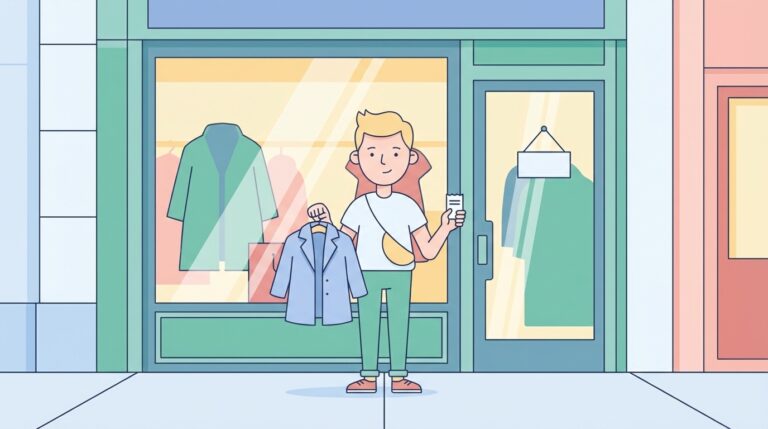
Picture this: You just had the ultimate K-Drama shopping montage in Myeongdong. You bought a beautiful, trendy jacket that looked amazing on the mannequin. You get back to your hotel, excited to try it on for tomorrow’s cafe-hopping adventure in Hongdae, and… oh no. It’s too tight. Or maybe there’s a tiny makeup stain on the collar.
Your heart drops. The thought of going back to the store and trying to explain the problem in Korean feels terrifying. In a K-Drama, the main character might just sigh and dramatically throw it on the bed, but this is real life!
Don’t worry. As a veteran tutor who has helped hundreds of expats survive Seoul, I know exactly where you’re struggling. Today, we are going to learn the magic phrase that will save your shopping trip and your wallet: “Can I exchange this?” By the end of this guide, you’ll be confidently walking up to the counter like a true local. Let’s dive in!
Phase 2: Core Expressions – Your Shopping Lifesavers 🛍️
1. 이거 교환 되나요?
- Pronunciation: [i-geo gyo-hwan dwe-na-yo?] -> Sound-alike: ee-geo (like “ego” but short) / gyo-hwan (gyo like “Tokyo”, hwan like “swan”) / dwe-na-yo (dwe like “way” with a d).
- Meaning: (Literal) Is this exchange possible? / (Real Nuance) Can I exchange this, please?
- K-Culture Moment: Imagine walking into a bustling Dongdaemun boutique. The music is loud, the staff is busy sorting clothes. You gently approach the counter holding the shopping bag and say this phrase. It immediately signals your intention politely without sounding demanding.
- Editor’s Insight: Notice how Koreans don’t say “I want to exchange this.” Instead, they ask, “Is an exchange possible?” This indirectness is a massive part of Korean politeness. It gives the staff space to explain the store’s policy without feeling confronted.
- Situation Spectrum:
[🚫 Never] ———— [⚠️ Be Careful] ———— [✅ Freely]- To a friend (Casual): 🚫 (Friends don’t exchange things with each other!)
- To store staff (Polite/Standard): ✅
- 🤔 Think About It: Why does Korean culture prefer asking “Is it possible?” instead of stating “I want…”? Does your native language favor directness or indirectness in customer service?
2. 사이즈가 안 맞아요.
- Pronunciation: [sa-i-jeu-ga an ma-ja-yo.] -> Sound-alike: sa-ee-jeu-ga (size-ga) / an (un) / ma-ja-yo (mah-jah-yo).
- Meaning: (Literal) The size doesn’t fit. / (Real Nuance) It’s the wrong size.
- K-Culture Moment: The classic fitting room struggle! You step out of the curtain, look at your Korean friend, shake your head, and say this.
- Editor’s Insight: Koreans use the English word “Size” (사이즈)! This is called Konglish. It makes shopping much easier for foreigners. “안 맞아요” means “it doesn’t fit/match.”
- Situation Spectrum:
- To store staff: ✅
- Complaining to a friend: ✅ (Just drop the ‘yo’ -> 사이즈 안 맞아)
3. 영수증 여기 있어요.
- Pronunciation: [yeong-su-jeung yeo-gi i-sseo-yo.] -> Sound-alike: yeong-soo-jeung / yuh-gee / ee-sso-yo.
- Meaning: (Literal) Receipt here is. / (Real Nuance) Here is the receipt.
- Editor’s Insight: ‘영수증’ (Receipt) is a must-know vocabulary word. In Korea, staff will almost always ask if you want the receipt (영수증 드릴까요?). If you think you might need an exchange, always say yes!
Phase 3: Textbook vs. Real Korean 📖🗣️
| Situation | 📖 Textbook Korean | 🗣️ Real Korean | 💡 Why the difference? |
|---|---|---|---|
| Asking for exchange | 이것을 교환해 주시겠습니까? (Would you please exchange this?) | 이거 교환돼요? (Can this be exchanged?) | Real Korean drops object particles (을/를) and favors shorter, efficient sentences in busy stores. |
| Handing over the receipt | 영수증이 여기에 있습니다. (The receipt is located here.) | 영수증이요. (Receipt, please/here.) | Adding ‘요’ (yo) to a noun is the ultimate native shortcut for polite, fast communication. |
| Refusing a bag | 아니요, 쇼핑백은 필요 없습니다. (No, a shopping bag is not necessary.) | 괜찮아요. (It’s okay/I’m good.) | “괜찮아요” is the universal Korean polite decline. It’s much softer than saying “no.” |
Bottom Note: As an A1 beginner, don’t worry about long, complex sentences. A simple “[Noun]+요” with a polite smile goes a very long way in Korea!
Phase 4: Cultural Context — K-Culture Deep Dive 🌊
4-1. The Magic of Non-Verbal Communication
Language isn’t just words; it’s body language! When you hand the clothing and the receipt back to the staff, use two hands. Or, use your right hand to hand over the item, while lightly supporting your right elbow with your left hand. This subtle gesture screams “I respect you” in Korean culture. The staff will instantly appreciate your manners, making the exchange process much smoother.
4-2. K-Travel: Department Stores vs. Underground Malls
If you’re shopping in places like The Hyundai Seoul or Lotte Department Store, exchanging clothes is a breeze. They have strict “Customer is King” policies.
However, if you are exploring the famous Goto Mall (Express Bus Terminal Underground) or small street shops in Hongdae, the rules change drastically. Many of these shops sell items at rock-bottom prices with a strict “No Refund, No Exchange” policy (환불 불가 / 교환 불가). Before you buy, always check for signs or ask “교환 되나요?” before handing over your card!
Phase 5: Interactive Roleplay Scenario 🎭
Setting: Saturday afternoon at a trendy, aesthetic clothing boutique in Hongdae. The music is bumping, and the shop is packed. You bought a sweater yesterday, but you realized it’s too small.
Characters:
– YOU: A tourist navigating Seoul, holding a slightly crumpled shopping bag.
– Minji (22): The stylish, fast-talking part-time staff (알바생 – Alba-saeng).
(Dialogue)
YOU: 저기요… 이거 교환 되나요? 🥺
(jeo-gi-yo… i-geo gyo-hwan dwe-na-yo?)
[Excuse me… can I exchange this?]
Minji: 네 고객님~ 영수증 있으세요?
(ne go-gaeng-nim~ yeong-su-jeung i-sseu-se-yo?)
[Yes customer~ do you have the receipt?]
YOU: 네, 영수증 여기 있어요.
(ne, yeong-su-jeung yeo-gi i-sseo-yo.)
[Yes, here is the receipt.]
(🎭 Stage Direction: You hand it over with both hands.)
Minji: 감사합니다. 어디가 불편하세요?
(gam-sa-ham-ni-da. eo-di-ga bul-pyeon-ha-se-yo?)
[Thank you. What is uncomfortable (wrong) with it?]
YOU: 사이즈가 안 맞아요.
(sa-i-jeu-ga an ma-ja-yo.)
[The size doesn’t fit.]
Minji: 아… 어떡하죠? 이 옷은 원사이즈(프리사이즈)예요. 다른 색상으로 교환해 드릴까요, 아니면 환불해 드릴까요?
(a… eo-tteo-ka-jyo? i o-seun won-sa-i-jeu(peu-ri-sa-i-jeu)-ye-yo. da-reun saek-sang-eu-ro gyo-hwan-hae deu-ril-kka-yo, a-ni-myeon hwan-bul-hae deu-ril-kka-yo?)
[Ah… what should we do? This clothes is one-size (Free Size). Shall I exchange it for a different color, or refund it for you?]
🔀 Your Turn! How should you respond?
– A) “음… 환불해 주세요.” (Umm… please refund it.)
– B) “사이즈 큰 거 주세요!” (Give me a bigger size!)
– C) “대박!” (Awesome!)✅ Best Choice: A — Why: Since the staff already said it’s “Free Size” (which means there are no other sizes), asking for a refund (환불 – hwanbul) is your best option.
⚠️ Choice B Analysis: You weren’t listening! She just said it’s one-size-fits-all.
⚠️ Choice C Analysis: “Daebak” is fun slang, but completely weird when a staff member is trying to process your refund.
Phase 6: 10-Second Shadowing Drill ⏱️
Let’s practice the flow of the sentence. Don’t sound like a robot; add some emotion!
🥺 저기요 / 이거 / 교환 되나요?
(jeo-gi-yo / i-geo / gyo-hwan dwe-na-yo?)
Emotion: Slightly apologetic but polite. Pause briefly at the slashes.
😊 네 / 영수증 / 여기 있어요!
(ne / yeong-su-jeung / yeo-gi i-sseo-yo!)
Emotion: Bright and helpful, extending both hands.
Phase 7: K-Culture Mini Dictionary 📚
| Korean | Romanization | English | Context |
|---|---|---|---|
| 영수증 | yeong-su-jeung | Receipt | Crucial for any exchange or refund. |
| 환불 | hwan-bul | Refund | Getting your money back. |
| 프리사이즈 | peu-ri-sa-i-jeu | Free Size | Korea’s “One Size Fits All” (usually fits Western XS to M). |
| 텍 | tek | Tag | The price tag. If you cut this off, NO refunds! |
| 피팅룸 | pi-ting-rum | Fitting Room | Where you try on clothes (Konglish). |
Phase 8: Traveler’s Survival Kit 🎒
Shopping in Korea is a world-class experience. Here are your top survival phrases for the boutiques!
🆘 Survival Phrases TOP 3
1. 🇰🇷 “입어봐도 되나요?” (i-beo-bwa-do dwe-na-yo?)
– 🗣️ Translation: Can I try this on?
– 📍 Where to use: Before heading to the fitting room. (Note: Many stores do NOT allow you to try on white shirts to prevent makeup stains!)
2. 🇰🇷 “다른 색깔 있어요?” (da-reun saek-kkal i-sseo-yo?)
– 🗣️ Translation: Do you have this in another color?
3. 🇰🇷 “이거 얼마예요?” (i-geo eol-ma-ye-yo?)
– 🗣️ Translation: How much is this?📌 Editor’s Travel Note
– The Makeup Cover: If you try on clothes in Korea, you will often find a white, tissue-like hood in the fitting room. Put it over your head! It prevents makeup from transferring onto the clothes. If you ruin the clothes with foundation, you might have to buy it!
– Card is King: Korea is a cashless society. Even tiny street stalls take credit cards now (though cash might get you a small “service” discount in underground markets).
Phase 9: Critical Thinking — “A Step Deeper” 🧠
The Global Era & The “Free Size” Shock
If you shop in Korea, you will quickly notice the dominance of “프리사이즈” (Free Size). Historically, Korea has been a highly homogeneous society, which meant body types were relatively similar across the population. Clothing manufacturers found it highly efficient to produce a single “average” size.
However, as Korea steps into the global era—welcoming diverse tourists, expats, and adopting broader fitness cultures—this “Free Size” norm is experiencing pushback. Many global fans of K-Fashion point out that “Free Size” isn’t truly free. Slowly, Korean brands are beginning to expand their sizing to accommodate diverse body types, reflecting a shift toward a more inclusive global mindset.
💬 Your Turn: Does your country have “One Size Fits All” clothing? How do people in your culture feel about standardized sizing? Let us know in the comments!
Phase 10: FAQ & Avoiding Mistakes 🛑
Q: Can I exchange something without a receipt?
Maybe. If you paid by credit card, the store can often look up the transaction using your card. Just hand them the card and say, “카드로 결제했어요” (I paid by card). If you paid in cash without a receipt, it’s almost impossible.
Q: How long do I have to exchange clothes?
Usually, large brands offer 7 to 14 days. But street shops might only give you 24 to 48 hours. Do it quickly!
❌ Common Mistake #1: Ripping the tags off (텍 제거) immediately!
✅ How to fix it: Try the clothes on at your hotel with the tags on. In Korea, the moment the tag is cut, the item is officially yours forever.❌ Common Mistake #2: Assuming underground market items can be exchanged.
✅ How to fix it: Always ask “교환 되나요?” before buying cheap items in places like Dongdaemun or Hongdae streets.
Phase 11: Summary & Action Items 🚀
One-Liner Summary: To fix a shopping mistake politely, just remember to ask “이거 교환 되나요?” (Is an exchange possible?) with your receipt in hand.
Action Mission:
– 🥉 Bronze (Solo): Stand in front of your mirror holding a shirt and practice saying “이거 교환 되나요?” three times with a polite smile.
– 🥈 Silver (Online): Comment below with the Konglish word for “fitting room”!
– 🥇 Gold (Real Life): Next time you are in Korea (or at a Korean-owned store in your country), confidently ask for your receipt by saying “영수증 주세요.”
K-Culture Mission: Look at the tags on the clothes in your closet. Imagine you have to exchange one of them. Open a map app, find a virtual clothing store in Seoul (like in Myeongdong), and mentally practice walking in and doing the exchange!
Phase 12: Quiz — Interactive Challenge 🎯
1. You are at an underground shopping mall, and a sign says “교환/환불 불가”. What does this mean?
– A) Exchanges and refunds are welcome!
– B) No exchanges or refunds allowed.
– C) Please show your receipt.
(Answer: B. 불가 means ‘not possible/allowed’.)
2. Fill in the blank: The staff asks you, “________ 있어요?” (Do you have the receipt?)
– A) 사이즈 (Size)
– B) 환불 (Hwanbul)
– C) 영수증 (Yeong-su-jeung)
(Answer: C)
3. True or False – K-Culture Edition: “It is completely acceptable to take off the price tag before trying on clothes at home if you plan to return them later.”
(Answer: FALSE! Never remove the tag, or you lose your right to an exchange or refund in Korea!)
Great job today! Next time you shop in Korea, you won’t have to panic. See you in the next lesson! 화이팅 (Fighting)! 🎉
Frequently Asked Questions (FAQ)
Q: What does "이거 교환 되나요?" mean in Korean and how do you pronounce it?
A: In Korean, "이거 교환 되나요?" is pronounced [i-geo gyo-hwan dwe-na-yo?] and means: (Literal) Is this exchange possible? / (Real Nuance) Can I exchange this, please?
Q: What does "사이즈가 안 맞아요." mean in Korean and how do you pronounce it?
A: In Korean, "사이즈가 안 맞아요." is pronounced [sa-i-jeu-ga an ma-ja-yo.] and means: (Literal) The size doesn't fit. / (Real Nuance) It's the wrong size.
Q: What does "영수증 여기 있어요." mean in Korean and how do you pronounce it?
A: In Korean, "영수증 여기 있어요." is pronounced [yeong-su-jeung yeo-gi i-sseo-yo.] and means: (Literal) Receipt here is. / (Real Nuance) Here is the receipt.







