

Phase 1: Empathy (The Ultimate Dilemma)
Hello! This is your Daily Hangul Editor.
Picture this: You are watching a K-Drama. The detectives have been on a stakeout all night. They finally return to the precinct, and the team leader shouts, “Let’s order Chinese food! Who wants what?” Suddenly, the tension in the room is thicker than the plot itself.
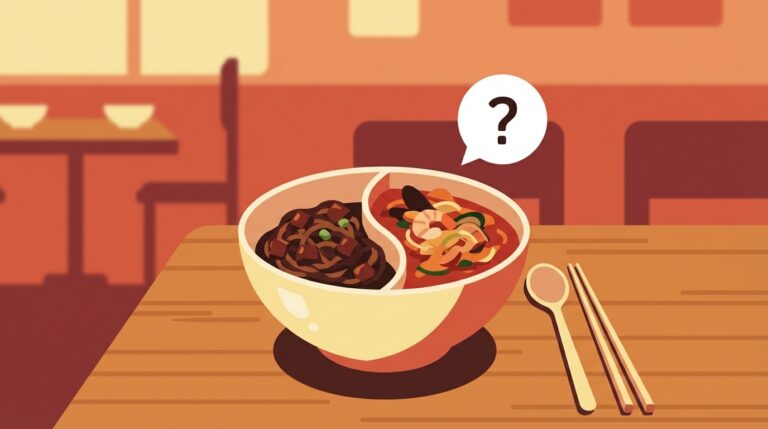
“Jajangmyeon (Black Bean Noodles) or Jjamppong (Spicy Seafood Noodle Soup)?”
If you have lived in Korea or watched enough Korean media, you know this isn’t just a lunch order. It’s the ultimate Korean dilemma. It’s the Korean equivalent of asking, “Coke or Pepsi?” or “Cats or Dogs?”
When someone asks you what you want to eat, simply saying “I want food” in textbook Korean might make you sound like a robot. You need to know how to compare, contrast, and politely (but firmly!) state your preference. Today, we are going to dive into the art of making choices in Korean. Don’t worry, this guide is based on real questions from my B1 students who panicked when handed a delivery menu!
Phase 2: Core Expressions Deep Dive
Let’s learn how to choose and compare like a true local.
1. 저는 [음식] 할게요.
- Pronunciation: jeo-neun [food] hal-ge-yo. (The ‘hal’ sounds like the ‘Hal’ in Halloween)
- Meaning: Literal: “I will do [food].” / Real nuance: “I’ll go with [food].”
- K-Culture Moment: You are at a cafe or restaurant, and your friends are deciding what to order. Instead of saying the textbook phrase “저는 짜장면을 먹겠습니다” (I will eat Jajangmyeon), you casually step in and say, “저는 짜장면 할게요.” It sounds decisive yet polite.
- Editor’s Insight: Using the verb 하다 (to do) for ordering food might feel weird to English speakers. But in Korean, 하다 is incredibly versatile. It implies “I will take/choose this one” without sounding overly formal.
- Situation Spectrum:
[🚫 절대 금지] ———— [⚠️ 주의] ———— [✅ 자유롭게]
- Casual with friends: ✅ (Drop the ‘요’ -> 나 이거 할게)
- Semi-formal coworkers: ✅
- Formal/Elders: ⚠️ (Better to say: “저는 짜장면으로 하겠습니다”)
- 🤔 Think About It: Why do Koreans use ‘to do’ (하다) instead of ‘to eat’ (먹다) when making a choice? Does your language have a versatile verb like this?
2. 짜장면보다 짬뽕이 더 땡겨요.
- Pronunciation: jjajangmyeon-boda jjamppong-i deo ttaeng-gyeo-yo. (‘ttaeng’ sounds like the ringing of a sharp bell)
- Meaning: Literal: “Jjamppong pulls me more than Jajangmyeon.” / Real nuance: “I’m craving Jjamppong more than Jajangmyeon.”
- K-Culture Moment: It’s a rainy day. Rain in Korea means one thing: specific food cravings (usually savory pancakes or Jjamppong). You use this phrase to explain why you are making your choice.
- Editor’s Insight: ‘땡기다’ is the ultimate B1 vocabulary upgrade. Textbooks teach you ‘원하다’ (to want), but native speakers almost never use ‘원하다’ for food. ‘땡기다’ means something is appetizing or you are craving it.
- Situation Spectrum:
[🚫 절대 금지] ———— [⚠️ 주의] ———— [✅ 자유롭게]
- Casual with friends: ✅
- Semi-formal coworkers: ✅
- Formal/Elders: 🚫 (Too colloquial. Use ‘짬뽕이 더 좋습니다’)
- 🤔 Think About It: “~보다” means “compared to.” In Korean, the thing you are comparing against comes before the word “보다”. It reflects a mindset of setting the baseline first before revealing the preference!
3. 전 무조건 짜장파예요.
- Pronunciation: jeon mu-jo-geon jjajang-pa-ye-yo. (‘pa’ sounds like the ‘pa’ in papaya)
- Meaning: Literal: “I am unconditionally Jajang-faction.” / Real nuance: “I’m 100% Team Jajangmyeon.”
- K-Culture Moment: The debate gets heated. Someone asks, “How can you eat sweet noodles? Spicy is the best!” You stand your ground and declare your allegiance.
- Editor’s Insight: The suffix ‘~파’ means “faction” or “team.” Koreans love categorizing themselves into teams based on preferences (Team Mint Choco, Team Pour-the-sauce, etc.). ‘무조건’ means ‘unconditionally’ or ‘no matter what.’
- Situation Spectrum:
[🚫 절대 금지] ———— [⚠️ 주의] ———— [✅ 자유롭게]
- Casual with friends: ✅
- Semi-formal coworkers: ✅
- Formal/Elders: ⚠️ (A bit too casual, but usually fine in a lighthearted food debate)
Phase 3: Textbook vs. Real Korean
| Situation | 📖 Textbook Korean | 🗣️ Real Korean | 💡 Why is it different? |
|---|---|---|---|
| Choosing your dish | 저는 짜장면을 먹고 싶습니다. | 전 짜장면 할게요. | Textbooks use formal grammar, but real conversations prioritize smooth, quick decisions. |
| Comparing two things | 짬뽕이 짜장면보다 더 좋습니다. | 짜장보다 짬뽕이 땡기네요. | Adding ‘땡기다’ (craving) makes the comparison about your feelings, not just an objective fact. |
| Showing strong preference | 저는 짜장면을 아주 좋아합니다. | 전 무조건 짜장파예요! | Koreans love identifying with a ‘team’ (~파) to build a sense of fun rivalry and community. |
Bottom Note: At the B1 level, try replacing ‘좋아요’ (good/like) with ‘땡겨요’ (crave) when talking about food. Your Korean friends will instantly think you’ve lived in Seoul for years!
Phase 4: Cultural Context — K-Culture Deep Dive
4-1. Non-Verbal Cues: The Art of ‘Nunchi’ in Ordering
When comparing options and making a choice in a Korean group setting, you need 눈치 (Nunchi – the ability to read the room). In the past, if the boss ordered Jajangmyeon, it was an unwritten rule that everyone else should also order Jajangmyeon to make the cooking process faster for the restaurant. Nowadays, this is considered old-fashioned, but it’s still polite to ask, “다 같이 통일할까요?” (Should we all unify our order?) just to show you have good manners!
4-2. K-Food Connection: The Eternal Rivalries
The ‘A vs B’ comparison grammar in Korean is most frequently used during K-Food debates.
1. Jajangmyeon vs Jjamppong: The classic. One is sweet and savory, the other is spicy and refreshing.
2. Tangsuyuk (Sweet and Sour Pork) – 부먹 vs 찍먹: Do you pour the sauce over the meat (부먹 – Bu-meok) or dip the meat into the sauce (찍먹 – Jjik-meok)?
If you know how to use the ~파 grammar, you can say “저는 찍먹파예요!” (I’m Team Dipping!) and instantly make friends (or friendly enemies) at the dinner table.
Phase 5: Real-Life Roleplay Scenario
Setting: Friday afternoon, 12:30 PM. A busy traditional Chinese-Korean restaurant in Euljiro. The sound of woks clashing in the kitchen. You are having lunch with your Korean coworker, Minsoo, and your manager.
Characters:
– YOU: A foreigner working in Korea, trying to show off your natural Korean skills.
– Minsoo: (30s, your friendly coworker who loves spicy food.)
– Manager: (50s, generous but a bit impatient.)
Dialogue:
Manager: 오늘 점심은 내가 쏩니다! 다들 뭐 먹을래요? 난 짜장면.
(o-neul jeom-sim-eun nae-ga ssom-ni-da! da-deul mwo meo-geul-lae-yo? nan jja-jang-myeon.)
[I’m paying for lunch today! What does everyone want? I’m having Jajangmyeon.]
Minsoo: 부장님, 감사합니다! 저는 어제 술을 마셔서… 짬뽕 할게요.
(bu-jang-nim, gam-sa-ham-ni-da! jeo-neun eo-je su-reul ma-syeo-seo… jjam-ppong hal-ge-yo.)
[Thank you, Manager! I drank yesterday, so… I’ll go with Jjamppong.]
(🎭 Stage Direction: Minsoo looks at you, waiting for your order. The waiter is standing right there with a notepad.)
🔀 Your Turn! How should you respond?
– A) “저는 짜장면을 먹기를 원합니다.” (I want to eat Jajangmyeon.)
– B) “저도 부장님처럼 짜장면 할게요!”
– C) “짬뽕보다 짜장면이 낫습니다.”✅ Best Choice: B — “I’ll go with Jajangmyeon like you, Manager!” This uses the natural ‘~할게요’ and builds rapport by matching the boss’s choice.
⚠️ Choice A Analysis: ‘원합니다’ sounds like a solemn wish to a genie, not a lunch order.
⚠️ Choice C Analysis: ‘낫습니다’ means ‘better.’ Saying “Jajangmyeon is better than Jjamppong” right after Minsoo ordered Jjamppong might sound a bit confrontational!
Manager: 그래요, 그럼 짜장 둘에 짬뽕 하나!
(geu-rae-yo, geu-reom jja-jang du-re jjam-ppong ha-na!)
[Alright, then two Jajang and one Jjamppong!]
Phase 6: 10-Second Shadowing Drill
Practice making your choice out loud! Pay attention to the pauses (/) and emotions.
- 😤 단호하게 (Firmly):
전 / 무조건 / 짜장파예요!
(jeon / mu-jo-geon / jja-jang-pa-ye-yo!) -
🤔 고민하며 (Thinking):
음… / 오늘은 / 짬뽕보다 짜장면이 / 더 땡기네요.
(eum… / o-neul-eun / jjam-ppong-bo-da jja-jang-myeon-i / deo ttaeng-gi-ne-yo.) -
😊 밝게 (Brightly):
저도 / 같은 걸로 / 할게요!
(jeo-do / ga-teun geol-lo / hal-ge-yo!) -> I’ll go with the same thing!
Phase 7: K-Culture Mini Dictionary
| Korean | Romanization | English | Context |
|---|---|---|---|
| 짜장면 | jjajangmyeon | Black bean noodles | A non-spicy, slightly sweet noodle dish. A comfort food staple. |
| 짬뽕 | jjamppong | Spicy seafood noodles | Spicy, red soup with noodles. The ultimate hangover cure. |
| 짬짜면 | jjamjjamyeon | Half-and-half bowl | A genius invention: a bowl split in the middle serving both dishes! |
| 단무지 | danmuji | Pickled radish | The yellow side dish always served at Chinese-Korean restaurants. |
| 찍먹/부먹 | jjik-meok/bu-meok | Dip / Pour | The great debate on how to eat Tangsuyuk (Sweet and Sour Pork). |
Phase 8: Traveler Survival Kit
If you are visiting Korea and comparing menu items, these phrases will save your life!
🆘 Survival Phrase #1: Asking for a recommendation
– 🇰🇷 “둘 중에 뭐가 더 잘 나가요?” (dul jung-e mwo-ga deo jal na-ga-yo?)
– 🗣️ Meaning: Between these two, which one sells better?
– 📍 Where to use: Any restaurant or cafe when you are stuck comparing two items.
– 💡 Pro Tip: Koreans love ordering the “signature” or “best-selling” item. This phrase is super natural.🆘 Survival Phrase #2: Finding a compromise
– 🇰🇷 “짬짜면 하나 주세요!” (jjam-jja-myeon ha-na ju-se-yo!)
– 🗣️ Meaning: One half-and-half bowl, please!
– 📍 Where to use: Chinese-Korean restaurants.🆘 Survival Phrase #3: Getting the right gear
– 🇰🇷 “앞치마 좀 주실 수 있나요?” (ap-chi-ma jom ju-sil su in-na-yo?)
– 🗣️ Meaning: Can I get an apron?
– 📍 Where to use: Crucial if you wear white and choose to eat Jjamppong!
📌 Editor’s Travel Note:
When comparing prices or items in a Korean market, don’t just point. Use the magic phrase: “이거보다 저게 더 싸요?” (Is that one cheaper than this one?). It shows you know a bit of grammar and might help you avoid the tourist tax!
Phase 9: Critical Thinking — “One Step Deeper”
Food & Identity: Why Do Koreans Love ‘Vs’ Questions?
🧠 Think Deeper:
If you spend time in Korea, you will constantly be asked to pick a side: Jajang vs Jjamppong, Mountain vs Sea, Pour vs Dip, or even your MBTI. Why does Korean culture emphasize these comparisons?
It’s not about creating conflict; it’s about rapid connection. In a high-context, fast-paced society, asking someone for their minor preferences is a safe, polite way to break the ice. It allows people to find common ground (“Oh, you’re a Jjamppong person too? Let’s go eat together!”) or engage in playful, harmless debates without touching sensitive topics like politics or religion.💬 Your Turn: Does your culture have a famous food debate like Jajangmyeon vs Jjamppong? How do people react when you choose the “wrong” side? Share it in the comments!
Phase 10: FAQ & Avoiding Misunderstandings
Q: Is it rude to order an expensive dish when someone else is paying?
Yes and No! If the person paying suggests a mid-tier food like Jajangmyeon, it’s a bit of a faux pas (lack of Nunchi) to suddenly order the most expensive seafood dish. A safe bet is to pick something of a similar price level.
Q: Can I use “무조건 [음식]파예요” with my boss?
It depends on the boss! If they are a young, cool manager, they will laugh. If they are very traditional, just stick to “저는 [음식]을 더 좋아합니다.”
❌ Common Mistake #1: Using 가장 (most/best) when comparing only TWO things.
– Incorrect: 짜장면하고 짬뽕 중에 짬뽕이 가장 좋아요.
– Correct: 짜장면하고 짬뽕 중에 짬뽕이 더 좋아요 (더 = more).
❌ Common Mistake #2: Translating “I prefer” directly to 선호하다.
– “저는 짜장면을 선호합니다” is grammatically perfect, but you sound like a news anchor delivering a survey result. Use “더 땡겨요” or “더 좋아해요” instead!
Phase 11: Summary & Action Items
One-Liner Summary: To compare and choose like a Korean, drop the formal “want to eat” and embrace “~할게요” (I’ll go with) and “땡겨요” (craving)!
Action Mission:
– 🥉 Bronze (Solo): Look at a menu online. Point to two things and practice saying “A보다 B가 더 땡겨요” out loud.
– 🥈 Silver (Online): Go to YouTube, search for a Korean Mukbang (먹방) of Jajangmyeon, and comment: “전 무조건 짬뽕파지만 이거 보니까 짜장면이 땡기네요!” (I’m 100% Team Jjamppong, but seeing this makes me crave Jajangmyeon!)
– 🥇 Gold (Real Life): Next time you go to a Korean restaurant, don’t just say “This one.” Tell the waiter: “저는 이걸로 할게요!” (I’ll go with this one!)
K-Culture Mission:
Watch an episode of a Korean variety show (like Running Man). I guarantee you will see a food debate within the first 20 minutes. Listen closely for the word “땡기다”!
Phase 12: Quiz — Interactive Challenge
1. Situational Judgment:
Your friend asks if you want Americano or Latte. You really want an Americano. What is the most natural native response?
A) 저는 아메리카노를 먹고 싶습니다.
B) 저는 아메리카노 할게요.
C) 라떼보다 아메리카노가 낫습니다.
2. Fill in the Blank:
“저는 비 오는 날에는 짜장면( ___ ) 짬뽕이 더 땡겨요!”
(Hint: “Compared to”)
3. True or False – K-Culture Edition:
If someone says “저는 찍먹파예요,” it means they hate Tangsuyuk. (T / F)
(Answers: 1: B, 2: 보다, 3: False – It means they love it, but they prefer dipping the meat rather than pouring the sauce over it!)
Frequently Asked Questions (FAQ)
Q: What does "저는 [음식] 할게요." mean in Korean and how do you pronounce it?
A: In Korean, "저는 [음식] 할게요." is pronounced [jeo-neun [food] and means: Literal: "I will do [food]." / Real nuance: "I'll go with [food]."
Q: What does "짜장면보다 짬뽕이 더 땡겨요." mean in Korean and how do you pronounce it?
A: In Korean, "짜장면보다 짬뽕이 더 땡겨요." is pronounced [jjajangmyeon-boda jjamppong-i deo ttaeng-gyeo-yo. ('ttaeng' sounds like the ringing of a sharp bell] and means: Literal: "Jjamppong pulls me more than Jajangmyeon." / Real nuance: "I'm craving Jjamppong more than Jajangmyeon."
Q: What does "전 무조건 짜장파예요." mean in Korean and how do you pronounce it?
A: In Korean, "전 무조건 짜장파예요." is pronounced [jeon mu-jo-geon jjajang-pa-ye-yo. ('pa' sounds like the 'pa' in papaya] and means: Literal: "I am unconditionally Jajang-faction." / Real nuance: "I'm 100% Team Jajangmyeon."







