

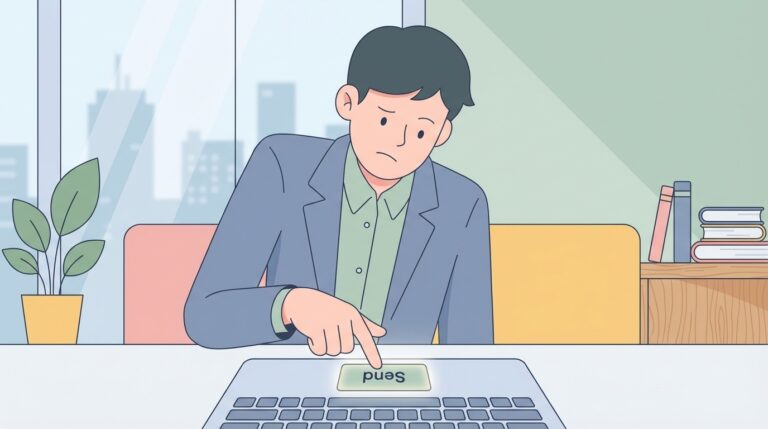
Phase 1: Empathy (The Send-Button Anxiety)
Hello! I’m your Daily Hangul Editor.
We’ve all seen that classic scene in office K-Dramas like Misaeng (Incomplete Life). The rookie employee, pale and sweating, hovers their finger over the ‘Send’ button. The team leader is glaring from across the room. Why the dramatic music? Because in Korean business culture, hitting ‘send’ on an email that asks a client or a senior to clarify something is like walking on a tightrope.
If you just translate “I have a question” or “Tell me what this means” directly into Korean, you might sound like a detective interrogating a suspect! As a B2 learner, you already know the basics, but in the Korean corporate world, it’s not just about grammar—it’s about Nunchi (reading the room) and protecting the other person’s Kibun (mood/face).
This guide is based on real SOS messages from my expat students working in Seoul. Let’s upgrade your emails from “awkward textbook” to “smooth professional” so you can ask anything with confidence!
Phase 2: Deep Dive into Core Expressions
Here are the 4 golden phrases you need to clarify inquiries without stepping on any toes.
1. ~에 대해 문의드립니다. (I am writing to inquire about…)
- Pronunciation: [~e daehae mun-ui-deu-rim-ni-da]
(Sound guide: ‘mun’ sounds like ‘moon’, ‘ui’ is a quick ‘oo-ee’, and ‘deu’ sounds like the ‘duh’ sound you make when you’re confused, but tighter).- Meaning: Literal: I am giving you an inquiry about~ / Real nuance: I am respectfully reaching out regarding~
- K-Culture Moment: This is the standard opening line for any official business email. It immediately sets a professional, respectful tone before you dive into the details.
- Editor’s Insight: Think of this as putting on a crisp blazer. It’s clean, objective, and removes any aggressive emotion from your question.
- Situation Spectrum:
[🚫 Never] ———— [⚠️ Caution] ———— [✅ Freely]
- Close Friends (Casual): 🚫 (Too robotic!)
- Coworkers (Semi-formal): ⚠️ (A bit stiff for internal Slack messages)
- Clients/Seniors (Formal): ✅ (Perfect for emails)
- 🤔 Think About It: Notice how we use ‘드립니다’ (to give respectfully) instead of ‘합니다’ (to do)? In Korean business, asking a question is framed as ‘giving’ an inquiry to honor the receiver. Does your language have a way to elevate the listener like this?
2. 다름이 아니라, (The reason I am contacting you is…)
- Pronunciation: [dareumi anira,]
- Meaning: Literal: It is nothing different, but… / Real nuance: I’m getting straight to the point, but softly.
- K-Culture Moment: You’ll hear this on the phone or in emails when a junior needs to ask a senior for a favor. It’s the ultimate ‘throat-clearing’ phrase in Korean offices.
- Editor’s Insight: This phrase is magic. It lowers the recipient’s defenses. It says, “Don’t worry, there’s no major crisis, I just need to mention one specific thing.”
- Situation Spectrum:
[🚫 Never] ———— [⚠️ Caution] ———— [✅ Freely]
- Close Friends (Casual): ✅ (Often used when asking a favor!)
- Coworkers (Semi-formal): ✅
- Clients/Seniors (Formal): ✅
- 🤔 Think About It: Why do Koreans apologize or soften the blow before stating their main purpose? It’s all about prioritizing the relationship over pure efficiency.
3. 혹시 ~인지 확인해 주실 수 있나요? (Could you possibly confirm if…)
- Pronunciation: [hoksi ~inji hwaginhae jusil su innayo?]
- Meaning: Literal: By any chance, can you confirm if… / Real nuance: I need you to check this, but I’m asking nicely.
- K-Culture Moment: When a K-Pop idol’s agency sends out a press release and there’s a typo, the journalists will reply with this exact phrase to double-check.
- Editor’s Insight: The word ‘혹시’ (by any chance) is your best friend. It transforms a direct demand into a gentle request, giving the other person an out if they made a mistake.
- Situation Spectrum:
[🚫 Never] ———— [⚠️ Caution] ———— [✅ Freely]
- Close Friends (Casual): ⚠️ (A bit too formal, just ask directly!)
- Coworkers/Clients (Formal): ✅
4. 바쁘시겠지만, 확인 부탁드립니다. (I know you are busy, but please confirm.)
- Pronunciation: [Bappeusigetjiman, hwagin butakdeurimnida.]
- Meaning: Literal: You must be busy, but I request confirmation. / Real nuance: Thanks in advance for your time.
- K-Culture Moment: The mandatory closing line of 90% of Korean corporate emails.
- Editor’s Insight: This is called a 쿠션어 (Cushion word). Just like a physical cushion softens a fall, these phrases soften the burden of your request by acknowledging the recipient’s hard work.
- Situation Spectrum:
[🚫 Never] ———— [⚠️ Caution] ———— [✅ Freely]
- Clients/Seniors (Formal): ✅ (Absolutely essential)
Phase 3: Textbook vs. Real Korean
| Situation | 📖 Textbook Korean | 🗣️ Real Office Korean | 💡 Why the difference? |
|---|---|---|---|
| Stating your question | 질문이 있습니다. (I have a question.) | 문의 사항이 있어 연락드립니다. (I am contacting you due to an inquiry.) | ‘질문’ sounds like a student asking a teacher. ‘문의’ is the professional business term. |
| Pointing out a missing file | 파일을 안 보냈습니다. (You didn’t send the file.) | 첨부파일이 누락된 것 같아 확인 부탁드립니다. (It seems the attachment was omitted, please confirm.) | Blaming directly is a big no-no. Using ‘것 같다’ (it seems) saves their face. |
| Asking for a fast reply | 빨리 알려주세요. (Tell me quickly.) | 가급적 빠른 회신 부탁드립니다. (I request a reply as soon as possible, if feasible.) | ‘빨리’ sounds like a demanding boss. ‘가급적’ adds a layer of professional politeness. |
Bottom Note: As a B2 learner, shifting your vocabulary from everyday words (질문, 빨리) to Sino-Korean business words (문의, 가급적, 회신) instantly elevates your professional image.
Phase 4: Cultural Context — K-Culture Deep Dive
4-1. The Non-Verbal Elements of Korean Emails
Even in writing, Nunchi (눈치) applies. In Korean business emails, visual formatting is a sign of respect. We use the “Polite Sandwich” format:
1. Top Bun: Warm greeting & asking about their well-being (e.g., 날씨가 많이 춥습니다 / The weather is very cold).
2. The Meat: The main inquiry, usually organized neatly with bullet points.
3. Bottom Bun: Cushion words (바쁘시겠지만…) and wishing them a good day.
If you just send “The Meat,” it feels incredibly aggressive to a Korean professional.
4-2. The K-Drama Office Trope
Have you noticed in dramas like Start-Up or Search: WWW how differently characters speak on internal messengers vs. external emails? On KakaoTalk or Slack with close team members, they use sentence endings like “~요” and drop the extreme formalities. But the moment they email an external client, their language shifts to strict “~습니다/비다” format. Mixing these up is a classic rookie mistake that leads to a comedic scolding from the team leader!
Phase 5: Real-life Roleplay Scenario
Setting: Friday afternoon, 4:00 PM. The Seoul office of a busy marketing firm. You just received an email from an external partner about a new campaign, but they forgot to include the launch date. You draft a reply and ask your Korean coworker to check it.
Characters:
– YOU: An expat marketing manager trying not to sound rude.
– Min-su (32): Your friendly, slightly overworked Korean coworker who loves iced americanos.
Dialogue:
YOU: 민수 대리님, 바쁘신데 죄송해요. 이 메일 한 번만 봐주실 수 있어요?
(Minsu daerinim, bappeusinde joesonghaeyo. I meil han beonman bwajusil su isseoyo?)
[Min-su, sorry to bother you when you’re busy. Could you take a look at this email?]
Min-su: 네, 무슨 일이에요? 아, A사에서 온 메일이네요.
(Ne, museun irieyo? A, A-saeseo on meirineyo.)
[Sure, what’s up? Ah, it’s an email from Company A.]
(🎭 Min-su rolls his chair over to your desk and squints at your screen)
YOU: 네, 근데 시작 날짜가 없어서요. 제가 이렇게 썼는데, 너무 공격적인가요?
(Ne, geunde sijak naljjaga eopseoseoyo. Jega ireoke sseonneunde, neomu gonggyeokjeogingayo?)
[Yeah, but there’s no launch date. I wrote this, is it too aggressive?]
(🎭 You point to your screen: “시작 날짜를 안 적으셨습니다. 빨리 알려주세요.” – You didn’t write the start date. Tell me quickly.)
Min-su: 헉… 이건 거의 싸우자는 건데요? 😅
(Heok… igeon geoui ssaujaneun geondeyo?)
[Gasp… This is almost asking for a fight?]
🔀 Your Turn! How should you rewrite it?
– A) “시작 날짜가 무엇입니까?” (What is the start date?)
– B) “혹시 시작 날짜가 언제인지 확인해 주실 수 있나요?” (Could you possibly confirm when the start date is?)
– C) “날짜 보내주시면 감사하겠습니다~” (I’d appreciate it if you send the date~)✅ Best Choice: B — It uses ‘혹시’ to soften the tone and ‘확인해 주실 수 있나요’ to politely request action without blaming them for forgetting.
⚠️ Choice C Analysis: The tilde (~) is way too casual for an external partner company. Keep emojis and tildes out of formal business emails!
Min-su: 맞아요! B처럼 쓰면 완벽해요. 마지막에 ‘바쁘시겠지만 답변 부탁드립니다’도 넣으시고요!
(Majayo! B-cheoreom sseumyeon wanbyeokaeyo. Majimage…)
[Exactly! If you write it like B, it’s perfect. Add the “I know you’re busy…” at the end too!]
Phase 6: 10-Second Shadowing Drill
Practice these lines to nail the natural rhythm and tone!
- 💼 Professional & Soft:
다름이 아니라, / 일정에 대해 / 문의드립니다.
(dareumi anira, / iljeong-e daehae / mun-ui-deu-rim-ni-da.) -
🥺 Polite & Cautious:
혹시 / 첨부파일이 / 누락된 것인지 / 확인해 주실 수 있나요?
(hoksi / cheombupairi / nurakdoen geos-inji / hwagin-hae jusil su innayo?) -
😊 Warm Closing:
바쁘시겠지만, / 확인 부탁드립니다!
(Bappeusi-get-jiman, / hwagin butak-deurim-ni-da!)
Phase 7: K-Culture Mini Dictionary
| Korean | Romanization | English | Context |
|---|---|---|---|
| 쿠션어 | kusyeoneo | Cushion word | Phrases like “I’m sorry but…” or “You must be busy…” used to soften requests. |
| 참조 / 숨은 참조 | chamjo / sumeun chamjo | CC / BCC | Essential email terms. “팀장님을 참조에 넣었습니다” (I CC’d the team leader). |
| 칼답 | kaldap | Knife-like reply | Slang for replying to a message immediately. Very appreciated in fast-paced Korean business! |
| 회신 | hoesin | Reply | Formal term for ‘reply’ used in emails instead of ‘대답’. |
Phase 8: Survival Kit (Business Trip Edition)
Even if you’re traveling for business or attending a conference in Seoul, clarifying things politely is a survival skill.
🆘 Survival Phrases for Clarification
– 🇰🇷 “죄송하지만, 다시 한 번 말씀해 주시겠어요?” (joesonghajiman, dasi han beon malsseumhae jusigesseoyo?)
– 🗣️ Meaning: I’m sorry, but could you say that one more time?
– 📍 Where to use: Meetings, noisy convention centers, hotel check-in.
– 💡 Pro Tip: Don’t just say “네?” (Huh?) to an elder or client. It sounds rude!📌 Editor’s Travel Note
– Business Cards: Always exchange business cards with TWO hands before you start asking questions. It dictates the level of honorifics you will use!
– Papago App: If you get an email on your trip and need to clarify, run your English draft through the Papago App set to ‘Honorific (높임말)’ mode. It’s much more accurate for Korean than Google Translate.
Phase 9: Critical Thinking Corner — “One Step Deeper”
Language & Power in the Korean Office
In Western business cultures, clarity and brevity are often prioritized. “Let’s get straight to the point” is a virtue. However, in Korean office culture, the structure of your email reflects the social hierarchy and power dynamics. Using highly elevated honorifics and cushion words isn’t just about “being polite”; it’s a structural way to protect the receiver’s Kibun (mood and social face). If a junior employee uses direct, textbook grammar to point out a senior’s mistake, it’s perceived as challenging their authority, not just exchanging information. By saying “It seems there might be an error” instead of “You made an error,” the language itself acts as a shock absorber for the strict social hierarchy.
💬 Your Turn: Does your culture value directness over saving face in the workplace? How would a boss react if a junior employee pointed out their mistake bluntly? Share in the comments!
Phase 10: FAQ & Avoiding Common Mistakes
Q: Can I use the “~요” form in business emails instead of “~습니다”?
A: It depends on the boundary! If you are emailing an external client or a senior executive, STRICTLY use “~습니다/비다”. However, if you are emailing a close coworker in your own department, “~요” is perfectly fine and often preferred so you don’t sound like a robot.
❌ Common Mistake #1: Translating “Please tell me” as “말해 주세요” in emails.
✅ Do this instead: Use “알려 주시겠어요?” (Could you let me know?) or “확인 부탁드립니다” (Please confirm). “말해 주세요” sounds like a police officer asking for a confession!❌ Common Mistake #2: Using “당신” (You) or “너” (You).
✅ Do this instead: Never use “You” in Korean business emails. Use their Title + Nim (e.g., 팀장님, 담당자님) or drop the subject entirely.
Phase 11: Summary & Action Items
- One-Liner Summary: To ask questions clearly in Korean business emails, wrap your inquiry in a polite “cushion” and use vocabulary that respects the recipient’s status.
-
Action Mission 3 Steps:
- 🥉 Bronze (Solo): Write out the 4 core expressions in your notebook and say them aloud 3 times.
- 🥈 Silver (Online): Draft a 3-line mock email to a “Korean partner” asking for a deadline extension, and post it in a Korean learning Discord or Reddit!
- 🥇 Gold (Real-world): Next time you use a Korean service (like ordering on Coupang or emailing a Korean hotel), use “~에 대해 문의드립니다” to ask a question.
- K-Culture Mission: Watch one episode of the K-Drama Misaeng or Extraordinary Attorney Woo. Pay attention to how the characters bow their heads slightly even when they are talking on the phone or typing an email to someone important!
Phase 12: Quiz — Interactive Challenge
1. Situational Judgment: You want to point out that the client forgot to attach the PDF. Which is the best sentence?
A) 첨부파일이 없습니다. (There is no attachment.)
B) 혹시 첨부파일이 누락된 것인지 확인 부탁드립니다. (Could you confirm if the attachment was omitted?)
C) 파일 보내주세요. (Send the file.)
2. Fill in the Blank:
“[ ] 아니고, 회의 시간 변경 건으로 연락드렸습니다.”
(It’s nothing else, I’m contacting you regarding changing the meeting time.)
3. True or False: In a Korean business email, it’s best to get straight to the point in the very first sentence to save the reader’s time.
(Answers: 1: B, 2: 다름이, 3: False – Always start with a polite greeting and ask about their well-being first!)
Frequently Asked Questions (FAQ)
Q: What does "~에 대해 문의드립니다. (I am writing to inquire about...)" mean in Korean and how do you pronounce it?
A: In Korean, "~에 대해 문의드립니다. (I am writing to inquire about...)" is pronounced [~e daehae mun-ui-deu-rim-ni-da] and means: Literal: I am giving you an inquiry about~ / Real nuance: I am respectfully reaching out regarding~
Q: What does "다름이 아니라, (The reason I am contacting you is...)" mean in Korean and how do you pronounce it?
A: In Korean, "다름이 아니라, (The reason I am contacting you is...)" is pronounced [dareumi anira,] and means: Literal: It is nothing different, but... / Real nuance: I'm getting straight to the point, but softly.
Q: What does "혹시 ~인지 확인해 주실 수 있나요? (Could you possibly confirm if...)" mean in Korean and how do you pronounce it?
A: In Korean, "혹시 ~인지 확인해 주실 수 있나요? (Could you possibly confirm if...)" is pronounced [hoksi ~inji hwaginhae jusil su innayo?] and means: Literal: By any chance, can you confirm if... / Real nuance: I need you to check this, but I'm asking nicely.
Q: What does "바쁘시겠지만, 확인 부탁드립니다. (I know you are busy, but please confirm.)" mean in Korean and how do you pronounce it?
A: In Korean, "바쁘시겠지만, 확인 부탁드립니다. (I know you are busy, but please confirm.)" is pronounced [Bappeusigetjiman, hwagin butakdeurimnida.] and means: Literal: You must be busy, but I request confirmation. / Real nuance: Thanks in advance for your time.







