

Phase 1: The “Wait, Do I Keep My Shoes On?” Panic
Hello! I’m your Daily Hangul Editor.
Picture this: You are watching a K-Drama. The main character gets invited to their friend’s house for the first time. They nervously open the door, step inside, and… abruptly stop to untie their shoelaces while awkwardly balancing on one foot. Or maybe you’ve experienced this yourself! You walk into a cozy traditional Korean BBQ restaurant, and suddenly, everyone is looking at your sneakers. Panic sets in. “Am I supposed to take them off? Where do I put them? What if there’s a hole in my sock?!”
Trust me, as someone who has guided hundreds of expats through the maze of Seoul, the “Shoe Dilemma” is a rite of passage. If you don’t know the cultural rules, you might accidentally walk into someone’s living room leaving a trail of street dirt—a huge K-Culture faux pas! But don’t worry. This guide is built from the real, sweaty-palmed experiences of learners just like you. By the end of this post, you’ll navigate Korean entrances like a true local.
Phase 2: Core Expressions Deep Dive
Here are the top 3 lifesaver phrases you need when hovering at the doorway.
1. 신발 벗어야 돼요?
- Pronunciation: sinbal beoseoya dwaeyo? [shin-bal buh-suh-ya dway-yo?]
(Tip: ‘beo’ sounds like the ‘bu’ in ‘butter’)- Meaning: (Literal) Do I have to take off shoes? / (Real nuance) Should I take my shoes off here?
- K-Culture Moment: You walk into a cute neighborhood cafe, but the seating area is on a raised wooden floor. You make eye contact with the barista, point to your shoes, and ask this.
- Editor’s Insight: This is your ultimate “get out of jail free” card. It’s polite, curious, and shows you respect the rules. Say it with a slight head tilt for extra politeness!
- Situation Spectrum:
[🚫 Never] ———— [⚠️ Caution] ———— [✅ Freely]
- Close Friends (Casual): ✅ (Just drop the ‘yo’: 신발 벗어야 돼?)
- Strangers/Staff (Semi-formal): ✅
- Boss/Elders (Formal): ✅
- 🤔 Think About It: Why is asking this question considered polite in Korea? In some cultures, keeping shoes on is a sign of being fully “dressed” for guests. How does your culture view bare feet versus shoes indoors?
2. 여기 신발 벗고 들어오세요.
- Pronunciation: yeogi sinbal beotgo deureooseyo. [yuh-gee shin-bal buht-go doo-ruh-oh-seh-yo]
- Meaning: (Literal) Here, take off shoes and come in. / (Real nuance) Please leave your shoes here before entering.
- K-Culture Moment: You are visiting a Korean home or a traditional Hanuiwon (Korean medicine clinic). The host or receptionist will greet you with a warm smile and gently point to the floor while saying this.
- Editor’s Insight: You will hear this more than you speak it. When you hear “beotgo” (take off), just start unlacing!
- Situation Spectrum:
[🚫 Never] ———— [⚠️ Caution] ———— [✅ Freely]
- As a guest hearing this: ✅ (Just smile and nod!)
3. 실내화 신으세요.
- Pronunciation: sillaehwa sineuseyo. [shil-lae-hwa shi-noo-seh-yo]
- Meaning: (Literal) Please put on indoor shoes. / (Real nuance) Please use these slippers.
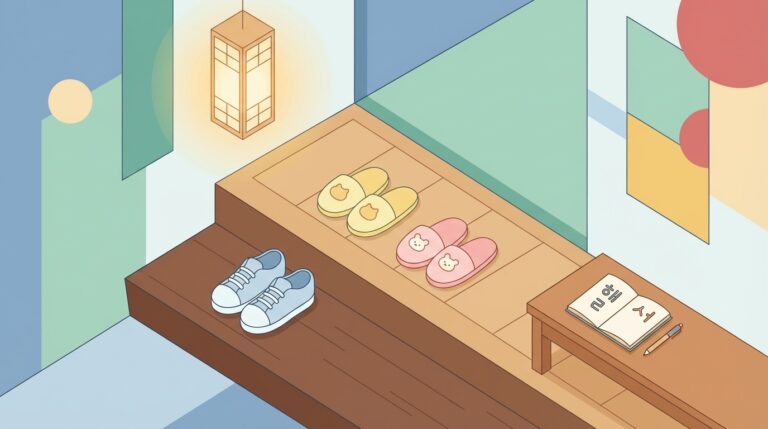
- K-Culture Moment: You take off your shoes at an office or someone’s house, and the host immediately slides a pair of cute, fluffy slippers toward your feet.
- Editor’s Insight: Koreans love their “sillaehwa” (indoor slippers). It keeps the feet warm and clean. If they offer them, definitely wear them!
- Situation Spectrum:
[🚫 Never] ———— [⚠️ Caution] ———— [✅ Freely]
- Close Friends (Casual): ✅
- Strangers/Staff (Semi-formal): ✅
Phase 3: Textbook vs. Real Korean
| Situation | 📖 Textbook Korean | 🗣️ Real Korean | 💡 Why the difference? |
|---|---|---|---|
| Asking to enter | 들어가도 됩니까? (May I enter?) | 들어가도 돼요? (Can I go in?) | The “~ㅂ니까” form is too military/formal for daily life. |
| Telling someone to remove shoes | 신발을 벗으십시오. (Remove your shoes.) | 신발 벗고 들어오세요~ (Take off your shoes and come in~) | Adding “come in” makes it a welcoming invitation rather than a strict command. |
| Offering slippers | 실내화를 착용하세요. (Wear indoor shoes.) | 여기 슬리퍼 신으세요~ (Wear these slippers here~) | Koreans often use the English loanword “슬리퍼” (slippers) in casual speech! |
Bottom Note for A2 Learners: Don’t stress about using heavy formal grammar (습니다/십시오) when visiting a friend’s house. Using the polite “~요” form is perfectly respectful and sounds much more natural!
Phase 4: Cultural Context — K-Culture Deep Dive
4-1. The Non-Verbal Cue: “Nunchi” at the Doorway
You don’t always need language to know what to do. In Korea, look at the architecture. The entrance area is called the Heongwan (현관). It is usually slightly lower than the main floor. That tiny 2-inch step up? That is the ultimate invisible boundary! If there is a step up onto wood or linoleum, your shoes stay below that step. Reading this physical cue is a prime example of Korean Nunchi (눈치)—reading the room.
4-2. K-Food Connection: The “Jwasik” (Floor Seating) Experience
If you love K-Drama, you’ve seen scenes where characters sit cross-legged on the floor at a Makgeolli (rice wine) tavern or a traditional BBQ restaurant, roasting pork belly. This is called Jwasik (좌식 – floor seating).
When dining here, taking off your shoes isn’t optional; it’s mandatory to protect the dining area’s cleanliness.
Critical Viewpoint: Why do Koreans prefer sitting on the floor to eat? It traces back to the traditional Ondol heating system. The floor is the warmest, most comforting place in the house. Sharing a meal on a warm floor creates a sense of deep intimacy and community that sitting in chairs sometimes lacks.
Phase 5: Interactive Roleplay Scenario
Setting: Friday night, 7 PM. You and your Korean coworker Min-su are at a famous traditional Makgeolli house in Jongno. The place is bustling, smells like green onion pancakes (Pajeon), and you notice people are sitting on cushions on a raised wooden floor.
Characters:
– YOU: A foreigner working in Korea, excited but slightly nervous about cultural rules.
– Min-su (32): Your friendly Korean coworker who loves good food.
Dialogue:
Min-su: 여기 파전 진짜 맛있어요! 빨리 들어가요.
(yeogi pajeon jinjja masisseoyo! ppalli deureogayo.)
[The green onion pancakes here are so good! Let’s go in quickly.]
YOU: (Looking at the wooden floor) 미안하지만…
(mianhajiman…)
[I’m sorry, but…]
Min-su: 네? 왜요?
(ne? waeyo?)
[Yes? Why?]
🔀 YOUR TURN! How do you ask Min-su if you need to remove your shoes?
– A) “여기 신발 안 좋아해요?” (Do they not like shoes here?)
– B) “신발 벗어야 돼요?” (Do I have to take off my shoes?)
– C) “제 신발 더러워요.” (My shoes are dirty.)✅ Best Choice: B — It is the most natural and direct way to ask about the rule.
⚠️ Choice A & C Analysis: Choice A sounds like the restaurant has a personal vendetta against shoes. Choice C is a funny confession, but doesn’t actually ask what you should do!
(Assuming you chose B)
YOU: 신발 벗어야 돼요?
(sinbal beoseoya dwaeyo?)
[Do I have to take off my shoes?]
Min-su: 아! 네, 여기 신발 벗고 들어오세요. 저기 신발장 있어요.
(a! ne, yeogi sinbal beotgo deureooseyo. jeogi sinbaljang isseoyo.)
[Ah! Yes, please take off your shoes and come in here. There is a shoe cabinet over there.]
(🎭 Stage Direction: Min-su points to the wooden cubbies next to the door.)
Phase 6: 10-Second Shadowing Drill
Repeat this out loud to get the rhythm of natural Korean!
🤔 (Politely curious) 저기요, / 신발 / 벗어야 돼요?
(jeogiyo, / sinbal / beoseoya dwaeyo?)
[Excuse me, / shoes / do I have to take off?]
😊 (Warm and welcoming) 네~ / 여기 신발 벗고 / 들어오세요!
(ne~ / yeogi sinbal beotgo / deureooseyo!)
[Yes~ / here, take off your shoes and / please come in!]
Phase 7: K-Culture Mini Dictionary
| Korean | Romanization | English | Context |
|---|---|---|---|
| 현관 | heongwan | Entrance / Foyer | The lowered area right inside the front door where shoes are kept. |
| 신발장 | sinbaljang | Shoe cabinet | The tall closet near the entrance where Koreans neatly organize their shoes. |
| 실내화 | sillaehwa | Indoor slippers | Worn inside homes, schools, or offices to keep feet warm and floors clean. |
| 좌식 | jwasik | Floor seating | Traditional Korean dining style where you sit on cushions on the floor. |
| 온돌 | ondol | Korean underfloor heating | The traditional heating system that makes Korean floors wonderfully warm in winter. |
Phase 8: Traveler Survival Kit
Whether you are visiting a temple, a traditional Hanok guesthouse, or a local eatery, these phrases will save you.
🆘 Survival Phrases for “Shoe Zones”
– 🇰🇷 “신발 신고 들어가요?” (sinbal singo deureogayo?) -> Do I go in with shoes on?
– 🇰🇷 “신발 어디에 둬요?” (sinbal eodie dwoyo?) -> Where do I put my shoes?
– 🇰🇷 “슬리퍼 있어요?” (seullipeo isseoyo?) -> Do you have slippers?📌 Editor’s Travel Note
– Sock Check: Always wear clean socks without holes when traveling in Korea! You never know when you’ll be invited to a shoe-free zone.
– Bathroom Slippers: If you see rubber slippers inside a bathroom at a guesthouse or home, switch into them! Do NOT wear your regular indoor slippers or bare feet into a wet Korean bathroom.
Phase 9: Critical Thinking — “One Step Deeper”
🧠 Think Deeper: Architecture & Identity (The Ondol Culture)
Taking off shoes in Korea is not just about avoiding dirt. It is deeply connected to the Ondol (온돌) system—Korea’s traditional underfloor heating. For centuries, Koreans ate, slept, and socialized directly on the warm floor. The floor is essentially the “bed” and the “dining table.” Stepping on it with outdoor shoes is viewed as deeply unhygienic, akin to someone walking on your bed mattress with muddy boots! As Korea modernized, western beds and chairs became common, but the deep-rooted cultural reverence for a clean, warm floor remains a core part of Korean identity.💬 Your Turn: Does your culture have a “shoes off” rule indoors? If not, how do you keep the living space clean? Share your thoughts in the comments!
Phase 10: FAQ & Avoiding Misunderstandings
Q: “Can I just go barefoot inside someone’s house?”
– Maybe, but be careful! In summer, going barefoot is common among friends. However, if you are visiting older relatives, a boss’s house, or a formal setting, bare feet can be considered slightly rude. Bringing a pair of clean socks to slip on is the ultimate “polite guest” flex.
Q: “What if I’m at a hospital or school?”
– Look at the locals! Many schools and clinics require you to take off your shoes at the entrance and switch into communal indoor slippers provided in racks.
❌ Common Mistake #1: Stepping on the raised main floor with your outdoor shoes while trying to take them off.
✅ Do this instead: Keep your feet in the lowered entrance area (Heongwan) while taking off your shoes. Only your socked foot should touch the raised floor!
Phase 11: Summary & Action Items
One-Liner Summary: Look for the step at the entrance, and when in doubt, just ask politely: “신발 벗어야 돼요?” (Should I take my shoes off?).
Action Mission:
– 🥉 Bronze (Solo): Look at your own front door. Say “신발 벗어야 돼요?” out loud 3 times as if asking permission to enter.
– 🥈 Silver (Online): Comment below with a funny story about a time you wore mismatched socks or had a hole in your sock in a “shoes off” situation!
– 🥇 Gold (Real Life): Next time you visit a Korean restaurant or a friend’s house, successfully navigate the Heongwan without them having to tell you what to do!
K-Culture Mission: Watch an episode of your favorite K-Drama today. Look closely at the scenes filmed inside homes. Can you spot the Heongwan (lowered entrance) and the indoor slippers?
Phase 12: Quiz — Interactive Challenge
1. Situational Judgment: You are invited to your Korean boss’s home for dinner. You take off your shoes at the entrance. What is the most polite thing to do next?
– A) Walk in barefoot because it’s summer.
– B) Wear the indoor slippers they offer you, or ensure you are wearing clean socks.
– C) Keep your shoes on but wipe them on the mat.
2. True or False: If a restaurant has chairs and tables, you NEVER have to take off your shoes.
– Hint: Look at the floor! (Answer: False. Some traditional places have raised floors with normal tables, and you still must remove your shoes!)
3. Fill in the Blank:
Host: “여기 신발 ________ 들어오세요!”
(Hint: Take off and…)
– A) 신고 (singo)
– B) 벗고 (beotgo)
(Answers: 1: B, 2: False, 3: B)
Frequently Asked Questions (FAQ)
Q: What does "신발 벗어야 돼요?" mean in Korean and how do you pronounce it?
A: In Korean, "신발 벗어야 돼요?" is pronounced [sinbal beoseoya dwaeyo? [shin-bal buh-suh-ya dway-yo?] and means: (Literal) Do I have to take off shoes? / (Real nuance) Should I take my shoes off here?
Q: What does "여기 신발 벗고 들어오세요." mean in Korean and how do you pronounce it?
A: In Korean, "여기 신발 벗고 들어오세요." is pronounced [yeogi sinbal beotgo deureooseyo. [yuh-gee shin-bal buht-go doo-ruh-oh-seh-yo] and means: (Literal) Here, take off shoes and come in. / (Real nuance) Please leave your shoes here before entering.
Q: What does "실내화 신으세요." mean in Korean and how do you pronounce it?
A: In Korean, "실내화 신으세요." is pronounced [sillaehwa sineuseyo. [shil-lae-hwa shi-noo-seh-yo] and means: (Literal) Please put on indoor shoes. / (Real nuance) Please use these slippers.







