

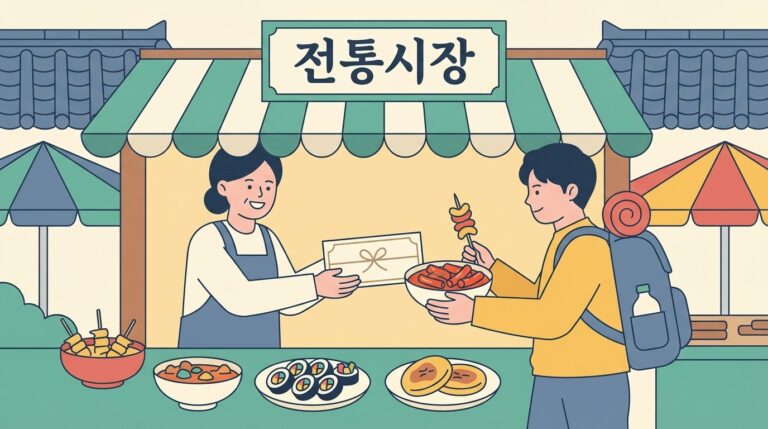
Phase 1: Empathy & Immersion (Welcome to the Market!)
Hello! I’m the lead editor of Daily Hangul.
Picture this: You are walking through the vibrant alleys of Gwangjang Market. The scent of sizzling bindaetteok (mung bean pancakes) and spicy tteokbokki fills the air. It feels exactly like a scene from your favorite K-Drama where the main leads go on a cute, casual street-food date. You’ve just finished a delicious meal, and you pull out a special piece of paper money—the Onnuri Gift Certificate (온누리 상품권) you received as a tourist welcome gift or bought at a discount.
The friendly ajumma (auntie) looks at you. You want to ask if she accepts it, but your mind goes blank. “Do I just say ‘money’? Is there a special word for this?”
Don’t panic! Traditional markets are the heart of K-Culture, filled with Jeong (정, warm affection). However, using a paper voucher instead of a credit card or regular cash can feel intimidating if you don’t know the right phrases. Today, I’ll teach you exactly how to use these vouchers like a local insider so you can shop and eat with total confidence!
Phase 2: Core Expressions Deep Dive
Let’s learn the essential phrases you need to use your Onnuri vouchers smoothly.
1. 온누리 상품권 받으세요?
- Pronunciation: [Onnuri sangpumgwon badeuseyo?]
(Sounds like: on-nu-ri / sang-poom-gwon / bah-deu-se-yo?)- Meaning: Do you accept Onnuri Gift Certificates? (Literal: Do you receive Onnuri Gift Certificates?)
- K-Culture Moment: Before you order your towering pile of fried snacks (twigim), it’s always polite to ask this first. While most traditional market stalls accept them, some smaller independent carts might not.
- Editor’s Insight: The verb 받다 (to receive/accept) is incredibly versatile in Korean. Instead of saying “Can I use…”, Koreans often ask “Do you receive…?” from the perspective of the seller.
- Situation Spectrum:
[🚫 Never] ———— [⚠️ Caution] ———— [✅ Freely]
- Close Friends (Casual): 🚫 (You wouldn’t ask a friend this!)
- Market Vendors (Polite/Respectful): ✅
- 🤔 Think About It: Why do Koreans often frame questions from the listener’s perspective (e.g., “Do you receive this?” instead of “Can I use this?”)? Does your native language do something similar to show politeness?
2. 잔돈 거슬러 주시나요?
- Pronunciation: [Jandon geoseulleo jusinayo?]
(Sounds like: jahn-don / geo-seul-leo / ju-shi-na-yo?)- Meaning: Do you give change? (Literal: Do you return the small change?)
- K-Culture Moment: This is the golden rule of Onnuri Certificates! If you use 60% or more of the face value (e.g., spending 6,000 won using a 10,000 won voucher), you are legally entitled to receive the remaining amount in regular cash. This is a great way to get some pocket change for your next street food adventure!
- Editor’s Insight: Jandon (잔돈) means “small money” or change. Geoseulleo juda (거슬러 주다) is the specific verb for “giving back change.”
- Situation Spectrum:
[🚫 Never] ———— [⚠️ Caution] ———— [✅ Freely]
- Market Vendors (Polite/Respectful): ✅
- 🤔 Think About It: In a cashless society where Korea is dominated by credit cards, traditional markets are one of the few places where the concept of jandon (change) is still an everyday conversation.
3. 이거 온누리(로) 돼요?
- Pronunciation: [Igeo onnuri(ro) dwaeyo?]
(Sounds like: ee-guh / on-nu-ri-(ro) / dway-yo?)- Meaning: Can I use Onnuri for this? (Literal: Does this work with Onnuri?)
- K-Culture Moment: You’ll hear young Koreans use this exact phrasing when paying at a bustling, noisy market. It’s short, practical, and sounds incredibly natural.
- Editor’s Insight: The magical verb 되다 (to work / to be possible)! It is the ultimate survival word in Korea. Just point to the voucher and ask “돼요?” (Does it work?).
- Situation Spectrum:
[🚫 Never] ———— [⚠️ Caution] ———— [✅ Freely]
- Casual / Fast-paced situations: ✅
- Extremely formal places: ⚠️ (A bit too casual for a high-end department store, but perfect for markets!)
Phase 3: Textbook vs. Real Korean
| Situation | 📖 Textbook Korean | 🗣️ Real Korean | 💡 Why is it different? |
|---|---|---|---|
| Asking if they accept the voucher | 온누리 상품권으로 결제할 수 있습니까? (Can I pay with the Onnuri Gift Certificate?) | 사장님, 이거 온누리 돼요? (Boss, does Onnuri work for this?) | Koreans love efficiency. “결제할 수 있습니까?” is way too robotic for a lively market. |
| Handing over the voucher | 여기 상품권 있습니다. (Here is the gift certificate.) | 이걸로 계산할게요. (I’ll pay with this.) | “계산하다” (to calculate/pay) is the most common verb used for checking out at eateries. |
| Asking for change | 남은 돈을 주시겠습니까? (Would you give me the remaining money?) | 잔돈 나오나요? (Does change come out?) | A more passive, softer way to ask if change is available without sounding demanding. |
Phase 4: Cultural Context — K-Culture Deep Dive
4-1. Non-Verbal Tips: The “Two-Hand” Rule
When handing your Onnuri Certificate to the vendor, try to use both hands, or place your left hand gently under your right elbow as you hand it over. This non-verbal gesture is a core part of Korean politeness. It immediately signals respect, and you’ll likely receive an extra warm smile (and maybe an extra piece of mandu!) in return.
4-2. The “Sajangnim” (사장님) Culture
In K-Dramas, you often hear characters shout “Sajangnim!” (Boss/Owner) or “Imo!” (Auntie) at restaurants or market stalls. When navigating traditional markets, starting your sentence with a cheerful “사장님!” instantly breaks the ice. It shows you acknowledge their hard work and authority over their delicious stall. It’s the ultimate “insider” attention-grabber!
Phase 5: Real-Life Roleplay Scenario
Setting: Saturday afternoon at Namdaemun Market. The air is slightly crisp, steam is rising from the dumpling (mandu) steamers, and merchants are calling out to customers. You have a 10,000 won Onnuri Gift Certificate in your pocket.
Characters:
– YOU: A traveler exploring Korean street food.
– Sajangnim (Owner): A cheerful woman in her 50s, wearing an apron and expertly packing dumplings into a box.
Dialogue:
YOU: 사장님, 고기만두 하나 포장해 주세요!
(sa-jang-nim, go-gi-man-du ha-na po-jang-hae ju-se-yo!)
[Boss, please pack one order of meat dumplings to go!]
(🎭 Stage Direction: You point at the steaming dumplings.)
Sajangnim: 네~ 5천 원입니다!
(ne~ o-cheon won-im-ni-da!)
[Yes~ That’ll be 5,000 won!]
YOU: (Pulling out the voucher) 사장님, 이거 온누리 상품권 돼요?
(sa-jang-nim, i-geo on-nu-ri sang-pum-gwon dwae-yo?)
[Boss, does the Onnuri Gift Certificate work here?]
Sajangnim: 그럼요~ 다 돼요.
(geu-reom-yo~ da dwae-yo.)
[Of course~ It all works.]
🔀 YOUR TURN! How do you respond to make sure you get your change? (Remember, you are spending 5,000 won with a 10,000 won voucher – which is exactly 50%. The rule usually requires 60%!)
- A) “잔돈 거슬러 주세요!” (Give me my change!)
- B) “이거 5천 원인데, 잔돈 받을 수 있나요?” (This is 5,000 won, can I get change?)
- C) “아… 그럼 꽈배기도 하나 더 주세요!” (Ah… then please give me a twisted donut too!)
✅ Best Choice: C — Why? The “60% rule” means you usually need to spend at least 6,000 won of a 10,000 won voucher to get cash back. By adding a 1,000 won twisted donut (kkwabaegi), you hit 6,000 won, get to eat a delicious dessert, AND legally get your 4,000 won cash change without any awkwardness! It’s a win-win market strategy!
Phase 6: 10-Second Shadowing Drill
Practice this sentence out loud. Follow the slashes for pauses and the emotion tag!
😊 밝게 (Brightly):
사장님, / 이거 / 온누리 / 돼요?
(sa-jang-nim, / i-geo / on-nu-ri / dwae-yo?)
🥺 조심스럽게 (Carefully):
혹시 / 잔돈 / 거슬러 주시나요?
(hok-si / jan-don / geo-seul-leo ju-si-na-yo?)
Phase 7: K-Culture Mini Dictionary
| Korean | Romanization | English | Context |
|---|---|---|---|
| 사장님 | sajangnim | Boss / Owner | The safest, most polite way to address a market vendor or restaurant owner. |
| 포장 | pojang | Takeout / To-go | Very useful! Street food is often eaten on the spot, but you can always ask for pojang. |
| 잔돈 | jandon | Change (coins/small bills) | What you get back when you pay with cash or a voucher. |
| 현금영수증 | hyeongeum-yeongsujeung | Cash Receipt | Vendors might ask if you want this for tax deductions. As a foreigner, you can just say “괜찮아요” (It’s okay/No thanks). |
| 덤 | deom | Extra / Bonus | The beautiful market culture where a vendor gives you an extra piece of food for free out of a warm heart! |
Phase 8: Traveler Survival Kit 🎒
🆘 Top 3 Survival Phrases for Traditional Markets
1. 🇰🇷 “이거 얼마예요?” (i-geo eol-ma-ye-yo?) – “How much is this?”
2. 🇰🇷 “안 맵게 해 주세요.” (an maep-ge hae ju-se-yo.) – “Please make it not spicy.”
3. 🇰🇷 “여기서 먹고 갈게요.” (yeo-gi-seo meok-go gal-ge-yo.) – “I’ll eat it here.”📌 Editor’s Travel Note:
– Where to use Onnuri: Look for the small oval “온누리상품권” sticker on the vendor’s cart or shop window.
– The 60% Rule: To get cash change, you generally must spend at least 60% of the voucher’s total value (e.g., 6,000 won for a 10,000 won voucher).
– No Tipping: Just like the rest of Korea, there is NO tipping at traditional markets. Tipping will actually cause confusion!
Phase 9: Critical Thinking — “One Step Deeper”
Food & Identity: The Power of ‘Sajangnim’ and ‘Jeong’ (정)
🧠 Think Deeper:
Have you noticed that Koreans rarely say “Excuse me, sir/ma’am” when ordering food, but instead use titles that imply a relationship, like Sajangnim (Boss) or Imo (Aunt)? In traditional markets, food isn’t just a transaction; it’s an exchange of Jeong (정, emotional connection). By calling the vendor “Boss,” you are instantly placing yourself into a community framework. You acknowledge their domain, and in return, they feed you warmly, often giving you a little extra (deom). It’s a beautiful reflection of how Korean language builds instant social bonds rather than keeping polite distance.💬 Your Turn: Does your culture have a special way of addressing street food vendors or local merchants to show respect or friendliness? Share it in the comments!
Phase 10: FAQ & Avoiding Mistakes
Q: Can I use Onnuri Gift Certificates at convenience stores like CU or GS25?
A: No. Onnuri certificates are exclusively designed by the government to support traditional markets and designated local shopping districts.
Q: What if the vendor says no to my Onnuri voucher?
A: Don’t take it personally! Some very small, unregistered street carts simply don’t have the administrative setup to process them. Always have a little physical cash as a backup.
❌ Common Mistake #1: Handing over a 10,000 won Onnuri voucher for a 1,000 won bottle of water and expecting 9,000 won in cash back.
✅ Do this instead: Remember the 60% rule! Group your purchases together, or buy enough snacks to cross that 6,000 won threshold.
Phase 11: Summary & Action Items
One-Liner Summary: To use an Onnuri voucher like a local, smile, use two hands, and confidently ask, “Sajangnim, igeo Onnuri dwaeyo?”
Your Action Missions:
– 🥉 Bronze (Solo): Stand in front of a mirror and practice saying “사장님, 이거 온누리 상품권 돼요?” three times with a bright smile.
– 🥈 Silver (Online): Look up “Gwangjang Market street food” on YouTube and leave a comment in English or Korean about what you would buy with a 10,000 won Onnuri voucher!
– 🥇 Gold (Real Life): Visit a traditional market in Korea (like Mangwon or Namdaemun), find a stall with the Onnuri sticker, and successfully buy a snack using your voucher!
Phase 12: Quiz — Interactive Challenge
1. Situational Judgment: You want to buy 7,000 won worth of tteokbokki using a 10,000 won Onnuri voucher. What is the most natural way to ask if they give you the remaining 3,000 won back?
– A) 사장님, 돈 주세요. (Boss, give me money.)
– B) 혹시 잔돈 거슬러 주시나요? (By any chance, do you give change?)
– C) 현금영수증 해 주세요. (Please issue a cash receipt.)
(Answer: B! It is polite and uses the correct vocabulary. A is demanding, and C is about tax receipts.)
2. True or False – K-Culture Edition:
“If a market vendor gives you an extra dumpling for free, you should give them a small tip to show appreciation.”
(Answer: False! This extra food is called ‘Deom’ (덤), an act of ‘Jeong’. Giving a tip is not part of Korean culture and might confuse them. Just say a bright “감사합니다!” [Thank you!])
Great job today! You are now fully equipped to conquer Korean traditional markets. Happy eating and shopping! 🥢🥟
Frequently Asked Questions (FAQ)
Q: What does "온누리 상품권 받으세요?" mean in Korean and how do you pronounce it?
A: In Korean, "온누리 상품권 받으세요?" is pronounced [Onnuri sangpumgwon badeuseyo?] and means: Do you accept Onnuri Gift Certificates? (Literal: Do you receive Onnuri Gift Certificates?)
Q: What does "잔돈 거슬러 주시나요?" mean in Korean and how do you pronounce it?
A: In Korean, "잔돈 거슬러 주시나요?" is pronounced [Jandon geoseulleo jusinayo?] and means: Do you give change? (Literal: Do you return the small change?)
Q: What does "이거 온누리(로) 돼요?" mean in Korean and how do you pronounce it?
A: In Korean, "이거 온누리(로) 돼요?" is pronounced [Igeo onnuri(ro] and means: Can I use Onnuri for this? (Literal: Does this work with Onnuri?)







