

Hello! I am the Lead Editor of Daily Hangul, your premium guide to the Korean language and culture.
Picture this: You are watching a political thriller K-Drama like Chief of Staff (보좌관). The campaign manager slams a file onto the desk, pointing at a chart. The subtitles simply read, “The polls are wrong!” But if you listen closely, the vocabulary they use is sharp, strategic, and deeply embedded in Korean society’s obsession with data and public sentiment.
As an advanced (C1) Korean learner, you already know how to order food or ask for directions. But what happens when you are having a coffee with your Korean colleagues in Yeouido (the political and financial hub of Seoul), and the topic shifts to the upcoming elections and breaking news?
Navigating political conversations in Korea requires intense Nunchi (눈치) and sophisticated vocabulary. Today, we are moving beyond textbook phrases to analyze the reliability of public opinion polls (여론 조사의 신뢰성) like a true local intellectual.
Let’s dive into the words that will instantly upgrade your Korean from “foreigner who speaks well” to “insider who truly understands Korea.”
Phase 2: Core Expressions Deep Dive
Let’s break down the essential C1 expressions you need when analyzing poll data or news reports.
1. 표본이 편향되다
- Pronunciation: [Pyo-bon-i pyeon-hyang-dwe-da] / Sound analogy: “Pyo” sounds like the ‘pyo’ in Pyongyang, “bon” like ‘bone’, “pyeon” like ‘pen’ with a y, “hyang” like a sneeze ‘hyang!’
- Meaning: The sample is biased.
- K-Culture Moment: You will see this phrase spammed in the comment section of Naver News articles when supporters of a particular political party refuse to believe a sudden drop in their candidate’s approval ratings.
- Editor’s Insight: This is the ultimate intellectual flex. Instead of just saying “I don’t believe this” (안 믿어요), you are criticizing the methodology. It shows you consume high-level Korean media.
- Situation Spectrum:
[🚫 절대 금지] ———— [⚠️ 주의] ———— [✅ 자유롭게]
- Casual with friends: ✅ (If they are into politics)
- Coworkers (Semi-formal): ⚠️ (Keep it objective, don’t get emotional)
- Boss/Elders (Formal): ⚠️ (Proceed with caution; politics is a sensitive topic)
- 🤔 Think About It: Koreans are hyper-aware of media framing. Why do you think internet portals (like Naver or Daum) show different political leanings in their comment sections? How does this reflect the “echo chamber” effect in modern society?
2. 표본 오차 범위 안이다
- Pronunciation: [Pyo-bon o-cha beom-wi an-i-da]
- Meaning: It is within the margin of error.
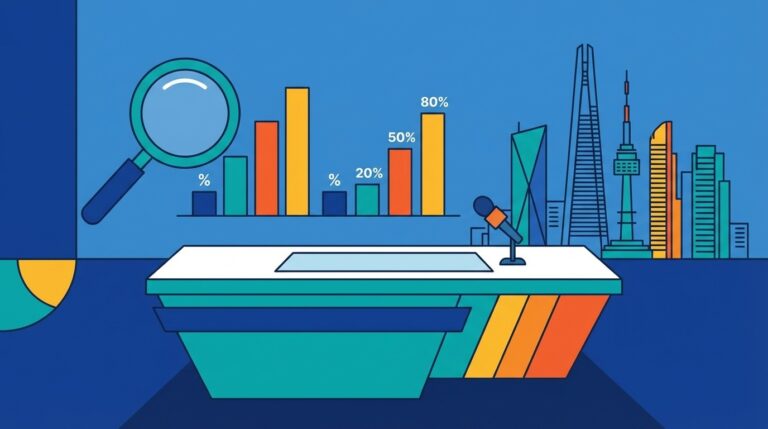
- K-Culture Moment: During election night broadcasts on KBS or MBC, anchor desks with massive, flashy CGI graphics will constantly repeat this phrase when two candidates are neck-and-neck.
- Editor’s Insight: 오차 means “error,” and 범위 means “range.” When someone panics over a 1% difference in a poll, calmly dropping this phrase makes you sound like a seasoned political analyst.
- Situation Spectrum:
[🚫 절대 금지] ———— [⚠️ 주의] ———— [✅ 자유롭게]
- Casual with friends: ✅
- Coworkers (Semi-formal): ✅
- Boss/Elders (Formal): ✅ (It’s a statistical fact, so it’s safe!)
- 🤔 Think About It: In Korea’s fast-paced “Palli-Palli” culture, news outlets rush to publish poll results. Does your country emphasize the “margin of error” as heavily as Korea does during elections?
3. 여론을 호도하다
- Pronunciation: [Yeo-ron-eul ho-do-ha-da]
- Meaning: To mislead/distort public opinion.
- K-Culture Moment: This isn’t just for politics! In the K-Pop world, when an entertainment agency releases a dubious press statement to cover up an idol’s scandal, fans will trend hashtags accusing the company of “여론 호도” (misleading the public).
- Editor’s Insight: This is a top-tier C1/C2 vocabulary word. 여론 (public opinion) + 호도하다 (to gloss over/mislead). Use this when you want to sound incredibly eloquent and critical of media manipulation.
- Situation Spectrum:
[🚫 절대 금지] ———— [⚠️ 주의] ———— [✅ 자유롭게]
- Casual with friends: ⚠️ (Might sound a bit too academic for a pub)
- Coworkers (Semi-formal): ✅
- Formal debates/Writing: ✅✅✅ (Perfect for essays or formal discussions)
- 🤔 Think About It: Language holds power. Using a Hanja-based word like 호도하다 carries more weight than just saying “거짓말이다” (It’s a lie). How does formal vocabulary change the tone of a debate in your native language?
Phase 3: Textbook vs. Real Korean
Let’s compare what you learned in your university Korean class with what you’ll actually hear in a Yeouido cafe.
| Situation | 📖 Textbook Korean | 🗣️ Real Korean | 💡 Why the difference? |
|---|---|---|---|
| Doubting a poll | 이 여론 조사는 틀린 것 같습니다. (I think this poll is wrong.) | 이거 표본이 편향된 거 아니에요? (Isn’t this sample biased?) | Koreans prefer to question the method rather than just calling something flat-out wrong. |
| Close race | 두 사람의 지지율이 비슷합니다. (The two people’s approval ratings are similar.) | 오차범위 내 접전이네요. (It’s a close battle within the margin of error.) | Media jargon heavily influences daily vocabulary, especially during election season. |
| Undecided voters | 아직 결정하지 않은 사람들이 중요합니다. (People who haven’t decided are important.) | 결국 부동층 표심이 관건이죠. (Ultimately, the swing voters’ minds are the key.) | 부동층 (Swing voters) and 관건 (Key factor) are standard advanced terms used in news. |
Phase 4: Cultural Context — K-Culture Deep Dive
4-1. The Non-Verbal “Nunchi” of Politics
In Korea, politics is deeply polarized (often divided by generation and region). When discussing polls or elections, eye contact and tone are crucial. Avoid speaking too loudly or aggressively. A common tactic is to use indirect endings like “~지 않을까요?” (Wouldn’t you say…?) or “~는 편인 것 같아요” (It seems to lean towards…) to soften your stance.
4-2. K-Drama & Media Connection
If you’ve watched K-Dramas like Pinocchio or Argon, you know that the “corrupt media manipulating public opinion” is a massive trope. But this stems from reality. Korea has a highly digitized, hyper-connected society where “real-time search rankings” (실시간 검색어 – though mostly abolished now) and portal main pages can make or break a political campaign.
Another uniquely Korean concept is the 깜깜이 기간 (Blackout Period)—literally the “pitch-black period.” Usually, 6 days before an election, publishing new poll results is strictly banned to prevent the “Bandwagon effect” (people voting for the winning side) or the “Underdog effect.”
Phase 5: Real-Life Roleplay Scenario
Setting: A Friday evening at a trendy cafe near the National Assembly in Yeouido. You are sipping an iced Americano with your Korean coworker, Min-su.
Characters:
– YOU: A foreign expat working in Seoul, interested in Korean society.
– Min-su (34): Your friendly coworker who compulsively checks Naver News.
Dialogue:
Min-su: (Sighs while looking at his phone) 아, 이번 여론 조사 결과 봤어요? 진짜 말도 안 돼.
(Ah, ibeon yeo-ron jo-sa gyeol-gwa bwas-seo-yo? Jin-jja mal-do an dwae.)
Ah, did you see the results of this public opinion poll? This makes absolutely no sense.
YOU: 왜요? 지지율이 많이 떨어졌어요?
(Wae-yo? Ji-ji-yul-i man-i tteo-reo-jyeot-seo-yo?)
Why? Did the approval rating drop a lot?
Min-su: 네, 갑자기 5%나 차이가 나네요. 이거 분명히 특정 연령대만 조사한 걸 거예요.
(Ne, gap-ja-gi o-pro-na cha-i-ga na-ne-yo. I-geo bun-myeong-hi teuk-jeong yeon-ryeong-dae-man jo-sa-han geol geo-ye-yo.)
Yeah, suddenly there’s a 5% gap. They definitely only surveyed a specific age group for this.
🔀 Your Turn! How should you respond?
– A) “거짓말이에요. 뉴스 믿지 마세요.” (It’s a lie. Don’t believe the news.)
– B) “에이, 근데 아직 표본 오차 범위 안이잖아요. 부동층도 많고요.”
– C) “민수 씨는 누구 뽑을 거예요?” (Who are you going to vote for, Min-su?)✅ Best Choice: B — “Hey, but it’s still within the margin of error. And there are plenty of swing voters.” This shows empathy but applies critical, objective thinking using advanced vocabulary.
⚠️ Choice A Analysis: Too blunt and dismissive.
🚫 Choice C Analysis: CRITICAL MISTAKE. In Korea, asking “Who are you voting for?” is considered highly inappropriate and invasive (비밀 투표 – secret ballot principle).
Min-su: 맞아요. 표본이 좀 편향된 것 같긴 해요. 끝까지 가봐야 알겠죠.
(Ma-ja-yo. Pyo-bon-i jom pyeon-hyang-doen geot gat-gin hae-yo. Kkeut-kka-ji ga-bwa-ya al-get-jyo.)
You’re right. The sample does seem a bit biased. We’ll only know when it goes to the very end.
Phase 6: 10-Second Shadowing Drill
Read this aloud to perfect your C1 rhythm! Pause at the slashes.
😤 이 여론 조사는 / 표본이 / 너무 편향된 거 아니에요?
(i yeo-ron jo-sa-neun / pyo-bon-i / neo-mu pyeon-hyang-doen geo a-ni-e-yo?)
Isn’t the sample for this poll / way too biased?
Phase 7: K-Culture Mini Dictionary
| Korean | Romanization | English | Context |
|---|---|---|---|
| 여론 | yeo-ron | Public opinion | The collective sentiment of the public, heavily monitored in Korea. |
| 지지율 | ji-ji-yul | Approval rating | Often tracked weekly for the President or political parties. |
| 부동층 | bu-dong-cheung | Swing voters | Literally “floating class.” The undecided voters who decide elections. |
| 출구조사 | chul-gu-jo-sa | Exit poll | A massive TV event in Korea. Broadcasters spend millions on flashy graphics for exit polls. |
| 팩트체크 | paek-teu-che-keu | Fact-check | Directly borrowed from English, heavily used by Korean news anchors. |
Phase 8: Traveler Survival Kit (Election Season Edition)
What happens when your trip to Korea aligns with an election period? You won’t be looking at data; you’ll be experiencing the loudest, most unique campaigns in the world!
🆘 Survival Phrases for Election Rallies (유세장)
– 🇰🇷 “여기 무슨 행사 해요?” (yeo-gi mu-seun haeng-sa hae-yo?)
– Meaning: Is there an event happening here?
– 🇰🇷 “길이 통제됐나요?” (gi-ri tong-je-dwaet-na-yo?)
– Meaning: Is the road blocked off?📌 Editor’s Travel Note:
If you visit Gwanghwamun or City Hall on weekends during an election season, you will see massive political rallies. Unlike in many western countries, Korean campaign rallies feature customized K-pop songs and synchronized backup dancers! However, buses are often detoured, so always check your Naver Map app for live traffic updates.
Phase 9: Critical Thinking — “One Step Deeper”
🧠 Media vs. Reality: The Illusion of Numbers
In Korea, public opinion polls are published almost daily by various organizations. However, because many surveys are conducted via automated phone calls (ARS) during working hours, the respondents tend to be heavily skewed toward older generations or highly politically engaged individuals. This leads to a phenomenon where the “published numbers” do not always reflect the “real sentiment” of the streets. As a C1 learner, recognizing the gap between news representation and actual reality is crucial when consuming Korean media.
💬 Your Turn: Does the media in your country have a strong influence on public opinion through constant polling? Share your thoughts in the comments below!
Phase 10: FAQ & Avoiding Common Mistakes
Q: Can I use terms like ‘여론 호도’ (misleading public opinion) in casual settings?
A: Yes, but with a caveat. It sounds very intellectual. If you use it while complaining about an idol’s agency handling a scandal, your Korean friends will be deeply impressed by your sophisticated vocabulary.
Q: Is it okay to debate politics with a taxi driver?
A: Maybe, but tread lightly. Many older taxi drivers love discussing the news. The safest approach is to use active listening (맞아요, 그렇군요) rather than strongly opposing their views, as it can lead to an uncomfortable ride.
❌ Common Mistake #1: Asking “누구한테 투표할 거예요?” (Who will you vote for?)
✅ Do this instead: Ask about the general atmosphere. “이번 선거 분위기가 어때요?” (How is the atmosphere for this election?)
Phase 11: Summary & Action Items
One-Liner Summary: To analyze Korean polls like an insider, question the methodology (표본 편향) and understand the boundaries of the data (오차 범위).
🎯 Action Missions:
– 🥉 Bronze (Solo): Read a Korean news headline about an election today and try to spot the word ‘지지율’ (Approval rating).
– 🥈 Silver (Online): Find a YouTube video of a Korean news broadcast and leave a comment: “오차 범위 내 접전이네요!”
– 🥇 Gold (Real World): The next time your Korean friend mentions a shocking news statistic, drop the phrase: “그거 표본이 편향된 거 아니에요?”
Phase 12: Interactive Challenge (Quiz)
1. Fill in the Blank:
“뉴스에서 A후보가 이기고 있다고 하지만, 사실은 ________ 내 접전입니다.”
(The news says Candidate A is winning, but it’s actually a close battle within the ________.)
a) 깜깜이 기간 (Blackout period)
b) 표본 오차 범위 (Margin of error)
c) 여론 호도 (Misleading opinion)
2. True or False – K-Culture Edition:
“It is completely normal and polite to ask your Korean boss who they voted for after an election.”
(Answers: 1. b / 2. False! Voting preferences are highly private in Korea.)
How did you do? Mastering this vocabulary opens up a whole new world of deep, intellectual conversations with Koreans. Until next time, keep studying with Daily Hangul!
Frequently Asked Questions (FAQ)
Q: What does "표본이 편향되다" mean in Korean and how do you pronounce it?
A: In Korean, "표본이 편향되다" is pronounced [Pyo-bon-i pyeon-hyang-dwe-da] and means: The sample is biased.
Q: What does "표본 오차 범위 안이다" mean in Korean and how do you pronounce it?
A: In Korean, "표본 오차 범위 안이다" is pronounced [Pyo-bon o-cha beom-wi an-i-da] and means: It is within the margin of error.
Q: What does "여론을 호도하다" mean in Korean and how do you pronounce it?
A: In Korean, "여론을 호도하다" is pronounced [Yeo-ron-eul ho-do-ha-da] and means: To mislead/distort public opinion.







