

Phase 1: Empathy (Welcome to the Real Korea!)
Hello! I’m your Daily Hangul Editor, your local Korean friend and veteran language tutor.
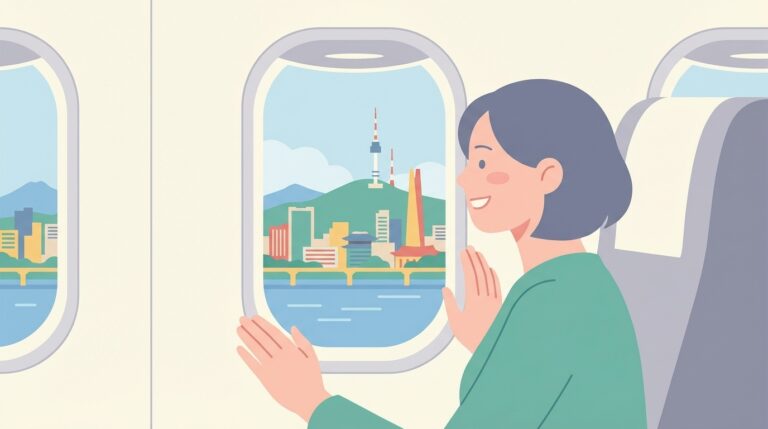
Imagine this: You are finally flying to Seoul. You’ve binge-watched over 200 K-Dramas, memorized your favorite K-Pop lyrics, and now, you are at the airport check-in counter. You want that aesthetic K-Drama moment—staring out the airplane window as you descend over the glowing Seoul skyline. But when the airline staff asks you where you want to sit… your mind goes blank. You freeze. You nod politely. And boom—you are stuck in the middle seat for 14 hours between two sleeping strangers.
We’ve all been there! Knowing how to ask for a window seat isn’t just about vocabulary; it’s about claiming your space and starting your K-Travel adventure right. Today, I’ll teach you the magic words to get that perfect seat, based on real mistakes my beginner students have made. Let’s dive in!
Phase 2: Deep Dive into Core Expressions
Here are the absolute must-know phrases for the check-in counter. They are short, sweet, and highly effective.
1. 창가 자리 주세요 (Window seat, please)
- Pronunciation: chang-ga ja-ri ju-se-yo [Sounds like: ‘chang-ga’ (cha-cha with an ng) + ‘ja-ri’ (jolly with an r) + ‘ju-se-yo’ (juice-say-yo)]
- Meaning: Please give me a window seat.
- K-Culture Moment: This is the phrase that starts every K-travel vlog. You get your boarding pass, head to the gate, and take that iconic photo of your passport against the window.
- Editor’s Insight: ‘주세요’ (ju-se-yo) is your magic wand in Korea. It literally means ‘please give me.’ You can attach it to almost any noun!
- Situation Spectrum:
[🚫 Do Not Use] ———— [⚠️ Caution] ———— [✅ Freely Use]
- Close Friends (Casual): ⚠️ (Friends use a shorter version: 창가 자리 줘)
- Service Staff (Semi-formal): ✅
- Elders/Boss (Formal): ✅
- 🤔 Think About It: In English, we usually say ‘I would like a window seat.’ But Koreans say ‘Window seat, give me.’ Why do you think Korean uses a direct request format rather than stating a personal desire?
2. 통로 자리 주세요 (Aisle seat, please)
- Pronunciation: tong-no ja-ri ju-se-yo [Sounds like: ‘tong-no’ (tongue-no)]
- Meaning: Please give me an aisle seat.
- K-Culture Moment: Koreans are famous for their ‘빨리빨리’ (ppalli-ppalli / hurry-hurry) culture. Many Korean business travelers prefer the aisle seat so they can jump up and be the first ones out of the plane!
- Editor’s Insight: ‘통로’ is spelled ‘tong-ro’, but because of Korean sound change rules, we pronounce it ‘tong-no’. It flows much smoother!
- Situation Spectrum:
[🚫 Do Not Use] ———— [⚠️ Caution] ———— [✅ Freely Use]
- Safe for all polite service interactions: ✅
3. 수하물 있어요 (I have baggage to check in)
- Pronunciation: su-ha-mul i-sseo-yo [Sounds like: ‘soo-ha-mool ee-so-yo’]
- Meaning: I have luggage.
- K-Culture Moment: You’ll definitely need this phrase on your way BACK from Korea, when your suitcase is overflowing with K-Beauty face masks and snacks from Lotte Mart!
- Editor’s Insight: ‘있어요’ (i-sseo-yo) means ‘I have’ or ‘it exists.’ Just like ‘주세요’, it is an absolute lifesaver for A1 beginners.
Phase 3: Textbook vs. Real Korean
Let’s see why the textbook can sometimes make you sound like a polite robot.
| Situation | 📖 Textbook Korean | 🗣️ Real Korean | 💡 Why is it different? |
|---|---|---|---|
| Asking for a seat | 저는 창가 쪽 좌석을 원합니다. (I want a seat on the window side.) | 창가 자리 주세요! (Window seat, please!) | Real Korean drops the subject (‘I’) and uses shorter, practical nouns in service settings. |
| Handing over baggage | 제 수하물을 부치고 싶습니다. (I would like to check in my luggage.) | 수하물 있어요. (I have baggage.) | Airports are busy! ‘Ppalli-ppalli’ culture values quick, clear, and polite communication. |
Phase 4: Cultural Context — K-Culture Deep Dive
4-1. The Non-Verbal Secret: Two Hands!
When you step up to the check-in counter, don’t just slide your passport with one hand. In Korean culture, handing over items (like passports, credit cards, or gifts) to someone you don’t know requires two hands. You can either hold the passport with both hands, or hand it over with your right hand while your left hand lightly supports your right wrist. It’s a tiny gesture, but the airport staff will instantly think, ‘Wow, this person knows Korean culture!’
4-2. K-Travel Link: The ‘Hurry-Hurry’ Airport Vibe
Incheon International Airport is repeatedly ranked as one of the best and fastest airports in the world. This is heavily influenced by Korea’s 빨리빨리 (Ppalli-ppalli) culture. Everything from immigration to luggage claim is optimized for speed. Therefore, when you speak at the counter, long and poetic sentences aren’t necessary. Clear, polite requests with ‘주세요’ (ju-se-yo) are exactly what the staff appreciates most. Keep it brief, polite, and efficient!
Phase 5: Real-Life Roleplay Scenario
Setting: Incheon International Airport Terminal 1 Check-in Counter. The line is moving fast. You step up to the counter with your passport and your heavy suitcase full of Korean souvenirs.
Characters:
– YOU: An excited traveler finishing a great trip in Seoul.
– Staff (지수, 28): A friendly but very efficient airline agent.
Staff: 안녕하세요, 여권 주세요.
(an-nyeong-ha-se-yo, yeo-gwon ju-se-yo.)
(Hello, passport please.)
YOU: 네, 여기 있어요.
(ne, yeo-gi i-sseo-yo.)
(Yes, here it is.)
(🎭 Stage Direction: You hand over your passport using both hands!)
Staff: 감사합니다. 수하물 있으세요?
(gam-sa-ham-ni-da. su-ha-mul i-sseu-se-yo?)
(Thank you. Do you have luggage?)
YOU: 네, 하나 있어요.
(ne, ha-na i-sseo-yo.)
(Yes, I have one.)
Staff: 네, 올려주세요. 좌석은 어디로 해 드릴까요?
(ne, ol-lyeo-ju-se-yo. jwa-seo-geun eo-di-ro hae deu-ril-kka-yo?)
(Yes, please put it up. Where would you like your seat?)
🔀 YOUR TURN! How do you answer?
– A) “창가 자리 주세요!” (Window seat, please!)
– B) “통로 자리 주세요!” (Aisle seat, please!)
– C) “아무데나 주세요.” (Anywhere is fine.)✅ Best Choice: A or B! Depending on your preference.
⚠️ Choice C Analysis: While polite, ‘anywhere’ might land you right in the middle seat. Don’t be shy—state what you want with ‘주세요’!
YOU: 창가 자리 주세요.
(chang-ga ja-ri ju-se-yo.)
(Window seat, please.)
Staff: 네, 창가 자리로 배정해 드렸습니다. 즐거운 여행 되세요!
(ne, chang-ga ja-ri-ro bae-jeong-hae deu-ryeot-seum-ni-da. jeul-geo-un yeo-haeng doe-se-yo!)
(Yes, I’ve assigned a window seat. Have a great trip!)
Phase 6: 10-Second Shadowing Drill
Speak out loud! Follow the pause (/) and try to match the emotion.
😊 밝게 (Brightly): 창가 자리 / 주세요!
(chang-ga ja-ri / ju-se-yo!)
💼 단호하게 (Clearly): 통로 자리 / 주세요!
(tong-no ja-ri / ju-se-yo!)
🙋♀️ 자신있게 (Confidently): 수하물 / 하나 / 있어요!
(su-ha-mul / ha-na / i-sseo-yo!)
Phase 7: K-Culture Mini Dictionary
| Korean | Romanization | English | Contextual Meaning |
|---|---|---|---|
| 여권 | yeogwon | Passport | The first thing you’ll be asked for anywhere at the airport. |
| 수하물 | suhamul | Luggage | Specifically checked baggage. For carry-on, Koreans often use ‘기내 수하물’. |
| 빨리빨리 | ppalli-ppalli | Hurry-hurry | The fast-paced mindset driving modern Korean society. |
| 눈치 | nunchi | Social awareness | Reading the room. In this case, stepping up quickly when it’s your turn in line! |
Phase 8: Traveler Survival Kit
🆘 Survival Expressions for the Airport / Transit
– 🇰🇷 1. 화장실 어디예요? (hwa-jang-sil eo-di-ye-yo?)
– 🗣️ Meaning: Where is the restroom?
– 🇰🇷 2. 이거 얼마예요? (i-geo eol-ma-ye-yo?)
– 🗣️ Meaning: How much is this? (Great for duty-free shops!)
– 🇰🇷 3. 게이트 어디예요? (ge-i-teu eo-di-ye-yo?)
– 🗣️ Meaning: Where is the gate?📌 Editor’s Travel Note
– Useful App: Download ‘Incheon Airport+’ app for real-time gate changes, or ‘Papago’ for the best Korean translation.
– Tipping: THERE IS NO TIPPING IN KOREA! Do not tip the airport staff, taxi drivers, or restaurant waiters. They might chase you down thinking you forgot your money!
Phase 9: Critical Thinking Corner — “One Step Deeper”
Language & Power: The Magic of ‘주세요 (Ju-se-yo)’
In many Western cultures, saying ‘Give me…’ to a service worker sounds extremely rude and demanding. We soften it with ‘Could I possibly have…’ or ‘I would like…’. However, in Korea, ‘주세요’ is completely polite as long as it has ‘요 (yo)’ at the end. The ‘요’ particle instantly elevates your speech to a polite register, showing respect to the listener. It reflects a culture that values both strict social hierarchy (politeness) and clear, practical communication (efficiency).
💬 Your Turn: Does your native language have a ‘magic word’ like ‘요’ that instantly makes a sentence polite? Let me know in the comments!
Phase 10: FAQ & Avoiding Misunderstandings
Q: Can I just say ‘창가’ without ‘주세요’?
No! Just saying ‘창가’ (Window) sounds like you are dropping formal speech (반말 – casual speech). Unless the staff is your childhood best friend, always attach ‘주세요’ (ju-se-yo) to be polite.
Q: What if the staff asks me a long question I don’t understand?
Don’t panic! Just say: “죄송해요, 한국어 잘 못해요” (joe-song-hae-yo, han-gu-geo jal mo-tae-yo – Sorry, I don’t speak Korean well). Incheon Airport staff speak excellent English!
❌ Common Mistake: Translating “I want” directly to “나는 원해 창가 자리”.
✅ Do This Instead: Throw away the English sentence structure. Just say the noun + 주세요. (창가 자리 주세요).
Phase 11: Summary & Action Items
One-Liner Summary: To get the seat you want and check your bags, just remember your magic wand: Noun + 주세요 (Ju-se-yo)!
Action Mission:
– 🥉 Bronze (Solo): Stand in front of the mirror, hold your passport with two hands, and practice saying “창가 자리 주세요” 3 times.
– 🥈 Silver (Online): Look up the seating map of your favorite airline in Korean. Find the word ‘창가’.
– 🥇 Gold (Real Life): Next time you fly to Korea, or even at a Korean cafe, use ‘주세요’ to order something!
K-Culture Mission:
Go to YouTube and search for an ‘Incheon Airport Vlog’ (인천공항 브이로그). See if you can spot the ‘빨리빨리’ (Hurry hurry) vibe!
Phase 12: Quiz — Interactive Challenge
1. Situational Judgment: You are at the check-in counter and want to sit next to the aisle so you can stretch your legs. What should you say?
– A) 창가 자리 주세요.
– B) 통로 자리 주세요.
– C) 화장실 어디예요?
2. True or False — K-Culture Edition:
“If the airline staff gives you a free upgrade to a better seat, you should give them a $10 tip to say thank you.”
3. Fill in the Blank:
Staff: “수하물 있으세요?” (Do you have luggage?)
You: “네, ____________.” (Yes, I have it.)
🚨 Click here to see the answers!
- B) 통로 자리 주세요. (A is window seat, C is asking where the restroom is!)
- False! There is no tipping culture in Korea. Tipping will cause confusion!
- 있어요 (i-sseo-yo). It means “I have” or “It exists.”
Frequently Asked Questions (FAQ)
Q: What does "창가 자리 주세요 (Window seat, please)" mean in Korean and how do you pronounce it?
A: In Korean, "창가 자리 주세요 (Window seat, please)" is pronounced [chang-ga ja-ri ju-se-yo [Sounds like: 'chang-ga' (cha-cha with an ng] and means: Please give me a window seat.
Q: What does "통로 자리 주세요 (Aisle seat, please)" mean in Korean and how do you pronounce it?
A: In Korean, "통로 자리 주세요 (Aisle seat, please)" is pronounced [tong-no ja-ri ju-se-yo [Sounds like: 'tong-no' (tongue-no] and means: Please give me an aisle seat.
Q: What does "수하물 있어요 (I have baggage to check in)" mean in Korean and how do you pronounce it?
A: In Korean, "수하물 있어요 (I have baggage to check in)" is pronounced [su-ha-mul i-sseo-yo [Sounds like: 'soo-ha-mool ee-so-yo'] and means: I have luggage.







