

Phase 1: Empathy (Welcome to the Real Korea)
Hello! I’m your Senior Editor from Daily Hangul.
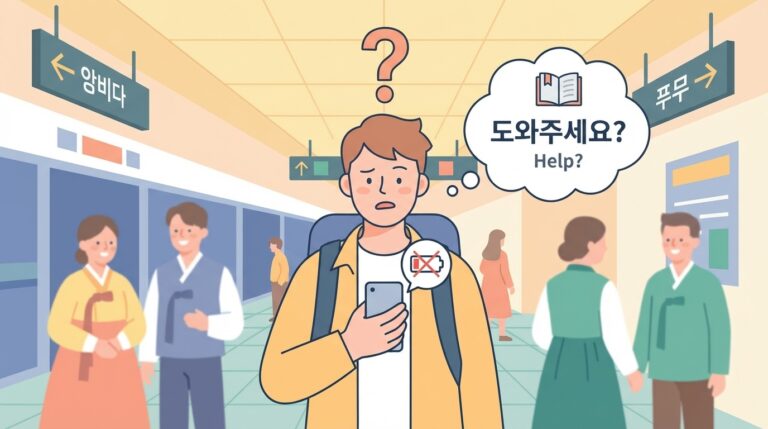
Picture this: You are standing in the middle of a bustling Seoul street. Maybe it’s Myeongdong, and your map app says you’ve “arrived,” but all you see are cosmetic shops and neon signs. Your phone battery is at 1%. Panic sets in.
In a K-Drama, this is the exact moment a handsome lead swoops in, catches your falling shopping bags, and perfectly understands your situation. But in reality? Everyone is walking fast, eyes glued to their smartphones, holding their iced Americanos. You need to ask for help, but you freeze. What do you say?
If you just yell “Help me!” like you learned in a textbook, people might think there’s a serious crime happening and either panic or run away!
Today, we are going to learn how to ask for help in Korean—from a simple “Excuse me, I’m lost” to a real “Emergency!” This guide is crafted from the actual experiences of my A2 students who survived the vibrant, sometimes chaotic streets of Korea. Let’s make you a confident insider!
Phase 2: Core Expressions Deep Dive
Let’s look at the absolute must-know phrases when you need assistance.
1. 저기요 (Excuse me)
- Pronunciation: jeo-gi-yo [Sounds like: juggy-yo]
- Meaning: Over there (Literal) / Excuse me to get attention (Real nuance)
- K-Culture Moment: You’ll hear this constantly in K-Dramas. Whether a detective is stopping a suspect on the street, or a hungry customer is calling the waiter at a noisy K-BBQ restaurant (“Jeogiyo! One more Soju please!”), this is your ultimate attention-grabber.
- Editor’s Insight: Think of this as “Hey, look here!” It’s a bit direct. Use it to catch someone’s attention before asking a question. However, don’t use it to call someone older than you if you already know them!
- Situation Spectrum:
[🚫 Never] ———— [⚠️ Caution] ———— [✅ Freely]
- Strangers on the street: ✅
- Restaurant waiters: ✅
- Your boss or a teacher: 🚫
- 🤔 Think About It: In Korean culture, addressing someone directly by “You” is often considered rude. Why do you think Koreans use a spatial word like “Over there” (저기) to call someone’s attention?
2. 실례합니다 (Excuse me – Formal)
- Pronunciation: shil-lye-ham-ni-da [Sounds like: shill-leh-ham-nee-da]
- Meaning: I am committing a discourtesy (Literal) / Excuse me, I’m sorry to interrupt (Real nuance)
- K-Culture Moment: This is the polite, gentle way to interrupt someone. In a classy K-Drama office scene, a junior employee will knock on the CEO’s door and say this before entering.
- Editor’s Insight: If
저기요is tapping a glass with a spoon,실례합니다is a gentle knock on the door. It’s the safest, most polite way to stop a stranger to ask for directions.- Situation Spectrum:
[🚫 Never] ———— [⚠️ Caution] ———— [✅ Freely]
- Strangers (especially older): ✅
- Official places (Subway info desk, Police): ✅
- Close friends: 🚫 (Too stiff!)
- 🤔 Think About It: Notice how the literal meaning is “I am committing a fault.” How does apologizing before asking for help reflect the Korean value of respecting others’ time?
3. 도와주세요 (Please help me)
- Pronunciation: do-wa-ju-se-yo [Sounds like: dough-wah-joo-seh-yo]
- Meaning: Please give me help (Literal) / Help me! (Real nuance)
- K-Culture Moment: The classic thriller drama scene. The protagonist is cornered in a dark alley and screams this. Or, in a cute rom-com, someone holding a huge stack of wobbly boxes might whine this to a coworker.
- Editor’s Insight: Be careful! If you shout this on the street, people will think it’s a 911-level emergency. Only use it when you actually need urgent physical assistance or are in danger. If you just need directions, say “길 좀 물어볼게요” (I’d like to ask for directions).
- Situation Spectrum:
[🚫 Never] ———— [⚠️ Caution] ———— [✅ Freely]
- Real emergencies (lost passport, injured): ✅
- Heavy luggage on stairs: ✅
- Asking where the restroom is: 🚫
Phase 3: Textbook vs Real Korean
| Situation | 📖 Textbook Korean | 🗣️ Real Korean | 💡 Why is it different? |
|---|---|---|---|
| Stopping a stranger | 도와주시겠습니까? (Would you help me?) | 저기요, 죄송한데요… (Excuse me, I’m sorry but…) | Koreans soften the burden of a request by apologizing first for taking up your time. |
| Asking for directions | 은행이 어디에 있습니까? (Where is the bank?) | 길 좀 물어볼게요. 은행 어디에요? (Let me ask a direction. Where is the bank?) | “좀” (a little) is used to make the request sound smaller and less demanding. |
| Real Emergency | 구급차를 불러주세요. (Please call an ambulance.) | 살려주세요! / 119 불러주세요! (Save me! / Call 119!) | In true panic, people use raw survival words or specific numbers (119 is Korea’s 911). |
Bottom Note: For A2 learners, sticking to
죄송한데요...(I’m sorry, but…) is your magic key. It instantly makes you sound like a polite local!
Phase 4: Cultural Context — K-Culture Deep Dive
4-1. Non-verbal Cues: The Art of Approaching
In Korea, body language speaks volumes. When you ask a stranger for help:
– Do NOT tap them on the shoulder. Physical touch with strangers is generally avoided in Korea.
– The ‘Nunchi’ Approach: Step into their line of sight, bow your head slightly, and wave your hand gently to get their attention.
– The Two-Hand Rule: If you are showing them your phone map, hold your phone with both hands. It instantly triggers a “polite foreigner” impression, and they will be 10x more willing to help!
4-2. The K-Travel Reality
Koreans often have what tourists call the “Seoul Face”—they look busy, serious, and might be walking at the speed of light with AirPods in. Don’t be intimidated! This is just the “urban commuting face.” Once you say “저기요, 죄송한데요…” (Excuse me, I’m sorry but…), 90% of Koreans will stop, take out their earphones, and go out of their way to help you. Some might even walk you to your destination!
Phase 5: Real-Life Roleplay Scenario
Scenario A: The Dead Battery Panic
Setting: Friday night, 8 PM. Inside the sprawling, maze-like Hongdae Subway Station. You are supposed to meet your friends, but your phone battery is at 1% and you are totally lost.
Characters:
– YOU: A foreign traveler in panic mode.
– Minji (20s): A friendly Korean university student passing by with AirPods in.
Dialogue:
YOU: 저기요! 실례합니다.
(jeogiyo! sillyehamnida.)
[Excuse me! Excuse me.]
(🎭 Stage Direction: You step slightly in front of her and bow your head lightly)
Minji: 네?
(ne?)
[Yes?]
(🎭 Stage Direction: Minji looks surprised and takes out one AirPod)
YOU: 죄송한데요… 제가 길을 잃어버렸어요.
(joesonghandeyo… jega gireul ileobeoryeosseoyo.)
[I’m sorry, but… I lost my way.]
Minji: 아, 어디 가세요?
(a, eodi gaseyo?)
[Ah, where are you going?]
YOU: 홍대 9번 출구 가야 돼요.
(hongdae gubeon chulgu gaya dwaeyo.)
[I have to go to Hongdae Exit 9.]
Minji: 아~ 9번 출구요?
(a~ gubeon chulguyo?)
[Ah~ Exit 9?]
YOU: 네, 그런데 핸드폰 배터리가 없어요.
(ne, geureonde haendeupon baeteoriga eopseoyo.)
[Yes, but my phone battery is dead.]
Minji: 저쪽으로 쭉 가서 오른쪽으로 가세요.
(jeojjogeuro jjuk gaseo oreunjjogeuro gaseyo.)
[Go straight that way and go to the right.]
🔀 Your Turn! How should you reply?
– A) “아, 오케이. 바이!” (Ah, okay. Bye!)
– B) “정말 감사합니다!” (Thank you so much!)
– C) “도와주세요!” (Please help me!)✅ Best Choice: B — Always show profound gratitude! A slight bow while saying “정말 감사합니다” will make her smile.
⚠️ Choice C Analysis: You already got the help! Shouting “Help me” now would confuse her.
YOU: 아! 정말 감사합니다!
(a! jeongmal gamsahamnida!)
[Ah! Thank you so much!]
Minji: 네, 조심해서 가세요~
(ne, josimhaeseo gaseyo~)
[Yes, have a safe trip~]
Scenario B: K-Food Bonus Roleplay
Setting: A loud K-BBQ restaurant. You need a new grill plate because your pork belly is burning!
YOU: 저기요! 사장님! (jeogiyo! sajangnim!) [Excuse me! Boss!]
Owner: 네~ (ne~) [Yes~]
YOU: 여기 불판 좀 갈아주세요! (yeogi bulpan jom garajuseyo!) [Please change the grill plate here!]
Owner: 네, 바로 갈아드릴게요! (ne, baro garadeurilkkeyo!) [Yes, I’ll change it right away!]
Phase 6: 10-Second Shadowing Drill
Let’s practice the most natural way to ask a stranger for help. Pay attention to the pauses (/) and emotions!
🥺 Polite & Hesitant:
저기요, / 죄송한데요… / 길 좀 / 물어볼게요.
(jeo-gi-yo, / joe-song-han-de-yo… / gil jom / mu-reo-bol-ge-yo.)
Excuse me, / I’m sorry but… / I’d like to ask for directions.
Phase 7: K-Culture Mini Dictionary
| Korean | Romanization | English | Contextual Meaning |
|---|---|---|---|
| 눈치 | nunchi | Social sense | The core Korean social skill of reading the room and sensing others’ moods. |
| 길치 | gilchi | Bad with directions | A funny slang word for someone who always gets lost. (길 = road, 치 = idiot) |
| 방전 | bangjeon | Battery dead | Literally means “discharged.” Used when your phone (or your energy) dies. |
| 사장님 | sajangnim | Boss/Owner | The magic word to call any restaurant owner or staff respectfully. |
Phase 8: Traveler Survival Kit
If you remember nothing else from this lesson, save this to your phone!
🆘 Survival Phrases TOP 3
– 🇰🇷 “영어로 말씀하셔도 되나요?” (yeongeoro malsseumhasyeodo doenayo?)
– 🗣️ Meaning: Can you speak English?
– 🇰🇷 “제 지갑/여권을 잃어버렸어요.” (je jigap/yeogwoneul ileobeoryeosseoyo.)
– 🗣️ Meaning: I lost my wallet/passport.
– 🇰🇷 “경찰서/병원이 어디에요?” (gyeongchalseo/byeongwoni eodieyo?)
– 🗣️ Meaning: Where is the police station/hospital?📌 Editor’s Travel Note
– Emergency Numbers: 112 for Police, 119 for Fire/Ambulance.
– Korea Travel Helpline: Dial 1330. They offer 24/7 free translation and travel assistance in English, Japanese, and Chinese! It’s a lifesaver.
– Map Apps: Google Maps doesn’t work well for walking in Korea. Download Naver Map or KakaoMap before you arrive.
Phase 9: Critical Thinking Corner — “One Step Deeper”
Media vs Reality: The ‘Cold’ City Myth
In many K-Dramas, Seoul is depicted either as a romantic paradise where destined encounters happen, or a cold metropolis where everyone ignores each other. When you visit, you might initially feel the latter because Koreans generally do not smile at strangers or make small talk on the subway. However, this isn’t unfriendliness—it’s a cultural respect for privacy in a very densely populated city. The moment you break the ice with a polite “실례합니다” (Excuse me), you activate their innate hospitality (called ‘Jeong’ – 정). They will switch from ignoring you to actively trying to solve your problem.
💬 Your Turn: In your home country, is it common to smile and make small talk with strangers on the street? How do people react when a tourist asks for help? Let me know in the comments!
Phase 10: FAQ & Misunderstanding Prevention
Q: Can I use “저기요” to my boss or teacher if I need their help?
No! “저기요” is strictly for strangers (like waiters or people on the street) or friends. Calling your boss “저기요” sounds like “Hey you over there!” Instead, call them by their title (e.g., “선생님!” – Teacher!, or “과장님!” – Manager!).
Q: I can’t speak Korean well. Is it rude to just show them my phone map?
Maybe. Shoving a phone in someone’s face silently is rude worldwide. But if you say “실례합니다” (Excuse me), bow slightly, and show the map using both hands, it becomes very polite!
❌ Common Mistake #1: Screaming “도와주세요!” (Help me!) when you just want to find a cafe. People will look for a criminal.
✅ Do this instead: Say “길 좀 물어볼게요” (I want to ask for directions).
Phase 11: Summary & Action Items
One-Liner Summary: To get help like a local, apologize for interrupting first (“죄송한데요…”) and keep “도와주세요” only for real emergencies.
Action Mission 3 Steps:
– 🥉 Bronze (Solo): Stand in front of a mirror and practice saying “저기요, 죄송한데요…” with an apologetic smile 3 times.
– 🥈 Silver (Online): Leave a comment below using the phrase “길 좀 물어볼게요” and tell us a place you want to visit in Korea!
– 🥇 Gold (Real Life): Next time you visit a Korean restaurant, try calling the waiter by raising your hand and saying confidently: “저기요! 사장님!”
K-Culture Mission:
Watch one episode of a modern K-Drama today. Count how many times you hear the word “저기요”! (Hint: Restaurant scenes are a goldmine for this).
Phase 12: Quiz — Interactive Challenge
1. Situational Judgment: You are at a subway station and your T-money transit card isn’t working. You see a station staff member. What is the BEST way to approach them?
– A) 도와주세요! (Help me!)
– B) 실례합니다. (Excuse me.)
– C) 어이! (Hey!)
2. Fill in the Blank: You want to ask a stranger on the street for directions.
“________, 길 좀 물어볼게요.”
– A) 안녕 (Hello – casual)
– B) 저기요 (Excuse me)
– C) 이름이 뭐예요? (What is your name?)
3. True or False – K-Culture Edition:
If a Korean stranger doesn’t smile at you on the street, it means they dislike foreigners. (T / F)
🚨 Click here for Answers!
1. B – Formal and polite. ‘A’ sounds like a physical emergency, and ‘C’ is extremely rude.
2. B – The perfect attention-grabber for strangers.
3. False – They are just respecting your privacy in a crowded city! Don’t hesitate to ask them for help politely.
Frequently Asked Questions (FAQ)
Q: What does "저기요 (Excuse me)" mean in Korean and how do you pronounce it?
A: In Korean, "저기요 (Excuse me)" is pronounced [jeo-gi-yo [Sounds like: juggy-yo] and means: Over there (Literal) / Excuse me to get attention (Real nuance)
Q: What does "실례합니다 (Excuse me - Formal)" mean in Korean and how do you pronounce it?
A: In Korean, "실례합니다 (Excuse me - Formal)" is pronounced [shil-lye-ham-ni-da [Sounds like: shill-leh-ham-nee-da] and means: I am committing a discourtesy (Literal) / Excuse me, I'm sorry to interrupt (Real nuance)
Q: What does "도와주세요 (Please help me)" mean in Korean and how do you pronounce it?
A: In Korean, "도와주세요 (Please help me)" is pronounced [do-wa-ju-se-yo [Sounds like: dough-wah-joo-seh-yo] and means: Please give me help (Literal) / Help me! (Real nuance)







