

Phase 1: Empathy (The Immersive Open)
Hello! Daily Hangul Editor here.
Picture this: You are watching your favorite K-Drama. The main characters are standing under a streetlamp. Suddenly, a soft white flake falls from the sky. It’s the first snow of winter. The music swells, they look at each other, and you just know a romantic confession is coming. Or maybe you’re watching a K-Pop music video, and the vibrant, energetic summer concept makes you want to teleport straight to a beach in Jeju Island.
Seasons are a massive deal in Korea. From the food we eat to the songs we listen to, everything changes when the weather turns. But what happens when a Korean friend turns to you at a cafe and asks, “So, what’s your favorite season?”
If you freeze up or just smile and nod, you are missing out on one of the easiest, most culturally rich conversation starters in Korea! Today, we are going to learn how to talk about your favorite season. This isn’t just about weather; it’s your golden ticket to becoming an insider. I’ve designed this guide based on real absolute beginners who wanted to sound natural, not like a robotic textbook. Let’s dive in!
Phase 2: Core Expressions Deep Dive
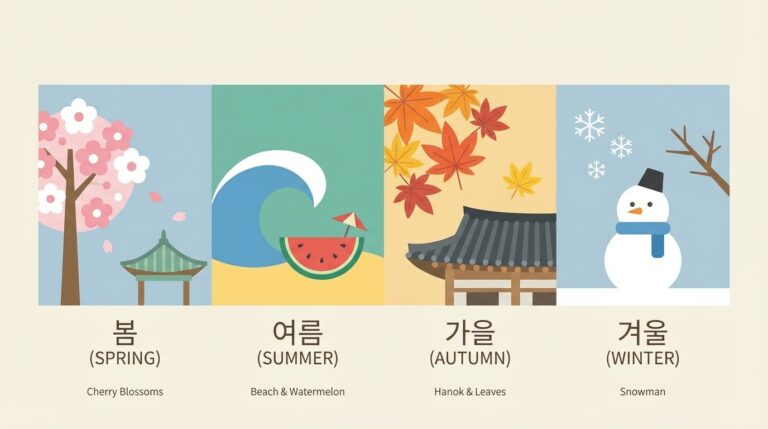
1. 봄, 여름, 가을, 겨울 (The Four Seasons)
- Pronunciation: bom, yeo-reum, ga-eul, gyeo-ul
- 봄 (bom) sounds like “bomb” but without the final ‘b’.
- 여름 (yeo-reum): ‘yeo’ sounds like the start of “yawn”, and ‘reum’ has a soft rolled ‘r’.
- 가을 (ga-eul): ‘eul’ is tricky! The ‘eu’ sounds like the disgusted noise you make when you step in gum.
- 겨울 (gyeo-ul): ‘gyeo’ rhymes with “yo” but with a ‘gy’ sound.
- Meaning: Spring, Summer, Autumn, Winter.
- K-Culture Moment: Koreans are very proud of having four distinct seasons (사계절). If you watch any Korean variety show, you’ll see how every season brings a completely different vibe, wardrobe, and most importantly, food menu!
- Editor’s Insight: Treat these four words like a rhythmic chant. Say them together: bom-yeo-reum-ga-eul-gyeo-ul. It rolls right off the tongue!
- Situation Spectrum:
[🚫 Never] ———— [⚠️ Caution] ———— [✅ Freely]
- Casual / Formal: ✅ (These are just nouns, use them anywhere!)
- 🤔 Think About It: Why do you think Korea places such an emphasis on the changing of seasons in its pop culture and daily conversations?
2. 어느 계절을 좋아해요?
- Pronunciation: eo-neu gye-jeo-reul jo-a-hae-yo?
- eo-neu sounds like “uh-nuh”.
- Meaning: Which season do you like?
- K-Culture Moment: Imagine sitting at a cozy Hanok cafe in Bukchon Village. The leaves are turning red. Your new Korean friend sips their hot tea and asks you this to break the ice.
- Editor’s Insight: This is the ultimate “getting to know you” question. It’s safe, polite, and opens the door to talk about hobbies and food.
- Situation Spectrum:
[🚫 Never] ———— [⚠️ Caution] ———— [✅ Freely]
- Casual with friends: ⚠️ (Friends usually drop the “yo” and say 좋아해?)
- Semi-formal (Co-workers, new acquaintances): ✅
- Formal (Bosses, Elders): ⚠️ (You might want to use more formal honorifics here).
3. 저는 [계절]을/를 좋아해요.
- Pronunciation: jeo-neun [season]-eul/reul jo-a-hae-yo.
- Meaning: I like [season].
- Editor’s Insight: Just plug your favorite season into the bracket! 봄 and 겨울 end in a consonant, so they take 을 (eul). 여름 and 가을 also end in consonants, so they all take 을. Easy!
- Situation Spectrum:
[🚫 Never] ———— [⚠️ Caution] ———— [✅ Freely]
- New friends / Semi-formal: ✅
- 🤔 Think About It: Notice how the verb (좋아해요 – like) comes at the very end of the sentence? In Korean, you have to listen until the end to know what the person is actually doing!
Phase 3: Textbook vs. Real Korean
| Situation | 📖 Textbook Korean | 🗣️ Real Korean | 💡 Why the difference? |
|---|---|---|---|
| Asking “What’s your favorite season?” | 가장 좋아하는 계절이 무엇입니까? | 무슨 계절 제일 좋아해요? | Textbooks teach formal document Korean. Real life uses the softer, casual-polite “yo” form and words like “제일” (best). |
| Saying “I love summer!” | 저는 여름을 매우 좋아합니다. | 여름 완전 좋아해요! / 여름 최애! | Young Koreans love using “완전” (totally) or “최애” (slang for ultimate favorite). |
Bottom Note for A1: Slang like “최애” is fun, but sticking to “[계절] 좋아해요” is the safest and most natural way to sound polite yet friendly!
Phase 4: Cultural Context — K-Culture Deep Dive
4-1. Non-Verbal Nuance: The Art of “Nunchi” in the Weather
When talking about seasons, Koreans often use exaggerated physical reactions. If someone says “I hate summer,” you should nod vigorously, fan yourself with your hand, and say “Ah, ne!” (Ah, yes!). It shows high Nunchi (social awareness and empathy).
4-2. The “First Snow” (첫눈 – Cheot-nun) K-Drama Trope
You cannot talk about winter in Korea without mentioning the “First Snow.” There is a deeply rooted cultural myth—heavily popularized by K-Dramas like Goblin and Reply 1988—that if you confess your love to someone during the first snow of the year, your love will come true. Alternatively, if you make a wish during the first snow, it will be granted.
Critical View: While dramas make it look like everyone is out confessing their love, in reality, the first snow usually just causes a massive traffic jam in Seoul! But the romantic sentiment remains, and you’ll see K-Pop idols immediately post selfies on Weverse or Instagram the moment the first snowflake drops.
Phase 5: Real-Life Roleplay Scenario
Setting: A cozy, aesthetic cafe in Yeonnam-dong, Seoul. It’s late October, and the wind outside is getting chilly. You are having an iced americano with your new Korean language exchange partner.
Characters:
– YOU: A beginner Korean learner, visiting Seoul for the fall foliage.
– Minji (25): Your language partner, warm, talkative, and loves cafes.
Dialogue:
Minji: 우와, 오늘 날씨 진짜 춥네요! 🍂
(u-wa, o-neul nal-ssi jin-jja chum-ne-yo!)
[Wow, the weather is really cold today!]
(🎭 Stage Direction: Minji wraps her scarf tighter and takes a sip of her hot latte.)
YOU: 네, 너무 추워요.
(ne, neo-mu chu-wo-yo.)
[Yes, it’s too cold.]
Minji: 저는 가을이 제일 좋아요. OO씨는 어느 계절을 좋아해요?
(jeo-neun ga-eu-ri je-il jo-a-yo. OO-ssi-neun eo-neu gye-jeo-reul jo-a-hae-yo?)
[I like autumn the best. Which season do you like, OO?]
🔀 Your Turn! How should you reply?
– A) 저는 겨울을 좋아해요! ❄️ (jeo-neun gyeo-u-reul jo-a-hae-yo!)
– B) 너는? (neo-neun?)
– C) 겨울 대박! (gyeo-ul dae-bak!)✅ Best Choice: A — It’s perfectly polite and natural for this level of friendship.
⚠️ Choice B Analysis: “너” means “you” but is ONLY used with close friends of the same age or younger. Using it with a new acquaintance sounds extremely rude!
⚠️ Choice C Analysis: “대박” (Jackpot/Awesome) is fun, but a bit too casual as a standalone answer here.
(Assuming you chose A)
YOU: 저는 겨울을 좋아해요!
(jeo-neun gyeo-u-reul jo-a-hae-yo!)
[I like winter!]
Minji: 아, 겨울이요? 눈을 좋아해요?
(a, gyeo-u-ri-yo? nu-neul jo-a-hae-yo?)
[Ah, winter? Do you like snow?]
YOU: 네, 첫눈이 예뻐요.
(ne, cheon-nu-ni ye-ppeo-yo.)
[Yes, the first snow is pretty.]
Minji: 맞아요! 그리고 겨울에 붕어빵도 정말 맛있어요.
(ma-ja-yo! geu-ri-go gyeo-u-re bung-eo-ppang-do jeong-mal ma-si-sseo-yo.)
[That’s right! And Bungeoppang is really delicious in winter.]
YOU: 붕어빵이 뭐예요?
(bung-eo-ppang-i mwo-ye-yo?)
[What is Bungeoppang?]
Minji: 한국의 겨울 간식이에요. 이따 같이 먹으러 가요!
(han-gu-ge gyeo-ul gan-si-gi-e-yo. i-tta ga-chi meo-geu-reo ga-yo!)
[It’s a Korean winter snack. Let’s go eat it later!]
YOU: 우와, 좋아요!
(u-wa, jo-a-yo!)
[Wow, sounds good!]
Phase 6: 10-Second Shadowing Drill
Practice speaking aloud! Pay attention to the pauses (/) and the feeling.
😊 밝게 (Brightly): 저는 / 겨울을 / 정~~~말 좋아해요!
(jeo-neun / gyeo-u-reul / jeong~~~mal jo-a-hae-yo!)
🥺 애교 섞어서 (Cute/Whiny): 너무 / 추워요~
(neo-mu / chu-wo-yo~)
Phase 7: K-Culture Mini Dictionary
| Korean | Romanization | English | Context |
|---|---|---|---|
| 사계절 | sa-gye-jeol | Four seasons | Korea’s pride and joy, the 4 distinct seasons. |
| 첫눈 | cheot-nun | First snow | Highly romanticized in K-Pop and K-Dramas. |
| 최애 | choe-ae | Ultimate favorite | Fan slang for bias, but used daily for “favorite thing”. |
| 이열치열 | i-yeol-chi-yeol | Fight fire with fire | Eating hot food in the dead of summer to gain stamina. |
Phase 8: Traveler Survival Kit
Seasons bring drastic weather changes in Korea. If you are traveling, you need these phrases to survive the elements!
🆘 Survival Phrase #1: When you are melting in August
– 🇰🇷 “너무 더워요.” (neo-mu deo-wo-yo)
– 🗣️ English Guide: no-moo duh-wo-yo
– 📍 Where to use: Stepping out of the subway in mid-summer.🆘 Survival Phrase #2: When you need to warm up in January
– 🇰🇷 “따뜻한 커피 한 잔 주세요.” (tta-tteu-tan keo-pi han jan ju-se-yo)
– 🗣️ English Guide: tta-teut-han koh-pee han jan joo-se-yo
– 📍 Where to use: Running into a cafe to escape the freezing wind.📌 Editor’s Travel Note
– Cafe Culture Shift: Did you know Koreans love “Iced Americano” so much they drink it even in freezing winter? It’s called 얼죽아 (Eol-juk-a – Freezing to death but still iced americano). But don’t worry, cafes will happily serve you warm drinks!
– Air Conditioning: In summer, indoor places (malls, buses) blast the AC. Always carry a light cardigan even if it’s 35°C (95°F) outside!
Phase 9: Critical Thinking Corner — “One Step Deeper”
Food & Identity: The Taste of the Seasons
🧠 Think Deeper:
In Korea, talking about seasons is almost synonymous with talking about food. Why? Korea has a strong agricultural history. Before greenhouses, you could only eat what was harvested in that specific season. This created a culture of “제철 음식” (seasonal food). Eating strawberries in spring or sweet potatoes in winter isn’t just a diet choice; it’s a way of connecting with nature and sharing a communal rhythm with the whole country.💬 Your Turn: Does your culture have a specific food that is strictly tied to a season? Share it in the comments below!
Phase 10: FAQ & Avoiding Mistakes
Q: If they ask me my favorite season, can I just say “You?” (너는?) to ask them back?
No! Unless you are speaking to a close friend of the exact same age, using “너” (you) is very rude in Korean. Instead, just ask the whole question back: “OO씨는 어느 계절을 좋아해요?” (And you, OO? Which season do you like?)
Q: I have trouble pronouncing “가을” (Autumn). Any tips?
Yes! The “eu” (으) sound doesn’t exist in English. Put your teeth together, pull your lips back into a tight, fake smile, and make a sound from your throat. Practice in the mirror!
❌ Common Mistake #1: Forgetting the object particle.
Beginners often say “겨울 좋아해요.” While locals will understand you and might even use it in rapid slang, proper A1 Korean requires the particle!
✅ Do this instead: “겨울을 좋아해요.” (gyeo-u-reul jo-a-hae-yo).
Phase 11: Summary & Action Items
One-Liner Summary: Remember the magic formula: 저는 [Season]을/를 좋아해요!
Action Mission 3 Steps:
– 🥉 Bronze (Solo): Stand in front of the mirror and confidently declare your favorite season in Korean 3 times.
– 🥈 Silver (Online): Go to a K-Pop idol’s YouTube video and comment “저는 [season]을 좋아해요!”
– 🥇 Gold (Real Life): Next time you meet your Korean friend or visit a Korean restaurant, mention the current weather and tell them your favorite season!
K-Culture Mission:
Turn on any K-Drama tonight. Pay close attention to the characters’ breath (can you see it in the cold?), their clothes, and what they are eating. Can you guess which of the 4 seasons it is? Say the season out loud in Korean!
Phase 12: Quiz — Interactive Challenge
Q1. You are talking to your Korean boss. They ask what season you like. Which is the safest reply?
1) 봄 좋아해!
2) 저는 가을을 좋아해요.
3) 여름 완전 대박!
Q2. Fill in the blank: “_______을 좋아해요.” (I like winter).
1) 봄
2) 가을
3) 겨울
Q3. True or False: Koreans ONLY eat hot food in the winter.
(Answers below)
.
.
.
Answers:
Q1: 2 (Safe, polite, and uses the correct honorific “저는” and “요”).
Q2: 3 (겨울 – Winter).
Q3: False! Remember the saying 이열치열 (Fight fire with fire)? Koreans also eat freezing cold noodles (Naengmyeon) in the summer, and sometimes icy treats in the winter!
Happy learning, and stay tuned for more Daily Hangul insights! 🌸☀️🍁❄️
Frequently Asked Questions (FAQ)
Q: What does "봄, 여름, 가을, 겨울 (The Four Seasons)" mean in Korean and how do you pronounce it?
A: In Korean, "봄, 여름, 가을, 겨울 (The Four Seasons)" is pronounced [bom, yeo-reum, ga-eul, gyeo-ul] and means: a key conversational Korean expression covered in this lesson.
Q: What does "어느 계절을 좋아해요?" mean in Korean and how do you pronounce it?
A: In Korean, "어느 계절을 좋아해요?" is pronounced [eo-neu gye-jeo-reul jo-a-hae-yo?] and means: a key conversational Korean expression covered in this lesson.
Q: What does "저는 [계절]을/를 좋아해요." mean in Korean and how do you pronounce it?
A: In Korean, "저는 [계절]을/를 좋아해요." is pronounced [jeo-neun [season] and means: I like [season].







