

Hello! I’m the Lead Editor at Daily Hangul, your veteran tutor and local cultural navigator.
Phase 1: The Magic Moment the Invisible Wall Drops
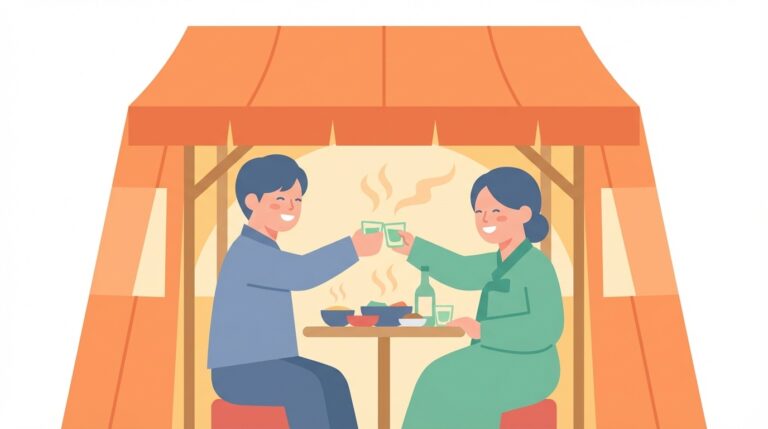
You’ve definitely seen this scene in a K-Drama. The two main characters are sitting in a cozy green pojangmacha (street tent bar). The steam from the fish cake soup is rising, and they’ve just clinked their soju glasses. Suddenly, one of them looks deeply at the other and says,
“우리… 이제 말 놓을까?” (Should we… drop the honorifics now?)
The background music swells. Their eyes meet. The invisible wall between them has just shattered.
In English, you’re always “you,” whether you’re talking to your best friend or the President. But in Korean, moving from Jondaetmal (formal/polite language) to Banmal (casual language) isn’t just a grammar change. It is a massive psychological shift. It’s the ultimate milestone in a Korean friendship.
But wait—when exactly do you do this? How do you ask? And what if you do it wrong and offend someone? Don’t worry. This guide is based on real struggles from my intermediate students. Let’s master the art of “dropping the words” and leveling up your Korean friendships!
Phase 2: Core Expressions Deep Dive
Here are the 3 golden phrases you need when you’re ready to cross the Jondaetmal-Banmal border.
1. 우리 말 놓을까요?
- Pronunciation: u-ri mal no-eul-kka-yo? [oo-ree mal no-eul-kka-yo?]
- Meaning: (Literal) Shall we let go of the words? / (Real) Shall we speak casually to each other?
- K-Culture Moment: This is the classic K-Drama line! You’ve been working with a colleague of the same age for a month, you went out for coffee, and you both feel the formal language is making things stiff.
- Editor’s Insight: Think of 말 (mal) as a heavy burden of politeness you are carrying. 놓다 (nota) means to put down or let go. You are literally suggesting, “Let’s put down this heavy polite language.”
- Situation Spectrum:
[🚫 Never] ———— [⚠️ Caution] ———— [✅ Go ahead]
- Same-age friend you just met: ✅
- Older/Younger colleague you’re close with: ⚠️ (Ask carefully!)
- Your boss or a senior (Sunbae): 🚫 (Wait for them to suggest it!)
- 🤔 Think About It: Why is it considered polite to ask for permission before speaking comfortably? What does this say about Korean personal boundaries?
2. 말 편하게 하세요.
- Pronunciation: mal pyeon-ha-ge ha-se-yo. [mal pyun-ha-ge ha-se-yo]
- Meaning: (Literal) Please do words comfortably. / (Real) Please speak comfortably (Use banmal to me).
- K-Culture Moment: You join a university club. A senior (선배, sunbae) who is a year older sees you nervously using super formal Korean. They smile warmly and say this to relieve your stress.
- Editor’s Insight: This is a “Top-Down” phrase. An older person or senior uses this to give a younger person permission to relax. Never say this to someone older than you!
- Situation Spectrum:
[🚫 Never] ———— [⚠️ Caution] ———— [✅ Go ahead]
- To someone younger/junior: ✅
- To someone of the exact same age: ⚠️ (Better to use Expression 1)
- To someone older than you: 🚫
- 🤔 Think About It: In your culture, does the older person usually dictate the formality of the conversation?
3. 이제 반말해도 돼?
- Pronunciation: i-je ban-mal-hae-do dwae? [ee-je ban-mal-hae-do dwae?]
- Meaning: (Literal) Is it okay if I do half-words now? / (Real) Can I use casual speech now?
- K-Culture Moment: You’ve been chatting with a language exchange partner online. You just found out you are the same age (동갑, dong-gap). You type this message with a cute emoji to transition to friend mode.
- Editor’s Insight: Notice that this sentence itself is in Banmal. You are testing the waters by using casual speech to ask if you can use casual speech. It’s a bit playful!
- Situation Spectrum:
[🚫 Never] ———— [⚠️ Caution] ———— [✅ Go ahead]
- Online friends / Same age: ✅
- Close younger friends: ✅
- Anyone older: 🚫
Phase 3: Textbook vs. Real Korean
| Situation | 📖 Textbook Korean | 🗣️ Real Korean | 💡 Why is it different? |
|---|---|---|---|
| Suggesting casual speech | 저와 반말로 이야기합시다. (Let’s talk in casual language with me.) | 우리 이제 말 놓을까? (Shall we put down the words now?) | “합시다” sounds like a military order or a business proposal. Koreans prefer softer, indirect suggestions. |
| Finding out you’re the same age | 우리는 나이가 같습니다. (Our ages are the same.) | 헐, 우리 동갑이네요? 말 편하게 해요! (Whoa, we’re the same age? Let’s speak comfortably!) | “동갑” (same age) is a magical cheat code in Korea that instantly grants you permission to be friends. |
| Transitioning awkwardly | (Switches immediately to 100% Banmal) | (Using 반존대 / Banjondae) “밥 먹었어…요?” | Switching overnight is awkward. Koreans often mix polite and casual endings for a few days to ease the transition! |
Phase 4: Cultural Context — K-Culture Deep Dive
4-1. The Non-Verbal “Nunchi” of Dropping Honorifics
When Koreans decide to drop honorifics, it’s rarely a dry, business-like transaction. It usually involves a drink (coffee or alcohol), a slight awkward laugh, and reading the room (Nunchi). If you ask “우리 말 놓을까요?” and the other person hesitates or says “아… 네… ㅎㅎ,” their Nunchi is telling you: I’m not ready yet. Don’t force it!
4-2. The Romance of “Banjondae” (반존대) in K-Dramas
Have you ever watched a romantic K-Drama where the male lead usually speaks politely (Jondaetmal), but in a moment of crisis or sudden affection, he drops a single Banmal word?
(e.g., “조심하세요… 다쳐.” -> “Please be careful… you’ll get hurt.”)
This is called 반존대 (Banjondae)—mixing Banmal and Jondaetmal. It creates immense tension and heart-fluttering moments. While dramas exaggerate it for romance, in real life, friends who are just transitioning to Banmal use Banjondae naturally because they keep forgetting they agreed to speak casually!
Phase 5: Real-life Roleplay Scenario
Setting: Friday night, 7 PM. A Samgyeopsal (pork belly) restaurant near Gangnam Station. The place is filled with smoke, chatter, and clinking green bottles. You are here with a few Korean coworkers.
Characters:
– YOU: A foreign employee on your 3rd month in Korea. Trying to make real friends.
– Minsu (32): Your Korean coworker. He’s exactly the same age as you. You’ve been using strict Jondaetmal at the office.
Dialogue:
Minsu: 짠~ 일주일 동안 고생 많으셨습니다! 🍻
(jjahn~ il-ju-il dong-an go-saeng man-eu-syeot-seum-ni-da!)
[Cheers~ You worked hard this week!]
(🎭 Stage Direction: Minsu clinks your glass and downs his soju.)
YOU: 민수 씨도 고생하셨습니다!
(Min-su ssi-do go-saeng-ha-syeot-seum-ni-da!)
[You worked hard too, Minsu!]
Minsu: 저기… 우리 나이도 동갑인데, 회사 밖에서는 말 놓을까요?
(jeo-gi… u-ri na-i-do dong-gab-in-de, hoe-sa bak-e-seo-neun mal no-eul-kka-yo?)
[Um… since we’re the same age, should we drop the honorifics outside the office?]
🔀 YOUR TURN! How do you respond?
– A) 아니요, 저는 존댓말이 좋습니다. (No, I like formal language.)
– B) 아, 넵! 좋아요. 그럼 이제 말 놓자! (Ah, yes! Sounds good. Let’s drop the words then!)
– C) 야!! 고기나 구워!! (Hey!! Just grill the meat!!)✅ Best Choice: B — You politely accept his offer (“넵!”) and immediately show you are trying by using Banmal at the end (“말 놓자!”). It’s cute, friendly, and perfectly paced.
⚠️ Choice A Analysis: This will build an ice wall between you two. He will feel rejected.
⚠️ Choice C Analysis: Whoa! You crossed the line (선 넘었다). Going from polite coworkers to screaming “Hey!” is too extreme even for Banmal.
🎁 Bonus Scenario: The K-Pop Fan Sign Event
Setting: You are at your favorite idol’s fan sign event. You finally get to the table.
Idol: 안녕하세요! 이름이 뭐예요? (Hello! What’s your name?)
You: [Your Name]이에요! 저보다 오빠니까… 오빠라고 부르고 반말해도 돼요?
(I’m [Your Name]! Since you’re older than me… can I call you Oppa and use banmal?)
Idol: (Laughs) 당연하지! 우리 [Your Name]이, 밥 먹었어?
(Of course! Did our [Your Name] eat?)
Phase 6: 10-Second Shadowing Drill
Practice making the transition smooth and friendly. Pay attention to the pauses (/) and emotions!
😊 우린 / 동갑이니까 / 이제 / 말 놓자!
(u-rin / dong-gab-i-ni-kka / i-je / mal no-ja!)
[Since we are the same age, let’s speak casually now!]
Tip: Smile widely when you say “말 놓자!” Don’t sound angry or demanding.
Phase 7: K-Culture Mini Dictionary
| Korean | Romanization | English | Context |
|---|---|---|---|
| 동갑 | dong-gap | Same age | The ultimate icebreaker in Korea. If you are dong-gap, you are automatically potential best friends. |
| 반존대 | ban-jon-dae | Mixed speech | Mixing formal and casual language. Often happens during the awkward transition phase, or used for flirting. |
| 선 넘다 | seon neom-da | Crossing the line | When someone uses Banmal too aggressively or asks overly personal questions too soon. |
| 야자타임 | ya-ja-ta-im | Yaja Time | A drinking game where the age hierarchy is reversed for a set time (the youngest gets to use Banmal to the oldest). |
Phase 8: Traveler Survival Kit
Wait, I’m just traveling to Korea. Will I encounter Banmal? YES!
🆘 Traveler Survival Info: The “Grandma Banmal”
When you go to a traditional market (like Gwangjang Market) or an old local restaurant, the elderly owner might say: “학생, 뭐 줄까?” (Student, what should I give you?) in Banmal.📍 Where you hear it: Markets, street food stalls, old diners.
💡 Pro Tip: Do not be offended! In this specific context, the older person using Banmal is an expression of 정 (Jeong – deep affection/warmth). They are treating you like their own grandchild. However, you must still reply in Jondaetmal!📌 Editor’s Travel Note
– Never use Banmal to a taxi driver, even if they look younger than you or if they start using Banmal to you. Always stick to Jondaetmal to maintain mutual respect in a service setting.
Phase 9: Critical Thinking — “One Step Deeper”
🧠 Think Deeper: Language & Power (권력과 언어)
In many Western cultures, closing the distance between people simply means sharing first names. But in Korea, language itself is built on a vertical hierarchy of age and status. Asking “우리 말 놓을까요?” is essentially a negotiation of power. It’s a mutual agreement to step off the vertical ladder and stand on a horizontal plane together. This is why Koreans often ask for your age within 5 minutes of meeting you—they need to figure out where you both stand on that ladder to know which grammar to use!
💬 Your Turn: Does your native language have a system that changes grammar based on who you are talking to? How do you show someone they are your “close friend” using language? Share in the comments!
Phase 10: FAQ & Mistake Prevention
Q: Can I ask my boss to drop honorifics to get closer?
A: NO! The suggestion to use Banmal must generally flow from top to bottom. The older person or the senior must initiate it. If you ask your boss, “말 놓을까요?” you might become famous in the company for the wrong reasons.
Q: What if someone uses Banmal to me without asking, and I feel disrespected?
A: Unfortunately, some older strangers might do this. The best response for a foreigner is to just smile and continue using Jondaetmal. Your polite Korean will gently remind them of the boundaries.
❌ Common Mistake #1: Thinking Banmal means “no rules.”
✅ Do this instead: Even in Banmal, you don’t swear at each other or disrespect parents. It’s casual, not lawless!❌ Common Mistake #2: Dropping the “~요(yo)” from every sentence and thinking it’s natural Banmal.
✅ Do this instead: Listen to native speakers. Sometimes “고마워요” becomes “고마워”, but “안녕하세요” doesn’t become “안녕해” (it’s just “안녕”).
Phase 11: Summary & Action Items
One-Liner Summary: Moving from Jondaetmal to Banmal is a beautiful milestone in Korean relationships, initiated by the magical phrase “우리 말 놓을까요?”
Action Mission:
– 🥉 Bronze: Say “우리 이제 말 놓을까?” out loud 3 times in front of a mirror with a friendly smile.
– 🥈 Silver: Leave a comment below pretending we are the same age and ask to use Banmal!
– 🥇 Gold: The next time your language exchange partner or Korean friend mentions you are the same age, bravely suggest: “그럼 우리 말 놓을까요?”
🎬 K-Culture Mission:
Watch one episode of a slice-of-life K-Drama (like Hospital Playlist or Reply 1988). Keep your ears open for the moment characters switch from polite endings (~요/습니다) to casual ones (~아/어). Notice how their body language changes!
Phase 12: Interactive Quiz
1. Situational Judgment: You are 25. You just met a nice Korean guy at a language meetup who is 28. You had a great time chatting. Which phrase is best for you to say?
– A) 오빠, 우리 말 놓을까?
– B) 선배님, 말 편하게 하세요.
– C) (Don’t suggest anything, wait for him to say it.)
2. True or False – K-Culture Edition:
If a 70-year-old grandmother at a traditional market calls you “학생 (Student)” and speaks in Banmal, she is being extremely rude and you should argue with her.
3. Fill in the Blank:
When two people are the same age, Koreans say they are “____”. This is the easiest way to start using Banmal.
(Click the toggle below to see the answers!)
Answers (Click to reveal)
1. C (Since he is older, you should wait for him to suggest dropping honorifics, or you can use B to invite him to speak comfortably to you, but C is the safest!).
2. False. She is showing ‘Jeong’ (affection).
3. 동갑 (Dong-gap).
Are you ready to break down the walls and make true Korean friends? Let me know your thoughts in the comments!
Frequently Asked Questions (FAQ)
Q: What does "우리 말 놓을까요?" mean in Korean and how do you pronounce it?
A: In Korean, "우리 말 놓을까요?" is pronounced [u-ri mal no-eul-kka-yo? [oo-ree mal no-eul-kka-yo?] and means: (Literal) Shall we let go of the words? / (Real) Shall we speak casually to each other?
Q: What does "말 편하게 하세요." mean in Korean and how do you pronounce it?
A: In Korean, "말 편하게 하세요." is pronounced [mal pyeon-ha-ge ha-se-yo. [mal pyun-ha-ge ha-se-yo] and means: (Literal) Please do words comfortably. / (Real) Please speak comfortably (Use banmal to me).
Q: What does "이제 반말해도 돼?" mean in Korean and how do you pronounce it?
A: In Korean, "이제 반말해도 돼?" is pronounced [i-je ban-mal-hae-do dwae? [ee-je ban-mal-hae-do dwae?] and means: (Literal) Is it okay if I do half-words now? / (Real) Can I use casual speech now?







